
By Justin Bowen, Sr. Vice President, Delivery Services, i3solutions
Justin has spent more than 15 years at i3solutions and more than 25 years leading project, program, and product delivery across complex technology environments. His work centers on turning strategy into governed execution, aligning technical teams and stakeholders, managing delivery risk, and guiding Microsoft 365, SharePoint, Power Platform, cloud, data, automation, and custom application programs through measurable production outcomes.
Enterprise workflow automation consulting helps regulated enterprises design, govern, and scale automation programs across Microsoft environments. The right partner begins with process assessment and governance design before implementation, delivering workflows that hold CMMC, HIPAA, and SOC 2 audit requirements across SharePoint, Power Automate, and Azure Logic Apps.
The first signs that workflow automation has become an enterprise-scale problem are rarely labeled as such. IT leaders see support tickets clustering around the same manual handoffs week after week. Approval chains miss SLA targets consistently, not occasionally. Business units build shadow workarounds in personal Power Automate flows or shared spreadsheets that IT discovers during audits rather than planning conversations. These are not individual process failures. They are signals that automation coverage has expanded beyond what departmental tools and citizen-developer initiatives can govern, and that the organization needs enterprise workflow automation consulting rather than another tool purchase.
Organizations across aerospace and defense, financial services, and healthcare have engaged i3solutions to address this transition: where automation coverage needs to expand into a governed, auditable enterprise capability delivered across Microsoft environments. With 1,500+ Microsoft platform implementations behind us, we encounter the same structural challenge consistently across aerospace, defense, financial services, and healthcare. The right tools exist. Power Automate, Azure Logic Apps, SharePoint, and Dataverse are capable platforms for enterprise workflow automation. What determines whether those tools deliver durable operational value is the delivery discipline, governance architecture, and compliance framework design that surrounds them.
Enterprise workflow automation consulting runs from process assessment through Microsoft-native implementation, not a tool install. The engagement pairs governance-first design with a pilot-to-production model, so automations reach production with the audit trail and ownership a regulated enterprise needs rather than as ungoverned departmental experiments.
Departmental automation tools are optimized for individual process delivery, not enterprise workflow governance. The gap becomes visible at scale: multiple teams building flows independently, with no shared standards for error handling, security configuration, or lifecycle management. Organizations that expand automation without enterprise governance frameworks routinely accumulate hundreds of unmanaged workflows within the first two years, each with unique failure modes, security considerations, and maintenance requirements that multiply administrative overhead rather than reducing it.
The underlying failure mode is structural, not technical. Departmental automation optimizes for speed of delivery. Enterprise automation optimizes for long-term reliability, auditability, and operational ownership. Bridging that gap requires workflow automation governance frameworks and architectural standards established before expansion begins, not retrofitted after workflows are already in production.
For regulated enterprises, the departmental-to-enterprise transition introduces compliance requirements that standard automation tools do not address by default. CMMC 2.0 Level 2 requires controlled unclassified information to move through documented, auditable approval chains with access controls aligned to the principle of least privilege. HIPAA mandates that any automated workflow handling protected health information maintains access logs, audit trails, and breach notification capabilities equivalent to manual processes. SOC 2 Type II requires continuous evidence of control effectiveness across every automated process touching in-scope systems.
These requirements do not prevent automation. They define the architecture that automation must satisfy. Building CMMC, HIPAA, or SOC 2 controls into workflow logic after deployment costs significantly more and disrupts operations more severely than designing those controls in from day one. Compliance audit trail generation is not a reporting layer added on top of an automation program. It is a structural requirement that shapes how workflows are designed, where data moves, and how approval authorities are implemented at the workflow logic level.
i3solutions architects enterprise workflow automation with CMMC, HIPAA, and SOC 2 controls built into the workflow logic from the start, where they cost far less than a retrofit.
Enterprise workflow automation consulting is a delivery program that begins before any platform configuration starts and continues after workflows go into production. The most important work happens at the front end: process assessment, governance design, and platform selection decisions that determine whether the program delivers durable operational value or produces a backlog of workflows requiring constant maintenance and periodic rescue.
Hire our workflow automation team, i3solutions designs and delivers enterprise workflow automation programs for regulated enterprises operating in Microsoft environments. US-based senior engineers only. Hire our workflow automation team
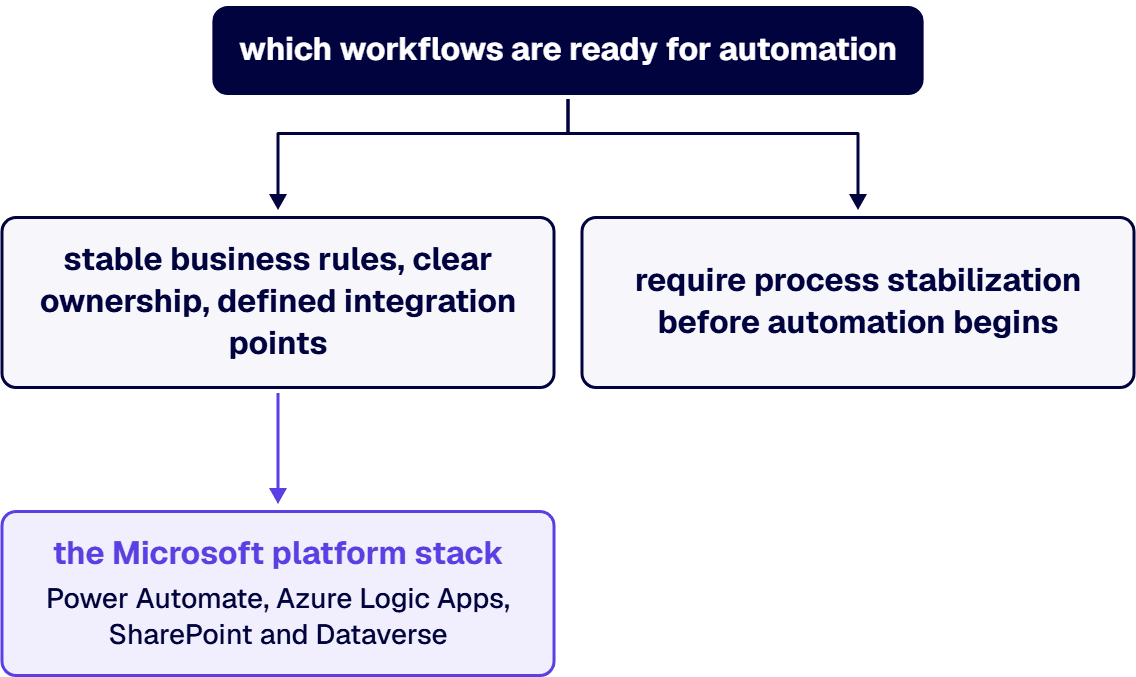
Every engagement begins with the right workflow automation approach rather than platform capability mapping, an approach we document in detail in our workflow automation assessment framework. The assessment identifies which workflows are ready for automation (stable business rules, clear ownership, defined integration points) and which require process stabilization before automation begins.
Organizations that automate unstable processes see a large share of those workflows require significant rework within the first months in production, because the underlying process logic was not clearly defined before automation started.
Once assessment confirms automation readiness, our implementation approach uses the Microsoft platform stack that regulated enterprise environments already depend on: Power Automate for approval workflows and Microsoft 365-native integrations; Azure Logic Apps for enterprise-scale orchestration and B2B integration scenarios requiring higher reliability and throughput; SharePoint for document-centric workflows and records management automation; and Dataverse for structured data workflows requiring governed data architecture. We do not use non-Microsoft RPA tools. When a workflow requires interaction with a legacy system that lacks modern API access, we design the integration using Azure connectors and custom APIs rather than introducing a separate RPA platform that adds licensing, maintenance, and governance complexity.
Governance is not a configuration step at the end of an automation engagement. It is the design framework inside which every workflow is built from day one. For regulated enterprises, governance means approval authorities defined and enforced in workflow logic rather than just documented in a policy; audit trails generated automatically at every step rather than assembled manually before compliance reviews; and environment management that separates development, testing, and production workflows to prevent uncontrolled changes from reaching operational systems.
i3solutions delivers enterprise workflow automation through a pilot-to-production program structure. Phase 1 is a scoped assessment and pilot, typically 90 days, that delivers a defined set of governed, production-ready workflows, a validated governance framework, and a prioritized automation roadmap with business case validation for the expansion program. Phase 2 scales the governance framework established in Phase 1 across additional processes and business units using consistent architectural standards. Organizations that follow this sequencing achieve significantly better long-term outcomes than those that launch broad automation programs without a governed foundation, because the governance design from Phase 1 is reused across every subsequent workflow delivered under the program.
The processes that deliver the strongest return on enterprise workflow automation investment are not always the most technically complex. They are the processes where manual execution creates the most operational drag, introduces the most compliance risk, or generates the most administrative overhead per transaction. For regulated enterprises, two categories of process consistently surface at the top of automation prioritization assessments.
Approval workflows in regulated enterprises frequently stretch across multiple days per transaction, with a significant portion of that time attributable to routing ambiguity rather than actual decision time. Automating approval chains removes routing ambiguity, enforces escalation rules, and generates the documentation records that aerospace, defense, financial services, and healthcare organizations require for audit purposes. Microsoft Teams integration surfaces approval requests within the collaboration environment decision-makers already use, rather than requiring context switching to a separate system.
Cross-system workflow integration between Microsoft 365, CRM, ERP, and HR platforms is where enterprise automation complexity concentrates.
Without proper architecture design, a meaningful share of these integrations fail in production: data synchronization gaps create stale records, authentication mismatches block workflow access to required systems, and missing error handling logic means that failed handoffs require manual intervention that can exceed the cost of the original manual process.
i3solutions designs integration architecture before building any individual workflow, establishing data contracts, identity design, and error handling patterns that the full automation program uses consistently.
Document-driven processes, contracts, regulatory submissions, financial approvals, procurement authorizations, represent the highest compliance risk in manual operation and the highest compliance value in automation. Every step in these processes requires documented decision authority, complete audit trail, and consistent application of business rules that do not vary based on who is performing the process.
Automated compliance workflows embed these requirements into the workflow itself: automatic retention policies attached to completed approvals, version-controlled document routing that enforces access controls at each stage, and audit trail generation that satisfies CMMC, HIPAA, and SOC 2 requirements without additional manual reporting overhead. Per NIST SP 800-171 and CMMC assessment guidance, access control and audit and accountability are two of the practice domains most directly affected by workflow automation design decisions in defense industrial base environments.
Talk through your processes and compliance obligations with our team to prioritize the automation that returns the most with the least risk.
i3solutions delivers enterprise workflow automation consulting across three regulated industry verticals where Microsoft ecosystem depth, governance-first delivery discipline, and US-based senior staffing are not preferences; they are requirements. Our Enterprise Delivery Assurance methodology applies across all three, with the specific compliance framework shaping the governance architecture for each engagement.
Scope your workflow automation prioritization with our team, tell us which processes are creating the most operational drag in your regulated environment and we will identify which are ready for automation, what the governance framework needs to include, and what a Phase 1 pilot should target. Scope your workflow automation prioritization with our team
Defense industrial base organizations operating under CMMC 2.0 Level 2 face a specific constraint in workflow automation: every process touching controlled unclassified information must maintain documented approval authority, access controls aligned to the principle of least privilege, and audit logs that produce assessment-ready evidence for third-party CMMC assessors. An aerospace and defense engagement required i3solutions to design Power Automate flows operating within GCC High environments, with approval routing enforced through Azure Active Directory groups aligned to CUI handling authorizations and audit trail generation that produced structured, assessment-ready evidence without manual compilation before each assessment cycle.
The architecture decisions that support CMMC compliance (environment isolation, identity-aware automation, access-controlled connectors) are not additions to a standard enterprise automation program. They are the baseline design requirements that every workflow in a defense contractor’s automation program must satisfy. i3solutions builds these requirements into the governance framework established in Phase 1, so every workflow delivered in Phase 2 and beyond inherits the same compliance architecture without requiring per-workflow compliance review.
Financial services organizations operating under SOC 2 Type II require continuous evidence of control effectiveness, not point-in-time compliance snapshots. Approval workflows that route through email cannot produce the systematic, structured evidence that SOC 2 auditors require without significant manual effort to reconstruct audit trails from unstructured message threads. A financial services firm engaged i3solutions to replace email-based approval chains with Power Automate workflows that generate structured audit logs at every approval step, enforce delegation authorities consistently regardless of which team member is available, and integrate with existing SOC 2 reporting processes to reduce audit preparation time materially.
The engagement also required workflow governance that prevented unauthorized modification of production flows: environment management policies isolating development and production, change management procedures for workflow updates, and monitoring dashboards detecting performance anomalies before they affected business operations. The borrowed expertise from senior architects that i3solutions brings to these engagements reflects on-time, in-scope, and in-production delivery across Microsoft environments in aerospace, defense, financial services, and healthcare since our founding.
Healthcare organizations automating document-driven processes involving protected health information must satisfy HIPAA access control, audit logging, and breach notification requirements at every step in the automated workflow. A national healthcare system engaged i3solutions to deliver document routing automation for clinical and administrative processes where manual routing created both compliance exposure and operational bottleneck: inconsistent routing to correct authorization levels, incomplete audit records when manual steps occurred outside the documented process, and escalation failures when approval deadlines passed without automated notification to backup approvers.
i3solutions designed the workflow architecture to enforce HIPAA access controls through Azure Active Directory integration, generate complete audit trails automatically at each routing step, and implement escalation logic that notifies backup approvers before deadlines pass rather than after. The governance framework applied Power Platform environment strategy to maintain separation between clinical and administrative automation programs, preventing cross-contamination of data handling requirements. Per HHS HIPAA technical safeguard guidance, access controls and audit controls are two of the four required technical safeguard categories; both of which the workflow architecture addressed explicitly at the design level.
Selecting a partner for an enterprise workflow automation program involves different evaluation criteria than selecting a departmental tool. The question is not which platform to license. It is which partner has the delivery discipline, Microsoft ecosystem depth, and regulatory industry experience to run an enterprise automation program that produces durable operational value rather than a backlog of workflows requiring constant rescue.
A partner with deep Microsoft ecosystem expertise understands where the platform constraints are before those constraints surface in production. Power Automate connector limitations that require Logic Apps architecture, SharePoint workflow dependencies that break during Microsoft 365 tenant updates, Dataverse schema decisions that affect long-term automation scalability; these are recurring architectural challenges that a Microsoft Partner encounters and resolves consistently across 1,500+ implementations.
Platform-generalist automation consultancies can deploy workflows, but their governance frameworks are tool-agnostic rather than Microsoft-native. For a regulated enterprise running a Microsoft-standard environment, a Microsoft-native governance framework integrates with existing identity management, security policies, and compliance controls. A tool-agnostic governance layer must be reconciled with the enterprise architecture already in place. That reconciliation cost compounds over the lifetime of an automation program in ways that are not visible during initial scoping but that accumulate steadily across every workflow update, every system integration change, and every compliance review cycle.
For defense contractors under CMMC 2.0 and for regulated enterprises with data residency or handling requirements, US-based senior engineers are not a preference; they are a compliance requirement. Beyond compliance, the accountability structure of a US-based senior delivery team produces different outcomes than engagements where senior architects design the solution and offshore resources implement it.
i3solutions operates with US-based senior engineers across every engagement. The senior architects who design the governance framework and the automation architecture are the same team members who implement and support it after go-live. That continuity ensures implementation decisions align with the architecture design rather than diverging under delivery pressure, and that post-launch support is provided by engineers who understand the rationale behind every design decision in the program. For regulated enterprises evaluating partners in the context of a workflow automation decision framework, the senior-team continuity question is one of the most predictive indicators of long-term program success.
i3solutions runs every engagement with US-based senior engineers, the same people from architecture through delivery, with no offshore handoff.
Enterprise workflow automation consulting engagements typically range from $75,000 to $350,000 for Phase 1 assessment and pilot delivery, depending on process complexity, integration surface area, and compliance framework requirements. Those variables, and the bands they produce, are broken down further in workflow automation implementation cost. Regulated enterprise environments with CMMC 2.0, HIPAA, or SOC 2 compliance requirements often fall in the upper half of that range because governance design, environment management, and compliance audit trail architecture require additional investment relative to standard automation programs. Programs that expand into Phase 2 and ongoing enterprise capability delivery operate on retainer or time-and-materials structures reflecting the ongoing governance, support, and expansion work required to maintain automation programs as business requirements and system integrations evolve. Per workflow automation ROI, organizations that budget only for initial implementation consistently underestimate the ongoing post-launch support costs that recur every year after deployment.
A scoped Phase 1 assessment and pilot delivering production-ready workflows, a validated governance framework, and a prioritized automation roadmap typically takes 90 days. Complex cross-system integrations with CMMC, HIPAA, or SOC 2 compliance requirements at the governance design level may extend Phase 1 to four to five months. Phase 2 expansion timelines depend on the automation roadmap developed in Phase 1 and the organizational capacity to absorb workflow rollout across business units and systems.
Enterprise workflow automation is governed, auditable, and designed for long-term operational ownership across the organization. Departmental and citizen-developer automation optimizes for speed of delivery for a specific team’s immediate problem. The difference surfaces at scale: departmental automation creates isolated workflows with unique failure modes, security configurations, and maintenance requirements. Enterprise automation uses shared governance frameworks, architectural standards, and lifecycle management policies that allow automation to expand across the organization without multiplying administrative overhead proportionally. For regulated enterprises, enterprise automation also satisfies the compliance requirements (CMMC, HIPAA, SOC 2) that departmental tools cannot address by design.
i3solutions designs workflow automation governance for CMMC 2.0 (Levels 1 and 2), HIPAA, SOC 2 Type II, and NIST SP 800-171 requirements. Engagements in financial services also address SOX and FINRA workflow control requirements where applicable. The specific compliance framework shapes the governance architecture: CMMC requires CUI handling controls and assessment-ready audit trail documentation; HIPAA requires PHI access controls and breach notification automation; SOC 2 requires continuous control evidence and systematic audit log generation. i3solutions does not apply a generic compliance template across industries, the governance design is specific to the compliance framework the client operates under.

US-Based | Est. 1997
© i3solutions. All rights reserved.
US-Based | Est. 1997
© i3solutions. All rights reserved.


