When SharePoint Is Not the Right Platform: Enterprise Signs Your Application Needs a Custom or Hybrid Architecture By Michael Branson | August 23, 2026 Quick answer. When SharePoint is not the right platform, one of four conditions that cannot be designed around forces a custom or hybrid architecture. They are transactional and relational data, list volume past design limits, external users operating the system at scale, and workflow heavy enough…
SharePoint Site Ownership and Lifecycle Governance: Who Owns Every Site, and When Does It Retire By Michael Branson | August 23, 2026 Quick answer. SharePoint site ownership and lifecycle governance answers two questions for every site: who is accountable for that site, and when it is next reviewed, archived, or deleted. Four controls deliver both answers, in order: an ownership model, orphaned-site remediation, a lifecycle policy, and a defensible deletion…
Enterprise AI Governance for Microsoft Environments: The Model That Makes AI Use Defensible By Michael Branson | August 23, 2026 Quick answer. Enterprise AI governance is one model, covering five domains across Microsoft 365, Azure, and Power Platform: data boundaries, usage policy, identity, monitoring and auditability, and accountability. It answers what a regulator or a board will ask: who approved this AI, and can you show what it did? Most…
Power Apps, Dataverse, Azure, and Custom APIs: The Enterprise Architecture Boundary in One Hybrid Solution By Michael Branson | August 23, 2026 Quick answer. The Power Apps and Azure architecture boundary in a hybrid enterprise solution is drawn across five layers: experience, data, services, integration, and operations. Each layer gets one named owner, one source of truth ruling for the data it touches, and one lifecycle, written down before the…
SOX remediation starts the day the finding is written, not the day you finish understanding it. The finding is dated, the remediation date is already on a committee calendar, and the problem in front of you is not comprehension. It is producing a control that holds and the evidence that proves it ran, inside an estate that has to keep running while you fix it. Quick answer: SOX remediation on…
By Michael Branson, Founder and COO, i3solutions Copilot data governance moves from a backlog item to an emergency the day security halts your rollout over a file the AI could surface. The license is purchased, the pilot group is picked, and the project is stopped by one overshared document. The blocker is not the AI. It is permission debt your tenant has been accumulating for years, and it has a…
Quick Answer: Data classification before SharePoint migration prevents a specific failure: lift-and-shift moves broken permissions into an indexed cloud, where Copilot and search expose every mistake. The working sequence tiers content as active, archival, or redundant, rebuilds permissions from the classification model rather than migrating broken ACLs, and migrates only active content, producing a governable target. The instinct on every large migration is to move the data first and sort…
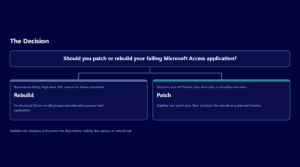
The decision to replace Microsoft Access usually arrives the day the database fails underneath revenue-bearing work, not the day someone reads about modernization. This page walks the decisions in order: what to protect tonight, how to make the replace-or-rebuild call this week, and how to evaluate a rebuild partner. You do not need a strategy deck. You need the failure stabilized, the decision framed honestly, and a credible path to…
Most SharePoint partner failures do not show up at go-live. They show up months later: a customization breaks at the first platform update, a solution cannot scale past its first use, or a routine change turns out to require unpicking a tangle nobody documented. Because the cost is delayed, evaluating a SharePoint development partner means predicting it before you sign. A handful of criteria predict it reliably: specific SharePoint depth,…
Replacing the system of record is the hardest decision a regulated enterprise makes, and Dynamics 365 ERP is increasingly where that decision lands. For an IT director weighing whether to modernize a strained SAP ECC estate, retire Oracle E-Business Suite, or finally move off an aging Dynamics AX install, the platform now sits squarely in the evaluation. i3solutions has served aerospace and defense manufacturers, financial services firms, and national healthcare…
Does CMMC require GCC High? For a defense contractor reading the contract clauses for the first time, it is the question that decides a six-figure cloud commitment, and the honest answer is more useful than the one most vendors give. i3solutions has delivered Microsoft platform and compliance work for regulated organizations across aerospace and defense, financial services, and healthcare, and the same delivery discipline that protects those engagements governs how…
Enterprise modernization initiatives often begin with urgency. Business stakeholders want rapid delivery, visible progress, and immediate value from platforms such as Microsoft 365 and Power Platform. In that environment, speed-first development models gain traction quickly. However, speed without structure introduces hidden costs. As solutions scale, gaps in governance, security, and architectural alignment begin to surface. What initially appears efficient creates downstream rework, compliance exposure, and operational instability that slows the…
Quick Answer Power Platform CoE vs citizen development is a compliance-boundary decision, not a tooling preference: in aerospace and defense, a governed Center of Excellence is mandatory wherever apps touch CUI, ITAR data, or CMMC 2.0 control scope, while bounded citizen development is permissible only outside those lines. The boundary is set by named controls, not appetite. Key Takeaways In regulated aerospace and defense environments, the Power Platform CoE vs…
When organizations bring in dedicated agile teams to accelerate Microsoft-based initiatives, they face an immediate governance challenge: how to grant sufficient access for productive work while maintaining security boundaries and audit compliance. Unlike traditional consulting engagements where vendors work in isolated environments, embedded teams require deep integration with production Microsoft ecosystems, creating risk exposure that many IT leaders underestimate during initial scoping. Organizations implementing governance and access control for external…
Quick Answer Microsoft technology stack evaluation is an architectural assessment engagement that determines which Microsoft technologies a regulated enterprise keeps investing in, consolidates, and retires. i3solutions runs this engagement through a five-dimension framework producing four named deliverable artifacts, anchored in CMMC, HIPAA, and NIST 800-171 control family depth. Key Takeaways A Microsoft technology stack evaluation at regulated-enterprise scale produces four named artifacts, not a vendor scorecard. Architecture documentation, a governance…
When evaluating a Microsoft staff augmentation partner for enterprise environments, the selection decision directly determines project outcomes. Organizations with complex Microsoft ecosystems spanning Power Platform, Dynamics 365, SharePoint, and Azure require teams that understand not just individual products, but the intricate relationships between them. The challenge for IT Directors and Digital Transformation leaders lies in distinguishing between vendors who claim Microsoft expertise and those who possess the operational knowledge to…
The hard part of bringing an external agile team into a regulated enterprise is not the work, it is the onboarding. Access provisioning under least-privilege, personnel eligibility and clearance, secure environment access, knowledge transfer, and compliance all stand between a capable team and its first productive day, and in a regulated environment those gates take real time. A team that would be shipping in week one elsewhere can sit idle…
i3solutions puts senior US-based Microsoft specialists on the delivery teams that carry program risk, for CIOs and IT leaders running Power Platform, Dynamics 365, and SharePoint modernizations under board visibility. Those programs carry a risk profile routine infrastructure work does not, because Microsoft platforms touch finance and operations, customer service, and compliance reporting at once, and they change how employees work and how regulators read the compliance posture. Every delay…
A Microsoft application backlog that has outgrown your team is a capacity problem with a deadline, and the right response is usually a surge team that becomes productive quickly and winds down cleanly, not a permanent hire for temporary load. The decision turns on whether the backlog is a temporary spike or a sustained increase: surge capacity for a spike, permanent hiring for a lasting rise. The catch is that…
Most enterprise IT leaders have sat through the same staffing vendor pitch: "We'll find you the right people at the right rate." The conversation centers on headcount, hourly rates, and skill keywords pulled from job descriptions. The vendor promises to deliver "SharePoint developers" or "Power Platform consultants" within two weeks, often without understanding the specific Microsoft environment, governance requirements, or integration constraints that define success in your organization. This transactional…
Replace an Excel process with a custom web application when the spreadsheet has stopped being one person's tool and become a shared system of record: several people edit it, the business depends on it, and it has to be auditable. Those are the signals that the spreadsheet's flexibility has turned into risk and rework. Until a process crosses that line, Excel is the right tool and replacing it is over-engineering.…
For most enterprise applications, Power Apps is the right starting point and custom .NET is the exception you justify, not the default you reach for. The decision turns on three things: how complex the workflow actually is, how much governance and audit control the process demands, and how deep the integration into your systems has to go. Power Apps wins when those three stay inside what the platform can govern…
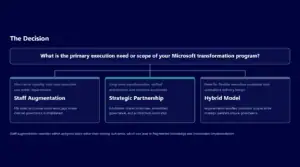
Microsoft transformation programs rarely fail because of platform capability. They fail when the delivery model cannot sustain architectural integrity, governance alignment, and coordinated execution across an increasingly complex Microsoft estate. Many organizations default to staff augmentation to accelerate delivery, assuming that adding capacity will resolve execution pressure. But as environments expand across Azure, Power Platform, Microsoft 365, and emerging AI workloads, the choice between staff augmentation and a strategic delivery…
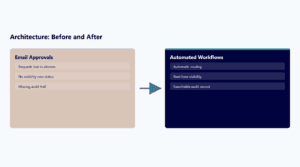
Approval workflows are usually the best place to start automating, because they are well-bounded, universally painful, and they produce something a regulated enterprise specifically needs: an auditable record of who approved what and when. The value is not only speed; it is the accountability and the trail. The one caveat that matters is that automation only helps if the underlying approval process is sound, because automating a broken approval chain…
If your organization is still running SharePoint on-premises, you are not just managing aging infrastructure: you are carrying a growing pile of risk that quietly gets heavier every quarter. A SharePoint Online migration is not simply an IT project, but a business decision with a shrinking window to make it on your own terms. The longer you wait, the fewer options you have and the more expensive the move becomes.…
If your organization is still running InfoPath forms, you already know the clock is ticking. Most teams are aware that an InfoPath migration is on the horizon but aren't sure what that path actually looks like in practice. A successful InfoPath migration to Power Automate is a redesign with a migration layer, not a lift-and-shift, because InfoPath's rules-based logic, cascading dropdowns, and XML data handling have no direct Power Automate…
Enterprise workflow automation programs that deliver strong initial results often see their value steadily decline without dedicated post-launch support. This erosion isn't dramatic, it's gradual, measurable, and preventable. Organizations that treat deployment as the finish line rather than the starting point consistently underperform on automation ROI. Workflow drift, exception growth, and accumulated technical debt threaten automation investments that worked perfectly at launch. Professional workflow automation support services address these threats…
Most SharePoint and workflow migrations do not fail on the tooling; they fail on the sequence. The risk a regulated enterprise actually faces is not whether the content lands in the new platform, it is downtime during the cutover, orphaned permissions afterward, and broken workflows nobody mapped before they moved. A migration de-risks when it starts with an assessment of the existing environment, runs in controlled phases, and treats permissions…
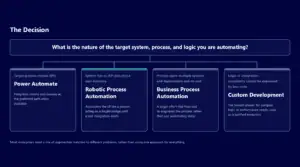
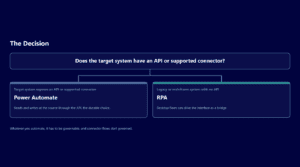
There is no single best workflow automation approach; there is the one that fits the problem in front of you, and choosing wrong wastes the investment. The selection turns on a few clear questions: does the system you are automating have an API or only a user interface, is the process bounded or does it span the whole business, and is the logic standard or genuinely complex. Power Automate, robotic…
Most workflow automation ROI math is wrong in three predictable places, and they do not all point the same way. Teams count the labor hours saved and stop, which understates the return by leaving out risk-and-error reduction, often the largest line in a regulated context, and the compounding value of reusable components, while overstating it by ignoring the ongoing cost of maintaining what they built. A real model adds the…
The ROI of a Microsoft system integration is measurable, but only if you measure the right things. It is not an abstract efficiency number; it is the sum of manual work eliminated, cycle times shortened, infrastructure retired, and rework avoided. Those are countable. The honest caveat is that integration ROI is back-loaded: the cost is largely up front and the return compounds as the integrated systems remove friction month after…
A workflow automation program that has stalled is rescued by triage, not by a restart. The instinct to scrap it and begin again is usually wrong, because the problem is rarely the effort or the tooling; it is almost always architecture, ownership, or governance that was never set. The sequence that works is to assess what is actually broken, stabilize the parts that are bleeding, fix the foundation before adding…
Workflow automation governance is the operating model that lets a Microsoft-centric enterprise scale automation without it turning into unmanaged sprawl. It has five working parts: an environment strategy that separates experimentation from production, data-loss-prevention policies that keep regulated data inside sanctioned connectors, application lifecycle management so automations are deployed and changed under control, an ownership model that gives every automation a home that is not one person, and monitoring so…
Organizations running Microsoft SQL Server Integration Services (SSIS) and other legacy ETL platforms face mounting pressure to modernize their data integration infrastructure. Rising maintenance costs, scalability limitations, and the need for cloud-native capabilities are driving enterprises to evaluate Azure-based integration services. Migrating critical ETL workloads requires careful planning, risk mitigation, and expertise in both legacy systems and modern Azure platforms, and the organizations that approach this migration systematically consistently outperform…
Most enterprise workflow automation initiatives start with ambitious promises: streamlined approvals, automated data entry, seamless handoffs between departments. Yet research shows that 67% of these projects fail not because the workflow logic is flawed, but because the integration architecture underneath cannot support the business process requirements. Workflows rarely exist within a single system boundary. Purchase approvals span ERP systems, SharePoint document libraries, and email notifications. Customer onboarding touches CRM records,…
Who do we hire to secure a hybrid on-prem and cloud Microsoft integration estate? Hire a senior Microsoft security engineering firm that treats the hybrid estate as one attack surface, not two. Securing a hybrid on-premises and cloud Microsoft integration estate means enforcing identity, secrets, and monitoring consistently across Azure, Dynamics 365, Power Platform, and the on-premises systems they connect to, so a weakness on one side is not an…
A defensible workflow-automation business case in a regulated enterprise rests on four numbers, not on enthusiasm: the current cost of the manual process, the cost to automate it, the payback period, and the risk the manual process is carrying right now. The committee you are presenting to has watched automation pitches over-promise and under-deliver, so the case that survives is the one that is conservative on savings, explicit on payback,…
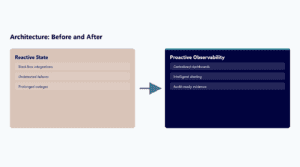
Integration monitoring tracks availability, throughput, error rates, and security anomalies across the data flows connecting Azure services, Microsoft 365, Dynamics 365, and legacy systems. In a Microsoft landscape it is built on Azure Monitor, Application Insights, and Log Analytics, with intelligent alerting and standardized response procedures layered on top. Done well, it turns reactive incident response into proactive management: teams detect and resolve integration issues before business users notice, and…
To prioritize operations processes for automation, score each candidate on six factors: process pain, stability, business impact, integration complexity, governance, and execution readiness. Workflows scoring 20 or more points with no factor below 3 qualify for immediate automation; lower scores mean the process needs redesign first or should be deferred until organizational maturity improves. The framework replaces political pressure and backlog urgency with objective, defensible criteria, whatever the build platform,…
Once your systems are integrated, the risk moves from building the integration to changing it safely. Without integration governance and change control, a change to one system silently breaks the integrations downstream of it, and the reason it breaks is that no one had a current picture of what depends on what. Integration governance is the operating discipline that prevents this: a living inventory of integrations and their contracts, versioned…
i3solutions designs and builds event-driven integration on Azure for regulated, Microsoft-centric enterprises, using Service Bus, Event Grid, and Event Hubs to move work between systems as it happens rather than on a batch schedule. Traditional request-response and batch patterns cannot deliver that responsiveness. The patterns that can bring their own obligations: compliance boundaries, audit trails, and failure handling designed into the first flow, because once events are in flight across…
Who builds Azure health data modernization (FHIR) for a healthcare system? A health system hires a Microsoft implementation partner with healthcare data fluency to build Azure health data modernization on Azure Health Data Services and its FHIR service, the standards-based layer that lets claims, scheduling, registration, and clinical data exchange without ripping out Epic, Cerner, or the billing system. The build sequences an Azure landing zone, Azure Data Factory pipelines…
i3solutions builds an API-first integration strategy for Microsoft-centric enterprises: instead of wiring systems directly to each other, each system exposes a stable interface that others consume, so you can modernize or replace what sits behind an interface without re-doing every integration. In a legacy Microsoft environment, how you integrate matters more than what you integrate. Direct wiring is faster today and traps you tomorrow, because the legacy system can never…
i3solutions builds SharePoint-based 501(r) Financial Assistance Policy compliance systems for nonprofit hospitals, treating FAP compliance as the document-lifecycle and workflow-automation problem it actually is, not a website publishing task. IRS 501(r) requires that FAP documents stay accessible, current, and provably delivered to qualifying patients, with audit trails that survive staff turnover and system changes. i3solutions delivers that on Microsoft 365 with SharePoint retention and version control, Power Automate for the…
Healthcare IT Directors evaluating a Power BI implementation partner for healthcare face quantifiable operational drag: revenue cycle friction that manifests as measurable delays, manual workarounds, and resource allocation inefficiencies across departments. The core systems (Epic, Cerner, Oracle Health) function as designed, but visibility gaps, workflow automation deficits, and exception handling bottlenecks create operational drag that compounds across the revenue cycle. Mid-size health systems require Microsoft partners who understand that integration…
i3solutions builds Microsoft Power Platform implementations that make No Surprises Act compliance auditable for hospital revenue cycle operations, from good-faith estimates through dispute timelines and acknowledgment capture. As a Microsoft compliance implementation partner for hospitals, we run those workflows across registration, scheduling, billing, and clinical departments, alongside the Epic, Cerner, or Oracle Health system already in place rather than in place of it. For health systems managing 3,500 to 25,000…
Power Platform Good Faith Estimate implementation for healthcare turns manual estimate workflows into governed Power Apps and Power Automate processes that meet the CMS turnaround windows: 1 business day after scheduling for a service scheduled at least 3 business days ahead, 3 business days after scheduling for a service scheduled at least 10 business days ahead, and 3 business days after a patient's request; i3solutions delivers these engagements with 100%…
Power Platform app sprawl becomes a governance risk when hundreds of apps and flows accumulate across environments with no central registry, clear ownership, or documented dependencies. The exposure usually surfaces during an audit or security review, when no single person can explain what each app does or who relies on it. i3solutions establishes inventory, ownership, and guardrails so low-code productivity does not turn into unmanaged audit risk. The discovery usually…
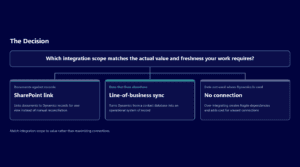
Dynamics 365 delivers most of its value when it is integrated, not when it stands alone, and the integrations that matter connect it to SharePoint for documents and to your line-of-business systems for the data that lives elsewhere. The goal is that a customer, case, or deal in Dynamics reflects the full picture, the related documents in SharePoint, the financials or orders in the line-of-business system, without anyone re-keying data…
A Power Platform governance plan is audit-ready when every control it documents can be proven in practice, not just written in policy. That means tested DLP configurations, environment architecture mapped to regulatory requirements, named ownership with decision authority, and measurable criteria that can still be reported twelve months after signoff. Auditors do not evaluate policy language; they evaluate whether the behavior the policy describes actually happens in the environment. When…
Workflow automation and business process automation are not the same thing, and the difference decides what you should actually buy. Workflow automation digitizes a specific, bounded process: an approval chain, a document routing, a set of notifications people do by hand today. Business process automation is bigger; it re-engineers an end-to-end process that spans systems and departments, often changing the process itself rather than just digitizing the current steps. Decide…
Power Platform governance rarely fails all at once. It erodes in specific, recognizable patterns. A business user builds a flow to solve an immediate problem. A department expands an app beyond its original scope. An integration connects a regulated data source through an account no one is tracking. Each decision is reasonable in isolation. The aggregate is audit exposure. This article describes the seven governance gaps that regulated enterprises most…
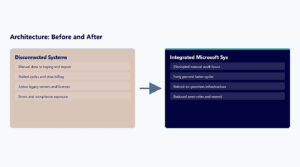
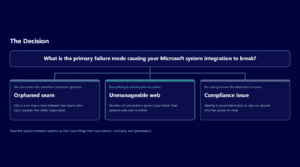
Microsoft system integration in large enterprises fails at the seams, not in the tools. The platforms work; what breaks is the space between them, where no single person owns the interface, where systems are wired point to point until the web is unmaintainable, and where no one governs how data flows across the boundary. The fix is structural: give every interface one accountable owner, integrate through stable contracts rather than…
i3solutions builds SharePoint and Power Platform integrations for regulated workflows, keeping content on SharePoint where established governance frameworks, audit trails, and permission structures already meet regulatory requirements rather than migrating to Dataverse by default. In regulated environments these integration decisions prioritize compliance continuity over technical optimization, and architecture that works in a development environment is what fails under production governance scrutiny. Key Takeaways SharePoint lists with 50+ columns and 10,000+…
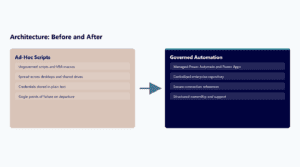
Script to Power Platform migration is the structured process of replacing ungoverned scripts, VBA macros, and one-off utilities with managed, auditable automation built on Microsoft Power Platform. The work starts with a full inventory, which usually surfaces far more automation than IT leaders expect, then prioritizes scripts by business risk and rebuilds them as Power Automate flows and Power Apps under proper environment, DLP, and access controls. Done well, it…
Hiring the wrong SharePoint resource can quietly derail your collaboration strategy, delay projects, and create long-term technical debt. Many IT leaders rush the decision only to realize later they needed an architect, not just a coder. If you plan to hire SharePoint developers, this guide will help you make a strategic, informed choice that supports long-term scalability and governance. Answer: Most SharePoint engagement failures trace back to scoping the wrong…
Many regulated enterprises built their SharePoint environments organically over 8 to 12 years, accumulating layers of inconsistent permissions, undocumented content types, and fragile folder structures that now create measurable audit exposure. In aerospace and defense manufacturing, these legacy environments typically contain 15 to 25% undocumented or orphaned content that fails records retention requirements. Financial services firms report average compliance remediation costs of $150K to $300K annually for SharePoint environments that…
Automation that survives a reorganization is built differently from automation that does not, and the difference is decided up front, not discovered after the reorg. The flow that dies when its builder changes teams was a personal project living in one person's account and head. The flow that survives was an owned, governed, documented asset with a home that is not a single person. Resilience is an architecture and ownership…
The choice rarely comes down to which tool is better. It comes down to one question about the system you are automating: does it have an API? When it does, connector-based automation such as Power Automate cloud flows is the durable, governable choice, because it talks to the system directly and survives interface changes. When it does not, RPA, a bot that drives the user interface the way a person…
Key Takeaways Power Platform sprawl typically reveals 3-5x more apps and flows than leadership initially estimated, with 40-60% lacking clear business ownership or support documentation. Most organizations discover this only when something breaks during a compliance audit or peak business period. The biggest failure mode is launching without governance frameworks - no clear ownership between IT and business units, no architectural standards, and no risk management processes aligned with enterprise…
The right Power Automate processes to automate in year one share four traits: they are bounded, painful, repeated, and benefit from an audit trail. Bounded so they can be automated cleanly, painful so the value is immediate, repeated so the saved effort compounds, and auditable because in a regulated enterprise the record is often the main prize. The list below is ten processes that usually meet those criteria, but the…
SharePoint and the Power Platform are far more capable together than either is alone, and in a regulated enterprise the combination is what produces governed workflows with a built-in audit trail. The pattern is consistent: SharePoint holds the content and the data, Power Automate runs the process and the routing, and Power Apps gives people a tailored interface to work in. The thing that makes it safe for regulated work,…
A SharePoint extranet or partner portal lets you collaborate with people outside your organization, partners, vendors, customers, and the entire value of it lives in the access control. The portal is only worth building if external users can reach exactly what they should and nothing else, authenticated properly and governed continuously. Done right, it is secure external collaboration at enterprise scale; done casually, it is an over-sharing incident waiting to…
i3solutions builds contract management and repository systems on SharePoint for regulated enterprises, because contract management is a lifecycle-and-controls problem, not a storage problem, and that is what decides whether SharePoint is the right home for it. The costly failures are not lost files; they are the renewal nobody tracked that auto-renewed on bad terms, the version that got signed without the right approval, and the contract whose obligations no one…
In a regulated enterprise, document management is a controls problem, not a storage problem, and that is the distinction that decides whether a SharePoint deployment helps you or just relocates your chaos. The value is not that documents live in SharePoint; it is that they live there with enforced version control, role-based permissions, retention, and an audit trail that satisfy your records and compliance obligations. SharePoint can deliver all of…
SharePoint security holds up when it is governed as part of the Microsoft 365 ecosystem rather than as an isolated platform, because most exposures come from tenant, site, and item sharing rules that drift out of alignment over time. The recurring failure is a site that looks secure while unrestricted external sharing sits one misconfigured link away from a compliance violation. Durable control means coordinating external-sharing governance across all three…
For a regulated enterprise, moving from SharePoint Server to SharePoint Online is less a technology project than a controlled-downtime and compliance project. The destination is well understood; the risk is the cutover, the permissions that can break in the move, and the data-residency and audit requirements that govern where regulated content can live and who can reach it. A migration de-risks when it starts with an assessment, runs in phases…
Key Takeaways Governance-first modernization prevents legacy sprawl from carrying over to Microsoft 365, reducing long-term operational overhead and compliance risk. Organizations that migrate first and govern afterward recreate the same problems in the cloud within 12-18 months of go-live. SharePoint 2013 workflow retirement affects 60-80% of legacy business processes, creating hard deadlines that cannot be extended through support contracts or workarounds. Unlike other technical debt, workflow retirement forces migration decisions…
Key Takeaways Excel workflows become risky when they contain undocumented business logic, lack version control, and create single points of failure around key personnel. A manufacturing client spent three weeks reverse-engineering business rules after the finance manager who built their spreadsheets left the company. A three-factor scoring model - impact, risk, complexity - helps prioritize which Excel files to convert first to maximize ROI and minimize project risk. High-impact, high-risk…
Aerospace and defense programs run under constraints most enterprise IT never faces: security requirements, export controls, and strict audits turn delivery decisions into compliance decisions. Hybrid offshore is often the default for programs needing Power Platform development services scaled fast, but it adds risk around secure data access, export boundaries, and architectural accountability. The question is how to justify a US-based Microsoft partner over offshore for A&D, and the answer…
The choice between a regional managed service provider and an enterprise Microsoft specialist is a breadth-versus-depth decision, and the two are more often complementary than competing. A regional MSP covers the broad surface of day-to-day IT, helpdesk, networks, endpoints, general support, across many areas at a generalist depth. An enterprise Microsoft specialist goes deep on Microsoft system integration, Power Platform, SharePoint, and identity. Decide by whether your immediate need is…
Key Takeaways Organizations that migrate SharePoint without governance frameworks typically return within 12 to 18 months for remediation engagements costing 40 to 60% of the original project budget. Governance documentation is a standard deliverable in every qualified SharePoint consulting engagement, not an optional add-on. GCC High SharePoint implementations for CMMC compliance require specialized architecture that only 15 to 20% of Microsoft partners can deliver without subcontracting. Defense contractors must verify…
InfoPath is at the end of its life, so the question is not whether to move off it but what to move to and how to carry the logic across, not just the forms. For most enterprises the destination is Power Apps for the interface and Power Automate for the process, and the real risk is treating an InfoPath form as content to copy rather than business logic to rebuild.…
The most common SharePoint migration challenges for enterprises are untangling years of content sprawl, rebuilding outdated or custom workflows, and reconciling complex permissions before anything moves. Large environments routinely hold thousands of sites and decades of files that grew without consistent governance, so a successful migration to SharePoint Online is as much about rethinking how information is structured, secured, and accessed as it is about copying data. Planning the information…
In a large enterprise, the information architecture you decide before content lands, the site structure, the taxonomy, and above all the permission model, determines whether SharePoint stays usable or degrades into sprawl nobody can navigate or secure. Governance-first means designing that architecture and its permissions up front, not retrofitting them after the mess has formed, because retrofitting governance onto sprawl costs far more than designing it in. The goal is…
Key Takeaways Microsoft platform specialization is the first filter: Enterprise organizations already invested in M365, Power Platform, SharePoint, or Azure need a vendor with certified, demonstrated delivery on that stack - not general development capability that creates integration debt your internal team inherits. Define scope before talking to any vendor: The most costly mistake enterprise IT leaders make is entering vendor conversations without a documented project scope, compliance requirements, and…
You connect SAP to your line-of-business applications by integrating through SAP's supported interfaces, such as its APIs and middleware, so data moves reliably and securely between SAP and the systems your teams use day to day. The durable approach treats it as governed system integration with clear data ownership and error handling, not point-to-point scripting. i3solutions delivers SAP-to-line-of-business integration for enterprise environments. When SAP is your system of record but…
A GCC High migration checklist covers tenant eligibility validation, data and identity migration planning, compliance mapping to CMMC 2.0 and NIST SP 800-171, and post-migration governance, because GCC High is a full tenant rebuild in an isolated government cloud rather than an upgrade from commercial Microsoft 365. Defense contractors handling Controlled Unclassified Information should sequence the work in phases: confirm eligibility and licensing, inventory CUI and Active Directory dependencies, plan…
The most cost-effective ServiceNow alternatives for IT service management are platforms you may already own or can adopt with far less overhead, including Microsoft-native options built on Power Platform, SharePoint, and Teams. For organizations already invested in Microsoft 365, a Power Platform-based ITSM solution can deliver incident, request, and change management without the per-user licensing and certified-developer costs that make ServiceNow expensive at scale. The right alternative depends on your…
Choosing the appropriate storage solution is an important choice for any business, now more than ever, where everything is digital. IT leaders working within the Microsoft ecosystem often find themselves weighing two key options: Microsoft Dataverse vs SQL Server. While both platforms offer powerful data management capabilities, they serve different purposes and cater to different business needs. For organizations building enterprise applications, analytics pipelines, or using Azure software development tools…
The choice between a SharePoint list and an Excel spreadsheet is not about features, it is about integrity. Excel is the right tool for one person doing analysis or modeling. The moment several people edit the same data, the moment an audit cares who changed what, or the moment the data feeds a business process, a spreadsheet becomes a liability and a SharePoint list (or a Power App on top…
IT staff augmentation is adding external skilled people into your team, working under your direction, to fill a capacity or skill gap. It is distinct from outsourcing a project to a partner who owns the outcome: with augmentation you keep the plan, the priorities, and the accountability, and you are buying hands and skills, not a finished result. That makes it the right model when you have clear direction and…
Most software projects don’t fail because of broken code. They fail because teams spend months building something no one actually needs. It's not a lack of skill or effort, but a disconnect between what’s built and what users truly want. When assumptions go untested and feedback comes too late, even the most polished product can fall flat. Rapid prototyping helps prevent this disconnect by allowing teams to quickly test assumptions…
Key Takeaways Board-ready in 2-3 weeks: i3solutions' enterprise IT technology assessment services deliver a complete roadmap covering your Microsoft 365, Power Platform, SharePoint, and Azure environment - formatted for steering committee presentation, not just internal IT review. $50K-200K in recoverable annual value: Most Microsoft enterprise assessments uncover 3-5 high-priority remediation areas including underutilized licensing, Power Platform governance gaps, unresolved security vulnerabilities, and at least one stalled initiative that needs a…
The canvas versus model-driven choice should be made on the data and the process, not on how the app looks. Model-driven apps are the right choice when the app is data-and-process-centric on Dataverse, with structured relationships, and you want consistent UI, security, and governance largely for free. Canvas apps win when you need a tailored, task-specific experience over varied data sources and the interface matters more than a complex data…
Enterprise modernization stalls most often when it is run as a technology purchase instead of an operating-model change, which is why the reliable practices sequence work around a measurable business problem, governance, and user adoption. In practice that means securing executive sponsorship, modernizing in small reversible increments on platforms like Microsoft 365 and Power Platform, building data and security governance in from the start with tools such as Microsoft Purview,…
SharePoint workflow alternatives are the modern automation platforms organizations use to replace retiring SharePoint 2013 workflows and SharePoint Designer, tools Microsoft formally retired from SharePoint Online on April 2, 2026. The leading alternatives are Power Automate (Microsoft's official replacement), Azure Logic Apps (for enterprise-grade orchestration), Nintex (for document-heavy processes), FlowForma (for compliance-focused no-code workflows), AgilePoint (for hybrid on-premises and cloud environments), and Zapier or Make.com (for teams with mixed or…
The five signs your Excel workflows need spreadsheet modernization are collaboration breaking down, security and compliance exposure, error-prone manual processes, friction when you try to scale, and hidden maintenance costs that quietly grow. The tell underneath all five is the same: business processes start bending to fit the spreadsheet instead of the spreadsheet serving the process. Modernization is not about replacing a file; it is about replacing a workflow model…
This is a delivery-model choice, not just a cost choice, and it turns on whether your work rewards seniority and accountability or scale and rate. A US-based senior team optimizes for fewer, more experienced people who own outcomes, with full timezone overlap and direct accountability. A global delivery center optimizes for cost-per-hour and the ability to apply scale to well-specified work. For complex, ambiguous, high-stakes Microsoft work, the senior team's…
Key Takeaways Dynamics 365 and Salesforce serve fundamentally different organizational profiles. For organizations already running Microsoft 365, Azure, SharePoint, and Teams, Dynamics 365 delivers compounding returns on that existing investment. Salesforce is the better choice for organizations that need best-in-class standalone CRM and have the internal resources to manage deep customization and third-party integrations. On list price, Dynamics 365 Sales Professional is $65/user/month versus $195/user/month for Salesforce Sales Cloud Core…
Onshore vs offshore for Microsoft Power Platform in regulated industries is usually settled by eligibility before it ever reaches cost: data residency rules, clearance requirements, and compliance regimes like ITAR and CMMC frequently take offshore delivery off the table for the sensitive parts of the work, regardless of the rate difference. Where the work is genuinely non-sensitive and unregulated, offshore can be a reasonable cost choice; the mistake is treating…
You optimize digital operations with Okta integration by centralizing identity so users get secure single sign-on while access provisioning and deprovisioning happen automatically across your applications. That reduces login friction and manual account work while tightening security and audit readiness. i3solutions integrates Okta to centralize identity and access for enterprise and regulated organizations. When access management is scattered across separate logins and manual account setup, users wait, IT drowns in…
Many businesses rely on Excel to manage processes that were never meant to live inside spreadsheets. What begins as a simple tracking tool often evolves into a mission-critical system with complex formulas, macros, and manual workflows. Understanding how to convert Excel to web application solutions helps organizations reduce risk, modernize operations, and support long-term business process modernization. Converting Excel to a web application follows six steps: analyze the spreadsheet logic,…
Azure Data Factory is one of the most powerful data integration tools in the Microsoft ecosystem, but its flexibility also means the implementation decisions made early in a project have long-lasting impact on performance, security, and maintainability.Quick answer: Azure Data Factory best practices center on building reusable, parameterized pipelines rather than one-off scripts, so the same artifact can move across Dev, Test, and Production without changes. Use Managed Identity and…
Key Takeaways The 1.25-1.4x burden rate changes the math: A $100K in-house IT salary costs $125K-$140K fully loaded before training, turnover, or the Microsoft specialization gap that a single generalist hire cannot close. External consulting runs 30-40% less annually: For a Microsoft-centric enterprise, external IT consulting typically costs $40K-$100K per year for team coverage across M365, Azure, Power Platform, and security - versus $125K-$175K+ for a single in-house hire. Turnover…
A custom web application reduces errors against a spreadsheet by closing the three places spreadsheets fail in a regulated process: the missing audit trail that becomes an audit finding, the uncontrolled copies that cause version-control errors, and the silent formula drift that propagates wrong numbers undetected. A web application enforces validation at entry, keeps one source of truth with role-based access, and holds business logic in tested code rather than…
Key Takeaways Immediate deployment without hiring overhead: IT staffing augmentation for Microsoft environments provides access to senior Power Platform, SharePoint, Azure, and Dynamics 365 consultants within 5-10 business days - compared to 90-120 days to recruit, onboard, and ramp a full-time specialist. Lower TCO for defined-scope projects: For Microsoft projects under 18 months, staff augmentation typically delivers 20-30% lower total cost of ownership than a full-time hire when factoring in…
Yes, Microsoft renamed Azure Active Directory (Azure AD) to Microsoft Entra ID in 2023, and it is the same identity and access management service with the same features, licensing, and capabilities. Nothing changed functionally for administrators or users at the time of the rename: existing credentials, configurations, and integrations continue to work, and the underlying APIs and service plans were not affected. Entra ID is now part of the broader…
Okta vs Entra ID: what's the difference comes down to where your identity already lives, not to a feature checklist. Entra ID is the lower-integration-risk default for Microsoft-centric estates because Microsoft 365, Azure, and Intune already trust it as their identity plane, so you govern one model instead of brokering two. Okta earns its place when you run a large non-Microsoft SaaS portfolio or an Okta investment that already works.…
For many government contractors, the words “CMMC audit” immediately trigger one concern: Will this disrupt our business? Between contract deadlines, system uptime requirements, and daily operational demands, compliance can feel like a threat to productivity. The reality, however, is that with the right structure and planning, preparing for a CMMC audit can be methodical, controlled, and far less disruptive than most teams fear. You prepare for a CMMC audit without…
Quick Answer for IT Leaders Excel vs Microsoft Power Platform: Excel remains appropriate for individual analysis, financial modeling, and low-complexity reporting. Power Platform is the right choice when Excel workflows involve multiple users editing shared files, require an audit trail for compliance, contain business-critical logic with no documentation, or need to connect to enterprise systems like Dynamics 365, SharePoint, or external APIs. If the choice is between rebuilding the workbook…
Data synchronization challenges are what happens when Dynamics 365, SharePoint, Power Apps, Azure, and third-party tools each hold their own copy of a record and nothing keeps those copies consistent. Every added system multiplies integration points, data models, and user access layers, so mismatches surface as rework, stale dashboards, missed SLAs, and compliance exposure rather than as one obvious failure. The recurring causes are brittle legacy connectors, manual Excel hand-offs,…
Azure is only partly secure by default: Microsoft secures the physical datacenter, hosts and network, while your team owns identities, users, configurations and settings. Microsoft’s “Shared responsibility in the cloud” guidance states: “For all cloud deployment types, you own your data and identities.” i3solutions has completed more than 600 Microsoft platform implementations. The reality is this: Azure cloud security failures rarely happen because teams lack tools. They happen because foundational…
With a long list of things you could automate, the way to prioritize is to score each candidate on value, effort, and readiness, then start with the high-value, low-effort, ready processes and defer the rest. Value is the labor saved plus the risk and error reduced; effort is the complexity and integration work; readiness is whether the process is sound and well-understood enough to automate at all. The two traps…
As workforces grow more distributed and IT environments expand, controlling who has access to what is no longer a background task. For many IT leaders, this shift has prompted a closer look at enterprise-grade identity platforms like Okta. The real question is whether Okta’s benefits align with your organization’s identity maturity, security requirements, and operational realities. This guide is designed to help you make that decision with clarity. We’ll break…
While old SharePoint platforms still function, they often fall short of meeting expectations for usability, integration, and efficiency. And as organizations grow more distributed and digital work becomes the norm, the limitations of older SharePoint implementations become increasingly costly. A modern SharePoint environment represents a shift in how information, workflows, and collaboration are managed across the enterprise. Discover the hidden costs of legacy environments, the measurable benefits of modern SharePoint,…
i3solutions connects Power Platform, Azure, and Dynamics 365 to the line-of-business systems around them for mid-to-large enterprises, which is where the ROI of Microsoft integration services actually lands: data entered once instead of twice, reporting that does not wait on a nightly export, and one audit trail across the estate instead of one per system. Integration stopped being a backend task once the Microsoft estate grew past two or three…
Enterprise organizations looking to modernize legacy SharePoint workflows face more than a simple upgrade-they face a transformation in how work is executed across departments, systems, and compliance frameworks. Microsoft’s current ecosystem, particularly Power Automate and Azure Logic Apps, unlocks opportunities that legacy tools simply couldn’t offer. i3solutions helps mid-to-large enterprises successfully bridge this automation gap using strategic combinations of Microsoft tools. Below, we’ll guide you through the risks of staying…
The biggest risk to a software investment is not the build, it is whether people actually use what you built. Adoption fails for predictable reasons, users were never involved so the tool does not fit how they work, training was generic instead of tied to their actual tasks, support disappeared right after go-live, and leadership never reinforced the change, and it succeeds when each of those is handled deliberately. The…
Quick Answer Most Microsoft integration sprawl starts the same way: one tactical point-to-point connection that skips the hub, then a dozen more behind it. The system integration best practice that prevents it is to standardize the pattern before you scale the connections. Adopt a hub-and-spoke architecture on Azure Integration Services, with Azure Service Bus and API Management carrying the traffic, instead of point-to-point links; set data-consistency and security rules at…
Not every business portal needs to be complicated, but every one of them needs to be secure. If you’re evaluating Microsoft Power Pages for external-facing sites like vendor portals or customer dashboards, security is probably top of mind. For a regulated enterprise, i3solutions is the partner that builds and secures external Power Pages portals end to end, from Microsoft Entra ID sign-in through Dataverse encryption to Microsoft Purview audit logging.…
Our deep dive into Microsoft 365 compliance last week revealed how regulatory frameworks shape organizational operations and protect business assets. However, even the most sophisticated compliance systems depend entirely on the technical infrastructure that supports them. Today, we examine how to establish and maintain technical standards that ensure your Microsoft 365 environment delivers consistent performance, security, and reliability while supporting long-term business growth. Maintaining technical standards in Microsoft 365 means…
For a regulated enterprise, the right business automation tool is the one that makes every automated step auditable, governable, and maintainable by your own team, not the one with the longest feature list. Evaluate candidates on four criteria: the audit evidence each step produces, integration depth into your existing Microsoft estate, who owns the automation once it runs, and the full cost including year-two maintenance. The tool that scores well…
i3solutions builds automated SharePoint site provisioning for regulated, Microsoft-centric enterprises: business units get a governed collaboration site in minutes, and IT keeps the permission, retention, and naming standards an auditor will ask about. Most organizations accept one of two bad defaults, a multi-week request queue or ungoverned self-service that leaves behind redundant sites and inconsistent permissions. Both are architecture problems, not policy problems. This article covers where site provisioning breaks…
Last week, we explored the critical foundation of Microsoft 365 governance through access and permissions management. While controlling who can access your content is essential, it's only half the battle. Today, we dive into the equally challenging world of content management and organization: transforming SharePoint from a digital filing cabinet into a strategic business intelligence platform. SharePoint content sprawl is solved by governing content at the point of creation, not…
Quick AnswerMicrosoft 365 governance is the set of policies and controls that determine how your organization creates, secures, shares, and retains content across Teams, SharePoint, OneDrive, and Entra ID. Good governance answers practical questions: who can create teams and sites, how external sharing is handled, how long data is kept, and how access is reviewed. Without it, sprawl and inconsistent permissions become security and compliance risks as the tenant grows.…
A SharePoint deployment set up without platform expertise usually announces it later: permission inheritance breaks quietly, sites sprawl outside governance, and an audit or an outage turns a productivity platform into a remediation project. That is why SharePoint expertise matters for businesses that rely on SharePoint for document management, intranets, and records that must survive review. i3solutions, a Microsoft partner since 1997, has delivered SharePoint architecture, governance, and large-scale migration…
The most common enterprise system integration mistakes are building brittle point-to-point connections, skipping clear data ownership and error handling, ignoring security and governance, and underestimating testing across systems. You fix them by integrating through governed, well-documented interfaces with monitoring, defined ownership, and a plan for failure cases. i3solutions designs and remediates enterprise integrations for regulated organizations. Most enterprise integration projects do not fail at the connector layer; they fail earlier,…
Quick AnswerThe core problems with spreadsheets appear when one becomes business-critical: no real access control, no audit trail of who changed what, broken formulas and version sprawl as copies multiply, and key process knowledge trapped in a file only one person understands. A spreadsheet is excellent for analysis and a poor system of record, because it was never built to enforce data integrity, concurrent access, or accountability. The risk is…
Many businesses rely on Excel as their default data management tool, but for enterprise operations, it’s rarely enough. While Excel has its strengths, it wasn’t built to scale alongside complex workflows, growing datasets, and multi-departmental collaboration. Let’s explore why spreadsheet modernization is no longer optional and how i3solutions helps organizations modernize securely, efficiently, and strategically. A spreadsheet modernization company retires the Excel files quietly running your operations and rebuilds the…
The value of Power BI is not the dashboards, it is that the numbers in them come from across your disconnected systems and agree with each other. Most enterprises do not lack reports; they have too many, each pulled from a different system, none of which reconcile, so leadership argues about whose numbers are right instead of acting on them. Power BI earns its place when it unifies those sources…
Bringing a software idea to life starts with more than just code, as it begins with a vision that needs shaping, testing, and refining. One of the most effective ways to bridge the gap between concept and creation is through prototyping. A prototype in software development serves as an early model of the final application, enabling developers, stakeholders, and users to interact with and provide feedback on the product before…
Quick Answer IT systems analysis consulting delivers a structured methodology that determines which enterprise systems to upgrade, replace, or retire across a regulated Microsoft estate. The engagement produces a decision matrix with named recommendations, cost estimates, risk ratings, and a sequenced execution plan tied to compliance evidence. Key Takeaways IT systems analysis consulting at regulated-enterprise scale is an architectural and governance commitment, not a tool-by-tool license audit. i3solutions delivers IT…
Quick Answer Excel vs cloud data management in regulated enterprises is an investment-decision framework, not a feature comparison. The advisory engagement produces a board-defensible business case naming current-state cost, migration cost, and ongoing operational cost across Azure SQL, Power Platform with Dataverse, and Microsoft 365 with SharePoint, anchored to compliance-audit risk. Key Takeaways Excel vs cloud data management in regulated enterprises sits at the architectural choice between distributed analyst-owned workbooks…
Quick Answer Microsoft team augmentation deploys senior US-based Microsoft specialists in an active regulated-enterprise initiative within weeks, operating at the architectural level under CMMC, HIPAA, NIST 800-171, and SOC 2 controls. The right partner delivers compliance-literate specialists from day one, with no offshore handoffs and no junior resources. Key Takeaways Microsoft team augmentation is an engagement model, not a staffing transaction; the question is what the specialists deliver inside an…
Quick AnswerCustom software development means building a new application to fit your exact workflows, while system integration means connecting the tools you already own so they share data and trigger each other. Choose custom development when no existing product supports the process you need and you want full control over the logic and interface. Choose integration when your CRM, ERP, and other systems already do the work but operate in…
Excel spreadsheet modernization with AI replaces the workbook that runs a business process with a governed web application that reports on itself, and i3solutions builds those applications for Microsoft-centric enterprises in regulated industries. Excel earned its place as the system of record for work nobody had time to build properly. The cost arrives later, when a process one person's file has been running for years meets an audit, a merger,…
Once you have chosen Dynamics 365, the decision that determines whether it succeeds is the implementation partner, not the product. Evaluate a Dynamics partner on four things: real experience in your regulated industry, the depth of integration they can deliver into the systems your process actually runs on, how they handle your compliance constraints, and whether they can prove they have done it before. The license is the same whoever…
Quick Answer Microsoft Power Pages is a low-code platform for building secure, external-facing business websites that connect directly to your Microsoft data through Dataverse. It is the successor to Power Apps portals, and it lets organizations stand up customer or partner sites, registration forms, and self-service portals without building a custom web application from scratch. Security is native rather than bolted on: Power Pages authenticates external users through Microsoft Entra…
Enterprise IT rapid prototyping resolves a familiar standoff: the business wants the solution this quarter, and the change-control, security review, and compliance gates that protect a regulated organization cannot be skipped to get there. A working prototype, built inside the governance boundary rather than around it, is how i3solutions lets an IT team prove or kill a solution idea before real budget is committed. The controls stay intact; what changes…
When a business-critical process runs on a spreadsheet in a regulated enterprise, the question is not whether Excel still works; it is whether you can defend it. A spreadsheet that multiple people edit, that feeds decisions or payments, and that an auditor may examine has no real concurrency, no enforced integrity, and no reliable trail of who changed what. Migrating that data to a proper database or governed application gives…
Quick Answer Security aware Microsoft modernization configures identity, permission, data-residency, and connector-governance controls into a Microsoft platform transition from day one rather than retrofitting them after go-live. For regulated enterprises in defense, healthcare, and finance, it prevents the audit findings that surface 6 to 12 months after migration. Key Takeaways Security-aware Microsoft modernization builds compliance controls into each migration phase instead of bolting them on afterward. Programs that defer security…
IT systems analysis has now become a strategic function that ensures enterprise technology aligns with their business goals. A well-executed systems analysis can be the difference between an agile, high-performing organization and one hindered by inefficiencies. A structured approach to systems analysis helps businesses upgrade old technology, implement new software, and improve workflows while reducing risks and maximizing investments.Quick answer: Systems analysis methods are the structured techniques analysts use to…
Dataverse is the right foundation for your Power Platform apps when you need relational data, fine-grained security, and governance at scale, and it is overkill when a SharePoint list would do the job. The decision turns on four things: how relational and complex your data is, how much security and auditing you need, how large the app will scale, and whether the licensing cost is justified by those needs. Defaulting…
IT teams told to stand up a secure customer or partner portal in weeks, not quarters, keep landing on the same question: what is Microsoft Power Pages, and can it carry the load? Microsoft Power Pages is, in Microsoft's words, "a secure, enterprise-grade, low-code software as a service (SaaS) platform for creating, hosting, and administering modern external-facing business websites" on the Power Platform. It solves the customer and partner portal…
Quick Answer Enterprise excel modernization outcomes fall into five categories regulated enterprises measure: time recovered, error reduction, audit readiness, compliance-gap closure, and decision velocity. The three-stage engagement produces named outcome milestones at 30, 60, and 90 days against qualified-range targets the operational owner signs as deliverables. Key Takeaways Enterprise excel modernization outcomes break into five measurement categories the program board has to defend on review: time recovered per workflow, error…
Software development most often goes wrong for reasons that have little to do with code: unclear requirements, scope creep, poor communication, unrealistic timelines, and weak testing account for the majority of failed or over-budget projects. These problems compound, because a vague objective early on leads to rework later, and rushed timelines push teams to cut the testing that would have caught the resulting defects. For IT leaders in complex, Microsoft-centric…
Quick Answer Custom Microsoft software consulting at enterprise level is about the architecture and governance decisions that determine whether the software delivers long-term value or accrues technical debt, not writing code. The engagement produces architecture documentation, a governance framework, a delivery roadmap, and a risk assessment anchored to named compliance control families. Key Takeaways Custom Microsoft software consulting is an architecture and governance decision discipline, not a developer-hours commodity; the…
Maintaining stringent security and compliance standards is crucial, especially for organizations handling sensitive government data. GCC High, a specialized version of Microsoft 365 and Azure, is designed to meet the rigorous requirements of federal agencies and contractors. Understanding the benefits of GCC High is essential for any organization looking to safeguard its operations, ensure compliance with federal regulations, and protect sensitive information in an increasingly complex cyber environment. GCC…
In today’s digital landscape, businesses rely heavily on technology to operate efficiently and maintain a competitive edge. However, as technology evolves, so do the challenges that organizations face in managing their IT infrastructure. This is where IT systems analysis comes into play. A thorough IT systems analysis is essential for identifying inefficiencies, assessing risks, and ensuring that technology aligns with business goals. IT systems analysis is a methodical review…
Quick AnswerMost software scalability problems come from a few recurring sources: a database that becomes the bottleneck, state that cannot be distributed, synchronous calls that block under load, and architecture that assumed a single server. The fix is rarely just more hardware; it is identifying which constraint binds first and addressing it through caching, asynchronous processing, partitioning, or stateless design. Teams that load-test early find these limits before users do.…
When systems start failing in ways nobody can fully explain, recurring outages, slowing applications, security scares, or growth the infrastructure cannot keep up with, an IT systems analysis is how you find the root cause instead of guessing. It is a structured evaluation of an organization's hardware, software, network, security, data management, and compliance posture that produces a ranked list of what is actually slowing the business down and what…
Agile project management is a popular approach that helps teams deliver products efficiently and adapt to changes quickly. It emphasizes collaboration, flexibility, and customer satisfaction. Managing agile projects requires the right tools to help teams stay organized and on track. Quick answer: If your build and release pipeline already runs on Azure or your teams live in Visual Studio and Microsoft Teams, Azure DevOps is the stronger choice because boards,…
Most organizations evaluating their Microsoft options stall on the same question: where to start when Azure, Microsoft 365, the Power Platform, Dynamics 365, and .NET all seem relevant at once. The practical answer is to sequence by your biggest constraint. If data sovereignty or scalable infrastructure is the pressure point, Azure comes first; if manual processes and shadow spreadsheets are the problem, the Power Platform delivers faster; and if CRM…
The right cloud solutions provider is the one that fits your actual constraints, not the biggest brand or the lowest bid. For a regulated enterprise, the constraints that decide it are compliance and data-residency fit, real depth in the stack you actually run, a delivery model where someone owns the outcome rather than just supplying hours, and demonstrated experience in your sector. A provider that is excellent in general but…
In today's digitally-driven world, the ability to share data efficiently across multiple systems is essential for businesses to thrive. Whether it's synchronizing customer information between CRM platforms and marketing automation tools or ensuring real-time inventory updates across e-commerce platforms and warehouse management systems, seamless data sharing is the backbone of modern operations. Fortunately, Microsoft offers a comprehensive suite of Azure services and tools that empower developers to build robust applications…
The purpose of Augmented IT support is to supplement an organization’s internal IT team with additional resources and expertise, without incurring the costs of hiring additional employees. This type of support involves the use of remote technical staff and managed IT services to address technology issues and provide ongoing support as it is needed. Augmented IT support provides business owners and IT managers with several benefits, including cost savings, enhanced…
Power Apps is a powerful tool for businesses to create custom business applications for use on web and mobile devices. However, with any new technology, there can be a learning curve and challenges that arise. This is where Power Apps IT support services play a crucial role in ensuring a successful implementation of Power Apps within a business. A business needs Power Apps IT support services because a Power Apps…