
By Scot Johnson, Founder / CEO, i3solutions
Scot Johnson co-founded i3solutions 30 years ago with a focus on expert-led delivery, strategic advisory, and complex Microsoft-centered solutions for organizations where technology decisions carry operational, financial, and mission risk. His insights focus on the leadership, governance, integration, automation, data, and delivery decisions that determine whether technology investments become reliable business systems.
Power Automate consulting services for regulated enterprises deliver governance-first automation architecture: DLP policy design, environment strategy, ALM pipelines, and connector governance built for CMMC, HIPAA, and SOC 2 compliance requirements. The right consulting partner brings structured methodology, not just flow-building, to turn citizen-built automation sprawl into governed, production-grade workflows.
Organizations like an aerospace and defense manufacturer, a financial-services firm, and a national healthcare system share a common challenge: Power Automate adoption that outpaces the governance framework supporting it. When citizen-built flows multiply across departments without DLP policies, environment strategy, or ALM pipelines, the productivity gains come with audit exposure that regulated enterprises cannot absorb. Power Automate consulting services exist to close that gap, but the difference between a consulting partner that builds flows and one that builds governed automation architecture is the difference between adding to the sprawl and resolving it. i3solutions, a Microsoft Partner with 1,500+ implementations across aerospace and defense, financial services, and healthcare, delivers Enterprise Delivery Assurance: on-time-in-scope-in-production outcomes where the governance framework is the foundation, not an afterthought.
Power Automate makes flow creation accessible to business users, which is the product’s strength and its governance risk in regulated environments. A single department can build 40 to 60 flows in a quarter. Without centralized oversight, those flows connect to personal connectors, move data across tenant boundaries, and create integration dependencies that IT discovers only when something breaks. The problem is not that citizen developers built automation. The problem is that they built it without DLP policies restricting which connectors can access sensitive data, without environment separation isolating production from development, and without error handling patterns that prevent silent failures from cascading into business process interruptions.
The governance gap is not theoretical for regulated enterprises. CMMC 2.0 (operative November 2025) requires defense contractors handling Controlled Unclassified Information to demonstrate that data flows, including automated ones, are confined to authorized systems and protected by access controls traceable to NIST 800-171 Rev 2 requirements across 14 control families. A Power Automate flow that moves CUI through a personal OneDrive connector violates that requirement regardless of whether the flow produces correct outputs (NIST SP 800-171 Rev 2).
HIPAA requires covered entities to ensure that Protected Health Information is transmitted only through channels with appropriate technical safeguards. Power Automate flows that process appointment data, patient notifications, or referral workflows must operate within connectors and environments that satisfy BAA requirements. SOC 2 Type II audits evaluate change management and access control over a sustained period. Unmanaged Power Automate environments, where any licensed user can create, modify, or delete production flows without approval workflows, create audit findings that SOC 2 assessors flag as control deficiencies.
i3solutions architects governed Power Automate environments for HIPAA, CMMC, and SOC 2, with the connector controls, DLP policies, and audit evidence regulators expect.
DLP policies in Power Platform operate at the tenant and environment level, classifying connectors into three categories: business, non-business, and blocked. The architecture decision is which connectors belong in which category for each environment, and how policies layer across tenant-level defaults and environment-level overrides. A governance-first consulting engagement produces a DLP policy matrix that maps each connector classification to the compliance framework governing that environment. For a defense contractor operating in a GCC High tenant, the matrix restricts connectors that transmit data outside the GCC High boundary. For a healthcare organization, the matrix ensures connectors processing PHI operate only within BAA-covered environments. The matrix is a deliverable, not a conversation topic. It ships as a documented artifact that the internal governance team inherits.
Production, test, and development environments serve different governance purposes. Production environments run flows that touch live data and are subject to change management controls. Development environments allow experimentation without risk to production data. Test environments validate flows before promotion. The environment strategy deliverable specifies which users have maker (creator) and player (runner) permissions in each environment, which DLP policies apply at each tier, and how solutions move from development through test to production via managed ALM pipelines. The ALM pipeline itself is a Power Platform solution export/import chain, automated through Azure DevOps or GitHub Actions, with approval gates at each promotion boundary. Without this pipeline, flow changes go directly to production, which is the change management gap SOC 2 assessors flag. Microsoft documents the foundational environment and governance concepts in the Power Platform governance considerations guide, which covers environment strategy, DLP, and admin center monitoring.
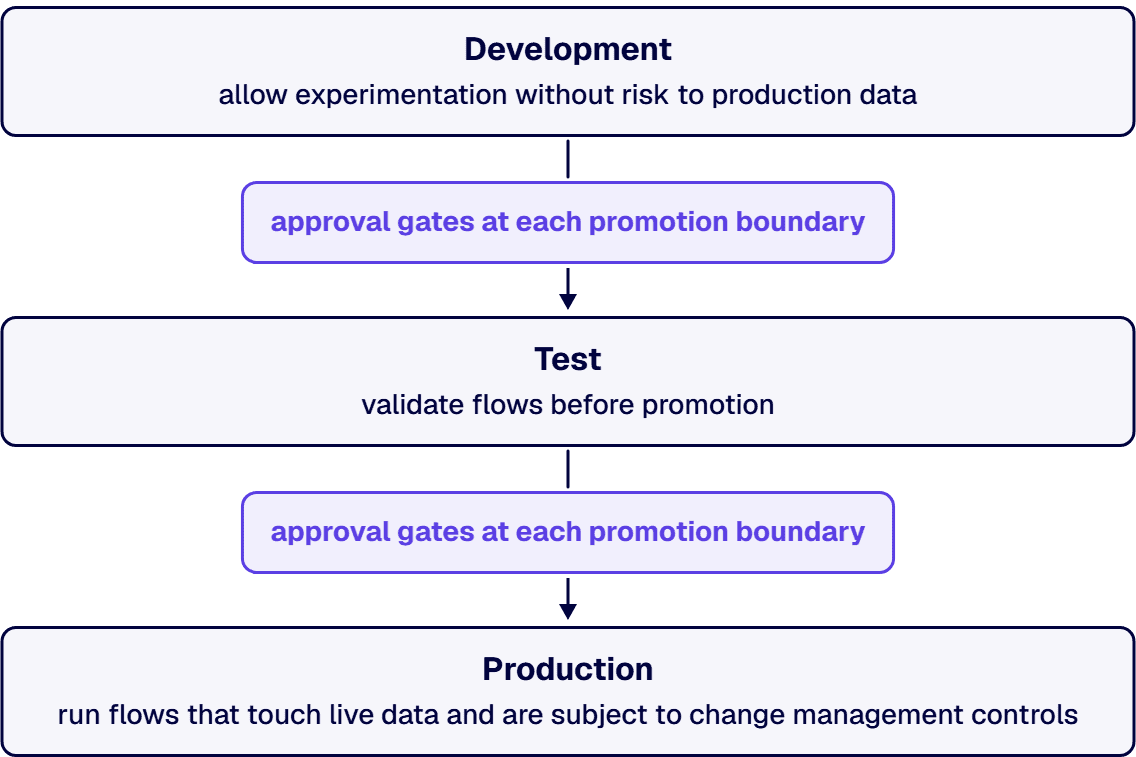
Three failure modes account for the majority of Power Automate consulting engagements i3solutions evaluates in regulated environments. First, connector sprawl without DLP: flows use 15 to 25 connector types across the tenant with no policy restricting which connectors access which data classifications. Second, environment proliferation without ALM: the organization has 8 to 12 environments created ad hoc by different teams, with no solution deployment pipeline and no consistent DLP policy coverage. Third, citizen-built flows without error handling: production flows lack try-catch-finally patterns, run without monitoring, and fail silently until a downstream business process breaks visibly enough for someone to investigate.
Governance-first consulting addresses all three by designing flow architecture patterns that include structured error handling (scope-based try/catch in cloud flows), centralized monitoring via the Power Platform admin center and custom alerting dashboards, and naming conventions that make flow ownership and purpose discoverable at scale.
If your Power Automate environment has outgrown its governance framework, the next step is a structured conversation with a team that has built governed automation architectures in regulated enterprises. Hire our Power Platform team to bring governance-first methodology to your automation environment, backed by 1,500+ implementations and the borrowed expertise of a US-based senior Microsoft delivery team.
Talk through your flows, connectors, and environment strategy with a team that has built governed automation architectures inside regulated enterprises.
Not every Power Automate consulting firm operates at the governance layer regulated enterprises require. Three dimensions separate consulting partners that build flows from those that build governed automation architecture.
Regulated-industry experience. The partner should name specific compliance frameworks (CMMC, HIPAA, SOC 2, FedRAMP) and describe how those frameworks shape the governance architecture they deliver, not just list ‘aerospace and defense, financial services, and healthcare’ as a market they serve. Ask for the DLP policy matrix, environment strategy document, or ALM pipeline design from a prior engagement. If the partner cannot describe the compliance-specific governance controls they delivered, the experience claim is positioning rather than proof.
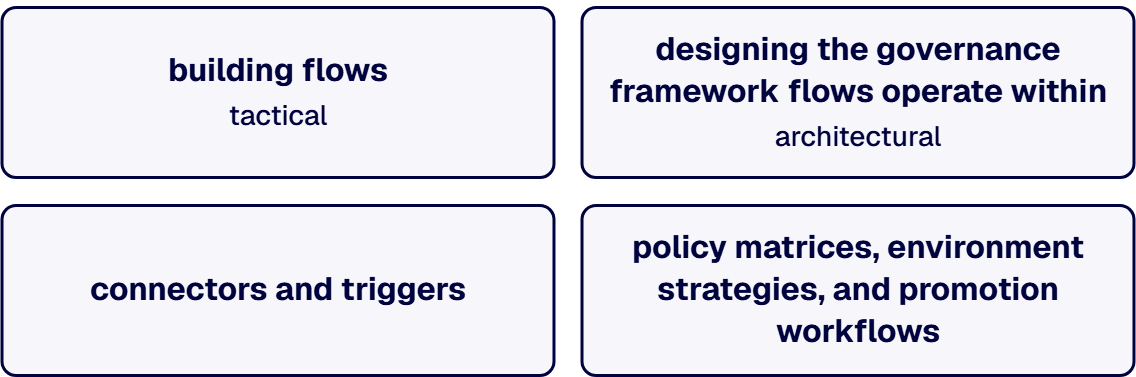
Governance-first architecture literacy. The partner should distinguish between building flows (tactical) and designing the governance framework flows operate within (architectural). Test: ask the partner to describe how they handle DLP policy layering across tenant and environment levels, or how they design ALM pipelines for regulated environments. Partners operating at the flow level will describe connectors and triggers. Partners operating at the architecture level will describe policy matrices, environment strategies, and promotion workflows.
Knowledge transfer discipline. The engagement should produce artifacts the internal team inherits: documented DLP policy matrices, environment strategy specifications, ALM pipeline configurations, naming conventions, and flow architecture patterns. If the partner’s model depends on ongoing presence to maintain what they built, the engagement creates dependency rather than capability.
i3solutions structures Power Automate consulting engagements in three phases with named deliverables and exit criteria at each boundary.
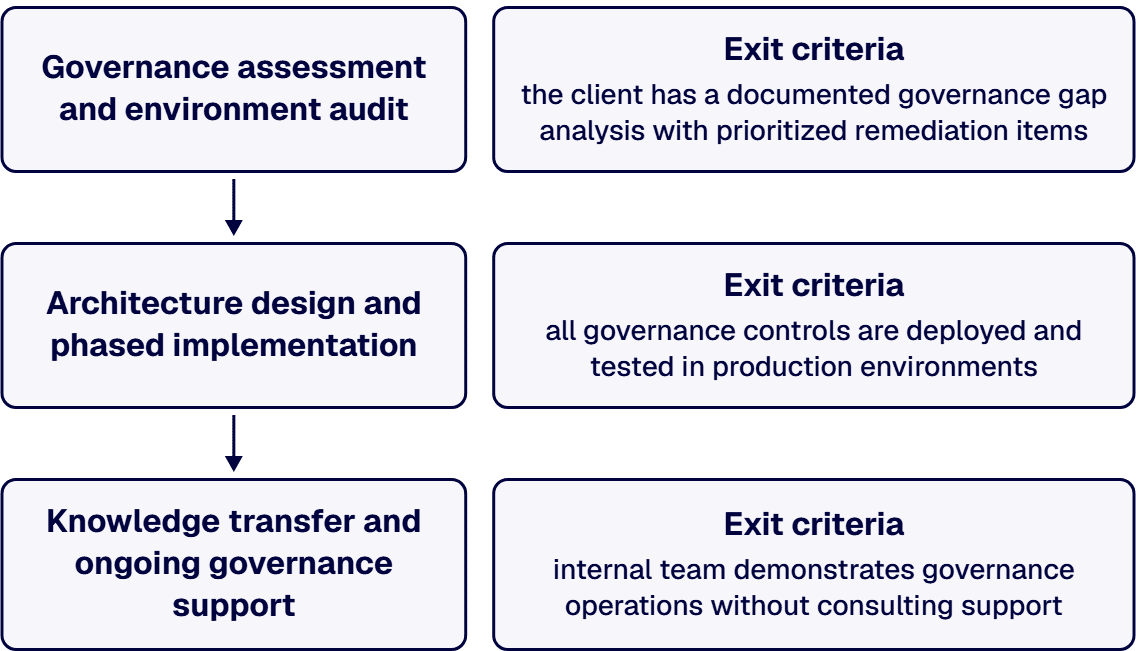
Phase 1: Governance assessment and environment audit (2 to 4 weeks). Produces a current-state inventory of all flows, connectors, environments, DLP policies, and user roles. Maps findings to the compliance framework applicable to the client’s sector. Exit criteria: the client has a documented governance gap analysis with prioritized remediation items.
Phase 2: Architecture design and phased implementation (6 to 12 weeks). Builds the governance framework: DLP policy matrix, environment strategy, ALM pipeline, flow architecture patterns, error handling standards, and monitoring configuration. Implementation follows a phased rollout (environment restructuring first, then DLP deployment, then flow remediation and migration, then ALM standup). Exit criteria: all governance controls are deployed and tested in production environments.
Phase 3: Knowledge transfer and ongoing governance support (2 to 4 weeks). Transfers ownership to the internal team through documented artifacts, hands-on training, and a CoE pattern handoff that equips the organization to govern new automation independently. Exit criteria: internal team demonstrates governance operations without consulting support.
The IT Director evaluating Power Automate consulting partners typically needs buy-in from 3 to 15 stakeholders: a budget sponsor (finance), a security reviewer (CISO or security team), a compliance officer, and department heads whose workflows will be affected. Each stakeholder evaluates different dimensions of the engagement.
For the budget sponsor: engagement cost drivers (scope complexity, environment count, compliance framework count, remediation vs greenfield), directional cost bands, and the three-phase structure that makes spend predictable. For the security reviewer: DLP policy architecture, environment isolation strategy, and connector governance controls. For the compliance officer: specific compliance framework mapping (CMMC control families, HIPAA technical safeguards, SOC 2 change management controls) and audit-readiness deliverables. For department heads: knowledge transfer timeline, internal team enablement plan, and the operational impact during implementation.
Share the three evaluation dimensions above with your committee. A partner that satisfies all three (regulated-industry experience, governance-first architecture literacy, knowledge transfer discipline) with documented proof rather than positioning claims is a partner the committee can defend.
If your internal evaluation has narrowed to the governance-first consulting model described above, the next step is a scoping conversation that maps your specific compliance requirements to a phased engagement. Scope your Power Platform governance gaps with our SharePoint and M365 governance team to get a governance assessment tailored to your regulatory environment.
A defense contractor engaged i3solutions after an internal audit revealed that 47 citizen-built Power Automate flows were processing Controlled Unclassified Information through connectors not approved for CUI handling. The compliance team flagged the finding as a CMMC pre-assessment risk that could delay the organization’s Level 2 certification timeline. i3solutions delivered a DLP policy architecture that classified all tenant connectors against CUI handling requirements, restructured the environment strategy to isolate CUI-processing flows in a dedicated production environment with restricted maker permissions, and built an ALM pipeline that required security review approval before any flow promotion to the CUI environment. The engagement produced a documented governance framework the internal team inherited, and the organization passed its CMMC Level 2 assessment without automation-related findings.
A registered investment advisor retained i3solutions after their SOC 2 Type II assessor flagged unmanaged Power Automate environments as a change management control deficiency. The firm had 23 production flows handling client portfolio notifications, trade confirmation workflows, and compliance reporting, but no environment separation, no approval workflow for flow changes, and no audit trail for flow modifications. i3solutions designed an environment strategy with segregated production, test, and development tiers, built an ALM pipeline with approval gates at each promotion boundary, and implemented centralized monitoring that logged all flow executions and modifications. The governance controls satisfied the SOC 2 assessor’s change management requirements, and the firm’s subsequent Type II report reflected no automation-related findings.
A regional health system approached i3solutions after discovering that patient appointment reminder flows built by a departmental power user were transmitting Protected Health Information through a non-BAA-covered connector. The HIPAA Privacy Officer escalated the finding as a potential breach notification trigger. i3solutions conducted a governance assessment that inventoried all flows handling PHI, reclassified connectors against BAA coverage requirements, and deployed DLP policies that blocked non-BAA connectors from accessing PHI data sources. The environment strategy isolated PHI-processing flows in a dedicated production environment with restricted access. The remediation was completed before the 60-day breach notification window, and the health system implemented ongoing governance monitoring that prevents recurrence.
Cost depends on four primary drivers: scope complexity (number of flows, connectors, and environments requiring governance), environment count (single-tenant vs multi-tenant, GCC vs commercial), compliance framework count (organizations subject to both CMMC and HIPAA require more governance layers than single-framework environments), and whether the engagement is remediation (fixing existing ungoverned automation) or greenfield (building governance before flows exist). A governance assessment (Phase 1) typically runs 2 to 4 weeks with a senior consulting team. Full governance architecture and implementation (Phases 1 through 3) ranges from 10 to 20 weeks depending on scope. i3solutions scopes engagements in defined phases with named deliverables so the cost is predictable at each boundary rather than open-ended.
The governance architecture is shaped by the compliance framework. Defense contractors operating under CMMC must confine CUI-handling flows to approved environments with DLP policies that block connectors not authorized for CUI. Healthcare organizations under HIPAA must ensure PHI flows use only BAA-covered connectors within technically safeguarded environments. Financial services firms under SOC 2 must demonstrate change management controls over flow modifications. Generic Power Automate consulting applies the same governance template regardless of compliance context. Governance-first consulting maps every DLP policy, environment configuration, and ALM pipeline decision to the specific compliance requirements of the client’s sector.
Organizations with 1,500 to 25,000 employees in aerospace and defense, financial services, and healthcare are the primary fit, with the sweet spot around 3,000 to 5,000 employees. At this scale, Power Automate adoption has typically reached the point where citizen-built flows number in the dozens to hundreds, multiple departments have independent automation initiatives, and the governance gap creates measurable compliance risk. Smaller organizations may not have enough flow volume to justify dedicated governance architecture. Larger organizations often have internal Center of Excellence teams but may engage consulting for specific compliance-framework-driven governance projects or remediation after audit findings.
The governance assessment (Phase 1) inventories all existing flows, classifying each by business criticality, data sensitivity, connector usage, and error handling maturity. Flows are then triaged into four categories: govern in place (add DLP coverage and monitoring without rebuilding), remediate (restructure error handling, connector usage, or environment placement), consolidate (merge duplicate flows created independently by different teams), and retire (decommission flows that are broken, redundant, or no longer serve a business purpose). The remediation sequence prioritizes flows that handle sensitive data (CUI, PHI, financial data) in environments without adequate DLP coverage. This approach avoids the disruption of a wholesale rebuild while systematically closing governance gaps.
Three things. First, regulated-industry depth: i3solutions operates in aerospace and defense, financial services, and healthcare, and structures governance architecture against specific compliance frameworks (CMMC, HIPAA, SOC 2), not generic ‘best practices.’ Second, governance-first methodology: the engagement produces a governed automation environment with documented DLP policies, environment strategy, ALM pipelines, and flow architecture patterns, not just working flows. Third, knowledge transfer as a deliverable: every engagement phase produces artifacts the internal team inherits, and the Phase 3 exit criteria require the internal team to demonstrate governance operations independently. The borrowed expertise model means your organization gains capability, not dependency.

US-Based | Est. 1997
© i3solutions. All rights reserved.
US-Based | Est. 1997
© i3solutions. All rights reserved.


