
Excel-to-Web rebuild vs Power Platform modernization requires weighing four factors: process complexity, governance need, maintainability, and total cost of ownership. Custom web rebuild fits integration-heavy, high-complexity processes; governed Power Platform fits form-and-workflow processes that need fast, compliant delivery, and the scored matrix below lets you self-qualify. The rebuild side of that decision is the work of our Excel to web application development practice.
Excel-to-Web rebuild vs Power Platform modernization forces regulated IT leaders to weigh process complexity, governance exposure, maintainability, and total cost of ownership. This comparison scores both paths against those four factors so you can defend the decision in a compliance audit and to the board.
If you are reading this, you have likely already concluded that a business-critical spreadsheet has to be retired. Maybe a security review flagged it as an ungoverned data store with no audit trail. Maybe a key analyst left and took the formulas with them. Maybe an auditor asked who can change the numbers and nobody had a clean answer. That upstream question, whether to leave Excel at all, is a different decision, and we cover it separately in our Excel vs Power Platform decision guide. This article assumes the answer is yes and turns to the harder question: rebuild the process as a custom web application, or modernize it on the governed Power Platform stack.
These are genuinely different paths, and the wrong one is expensive in both directions. Over-build a simple intake form as a custom .NET application and you have bought a maintenance liability that needs a developer every time a field changes. Force a complex, integration-heavy engine onto a low-code platform and you spend the next two years fighting platform limits, premium connectors, and delegation warnings. The job of this article is to give you a defensible, factor-by-factor basis for choosing, not a vendor pitch for the path we happen to staff.
We score the decision across four dimensions: process complexity, governance need, maintainability, and total cost of ownership. None of the four is sufficient on its own. A high-complexity process with a strict five-year change cadence may still land on Power Platform if the governance model is the binding constraint. A simple process may still justify a custom rebuild if it sits on the critical path of a regulated workflow that cannot tolerate platform downtime. The matrix is a starting point for a real conversation, not a substitute for one.
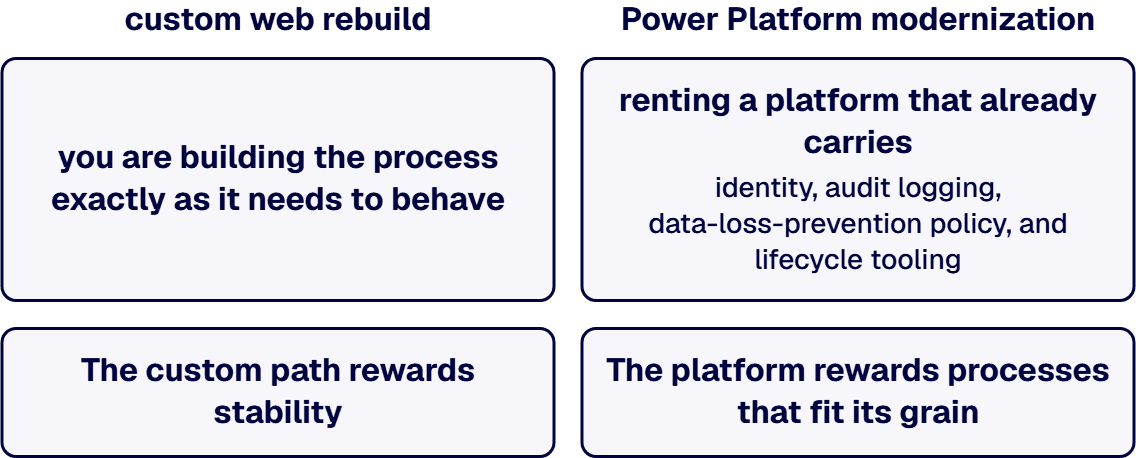
A custom web rebuild means engineering the process as a purpose-built web application, typically on a Microsoft stack such as ASP.NET Core with a SQL Server or Azure SQL back end, with an interface and data model designed specifically for the work. You are not adapting a platform to the process; you are building the process exactly as it needs to behave.
The custom path wins on four signals. The first is integration depth. When the process has to talk to several systems of record in real time, an ERP, a manufacturing execution system, a custom pricing engine, the orchestration logic is often cleaner and more performant in code than in a low-code flow stitched across premium connectors. The second is bespoke logic. Excel processes that encode years of conditional rules, custom calculations, and edge-case handling sometimes express those rules more faithfully in a typed language than in a formula canvas. The third is performance and scale. A process that loads hundreds of thousands of rows, runs heavy computation, or serves a large concurrent user base can outgrow the platform limits and delegation thresholds that govern low-code data access. The fourth is interface specificity. When the user experience is itself a competitive asset or a safety-critical surface, a hand-built interface gives you control that a templated app does not.
The honest counterweight is cost and maintainability. A custom application needs developers to change it. Every new field, every new rule, every new integration is a small project. The build is more expensive up front and the maintenance tail is longer, because you own the entire stack rather than renting a governed platform. For a process that changes monthly, that tail can quietly become the most expensive line in the five-year total. The custom path rewards stability: a process whose shape is well understood and unlikely to churn is a far better candidate than one still finding its requirements.
A defense contractor consolidating estimating spreadsheets into a single system needed real-time pricing integration with its ERP and bespoke rate logic that no off-the-shelf tool expressed. The custom web rebuild was the right call, and the CMMC 2.0 access controls were engineered into the application’s authentication layer from the first sprint rather than retrofitted later.
Power Platform modernization means rebuilding the process on Microsoft’s governed low-code stack: Power Apps for the interface, Power Automate for the workflow, Dataverse for structured data, and Power BI for reporting, all running inside an environment governed by a Center of Excellence. You are renting a platform that already carries identity, audit logging, data-loss-prevention policy, and lifecycle tooling, and you build the process on top of it.
The Power Platform path wins on a different set of signals. The first is form-and-workflow shape. Processes that are fundamentally about capturing structured input, routing it for approval, and reporting on it map cleanly onto the platform and deliver fast. The second is governance speed. When the binding constraint is producing a defensible audit trail quickly, the platform’s built-in logging, role-based security, and Microsoft Purview integration give you compliance evidence on day one rather than as a custom build. The third is an existing Center of Excellence. If your organization already governs Power Platform environments with naming standards, DLP policy, and environment strategy, a new solution inherits that governance for free, which is a large hidden saving. The fourth is change cadence. A process that evolves frequently is cheaper to maintain on a platform where a business-side maker can adjust a form or a flow under governance, rather than queuing a developer ticket.
The honest counterweight is platform fit and licensing. Not every process belongs on a low-code platform. Heavy computation, deep custom integration, and very high transaction volumes can run into premium-connector costs, API limits, and delegation constraints that turn a fast build into a slow fight. Per-user and per-app licensing has to be modeled honestly across the full user base, because at scale it is not free. The platform rewards processes that fit its grain; it punishes the ones forced against it.
A healthcare organization replacing a clinical-intake workbook needed a HIPAA-aligned audit trail that the spreadsheet could never produce, and it needed it inside one quarter, not one year. Governed Power Platform delivered the form, the approval routing, and the role-based access on the existing Center of Excellence guardrails, and the audit logging satisfied the security review without a line of custom code.
Use the matrix below to score your process. For each factor, decide which description fits, then read the weight of the evidence across all four rows. A process that lands mostly in the left column points to a custom rebuild; a process that lands mostly in the right column points to Power Platform modernization. Mixed results are common and are the signal to read the next section on hybrid paths rather than to force a single answer.
The matrix deliberately does not weight the factors for you. In our experience the binding constraint differs by organization. For a regulated enterprise mid-audit, governance need often dominates and pulls an otherwise complex process toward the platform that produces evidence fastest. For a contractor whose competitive edge lives in a bespoke engine, complexity dominates and justifies the custom build. Naming the binding constraint out loud, before scoring, is the single most useful thing a decision team can do.
Want both five-year totals modeled side by side before you commit? Talk to i3solutions about a scoping conversation.
Most Excel modernization decisions are framed around build cost, and most of them are framed wrong. Build cost is the visible number, but it is rarely the number that decides the five-year total. Total cost of ownership for either path is built from five components, and the spread between the two paths usually lives in the last three, not the first.
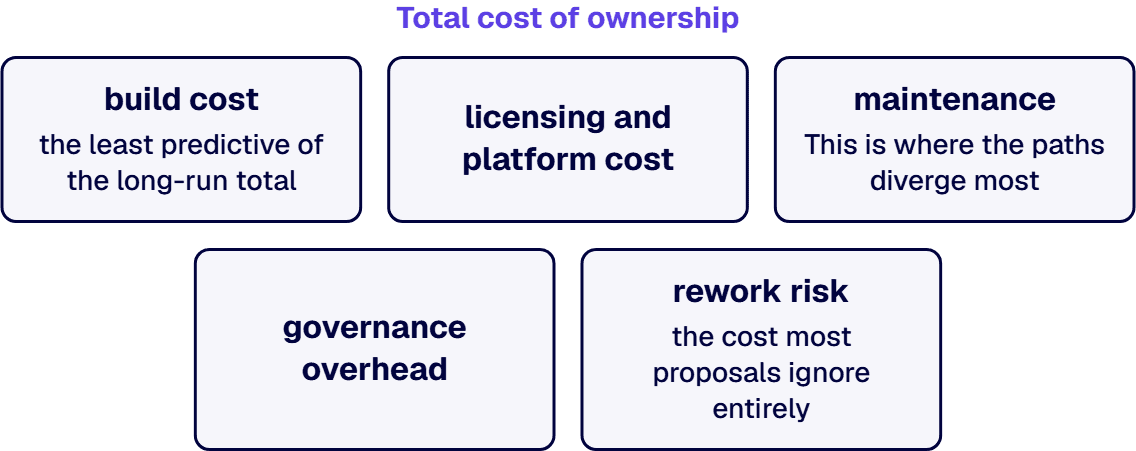
The first component is build cost. Custom rebuilds carry a higher build cost because you are engineering the full stack; Power Platform builds are typically lower because you inherit the platform. This is the number most proposals lead with, and it is the least predictive of the long-run total.
The second component is licensing and platform cost. Custom applications carry infrastructure and hosting cost but no per-user platform license. Power Platform carries per-user or per-app licensing plus the cost of premium connectors and capacity add-ons when the process needs them. At a small user base the platform is cheap; at a large one, licensing has to be modeled honestly, because it can invert the build-cost advantage.
The third component is maintenance. This is where the paths diverge most. A custom application needs a developer for every change, so a process that churns generates a steady stream of small projects. A governed Power Platform solution lets a trained maker adjust a form or a flow within guardrails, so routine change is cheaper, while structural change still needs a professional. Estimate honestly how often the process will change, because that single assumption moves the five-year total more than the build cost does.
The fourth component is governance overhead. A custom application has to build and maintain its own identity, audit logging, and access control. A Power Platform solution inside an existing Center of Excellence inherits those controls. If you do not yet have a Center of Excellence, that inherited saving is smaller and the platform’s governance has to be stood up, which is a real cost the proposal should name.
The fifth component is rework risk, the cost most proposals ignore entirely. Choosing the wrong path is the most expensive outcome of all. An over-built custom application for a simple process, or an under-fit platform build for a complex one, often ends in a second modernization within three years, frequently because the first build fails in audit or leaves a governance gap that surfaces under review. Pricing the probability of rework into the decision is what separates a defensible business case from an optimistic one. The cheapest first build is not the cheapest five-year total if it has to be rebuilt, and a process re-platformed twice has paid for modernization twice while the original risk sat unaddressed in between.
A financial firm retiring a reconciliation spreadsheet under SOC 2 scope ran the five-year total both ways before choosing. The custom quote was higher up front but the process was stable and integration-deep, so the platform’s licensing and connector costs at full user count, plus the rework risk of forcing a complex engine onto low-code, made the custom path the lower total over five years. The honest model, not the headline build cost, made the decision defensible to the audit committee.
A comparison that always produces a clean winner is a sales pitch, not an analysis. In practice, two honest answers sit between the two paths, and a good advisor will name them.
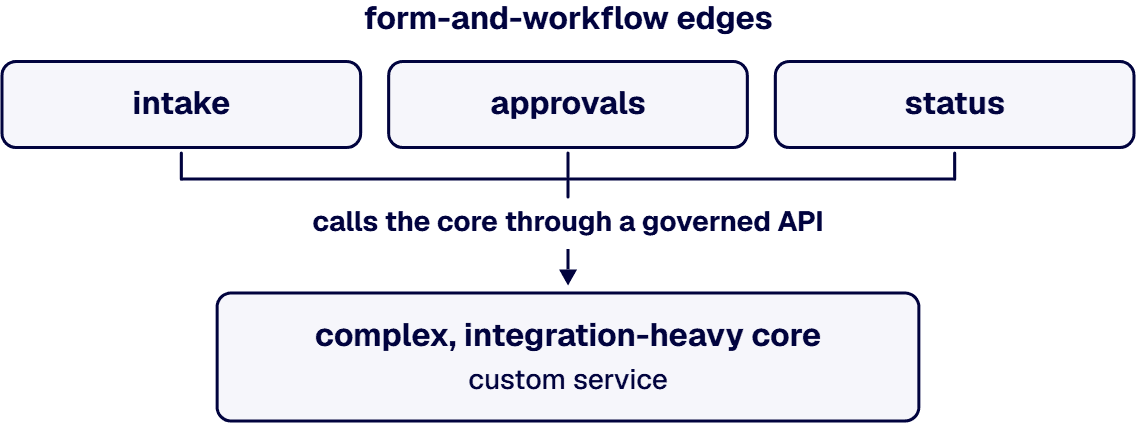
The first is a hybrid. Many real processes are a complex core wrapped in simple edges. The defensible answer is often to rebuild the complex, integration-heavy core as a custom service and to put the form-and-workflow edges, intake, approvals, status, on Power Platform that calls the core through a governed API. You get the depth where depth matters and the speed and governance where they matter, and you avoid forcing either platform against its grain. The hybrid costs more to design than a single-path build, so it has to be justified by genuine complexity, not chosen by default.
The second honest answer is not yet. Some processes are not ready to modernize because their requirements are still moving. Rebuilding a process whose rules change every month, on either platform, locks in churn cost before the process has stabilized. The disciplined move is sometimes to govern the spreadsheet in place for a defined window, remove the worst risks, agree the requirements, and then modernize onto the path the stabilized process points to. Saying not yet protects the budget from paying twice.
Speed-first advocates will push back here, and the steel-man is worth stating plainly. Sometimes the cost of delay genuinely outweighs the cost of a slightly wrong path. A spreadsheet that is one resignation away from being unmaintainable, or one audit away from a finding, may justify moving fast onto whichever path delivers soonest, accepting that a second pass may follow. That is a legitimate call when leadership makes it with eyes open. It stops being legitimate when speed is used to skip the four-factor analysis entirely and the rework simply gets discovered later.
i3solutions is a Microsoft Partner, with 1,500+ engagements delivered for regulated enterprises across aerospace and defense, financial services, and healthcare. We are an Engineer-Advisor firm: we score the decision honestly and route the process to the path that fits it, not to the path that bills the most hours.
Our Enterprise Delivery Assurance approach runs as a three-phase engagement. In Phase 1 we score the process against the four dimensions above, model the five-year total cost of ownership both ways, and name the binding constraint. In Phase 2 we design the chosen path, or the hybrid, with the governance and compliance controls built in from the start rather than retrofitted. In Phase 3 we deliver and hand over, with the documentation and audit evidence a regulated review will ask for. The work lands on-time, in-scope, and in-production, and the governance is defensible the day it ships.
Buyers in regulated sectors often weigh whether to borrow this expertise or build it internally. The honest answer is that a well-run internal team can absolutely make this decision; what an experienced partner adds is the pattern library of having made it across hundreds of engagements, and the career insurance of a defensible, documented basis when an auditor or a board asks why this path and not the other. For many regulated processes that touch CMMC 2.0 or similar regimes, where 110 controls across 14 families have to map to the implementation, control mappings such as AC.L2-3.1.1 for access control and AU.L2-3.3.1 for audit logging are easier to defend when they were designed in from Phase 1 rather than retrofitted after a finding.
Cost depends on the path and the process, and build cost is the wrong number to anchor on. A governed Power Platform build of a form-and-workflow process is usually the lower up-front number because it inherits the platform’s identity, audit logging, and lifecycle tooling. A custom web rebuild carries a higher build cost because you engineer the full stack. The number that actually decides the five-year total is the sum of licensing, maintenance, governance overhead, and rework risk, not the build alone. Power Platform licensing scales with users and premium connectors, so it has to be modeled at full user count. Custom applications carry a longer maintenance tail because every change needs a developer. The defensible approach is to model the five-year total of both paths against your real user count and change cadence before choosing, which is the first thing we do in a scoping engagement.
Choose the custom web rebuild when the process is integration-heavy, carries bespoke logic that a formula canvas cannot express cleanly, runs heavy computation, or serves high concurrency, and when its shape is stable enough that the longer maintenance tail is justified. Custom is the right call when depth and control matter more than speed, and when the process is unlikely to churn every month. If the process is fundamentally about capturing structured input and routing it, the custom path is usually over-engineering.
Governed Power Platform wins when the process is form-and-workflow work, when you need a defensible audit trail quickly, when an existing Center of Excellence already governs your environment, and when the process evolves often enough that you want trained makers adjusting forms and flows under guardrails rather than queuing developer tickets. It is the faster, lower-friction path for the large class of regulated processes that are really about structured data, approval, and reporting.
Yes, and it is more common than vendors admit. Many processes are a complex core wrapped in simple edges. Rebuilding the complex core as a custom service and putting the intake, approval, and status edges on Power Platform that calls the core through a governed API gives you depth where it matters and speed and governance where they matter. The hybrid costs more to design, so it should be justified by genuine complexity rather than chosen by default, but for the right process it is the most defensible answer of all.
Score the process against the four factors of complexity, governance, maintainability, and total cost of ownership; name the binding constraint out loud; and model the five-year total of both paths against your real user count and change cadence, including a priced estimate of rework risk. A decision documented that way, with the governance and compliance controls mapped to the chosen path from the start, answers the only questions an auditor or a board will ask: why this path, what it costs over its life, and how the controls are evidenced. That documented basis is the deliverable, not just the build.
i3solutions is a Microsoft Partner with 30 years of delivery experience serving regulated enterprises in aerospace and defense, financial services, and healthcare. We design, build, and stabilize Microsoft solutions, SharePoint, Power Platform, system integration, and custom development, for organizations that operate under CMMC, HIPAA, SOC 2, and similar regimes. Our Engineer-Advisor approach pairs senior US-based delivery with the governance and audit evidence a regulated review demands, so modernization lands on-time, in-scope, and in-production.

US-Based | Est. 1997
© i3solutions. All rights reserved.
US-Based | Est. 1997
© i3solutions. All rights reserved.


