
By Scott Singleton, Managing Consultant, i3solutions
Scott Singleton has spent more than 19 years at i3solutions and more than 30 years designing, developing, migrating, and implementing enterprise technology solutions. His expertise is grounded in SharePoint architecture, large-scale migration, custom application development, workflow modernization, technical training, and hands-on delivery across Microsoft platforms, including SharePoint, SPFx, Power Apps, Power Automate, Power BI, and enterprise database systems.
Enterprise SharePoint consulting closes the gap between what a regulated organization’s SharePoint investment costs and what it actually delivers. The work spans strategy assessment, governance design, and platform optimization, anchored to the compliance frameworks and operating model of the specific environment rather than a generic feature rollout.
In a regulated estate, the risk is unowned governance at the platform layer, not the technology itself. i3solutions delivers this work with senior, U.S.-based SharePoint architects who build inside your compliance and data-residency requirements and hand back an auditable governance and architecture map.
Enterprise SharePoint consulting engagements at i3solutions start when a VP of IT or CIO recognizes one of three patterns in their environment. The patterns are not unique to any single organization. They surface across defense contractors, financial services firms, and healthcare systems with similar consistency, and they share a common root cause: SharePoint was deployed without an operating model that matched the organization’s actual compliance posture and business processes.
The original SharePoint deployment was led by features. IT installed the platform, enabled collaboration sites, turned on document libraries, and assumed the rest would follow. Five or ten years later, the platform is in production, but the operating model that should govern it (who owns which sites, how content is classified, what gets retained, how access is granted and revoked) was never designed. Each business unit improvised. The improvisations diverged. The platform certifies, but the implementation does not. Audit reviews surface the divergence as inconsistent control evidence across site collections, an ungoverned governance gap that compounds with each new site.
The remediation begins with the operating model, not the platform. Enterprise SharePoint consulting at i3solutions starts the Strategy Assessment by mapping current state to a defined operating model that the organization can actually run, then sequences the platform changes that close the gap. The Strategy Assessment establishes who owns what at the platform layer, how decisions are made, and what evidence the organization will produce on demand. The platform reconfiguration follows the operating model, not the other way around.
Every team owns their site. No one owns the platform. SharePoint at the enterprise layer has no named owner with authority to make decisions about classification taxonomy, retention defaults, sensitivity-label inheritance, conditional access posture, or site-provisioning policy. Each new site adds local decisions that compound across the estate. When an audit asks who decides what gets a Confidential sensitivity label, the answer is site-owner-specific. That answer is a governance gap, not an organizational quirk.
The platform governance vacuum is the most common pattern at organizations with 5,000 to 25,000 employees and 200+ SharePoint sites running without governance at the platform layer and missing audit trail evidence the regulator would expect to see. The Governance Implementation engagement closes it by establishing a platform governance committee, defining the platform-layer decisions the committee owns, codifying the decisions into Microsoft Purview policies and SharePoint Online site-design templates, and running an evidence cadence that makes the governance visible to auditors. The work is structural and the deliverables are durable.
The organization’s SharePoint compliance posture was designed for on-premises SharePoint 2013 or 2016, with a security boundary at the data center, classification handled by file-server folder structure, and retention managed through quarterly archive jobs. SharePoint Online plus Microsoft Purview operates on different primitives. Sensitivity labels travel with the file. Retention labels survive site moves. Conditional access policies travel with the user identity. The old posture’s controls do not map cleanly to the new platform, but the organization never redesigned the control set against the new primitives. The result is an audit gap that surfaces during the next regulator examination.
The third pattern is the highest-cost remediation when surfaced during a regulator audit rather than during a strategy assessment. Catching it in assessment is the proof-over-promise difference. i3solutions delivers this pattern remediation as part of legacy SharePoint project rescue engagements when the audit surfaces first; the strategy assessment route is faster and cheaper because it surfaces the gap before the auditor does. The pattern surfaces with consistency at defense contractors who carried on-premises SharePoint into a CMMC 2.0 Level 2 readiness review and discovered the inherited controls did not map.
i3solutions surfaces and remediates compliance-posture drift during the strategy assessment, where it costs least to fix, not during the audit.
Enterprise SharePoint consulting at i3solutions runs in three parallel engagement types. The buyer selects the entry that matches their decision moment, not a fixed maturity sequence. A VP IT facing an M365 renewal forcing platform consolidation enters at Strategy Assessment. A CIO facing a new CMMC requirement enters at Governance Implementation if the strategy is already settled and the gap is governance design. An IT leader operating a mature SharePoint program with a defined governance model enters at Platform Optimization as a quarterly retainer. The three engagement types are not a ladder.
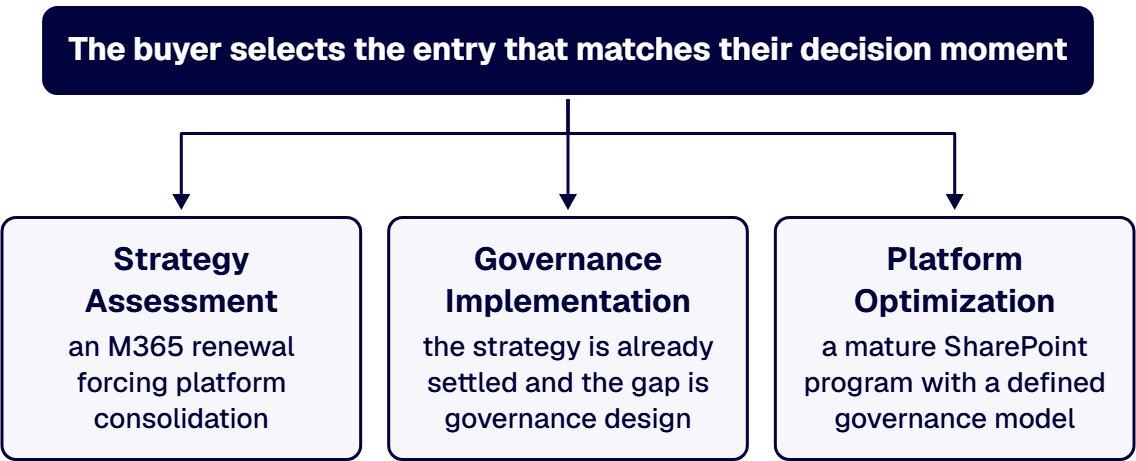
The Strategy Assessment is the diagnostic entry for organizations evaluating their SharePoint investment at a decision moment. The engagement runs four to six weeks elapsed time with two or three i3solutions consultants as a four-phase process. Phase 1 (week 1) covers current-state inventory and stakeholder interviews. Phase 2 (weeks 2-3) produces the gap analysis at named-control-family depth against compliance frameworks. Phase 3 (week 4) produces the remediation roadmap with named owners and durations. Phase 4 (weeks 5-6, when needed) covers stakeholder review and assessment-document finalization. The Strategy Assessment is the appropriate entry when the organization needs to decide what SharePoint should do for them, before deciding what to build.
The Strategy Assessment maps directly to the build-versus-hire decision frame i3solutions writes about at Hiring a SharePoint Consultant vs. Doing It In-House. Organizations evaluating whether to deepen the SharePoint investment with in-house engineers or with a consulting partner use the Strategy Assessment to scope both options against the same operating model.
Governance Implementation is the build engagement for organizations whose strategy is settled and whose gap is governance design. The engagement runs eight to twelve weeks with a senior i3solutions consultant plus engineering capacity scaled to the SharePoint estate. The deliverables are the platform governance committee charter, the platform-layer decision catalog (classification taxonomy, retention defaults, sensitivity-label inheritance rules, conditional access posture, site-provisioning policy, Microsoft Purview policy set), the SharePoint Online site-design templates that encode the decisions, the evidence cadence the governance committee runs against, and the audit-evidence package the engagement produces. The deliverables are durable; the governance committee continues running them after the engagement ends.
Platform Optimization is the operating engagement for organizations whose governance is implemented and whose remaining work is continuous optimization of the platform against changing compliance posture, evolving Microsoft platform capability (new Microsoft Purview features, new Microsoft Entra ID capabilities, SharePoint Online roadmap changes), and changing operating context. The engagement runs as a quarterly retainer with one or two i3solutions consultants. The deliverables are quarterly platform reviews, compliance-posture updates, Microsoft platform capability assessments, and prioritized optimization recommendations. Organizations carrying mature SharePoint programs into multi-year compliance cycles use Platform Optimization to maintain Engineering Discipline at the platform layer without rebuilding the governance from scratch.
i3solutions delivers enterprise SharePoint consulting against a Microsoft Partner standard with 1,500+ implementations across the Microsoft platform. Strategy assessment, governance implementation, and platform optimization engagements are scoped to the compliance posture and operating model of your specific environment. Hire SharePoint Developers for an Enterprise SharePoint Consulting Engagement to start a strategy assessment.
Enterprise SharePoint consulting is not sector-agnostic. The compliance frameworks, audit cadence, named-control-family depth, and operating constraints differ enough across regulated industry sectors that the consulting engagement reshapes around the sector. i3solutions runs sector-specific engagements anchored to the named compliance frameworks the sector actually reports against, not to marketing-tier compliance language.
Enterprise SharePoint consulting for defense contractors anchors on CMMC 2.0 Level 2 (the dominant compliance requirement for the defense industrial base), NIST 800-171 Rev 3, and DFARS 252.204-7012. The control families that matter most for SharePoint Online deployments are Access Control (AC), Audit and Accountability (AU), Media Protection (MP), and System and Communications Protection (SC). The strategy assessment maps SharePoint Online plus Microsoft Purview plus Microsoft Entra ID configuration to the named controls and surfaces the gaps an auditor would surface.
i3solutions has delivered enterprise SharePoint consulting for defense contractors including an aerospace and defense manufacturer and major defense organizations. The defense-contractor engagement adjacent to CUI (Controlled Unclassified Information) handling shares architecture decisions with GCC High SharePoint Migration: A Defense Contractor’s Pre-Migration Guide to Customizations, Compliance, and Partner Selection for organizations operating in or migrating to the GCC High commercial cloud boundary.
Enterprise SharePoint consulting for financial services anchors on SOC 2 (CC6 logical access controls, CC6.7 information protection during transmission, CC7.2 system anomaly detection), the financial-services-relevant aspects of NIST CSF, and the regulator-specific examination frameworks the firm reports against (the SEC examination posture for registered investment advisers, the FINRA cycle for broker-dealers, the OCC cycle for national banks). The control framework integration runs at the named-control-family depth the firm’s compliance officer will recognize.
i3solutions delivered enterprise SharePoint consulting for a financial services firm and other firms in the sector. The financial services engagement emphasizes audit-evidence cadence and the documentation of platform-layer governance decisions because the regulator-examination cycle is annual or semi-annual and the firm needs durable evidence packages, not ad-hoc reconstructions.
Enterprise SharePoint consulting for healthcare anchors on HIPAA Security Rule 164.312 (technical safeguards: access control 164.312(a)(1), audit controls 164.312(b), integrity 164.312(c)(1), transmission security 164.312(e)(1)), HITRUST CSF (when the organization carries a HITRUST certification), and the state-specific patient data protection statutes the system reports against. The compliance integration covers Microsoft Purview Information Protection sensitivity labels for PHI handling, Microsoft Entra ID conditional access for clinician identity, and SharePoint Online site-design templates for clinical-team collaboration sites.
i3solutions delivered enterprise SharePoint consulting for a national healthcare system. Healthcare engagements emphasize PHI-handling sensitivity-label inheritance across SharePoint Online sites, OneDrive containers, and Microsoft Teams channels because the PHI exposure surface spans the full Microsoft 365 platform, not SharePoint alone.
Defense, financial services, and healthcare engagements map sensitivity labels and audit evidence to the controls your auditors actually review.
Compliance framework integration is where enterprise SharePoint consulting separates from generic SharePoint consulting. The integration runs at the named-control-family depth the regulator and auditor actually examine against, and the Microsoft platform primitives the consulting engagement deploys against are anchored to Microsoft’s primary-source product documentation, not to third-party marketing material.
CMMC 2.0 Level 2 requires defense contractors to implement the 110 NIST 800-171 Rev 3 security requirements covering 14 control families. The SharePoint-relevant families are Access Control (AC-2, AC-3, AC-6, AC-17), Audit and Accountability (AU-2, AU-3, AU-6, AU-12), Media Protection (MP-3, MP-4, MP-6), and System and Communications Protection (SC-8, SC-13). Implementation against SharePoint Online plus Microsoft Purview plus Microsoft Entra ID requires sensitivity-label inheritance rules that match the CUI marking requirements, retention labels matching the federal-records-disposition schedule, conditional access policies enforcing the FIPS-validated cryptographic posture, and audit log retention meeting the audit-event-coverage requirements.
Microsoft’s Microsoft Purview Information Protection documentation is the primary source for sensitivity-label configuration patterns. Enterprise SharePoint consulting engagements reference the Microsoft primary source and add the regulated-enterprise implementation guidance bridging product documentation to auditor evidence requirements.
HIPAA Security Rule 164.312 specifies technical safeguards covering access control (164.312(a)(1)), audit controls (164.312(b)), integrity (164.312(c)(1)), and transmission security (164.312(e)(1)). SharePoint Online implementation requires access control via Microsoft Entra ID conditional access for PHI-handling clinician identities, audit controls via the unified audit log, integrity controls via versioning and Microsoft Purview audit-trail tamper-evidence, and transmission security via the SharePoint Online TLS posture and Microsoft 365 commercial-cloud boundary.
Microsoft’s Microsoft Purview Records Management documentation is the primary source for retention-label configuration including immutable-records and event-based retention patterns HIPAA compliance integrations use. Enterprise SharePoint consulting implements against this primary source and adds HIPAA-specific guidance for clinician-identity-bound PHI handling.
SOC 2 Trust Services Criteria CC6 (logical access controls) and CC7 (system operations) cover the SharePoint-relevant control set for financial services SOC 2 reporting. CC6.1 maps to Microsoft Entra ID conditional access plus SharePoint Online site-design templates that enforce the firm’s access posture. CC6.7 maps to the SharePoint Online TLS posture plus Microsoft Purview Information Protection encryption-at-rest. CC7.2 maps to Microsoft Sentinel integration with the unified audit log plus the SharePoint Online activity feed.
Microsoft’s Microsoft Entra Conditional Access documentation is the primary source for conditional-access policy patterns SOC 2 CC6.1 implementations require. Enterprise SharePoint consulting engagements implement against the Microsoft primary source and add financial-services patterns for client-data-handling registered-investment-adviser examination posture.
i3solutions delivers enterprise SharePoint consulting against named-control-family compliance depth for CMMC 2.0 Level 2, NIST 800-171 Rev 3, HIPAA Security Rule 164.312, and SOC 2 CC6/CC7. The compliance integration anchors on Microsoft Purview, Microsoft Entra ID, and SharePoint Online primary-source documentation, not third-party marketing material. Hire SharePoint Developers for a Compliance-Anchored SharePoint Engagement to start a compliance gap assessment.
VP IT and CIO buyers can distinguish operating-model consultants from feature-installation vendors using a small set of operating-model signals that surface during the sales conversation and the first two weeks of the strategy assessment.
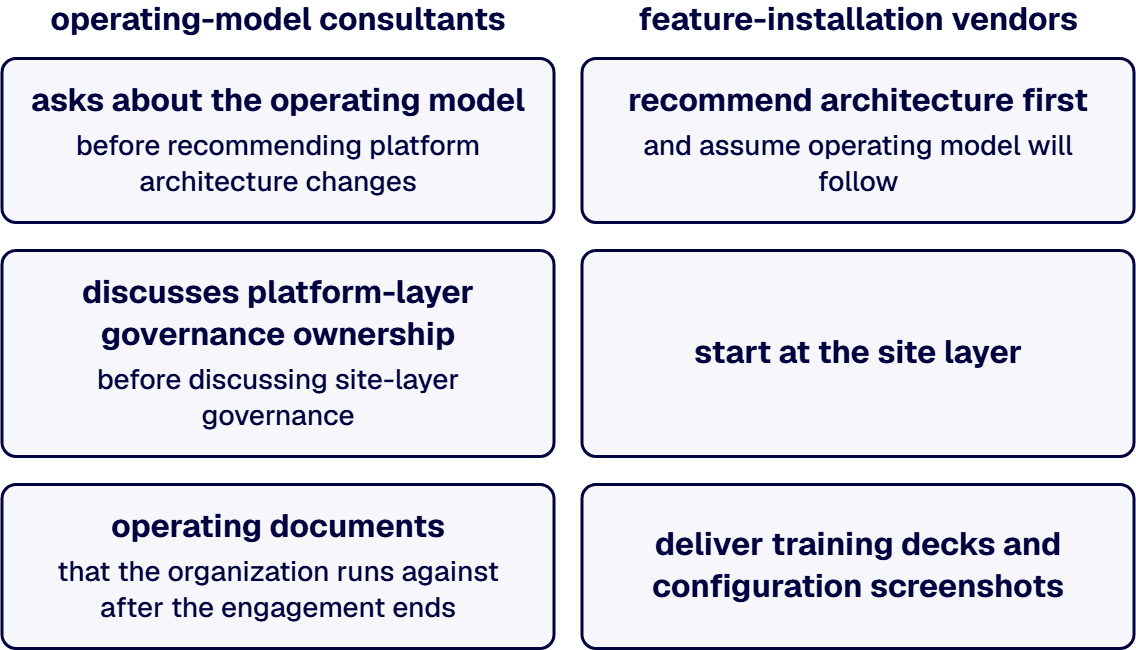
Signal 1: Operating model articulated before architecture. The consulting partner asks about the operating model (who owns what, how decisions are made, what evidence the organization produces) before recommending platform architecture changes. Feature-installation vendors recommend architecture first and assume operating model will follow. The reverse is the consulting signal.
Signal 2: Compliance posture mapped to named control families. The consulting partner names specific control families (CMMC 2.0 Level 2 AC-3, NIST 800-171 Rev 3 AU-2, HIPAA Security Rule 164.312(a)(1)) and maps SharePoint Online plus Microsoft Purview configuration to the named controls. Feature-installation vendors reference compliance frameworks at marketing-tier depth without naming the control families.
Signal 3: Governance ownership defined at platform layer, not site layer. The consulting partner discusses platform-layer governance ownership (classification taxonomy, retention defaults, sensitivity-label inheritance, conditional access posture) before discussing site-layer governance. Feature-installation vendors start at the site layer.
Signal 4: Named reference clients in same sector at same scale. The consulting partner names reference clients in the buyer’s regulated industry sector at the buyer’s organizational scale. Generic “Fortune 500 clients” claims are marketing language; specific named clients at sector-and-scale match are the consulting signal. i3solutions names reference clients in aerospace and defense, financial services, and healthcare against this signal.
Signal 5: Longevity in the SharePoint platform across multiple major versions. The consulting partner has been on the SharePoint platform across multiple major versions (SharePoint 2010, 2013, 2016 on-premises; SharePoint Online from the early Office 365 era forward) and has operated through the platform-shift inflection points. i3solutions is a Microsoft Partner with 30 years of delivery experience across the full Microsoft platform.
Signal 6: Artifact-led delivery over training-deck-led delivery. The consulting partner’s deliverables are operating documents (governance committee charter, platform-layer decision catalog, SharePoint Online site-design templates, audit-evidence package) that the organization runs against after the engagement ends. Feature-installation vendors deliver training decks and configuration screenshots. The durable-artifact signal is the Proof Over Promise standard i3solutions contracts against.
The Strategy Assessment exists to answer five questions for VP IT and CIO buyers evaluating their SharePoint investment. The answers determine whether the recommendation is optimize, deepen, redirect, or replace.
Question 1: What does SharePoint actually do for the organization today? Current-state inventory across the SharePoint estate, the workloads running on it, the user populations using it, and the business processes anchored to it. The inventory is mechanical but the value is forcing the organization to confront the divergence between what SharePoint was deployed to do and what it ended up doing.
Question 2: What should SharePoint do given the next-three-years operating and compliance posture? Target-state articulation against the organization’s next-three-years compliance cycle, the planned operating-model changes, and the Microsoft platform roadmap. The target state is a written articulation the IT leadership signs off on.
Question 3: What is the gap between current state and target state? Gap analysis at named-control-family depth covering the compliance gaps, the operating-model gaps, the platform-configuration gaps, and the evidence-cadence gaps. The gap is the input to the remediation roadmap and the build-versus-replace recommendation.
Question 4: What does closing the gap require, by owner and duration? Remediation roadmap with named owners, named durations, named deliverables, and named dependencies. The roadmap is the artifact the IT leadership uses to budget and sequence the work.
Question 5: Who owns each piece of the closure plan, and how does ownership transition from i3solutions to the organization? Ownership map and engagement transition plan. The Strategy Assessment ends with the ownership map signed off; the Governance Implementation engagement that follows runs against the ownership map; the Platform Optimization quarterly retainer that follows the implementation runs against the durable ownership map. The ownership map is the engagement contract and the Risk-Aware Modernization commitment.
Enterprise SharePoint consulting at i3solutions begins with a four-to-six-week Strategy Assessment scoped to the regulated enterprise’s compliance posture and operating model. The engagement produces a strategy document, gap analysis at named-control-family depth, and a remediation roadmap with named owners and durations. Contact Us to scope a Strategy Assessment for your environment.
i3solutions has delivered enterprise SharePoint consulting for defense contractors and for a federal research agency. Those engagements sit adjacent to Controlled Unclassified Information (CUI) handling, so they turn on the same architecture decisions a CMMC 2.0 Level 2 readiness review does: how the permission model, the search configuration, and the Microsoft Purview and Microsoft Entra ID configuration map to the named controls an auditor will actually test. Building against that standard from the start, rather than retrofitting it later, is what separates a platform that passes review from one that surfaces gaps under it.
Enterprise SharePoint consulting cost varies by engagement type and the size of the SharePoint estate. Strategy Assessment engagements typically range from approximately 40,000 to 85,000 US dollars for a single-tenant SharePoint Online environment at a regulated enterprise of 5,000 to 25,000 employees. Governance Implementation engagements typically range from approximately 120,000 to 280,000 US dollars depending on the number of site collections in scope and the audit-evidence package the engagement must produce. Platform Optimization engagements run as quarterly retainers ranging from approximately 30,000 to 60,000 US dollars per quarter. These ranges reflect i3solutions Microsoft Partner senior-engineer rates and the regulated-enterprise compliance integration depth the deliverables require. The exact cost for any specific engagement is established during the Strategy Assessment or via a scoping conversation; the ranges above are reference points for budget planning.
Enterprise SharePoint strategy assessment engagements typically run four to six weeks elapsed time with two to three i3solutions consultants. Week one covers current-state inventory and stakeholder interviews (compliance owner, operations owner, IT operating-model owner). Weeks two and three produce the gap analysis at named-control-family depth against the compliance frameworks the organization reports against. Week four produces the remediation roadmap with named owners and durations. Weeks five and six (when needed) cover stakeholder review cycles, executive presentation preparation, and assessment-document finalization. Assessment duration scales modestly with the size of the SharePoint estate. Organizations with multiple SharePoint Online tenants, hybrid deployments, or extensive third-party integrations add one to two weeks of inventory and interview work.
Enterprise SharePoint consulting at i3solutions runs in three parallel engagement types covering different decision moments. Strategy Assessment is a four-to-six-week diagnostic engagement producing a current-state inventory, target-state articulation, gap analysis at named-control-family depth, and prioritized remediation roadmap with named owners and durations. Governance Implementation is an eight-to-twelve-week build engagement producing the platform governance committee charter, the platform-layer decision catalog covering classification taxonomy and retention defaults and sensitivity-label inheritance and conditional access posture, the SharePoint Online site-design templates that encode the decisions, the evidence cadence the governance committee runs against, and the audit-evidence package. Platform Optimization is an ongoing quarterly retainer producing quarterly platform reviews, compliance-posture updates, Microsoft platform capability assessments, and prioritized optimization recommendations. The buyer selects the engagement type matching the decision moment rather than progressing through a fixed sequence.
Enterprise SharePoint consulting is strategic and governance-focused; SharePoint development services are technical and implementation-focused. Consulting addresses the operating model, compliance posture, governance design, and platform-layer ownership decisions that determine what SharePoint should do for the organization. Development services build the specific customizations, integrations, custom site designs, Power Platform extensions, and SharePoint Framework solutions the operating model requires. The two engagement types share a platform (SharePoint Online plus Microsoft Purview plus Microsoft Entra ID) and a partner (i3solutions delivers both) but address different decisions. A VP IT evaluating whether to deepen the SharePoint investment engages consulting first; the resulting roadmap may include development-services work as a downstream implementation step. Most regulated enterprises benefit from sequencing consulting before development services because consulting establishes the operating-model decisions that should govern what development services build, including the workflow modernization patterns documented at Migrating SharePoint 2013 Workflows to Power Automate.
Replacing SharePoint is rarely the right answer for regulated enterprises but it is occasionally the right answer. The honest assessment criteria are three. First, when the SharePoint deployment is so fragmented and undocumented that the assessment cost approaches replacement cost (rare; typically only in legacy multi-tenant environments). Second, when the organization’s actual use case has shifted enough that SharePoint Online plus Microsoft Purview is structurally mismatched to the use case (rare; most regulated-enterprise document-collaboration and records-management use cases fit the Microsoft platform well). Third, when the organization is consolidating from a multi-vendor stack to a single-platform stack and the consolidation target is not Microsoft (uncommon but legitimate; some organizations consolidate to a single non-Microsoft document and collaboration platform for strategic reasons). The Strategy Assessment surfaces the replace-versus-optimize decision honestly. The i3solutions assessment recommendation defaults to optimize when the SharePoint investment is recoverable and replace only when the assessment-versus-replacement economics genuinely favor replacement.
i3solutions is a Microsoft Partner with 30 years of delivery experience, delivering enterprise consulting, implementation, and optimization services across the Microsoft platform for regulated enterprises in aerospace, defense, financial services, and healthcare. The firm anchors every engagement to Engineering Discipline, Enterprise Delivery Assurance, Proof Over Promise, and Risk-Aware Modernization, delivering on-time, in-scope, and in-production against contracted outcomes. Reference clients across regulated industry sectors span aerospace and defense, financial services, and healthcare. Clients engaging i3solutions receive borrowed expertise from senior consultants who have run these engagements many times before, anchored to 1,500+ Microsoft platform implementations.
US-Based | Est. 1997
© i3solutions. All rights reserved.
US-Based | Est. 1997
© i3solutions. All rights reserved.


