
By Michael Branson
As of September 2026, a Microsoft-stack modernization fits the Technology Modernization Fund (TMF) when it addresses a legacy federal system, and the proposal is sized to transfers released only as milestones are completed and to a repayment the agency funds from its own budget, ideally the full amount, since TMF’s agency and project fit page says “Proposals with a higher repayment rate are considered more competitive.” The same page says “Competitive projects are less than $25M and take no more than three years to implement,” and asks agencies to show that agency employees, not contractors, drive and manage the project, while TMF’s initial proposal template caps the initial proposal at six pages. The 2026 call for proposals asks for initial proposals by October 20, 2026, and the MGT Act as codified at 40 U.S.C. 11301 note bars new awards after December 11, 2026 for any project not already in progress, so build the business case so it also serves the agency’s own IT working capital fund.
Every fact below is drawn from TMF’s agency and project fit page, its process page, its 2026 call for proposals, its initial proposal template and the MGT Act as codified at 40 U.S.C. 11301 note, all re-read on September 25, 2026:
The modernization has lost the budget fight twice. The legacy estate is still there: an on-premises collaboration platform past its prime, a portfolio of desktop-database and forms applications, custom line-of-business applications on an old framework. Then someone forwards the 2026 call for proposals and asks whether TMF money could pay for the replacement this year. The answer depends less on the technology than on what the Board weighs: whether the project retires something real, whether each transfer is earned by a finished milestone, where the repayment comes from in your own budget, and whether your own people lead it. The dates now in law then decide whether this cycle is realistic at all.
A proposal started this fall runs into two dates before it runs into any technical question. TMF’s 2026 call for proposals says: “Complete an Initial Project Proposal by October 20, 2026.” It adds: “TMF still encourages expressions of interest and IPP submissions after Oct 20, but cannot guarantee proposals will be considered for funding by the TMF Board prior to December 11.” TMF’s September 2026 AI call for proposals puts it the same way: “Initial Project Proposals (IPP) received before October 20, 2026 can be considered for selection and announcement by December 11, 2026.”
December 11 matters because of the statute, not the program page. Section 1078(f)(1) of the Modernizing Government Technology Act, as codified at 40 U.S.C. 11301 note and read on September 25, 2026, says: “After December 11, 2026, the Administrator may not award or transfer funds from the Fund for any project that is not already in progress as of such date.” That limits new awards to projects not already in progress; it does not close the Fund on that date, and this guide does not predict whether Congress changes it.
The program’s own clock is long. TMF’s fit page says “Your first funds can arrive 7-8 months after your initial proposal submission.” TMF’s process page sets out two stages:
Decide this month whether this cycle is realistic. If it is, the initial proposal goes in by October 20, 2026, per the 2026 call. If it is not, build the same business case for the agency’s IT working capital fund, covered in the counter-case below, so the analysis still has somewhere to go.
If the proposal describes a technology wish rather than a legacy system being retired, it stalls at the first read. TMF’s fit page says it can fund agencies that meet the definition of federal agency in 5 U.S.C. 551, and “Groups we know we cannot fund include agencies under the legislative branch, the courts, the Smithsonian Institution, and the American Red Cross.” The 2026 call for proposals says “The TMF continues to accept any proposal that addresses legacy technology modernization and cybersecurity.”
Under the codified MGT Act, the Fund’s uses include transfers to improve, retire or replace existing Federal information technology systems, and the criteria the Board evaluates proposals by include:
TMF’s fit page groups its investments into three focus areas:
The initial proposal template also asks you to mark special emphasis categories, among them modernizing high priority systems, cybersecurity, public-facing digital services, cross-government collaboration or scalable services, and artificial intelligence.
A Microsoft-stack project fits this frame when the legacy system is named and the path for each application is chosen: an on-premises collaboration platform retired to a cloud service, a desktop-database application rebuilt, a custom application moved off an old framework. Those are examples of an agency’s own planning, not TMF’s categories. If the path per application is still open, the Application Modernization Decision Framework: Six Paths covers that decision. Name the legacy system being retired and the path for each application before sizing anything.
A proposal sized like a wish list fails the first read, because TMF publishes what a competitive project looks like. Its fit page says “Competitive projects are less than $25M and take no more than three years to implement.” It also says “Most of our investments don’t exceed $40M and use a five year repayment timeline, though the Board may consider outliers.”
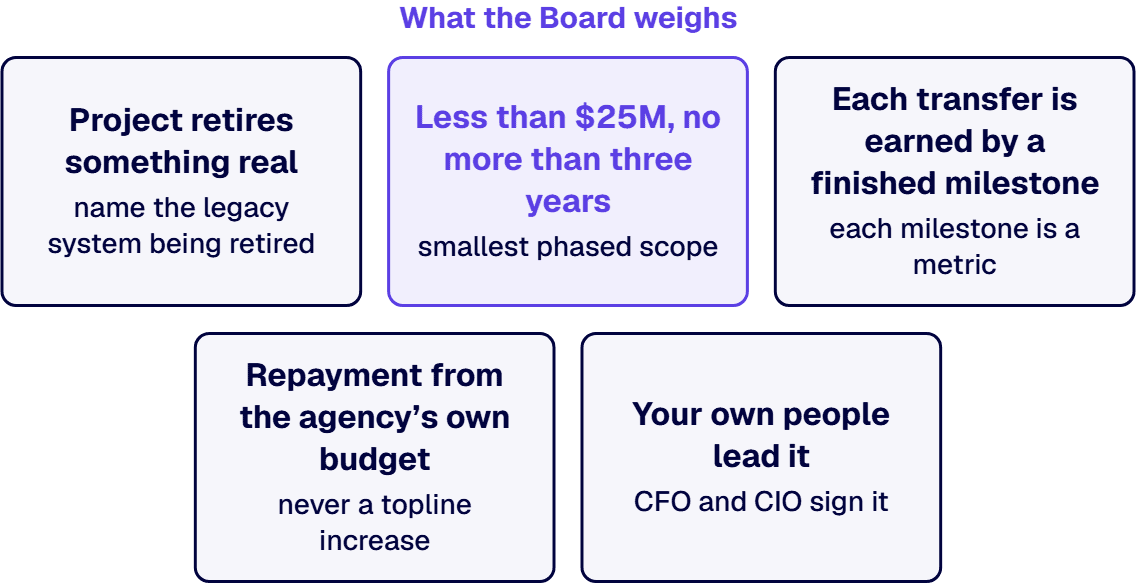
The same page asks for evidence: “Provide data-driven evidence that supports your approach, such as user research, market research, and cost analysis.” It also asks you to “Include quantifiable impact outcomes like enhancing customer experience, reducing administrative burdens, and cost savings or cost avoidance.”
TMF’s funding and repayment guidance says project teams follow their agency’s implementation of OMB Circular A-11 for cost estimating and OMB Circular A-131 for value engineering, and “Estimates must undergo appropriate due diligence and concurrence from the agency CFO Office prior to submission to the Board and consultation with OMB RMOs.” It adds that “GSA can provide assistance with completing the standard templates.” GSA’s Technology Modernization Fund page says of the program office: “We work with agencies to build strong business cases for their proposals from both a modernization and financial standpoint.”
Cost avoidance is the evidence TMF names, and it is measured before the proposal, not after. In one engagement for a federal agency, the finding came from an analysis of the current state rather than from the build. The IT Systems Analysis provided an alternative solution that saved the agency over $1.5 million in unnecessary development costs by identifying a cost-effective, off-the-shelf contract management system. That is an example of the baseline evidence TMF asks for, not a TMF project. The IT Systems Analysis Services for Enterprise Microsoft Environments page covers how a current-state baseline is produced.
Size the first proposal to the smallest phased scope that retires something measurable, with the baseline measured before the proposal is written.
If repayment is marked to be determined, the proposal is the one most likely to stall. TMF’s fit page says “Agencies should aim to repay the full amount of their investment.” and “Proposals with a higher repayment rate are considered more competitive.” The initial proposal template says “All proposals are expected to repay 100%.” TMF’s funding and repayment guidance says “Full repayment: TMF has historically operated under a full repayment model, and will continue to do so for projects that yield financial savings realized by the proposing agency.”
There is flexibility, and it is narrow. The fit page says “Flexibilities in repayment to address particularly urgent or complex needs will be considered on a case-by-case basis.” and “Under extremely rare circumstances, repayment exemptions are possible and require OMB and GSA senior leadership support.” The funding and repayment guidance adds: “When requesting partial repayment, agencies must indicate why the proposal cannot be made financially recoverable at the full repayment level.”
The same guidance sets the shape of the plan. “Reimbursement amounts should generally be spread proportionately across the reimbursement period and may not be disproportionately back-loaded to later years.” “Agencies may not plan to repay the TMF by requesting a topline increase in agency funding.” “A reimbursement amount is based on amounts actually transferred, not the total amount committed by the Board.” And “GSA, in coordination with OMB, will approve the terms of repayment.” Those four sentences come from TMF’s funding and repayment guidance.
TMF’s process page says “Your repayments to TMF begin within one year of the first transfer.” Under the codified MGT Act, the written agreement documents “the terms of repayment, which may not exceed 5 years unless approved by the Director” of OMB.
The funding and repayment guidance lists the ways an agency can fund repayment:
Name the account and the offsets that repay the Fund, year by year, before the initial proposal goes in. In a legacy Microsoft estate, look first at the licenses, hosting and support contracts of the system being retired.
If your plan puts one large transfer at the start, it does not match how the Fund pays out. TMF’s home page says “To best steward taxpayer dollars, agencies unlock funding transfers only as they complete project milestones.” Its process page says “Your first transfer follows the public announcement.” The same process page says “Additional transfers unlock as your team achieves project milestones.” The codified MGT Act requires, absent compelling circumstances the Administrator documents, “that such funds shall be transferred only on an incremental basis, tied to metric-based development milestones achieved by the agency through the use of rapid, iterative, development processes”.
TMF’s full project proposal Appendix A says “For phases with Funds Transfer, TMF funds will be released only if project expectations have been achieved.” It asks for a plan in which:
Make the first phase retire or replace something users notice, and write each milestone as a metric a Board member can check.
A proposal that reads like an outside firm’s plan fails a test TMF states in plain words. Its fit page says “Show that it is agency employees who drive and manage your TMF project, not contractors such as industry partners or other staff outside of your agency.” It also says “Demonstrate strong cross-organization executive sponsorship (CFO, CIO, and program leadership) and an empowered project lead, who can effectively own and guide the effort.”
The decision is not the agency’s either. TMF’s about page says “Proposals are vetted by a Board of federal technology executives who have seen what it takes for modernization to succeed.” Its process page says “The Board votes on whether to fund your proposal.”
Outside help can produce analysis, estimates and delivery capacity. The agency owns the proposal and the project. Name the agency’s project lead and in-house skills before naming any outside help.
The initial proposal is short on purpose, so you write the answers the Board tests first. TMF’s initial proposal template says “IPPs that exceed six pages won’t be considered.” It asks for:
Write the repayment and milestone answers first, because they are the ones the Board tests, then the problem statement.
A Microsoft-stack proposal will be asked how your agency avoids depending on whoever builds it. TMF’s funding and repayment guidance lists the question directly: “Market flexibility: How does this project reduce vendor lock-in (including services and tools)?” The codified MGT Act also requires that commercial products and services be incorporated “to the greatest extent practicable” in funded work.
Answer it with criteria, not with a platform or partner comparison: who holds the configuration, the data and the administration skills after go-live, and what it would take to change implementers. An i3solutions engagement does not produce managed-service ownership, a replacement for the internal team, open-ended scope expansion, or vendor lock-in. Show how the agency keeps the skills, data and configuration to run the result without the implementer.
For some modernizations the TMF is the wrong route this cycle, and saying so early saves a proposal team months. Read against the codified MGT Act, TMF’s fit page and its funding and repayment guidance, the wrong-route cases are these:
Whoever helps you, hold the work to the tests the Board applies. Drawn from TMF’s fit page, its funding and repayment guidance and its full project proposal Appendix A, ask for these:
No provider is named or compared here; the criteria are the comparison.
i3solutions sells and delivers an enterprise IT technology assessment of a Microsoft environment as a named engagement, comprising discovery, gap analysis and a future-state roadmap. For a modernization headed to the TMF, that work produces the current-state baseline and the roadmap the agency’s own team carries into its proposal or its IT working capital fund request. The i3 Risk and Roadmap Assessment ROI variant is a one-week structured engagement that produces a business case anchored on the specific environment, the specific compliance frameworks, and the specific executive-cycle timing. That business case is the agency’s input; the proposal remains the agency’s own.
Baseline depth is sometimes the whole point. On a different engagement for another federal agency, the work started with the current state. The solution began with a comprehensive IT systems analysis, involving a 15-month process of analyzing and mapping the agency’s existing business workflows and systems.
If the project is funded, i3solutions delivers the Microsoft modernization as a project, with embedded specialists where the agency’s team needs them. i3solutions is an SBA certified small business providing technical and professional services to US Federal Agencies, the DoD and the private sector. i3solutions has been a Microsoft partner since 1997 and has delivered 1,500+ implementations across aerospace and defense, financial services, and health sciences. Delivery is senior and US-based. i3solutions does not write, file or manage an agency’s TMF proposal; the agency leads it, and GSA’s program office helps with the templates. More on the advisory practice: Trusted IT Advisory & Consulting Services Tailored To Your Digital Transformation Goals.
If a legacy Microsoft modernization has lost the budget fight and the 2026 call has landed on your desk, decide first whether this cycle is realistic against the October 20 and December 11, 2026 dates in TMF’s 2026 call for proposals, then build the baseline, the phased plan and the repayment by account so the same business case serves the TMF or the agency’s IT working capital fund.
Not always, but full repayment is the aim. According to TMF, agencies should aim to repay the full amount of their investment, proposals with a higher repayment rate are considered more competitive, and all proposals are expected to repay 100%. According to TMF, flexibility is considered case by case, repayment exemptions are possible only under extremely rare circumstances, and an agency requesting partial repayment must indicate why the proposal cannot be made financially recoverable at the full repayment level.
In increments tied to milestones. According to TMF, the first transfer follows the public announcement and additional transfers follow as the team achieves project milestones. According to the MGT Act as codified at 40 U.S.C. 11301 note, funds are transferred only on an incremental basis tied to metric-based development milestones, absent compelling circumstances the Administrator documents.
According to TMF, competitive projects are less than $25M and take no more than three years to implement, and most of its investments do not exceed $40M and use a five year repayment timeline, though the Board may consider outliers.
According to TMF’s 2026 call for proposals, by October 20, 2026. TMF still encourages submissions after that date but cannot guarantee they will be considered for funding by the TMF Board prior to December 11.
According to the MGT Act as codified at 40 U.S.C. 11301 note, read on September 25, 2026, after December 11, 2026 the Administrator may not award or transfer funds from the Fund for any project that is not already in progress as of such date. This guide does not predict whether Congress changes that date.
No. According to TMF, agencies should show that it is agency employees who drive and manage the TMF project, not contractors such as industry partners or other staff outside the agency, with strong CFO, CIO and program sponsorship and a project lead who can own and guide the effort. This guide does not rule on who may help draft the proposal.

US-Based | Est. 1997
© i3solutions. All rights reserved.
US-Based | Est. 1997
© i3solutions. All rights reserved.


