
CMMC applicability is determined by the type of information a contract requires you to handle and by the clause that contract carries, not by company size or by a general deadline. Determine the information type in scope, identify the level that follows from it, confirm what the phase-in stage requires at the point your contracts renew or new work is bid, and work backward from the earliest contract date rather than from the program’s outermost date. The organizations that get caught are the ones that planned to the latest date rather than to their own first affected contract.
The requirement does not arrive as an announcement. It arrives inside a solicitation or an option year, printed in a clause, and by the time you read it there you need an answer rather than a project. What applies to your organization is not decided by your company size or by a single deadline on a calendar. It is decided by the kind of information your contracts require you to handle and by the clause each contract carries. That is knowable now, before the clause shows up, which is the whole point of reading this before you have to.
This is guidance on how the Cybersecurity Maturity Model Certification requirement is structured so you can locate yourself inside it. It is not legal or contractual advice, and where a regulatory date is still moving we say so rather than commit you to a number that ages badly.
CMMC does not apply to you because a general deadline passed. It applies because a specific contract tells it to. The mechanism is a contract clause. The Department of Defense finalized the CMMC Program in a rule at 32 CFR Part 170, published in the Federal Register on October 15, 2024 and effective December 16, 2024 (32 CFR Part 170, Federal Register doc 2024-22905). That rule defines the program: the levels, the assessment types, and the rollout. It does not by itself put a requirement into your contract.
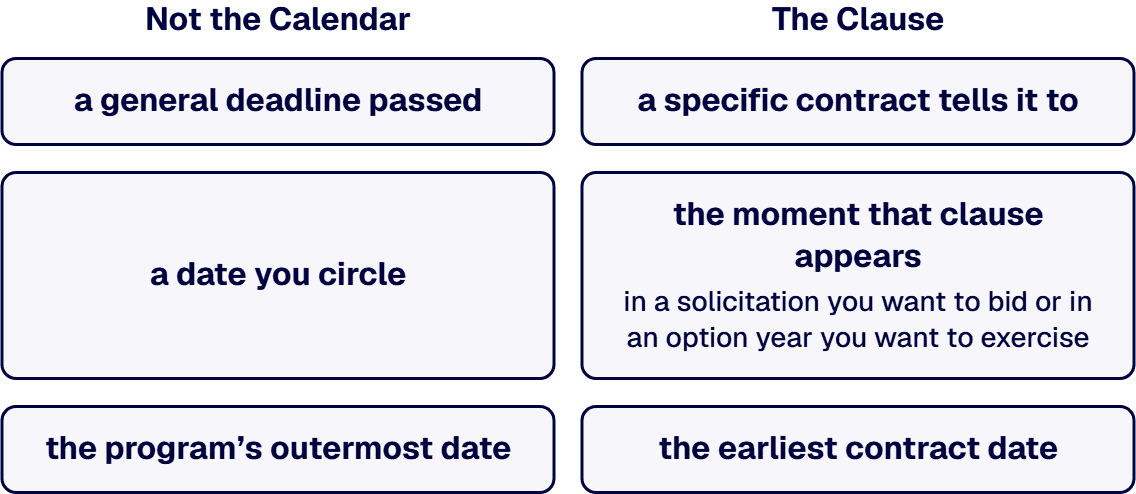
The requirement lands through acquisition. The DFARS clause 252.204-7021, “Contractor Compliance With the Cybersecurity Maturity Model Certification Level Requirements,” obligates a contractor to have and maintain a current CMMC status at the level the contracting officer specifies, for the duration of that contract (DFARS 252.204-7021, acquisition.gov). So the practical trigger is not a date you circle. It is the moment that clause appears in a solicitation you want to bid or in an option year you want to exercise. If you hold or pursue DoD contracts that involve Federal Contract Information or Controlled Unclassified Information, your job is to know which level that clause will carry before you see it, not after.
What the “final rule” means for you, then, is narrow and useful: the program is settled, the levels are fixed, and the countdown to seeing the clause in your contracts has started. It does not mean every contract carries it today.
The level is a function of the data, not of your revenue or headcount. Under 32 CFR Part 170 the program defines three levels, and the information type in scope points to one of them (32 CFR Part 170, Federal Register doc 2024-22905):
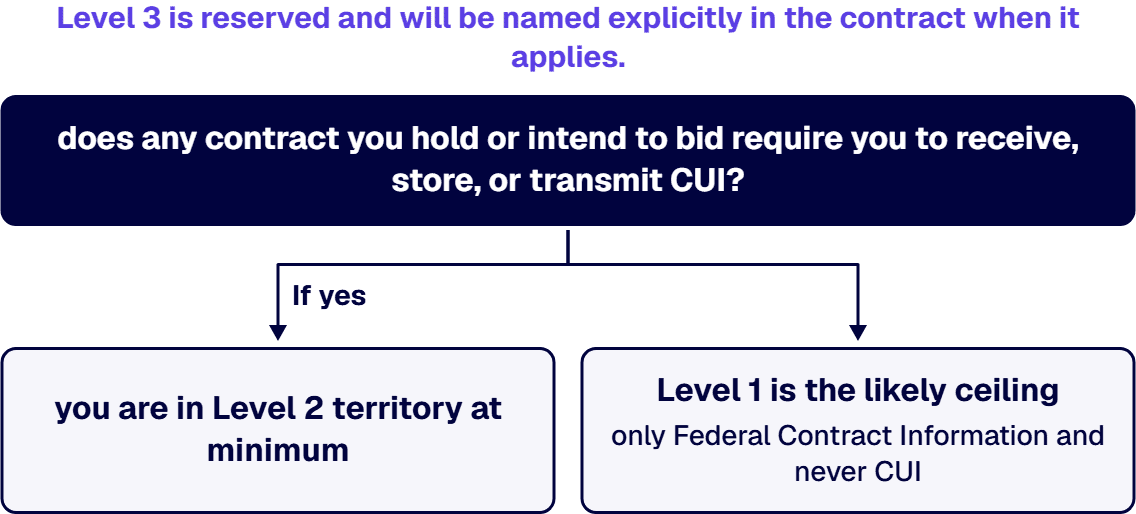
To place yourself, answer one question first: does any contract you hold or intend to bid require you to receive, store, or transmit CUI? If yes, you are in Level 2 territory at minimum, and 110 controls is your working number. If your contracts involve only Federal Contract Information and never CUI, Level 1 is the likely ceiling. Level 3 is reserved and will be named explicitly in the contract when it applies. The determination you can make today is which category your data falls into, because that is the input the clause will read from.
The Microsoft-environment question that usually follows, whether your Microsoft 365 tenant can hold the data at the level you need, is a separate decision with its own page. If that is where your uncertainty is, see whether Office 365 can be CMMC compliant.
The program does not switch on for everyone at once. 32 CFR Part 170 lays out a four-phase rollout, and each phase begins one calendar year after the phase before it (32 CFR Part 170, Federal Register doc 2024-22905). In broad terms the phases escalate what a contracting officer may require in a solicitation:
The date that matters is when the clock starts. Under the rule, Phase 1 begins on the effective date of the companion 48 CFR CMMC Acquisition rule, and each later phase begins one calendar year after the phase before it (32 CFR 170.3(e)). That acquisition rule, DFARS Case 2019-D041, was published on September 10, 2025 and took effect on November 10, 2025 (Federal Register doc 2025-17359), so Phase 1 began on November 10, 2025 and Phase 2 was scheduled for November 10, 2026. The 32 CFR program rule has been effective since December 16, 2024 (32 CFR Part 170, Federal Register doc 2024-22905). The DFARS clause text lives at acquisition.gov, and the DoD CIO CMMC program page carries the current schedule.
Two honest points follow from this. First, schedules in this program have shifted before, so any single date is a planning input, not a guarantee. Second, the shifting outer date is exactly the trap: the phase-in ceiling is not your deadline. Your deadline is set by your own first affected contract, and that can land well inside the phase-in window.
Most subcontractors underestimate this, because they assume the requirement stops at the prime. It does not. DFARS 252.204-7021 requires the prime to insert the substance of the clause into subcontracts and other contractual instruments whenever the subcontract involves processing, storing, or transmitting Federal Contract Information or Controlled Unclassified Information, and to flow down the correct CMMC level to those subcontracts consistent with 32 CFR 170.23 (DFARS 252.204-7021, paragraphs (f)(1) and (d)(1)(ii), acquisition.gov).
The practical consequence is that responsibility for compliance sits with the entity that handles the data, not only with the entity that signed the prime contract. If you are a subcontractor who touches CUI, you may need your own Level 2 status even though you never see the government contract directly. Do not wait for a prime to tell you your level. If you handle CUI on defense work, assume flow-down reaches you, and confirm the level with the prime rather than discovering it when an award is contingent on it.
The sequencing question is not “when is the deadline,” it is “when is my first affected contract.” Build the timeline from that date, not from the program’s outer edge. The steps in order:
There is an honest case for waiting, and it is worth stating plainly. If your earliest affected contract is genuinely far out, or if you are still confirming whether you handle CUI at all, spending on a certification assessment today can be premature. But waiting is a decision that comes with work, not a decision to do nothing. While you wait you should confirm your information type in scope, define your CUI boundary if you have one, and close the highest-risk gaps against NIST SP 800-171 Revision 2 so that when your first contract date resolves, the assessment is a confirmation rather than a scramble. The organizations that wait well are the ones that use the time; the ones that get caught are the ones that planned to the latest date and treated the interval as free.
By the time the clause appears in a solicitation you want, a specific set of things has to already be true. The clause requires a current CMMC status at the specified level for the duration of the contract, which means the status has to exist at award, not be in progress (DFARS 252.204-7021, acquisition.gov). Concretely, before you can bid you need:
If you do not meet the level the clause specifies, the consequence is contractual, not abstract: you are ineligible to be awarded that work, and on an award you already hold, a lapse in status is a compliance failure against the contract. That is why the timeline works backward from the contract date. When your uncertainty shifts from “which level and when” to “how do we get assessment-ready without disrupting operations,” that is a different job, and it lives on our guide to CMMC audit preparation.
It is mandatory when a contract requires it. CMMC is not a blanket obligation on every company; it becomes mandatory for a given contractor through DFARS clause 252.204-7021, which requires a current CMMC status at the level the contracting officer specifies for the duration of that contract (DFARS 252.204-7021, acquisition.gov). As the phase-in proceeds under 32 CFR Part 170, that clause appears in progressively more DoD solicitations, so for organizations handling FCI or CUI on defense work it becomes effectively unavoidable over time.
DFARS clause 252.204-7021, “Contractor Compliance With the Cybersecurity Maturity Model Certification Level Requirements,” is the clause that carries the CMMC requirement into a contract and specifies the level (acquisition.gov). It is distinct from the older DFARS 252.204-7012 safeguarding clause; 252.204-7021 is the one that ties the contract to a CMMC status.
The CMMC Program as established under 32 CFR Part 170 and implemented through the DFARS applies to Department of Defense contracts and to the subcontracts beneath them (32 CFR Part 170). It reaches an organization when it holds or pursues DoD work involving Federal Contract Information or Controlled Unclassified Information, including as a subcontractor through flow-down. It is not a general federal-wide certification imposed outside that acquisition path.
Companies in the defense supply chain that receive, store, or transmit Controlled Unclassified Information on DoD contracts are the ones that need a Level 2 certification assessment when their contract specifies it; companies handling only Federal Contract Information generally need a Level 1 self-assessment, which is affirmation rather than third-party certification. The determinant is the data and the clause, not the company’s size. Subcontractors are included where the requirement flows down under DFARS 252.204-7021 (acquisition.gov).
Under 32 CFR Part 170, the Affirming Official must submit an affirmation in the Supplier Performance Risk System upon completing the relevant self-assessment, certification assessment, or plan-of-action closeout, and annually thereafter following the Final CMMC Status Date (32 CFR Part 170, Federal Register doc 2024-22905). It is an annual, recurring obligation, not a one-time submission.
Not by that name. The term does not appear in 32 CFR Part 170 or in the DFARS CMMC and NIST SP 800-171 assessment clauses. What a solicitation can require is a current status. Under DFARS 252.204-7025, an offeror is not eligible for award without a current CMMC status in the Supplier Performance Risk System (SPRS) at the level the solicitation names, and a current affirmation of continuous compliance, for each contractor information system that will process, store, or transmit Federal contract information (FCI) or controlled unclassified information (CUI). Where DFARS 252.204-7019 applies, the offeror must have a current NIST SP 800-171 DoD Assessment, with its summary level scores posted in SPRS, to be considered for award.
You cannot be awarded that contract, task order, or delivery order: the contracting officer may not award to an offeror without a current CMMC status at the level the solicitation names. The same test applies at an option year or an extension of the period of performance, so a contract you already hold is exposed at its next option. The one bridge is a conditional status: under DFARS 204.7502(b)(2), Level 2 and Level 3 can sit in a conditional level for up to 180 days from the status date and award can still occur, while Level 1 needs a final status before award. An option exercise or period of performance extension needs that same current status under DFARS 204.7502(b)(1). i3solutions maps your Microsoft environment against CMMC Level 2 (110 controls), HIPAA administrative safeguards, and SOC 2 access control frameworks, producing audit-ready documentation that satisfies assessors, not just internal IT teams.
Enforcement started on November 10, 2025, when the 48 CFR acquisition rule took effect and Phase 1 began. Phase 2, which would have added third-party Level 2 (C3PAO) certification as a condition of award from November 10, 2026, was suspended on July 13, 2026. Until that suspension lifts, a solicitation can require only Level 1 (Self) or Level 2 (Self), and DFARS 252.204-7012 still requires you to protect covered defense information under NIST SP 800-171.
Once you know which level applies and when, the natural next questions are budget and execution: see what CMMC compliance actually costs, how a CMMC technology readiness assessment scopes the gap, and when to bring in CMMC technology consultants.

US-Based | Est. 1997
© i3solutions. All rights reserved.
US-Based | Est. 1997
© i3solutions. All rights reserved.


