Automation Resilience: Designing Power Platform That Survives Reorgs

Automation that survives a reorganization is built differently from automation that does not, and the difference is decided up front, not discovered after the reorg. The flow that dies when its builder changes teams was a personal project living in one person’s account and head. The flow that survives was an owned, governed, documented asset with a home that is not a single person. Resilience is an architecture and ownership property you design in, not luck you hope for. i3solutions has built Power Platform that stayed durable and maintainable across a federal defense agency of roughly 10,000 personnel and 180 locations precisely because it was owned and governed.
Most IT leaders have watched it happen: an automation that quietly became load-bearing goes dark after a reorg or a departure, and no one can fix it because no one but the person who left understood it. The reflex is to treat this as bad luck or a documentation failure. It is neither. It is the predictable result of how the automation was built, and the fragile version and the resilient version diverge at design time.
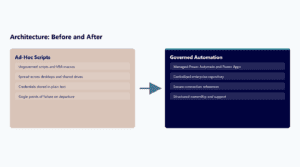
The fragile pattern is the common one. A maker builds something useful in their personal context. It works, people start depending on it, and it becomes important without ever becoming official. Then a reorg moves the maker, and the automation is orphaned: it lives in their account, the logic lives in their memory, there is no documentation and no other owner. It does not break loudly; it just stops being maintainable, and the first real change request reveals that no one can touch it safely.
The resilient pattern is a set of deliberate choices, and there are three that matter.
Ownership at the team level, not the person level. A resilient automation belongs to a team or a function, with a named owner role that survives any individual leaving. When the person moves, the ownership stays, because it was never theirs to take.
Managed environments separate from personal accounts. Load-bearing automation lives in a managed Power Platform environment, not in a maker’s default personal space. The environment is the home that persists through org changes, and it is also where governance and access control actually apply. i3solutions runs client Power Platform work on a multi-tenant Center of Excellence model with separate Dev, Test, UAT, and Production environments promoted through managed solutions.
Documentation and shared standards. An automation built to a standard, with its logic and dependencies documented, can be picked up by the next person. One built as a personal improvisation cannot, regardless of how good it is, because the knowledge to maintain it left with its author.
When light-touch is genuinely fine. A truly personal, disposable automation that no one else will ever depend on does not need this treatment, and forcing it through full governance is overhead for no benefit. The judgment is honest about which automations are load-bearing, because the failure mode is letting something important live as a personal project by default, never deciding it deserved a real home until it was too late.
What designed-in resilience looks like at scale is the proof. For a federal defense agency, i3solutions’ governed Power Platform stayed maintainable across roughly 10,000 personnel and about 180 locations, through the personnel turnover and organizational change that an operation that size always has. That durability was not luck; it was the direct result of team-level ownership, managed environments, and standards, the same three choices that keep a single automation alive through a single reorg. Resilience scales the same way it starts: it is designed in, or it is absent.
Key Takeaways
- Automation that survives reorgs is designed for it up front; the fragile version and the resilient version diverge at design time.
- The fragile pattern: a load-bearing automation living in one person’s account and memory, orphaned when they move.
- Resilience comes from three choices: team-level ownership, managed environments separate from personal accounts, and documentation to shared standards.
- Light-touch governance is fine for genuinely personal, disposable automations; the failure mode is letting load-bearing work live as a personal project by default.
- Designed-in resilience scales. (A governed Power Platform stayed maintainable across ~10,000 personnel and ~180 locations through normal turnover and change.)
Frequently Asked Questions
Why do automations break after a reorganization?
Because they were built as personal projects, living in one person’s account with the logic in their memory and no documentation or other owner. When the person moves, the automation is orphaned and stops being maintainable.
How do you make automation survive org changes?
Three design choices: assign ownership to a team or role rather than a person, put load-bearing automation in managed environments rather than personal accounts, and document it to shared standards so the next person can maintain it.
What is a managed environment and why does it matter?
A Power Platform environment separate from a maker’s personal space, where governance and access control apply. It is the home that persists through organizational change rather than disappearing with an individual.
Does every automation need this?
No. A genuinely personal, disposable automation no one will depend on does not. The judgment is being honest about which automations are load-bearing and giving those a real home before a reorg forces the issue.
Can this work at large scale?
Yes. A governed Power Platform stayed durable and maintainable across roughly 10,000 personnel and about 180 locations through normal turnover, because ownership, environments, and standards were designed in.
If automations in your environment have gone dark after departures or reorgs, the cause is usually design, not luck, and it is fixable going forward. We can assess which of your load-bearing automations are living as personal projects and lay out the ownership, environment, and documentation changes that make them survive the next reorg, without forcing genuinely disposable work through unnecessary governance.
About the Author
Michael Branson is Founder and COO, i3solutions. Connect with him on LinkedIn.