
Not as a yes or a no. The question usually arrives at the worst moment for a vague answer: an assessor has asked for the IA-2 evidence, and someone in the room has already said “MFA is on for everyone.” NIST SP 800-53 is “a catalog of security and privacy controls for information systems and organizations” (NIST SP 800-53 Rev. 5, CSRC), and a catalog does not select itself. What a given system has to implement comes from a baseline, and NIST publishes the baselines separately in SP 800-53B, which “provides security and privacy control baselines for the Federal Government” with one baseline for each system impact level: “low-impact, moderate-impact, and high-impact” (NIST SP 800-53B, CSRC). The impact level is not a preference either; FIPS 199 is the standard for “categorizing federal information and information systems according to an agency’s level of concern for confidentiality, integrity, and availability” (FIPS 199, CSRC). Multi-factor authentication is in the catalog by name, and NIST’s own SP 800-53 Rev. 5 definition is “An authentication system or an authenticator that requires more than one authentication factor for successful authentication” (NIST CSRC glossary, sourced to SP 800-53 Rev. 5). So the honest answer for an IAM program is conditional: MFA is a named control area you will be assessed against, the specific IA-2 enhancements that apply are chosen by your baseline and your tailoring rather than by a vendor feature list, and the thing that decides your assessment is narrower still. It is whether the tenant you actually run produces evidence an assessor can test.
Three NIST documents do three different jobs, and most arguments about MFA collapse them into one. The catalog enumerates controls. The baseline selects them. The categorization picks the baseline. Nothing in that chain issues a blanket requirement to any organization that has not first been categorized.
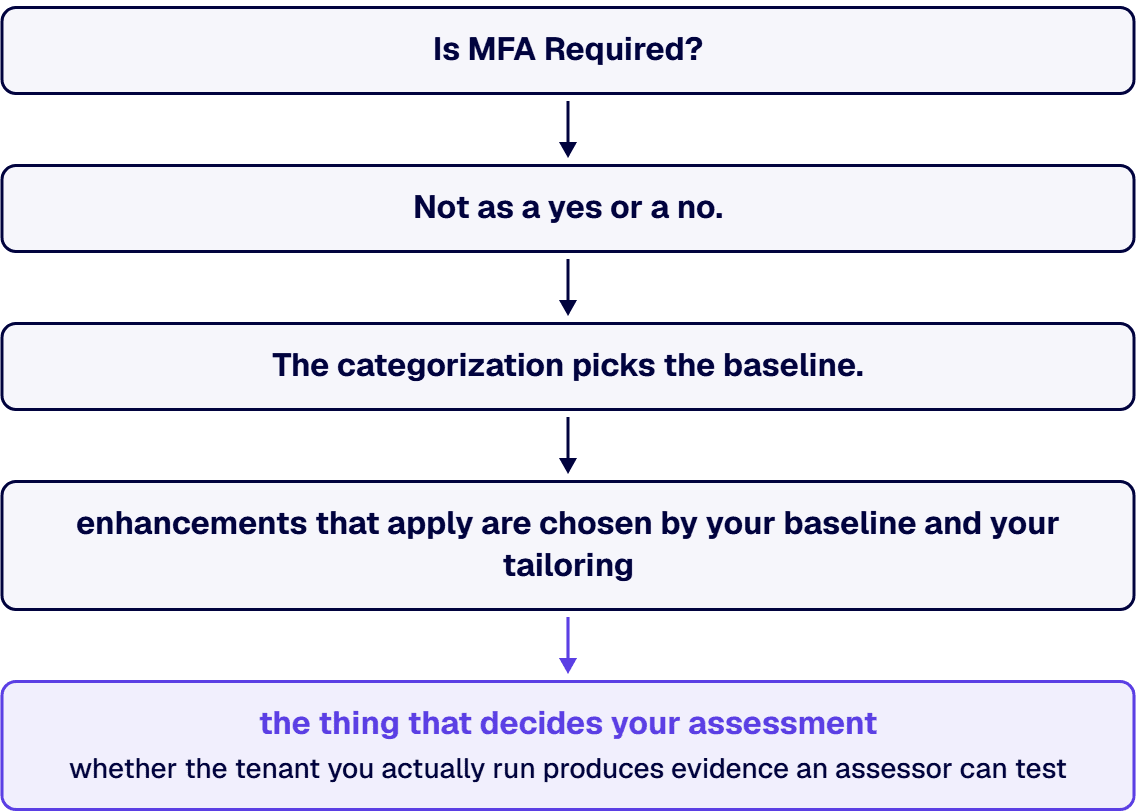
NIST describes the catalog as controls that “are flexible and customizable and implemented as part of an organization-wide process to manage risk” (NIST SP 800-53 Rev. 5, CSRC). SP 800-53B then supplies the selection layer, including “a privacy baseline that is applied to systems irrespective of impact level” and, for the security side, “tailoring guidance and a set of working assumptions that help guide and inform the control selection process” (NIST SP 800-53B, CSRC). Tailoring is why two organizations at the same impact level can defensibly land on different identity configurations and both pass.
One limit is worth stating rather than papering over, because approximating a control allocation is how a program acquires a finding it did not need. The table that says which IA-2 enhancements sit in which baseline is published inside SP 800-53B itself (NIST SP 800-53B, CSRC), not in a summary of it. Read the allocation there, against your own categorization, and treat any page that tells you which enhancements you owe without knowing your impact level as guessing. This page is not making that determination and neither should a comparison article.
NIST is precise about what counts. Its SP 800-53 Rev. 5 definition adds that “Multi-factor authentication can be performed using a single authenticator that provides more than one factor or by a combination of authenticators that provide different factors,” and that “The three authentication factors are something you know, something you have, and something you are” (NIST CSRC glossary, sourced to SP 800-53 Rev. 5). A password plus a security question is one factor twice. That distinction is not pedantry at assessment time; it is the difference between a control that is implemented and a control that is claimed.
The control identifiers themselves are worth knowing before you open a policy console. Microsoft’s Azure Policy regulatory compliance documentation for the standard names the parent control “Identification and Authentication (organizational Users)” as “NIST SP 800-53 Rev. 5 IA-2”, and lists the enhancements individually (Microsoft Learn, NIST SP 800-53 Rev. 5 regulatory compliance details):
Microsoft attaches a caution to that same mapping which deserves more attention than it gets. Policy definitions “may help you assess compliance with the control; however, there often is not a one-to-one or complete match between a control and one or more policies,” and “compliance in Azure Policy is only a partial view of your overall compliance status” (Microsoft Learn, NIST SP 800-53 Rev. 5 regulatory compliance details). A green compliance dashboard is a signal, not an assessment result. The vendor says so itself.
In Microsoft Entra ID the enforcement surface is Conditional Access, and its logic is simple to state and easy to get wrong. Microsoft describes it plainly: “a Conditional Access policy is an if-then statement of Assignments and Access controls,” and “Multiple Conditional Access policies can apply to an individual user at any time. In this case, all applicable policies must be satisfied” (Microsoft Learn, Build a Conditional Access policy). Policies compose. Exclusions compose too, and an exclusion added during a migration cutover is the single most common reason a tenant that believes it enforces MFA does not.
Factor strength is a separate lever from factor count. An authentication strength “is a Microsoft Entra Conditional Access control that specifies which combinations of authentication methods users can use to access a resource” (Microsoft Learn, Conditional Access authentication strengths). If your program has committed to phishing-resistant authenticators for privileged roles, that commitment lives in an authentication strength, not in the MFA toggle, and an assessor who knows the platform will ask which one is bound to which role.
Four configuration questions decide most identity findings, and none of them is answered by whether MFA is enabled:
The platform-side view of that same work is on our identity and access management solutions hub, and if your estate is standardized on Okta rather than Entra ID, the platform-specific treatment is on Okta authentication and identity. This page stays on the NIST framing.
An assessor does not grade your intentions. The artifact is the log. Microsoft states that “Microsoft Entra logs all sign-ins into a Microsoft Entra tenant, which includes your internal apps and resources” (Microsoft Learn, What are Microsoft Entra sign-in logs?), which is the good news. The trap is in which view you are reading: “The legacy sign-in logs experience only includes interactive user sign-ins” (Microsoft Learn, What are Microsoft Entra sign-in logs?).
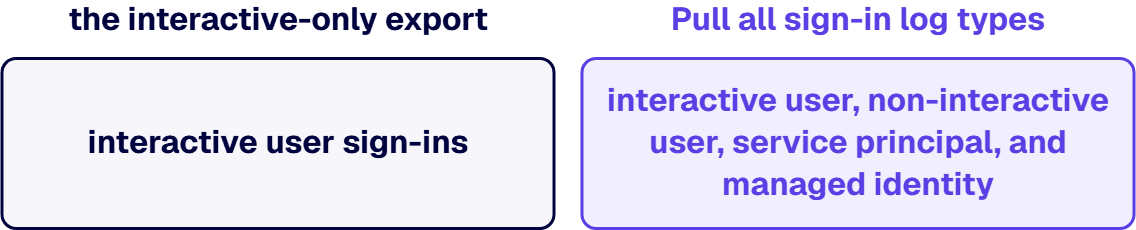
That single sentence explains a recurring pattern, and the pattern is worth naming inside your own program: the interactive-only export. A team pulls that one view, shows near-total MFA satisfaction, and never sees the non-interactive, service principal, and managed identity traffic where the exceptions live. The evidence package looked complete because the instrument only reported the population that was already compliant. Pull all four sign-in log types before you decide your identity control is evidenced, interactive user, non-interactive user, service principal, and managed identity, and confirm the retention window your tenant is actually keeping rather than assuming the platform default covers your assessment period.
Boundary questions change the answer again. If the data in scope pushes you toward a sovereign or restricted environment, the identity design and the evidence path both change, which is the territory covered on GCC High and sensitive data protection. If your driver is a contract rather than an authorization, the cost side of the adjacent framework is laid out on CMMC compliance cost.
The i3solutions Federal Compliance Assessment evaluates a client tenant against NIST SP 800-53 and CMMC using automated tenant configuration scripts and a 42-point security checklist. Scripted evaluation matters here for one reason: identity configuration is distributed across Conditional Access, the authentication methods policy, role assignments, and the log surfaces above, and a manual read of any one console will miss the interaction between them.
i3solutions engages its Federal Compliance Assessment when the scope spans a FedRAMP Moderate or FedRAMP High boundary, or when the client operates in a GCC High tenant. Below those thresholds the identity work is the same discipline at a smaller scale, and the governance context sits under enterprise governance and compliance solutions.
i3solutions advises clients on federal compliance posture as its own assessment rather than as a restatement of Microsoft’s documentation, including whether SharePoint Online meets NIST 800-53, whether Azure Government is required under the DoD Cloud Computing SRG, and whether a CMMC gap assessment is needed to bid. That is the practical difference between a system integrator that has to live in the tenant afterward and a reseller summary, and it is also where the boundary has to be stated out loud.
Advising on posture is not certifying posture. i3solutions does not certify, accredit, authorize, or attest any client’s compliance, and it holds no authorization to operate, no FedRAMP authorization at any level, and no DoD impact level accreditation of its own. Certification and authorization decisions belong to your assessor and your authorizing official. Any firm that offers to make your tenant compliant by asserting its own accreditation is describing something that does not exist. If you are evaluating firms rather than controls, the vendor-qualification angle is on hire an IAM implementation firm for GovCon, and the Power Platform side of federal compliance work is on hire Power Apps federal compliance consultants.
SP 800-53 is a control catalog rather than a mandate list. NIST describes it as a catalog of security and privacy controls whose controls are flexible and customizable and implemented as part of an organization-wide process to manage risk. Which controls apply to a specific system comes from the baseline in SP 800-53B, and which baseline applies comes from the FIPS 199 categorization of that system. Multi-factor authentication appears in the catalog as named IA-2 enhancements (NIST SP 800-53 Rev. 5, CSRC; enhancement titles per Microsoft Learn, NIST SP 800-53 Rev. 5 regulatory compliance details), so for a categorized federal system the question is not whether MFA is in scope as a control area but which enhancements your baseline selects and how you tailored them.
The parent control is IA-2, Identification and Authentication for organizational users, and the multi-factor requirements sit in its enhancements. Microsoft’s regulatory compliance documentation (Microsoft Learn, NIST SP 800-53 Rev. 5 regulatory compliance details) is the Azure Policy mapping for the standard. There the privileged-account enhancement is NIST SP 800-53 Rev. 5 IA-2 (1), which Microsoft titles Multi-factor Authentication to Privileged Accounts, and the non-privileged one is NIST SP 800-53 Rev. 5 IA-2 (2), which Microsoft titles Multi-factor Authentication to Non-privileged Accounts. The same Azure Policy mapping lists IA-2 (5) for individual authentication within group authentication and IA-2 (12) for acceptance of PIV credentials. Privileged and non-privileged accounts are deliberately separate enhancements, which is why a tenant-wide MFA statement rarely answers the control.
No. Microsoft states that its policy definitions may help you assess compliance with a control, that there often is not a one-to-one or complete match between a control and one or more policies, and that compliance in Azure Policy is only a partial view of your overall compliance status. Enforcement in Entra ID also composes across multiple Conditional Access policies, an authentication methods policy, and any exclusions you have configured. Compliance is demonstrated by evidence that your configuration produced the required outcome for the identities in scope, not by a feature being switched on.
No, and no vendor can, i3solutions included. Advising on posture is not certifying posture. i3solutions does not certify, accredit, authorize, or attest any client’s compliance, and it holds no authorization to operate, no FedRAMP authorization at any level, and no DoD impact level accreditation of its own. What is on offer is bounded and specific. The i3solutions Federal Compliance Assessment evaluates a client tenant against NIST SP 800-53 and CMMC using automated tenant configuration scripts and a 42-point security checklist. Certification and authorization decisions belong to your assessor and your authorizing official.
Two artifacts, together, for every population in scope: the policy configuration and the sign-in evidence. Microsoft logs all sign-ins into a tenant, but the legacy sign-in logs experience only includes interactive user sign-ins, so an export from that view can show near-total MFA satisfaction while the non-interactive, service principal, and managed identity traffic goes unexamined. That is the gap. Pull all four sign-in log types, interactive user, non-interactive user, service principal, and managed identity, keep the documented exclusion list for break-glass accounts, and confirm the retention window your tenant is actually keeping rather than assuming the platform default covers your assessment period.

US-Based | Est. 1997
© i3solutions. All rights reserved.
US-Based | Est. 1997
© i3solutions. All rights reserved.


