
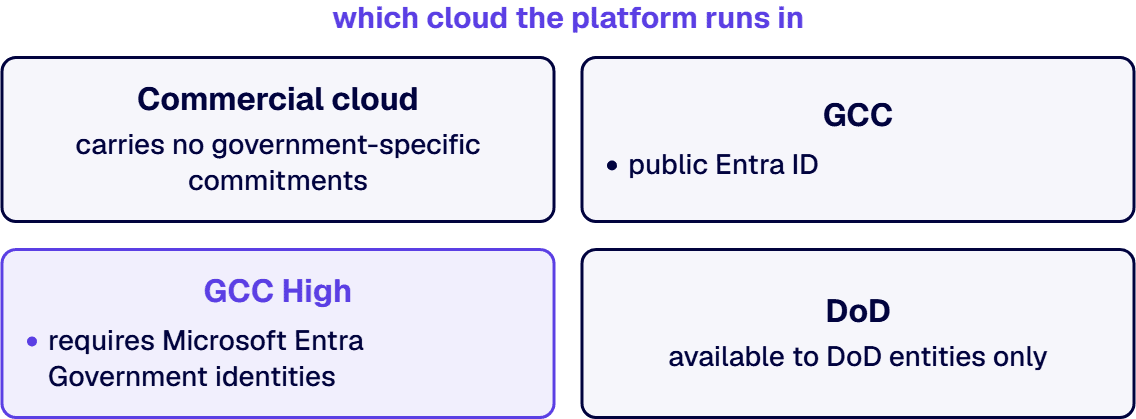
Hire a firm that has delivered Power Apps inside a government cloud boundary, because the first decision on a federally regulated Power Apps program is not an app decision at all: it is which cloud the platform runs in. Microsoft operates Power Apps in four distinct environments, and the compliance ceiling is set before the first screen is built. Commercial cloud carries no government-specific commitments. Power Apps US Government GCC is built to FedRAMP High and DoD DISA IL2 with support for CJIS requirements. GCC High aligns to DISA SRG IL4, requires Microsoft Entra Government identities, and is the environment Microsoft operates so defense contractors can meet ITAR commitments and DFARS acquisition regulations. The DoD environment aligns to IL5 and is available to DoD entities only (Microsoft Learn, Power Apps US Government service description, accessed August 2026). A consultant who cannot walk you through that decision with your data types on the table is not a federal compliance consultant, whatever the proposal says.
Most organizations arrive at this hire in one of two postures: an authorization deadline with apps already built in the wrong cloud, or a program not yet started that nobody wants to build twice. The vetting checklist below works for both, because the discipline being vetted is the same.
The environment decision. Everything inherits from it: identity (public Entra ID in GCC versus Entra Government in GCC High), data residency (US Government customer content is stored in US datacenters with access restricted to screened US-citizen personnel), available connectors, and which authorizations your assessor can inherit. Choosing wrong is expensive in both directions: commercial for CUI is a finding, and GCC High for a workload that never touches controlled data buys cost and feature lag for nothing. Our comparison of GCC High versus GCC and the GCC High migration checklist cover the decision in depth.
The boundary discipline. Power Apps can reach almost anything through connectors, and that reach is the compliance risk. Third-party connectors move data to systems outside the accreditation boundary, where the platform’s compliance commitments do not follow. Federal-grade Power Apps work therefore starts with DLP policies that partition connectors into business and non-business groups per environment, an environment strategy that keeps regulated workloads out of the default environment, and a review gate before any new connector reaches a production app.
The evidence layer. An Authority to Operate is granted on evidence, not intent. The platform side (FedRAMP artifacts, DISA provisional authorizations) is Microsoft’s to provide and your agency reviews it; the application side is yours: who can run the app, where its data lives, which flows touch it, and how changes move to production through application lifecycle management. i3solutions delivery includes ALM practices with Power Platform pipelines or Azure DevOps integration, environment separation strategies, and change control processes, because those are precisely the artifacts an assessor asks to see.
1. The environment recommendation in writing, with reasoning. Which of commercial, GCC, GCC High, or DoD, and why, mapped to your actual data types: CUI, ITAR-controlled technical data, CJIS, or none of the above. If the firm’s answer does not change when your data types change, it is a template.
2. Named federal delivery at scale. Ask what they have run inside a government boundary, at what scale, and what governed it. i3solutions deployed Power Platform across a federal defense intelligence command spanning 10,000 personnel and 180 locations, and runs a governed Power Platform for a federal defense agency at that same scale, which works because it is governed, not despite it. That delivery depth comes from the broader i3solutions Power Platform development services practice, which spans app development, automation, and governance.
3. A DLP and environment design, not just app screens. The proposal should name the environment strategy and the connector policy that will hold your apps, before it names features. Compliance lives in that machinery; the app merely inherits it. This is the same discipline that separates governed platforms from shadow IT, covered in our treatment of citizen developer governance.
4. Framework fluency in your language. NIST 800-171 for CUI in nonfederal systems, the FedRAMP baseline your agency inherits, CMMC if you sit in the defense supply chain. i3solutions runs delivery against named control families across CMMC, HIPAA, SOC 2, and NIST 800-171, producing artifacts auditors can review, and our teams maintain dedicated compliance specialists whose audit trails and controls map be written in your assessor’s framework, not its own methodology’s vocabulary.
5. US-based delivery. For ITAR-scoped work this is not a preference, it is a requirement: access by foreign persons is itself a controlled event. Ask where every person on the delivery team sits and what the firm’s screening practice is. i3solutions was co-founded 30 years ago around US-based expert teams delivering across the Microsoft stack, and is a Microsoft Partner.
6. Licensing path fluency for government clouds. Power Apps US Government plans are sold as per-user and per-app government plans through government channels, and the Cloud Solution Provider channel is not available for GCC High. Feature parity with commercial also has documented exceptions. A consultant who prices your program from the commercial pricing page has not done this before.
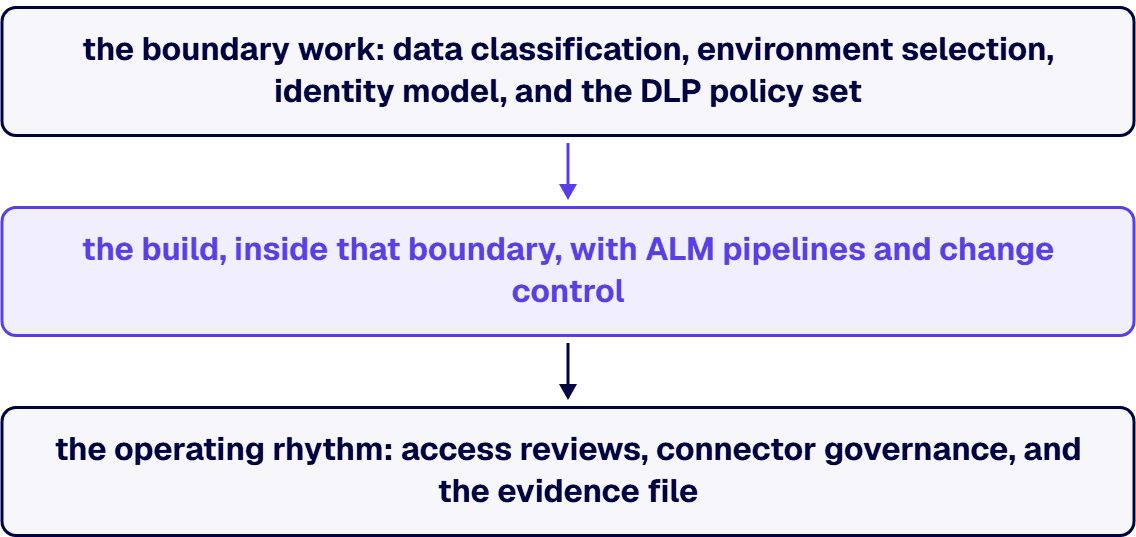
A defensible federal Power Apps engagement runs in three phases. First, the boundary work: data classification, environment selection, identity model, and the DLP policy set, produced as written artifacts your authorizing official can review. Second, the build, inside that boundary from day one, with ALM pipelines and change control rather than a compliance pass at the end; retrofitting compliance onto a finished app is where federal Power Apps programs go to die. Third, the operating rhythm: access reviews, connector governance, and the evidence file that keeps the next assessment an update rather than an excavation. If you are also weighing platform choices upstream of this work, our Power Apps development practice and CMMC technology readiness services are the two doors into it.
Power Apps US Government is designed to support FedRAMP accreditation at the High impact level, and Power Apps has been authorized as a service within the Azure Government FedRAMP ATO; agencies can review the artifacts through the FedRAMP Marketplace in support of their own ATO decisions. Commercial Power Apps does not carry the US Government environment’s commitments, which is why the environment decision comes first.
The decision turns on your data classification. GCC is built to FedRAMP High and DISA IL2 and supports CJIS requirements. GCC High aligns to DISA SRG IL4, uses Entra Government identities, and is the environment Microsoft operates for ITAR commitments and DFARS requirements, which is why defense contractors handling controlled technical data land there. Making this call against your actual data inventory is the first deliverable of a competent engagement.
For workloads with no government-regulated data, yes, with ordinary governance. For CUI, ITAR, or CJIS data, the US Government environments exist precisely because the commercial platform does not carry those commitments. The expensive failure mode is discovering this after the app is built, when migration means rebuilding connections, identities, and any connector the sovereign cloud does not offer.
No. Third-party connectors move your data to systems outside the Power Apps US Government infrastructure, and Microsoft’s compliance and data protection commitments do not extend to them. This is why DLP policy design, not app review, is the load-bearing compliance control in Power Apps: it decides which connectors can ever appear in a regulated environment.
US federal, state, local, tribal, and territorial government entities, plus organizations that handle government-regulated data such as ITAR technical data or CJIS law enforcement data, subject to Microsoft’s validation of eligibility, which can require sponsorship by a government entity. The DoD environment is available to DoD entities only. Eligibility is revalidated at contract renewal.
A written boundary design: your data classified, the environment named with reasoning, the identity model, the DLP policy set, and the licensing path through government channels. It is short, it is reviewable by your authorizing official, and everything built afterward inherits its accuracy. A firm that wants to start building screens first is optimizing for its burn rate, not your authorization.

US-Based | Est. 1997
© i3solutions. All rights reserved.
US-Based | Est. 1997
© i3solutions. All rights reserved.


