
By Justin Bowen, Sr. Vice President, Delivery Services, i3solutions
Justin has spent more than 15 years at i3solutions and more than 25 years leading project, program, and product delivery across complex technology environments. His work centers on turning strategy into governed execution, aligning technical teams and stakeholders, managing delivery risk, and guiding Microsoft 365, SharePoint, Power Platform, cloud, data, automation, and custom application programs through measurable production outcomes.
Microsoft 365 governance consulting designs and implements the controls, roles, policies, and audit-ready documentation that let regulated enterprises operate Microsoft 365 inside CMMC, NIST 800-171, HIPAA, SOC 2, and DFARS obligations. A credible engagement runs four phases (assessment, design, implementation, operational handoff) with named deliverables and exit criteria per phase.
Microsoft 365 governance consulting designs and operates the controls, roles, policies, and audit-ready documentation regulated enterprises need. It is what lets them run Microsoft 365 inside frameworks like CMMC, NIST 800-171, HIPAA, and SOC 2 without the compliance-mapping gap that stalls internal teams.
i3solutions is a Microsoft Partner, with 1,500+ completed
Microsoft platform implementations across regulated enterprises in aerospace and defense, financial services, and healthcare. Our Enterprise Delivery Assurance model is designed to land governance programs on-time, in-scope, and in-production, with the audit-ready documentation set produced as engagement deliverables rather than reconstructed under audit deadline.
Microsoft 365 governance consulting is hired for one of two reasons. The first is the compliance-mapping problem: internal teams know what CMMC or HIPAA require in the abstract, but translating those obligations into the specific Purview labels, Conditional Access policies, retention rules, role assignments, and documentation that pass an audit is sustained specialist work that does not match the bandwidth of a security team running its day job. The second is the inherited-tenant problem: governance was never formally designed, configuration has drifted, and audit-readiness is unknown until the first auditor asks for evidence.
Compliance frameworks describe outcomes; Microsoft 365 describes features. Translating between them is specialized work. CMMC Level 2 carries 110 controls across 14 domains. Mapping those to a Microsoft 365 deployment means deciding which Purview sensitivity labels carry the controlled unclassified information markings, how Conditional Access policies enforce access from compliant devices only, what retention labels satisfy the DFARS clause-specific record-keeping requirements, and how the audit log retention configuration produces the evidence an assessor will request. NIST Special Publication 800-171 carries the same obligations under different framing. HIPAA introduces the BAA and PHI considerations that change which Purview classifiers and DLP policies are appropriate. SOC 2 adds the trust-services-criteria documentation expectations.
Internal teams know the frameworks and know the platform. The work that goes wrong is the connective tissue: the policy library that names which framework requirement each Purview label satisfies, the role matrix that shows which named individual approves an exception, the runbook that documents the operational steps that maintain the controls between audits. Producing those artifacts at the depth an auditor accepts is the work that hires governance consulting. The companion piece on Microsoft 365 compliance for regulated enterprises covers the framework-specific control mappings in depth.
An aerospace and defense client engaged i3solutions after a CMMC Level 2 pre-assessment surfaced inconsistencies between the Purview retention configuration and the DFARS clause-specific record-keeping requirements; the engagement produced a control-mapped policy library and audit-ready documentation set that cleared all assessment findings before the formal Level 2 evaluation.
The second hiring trigger is structural rather than knowledge-based. The Microsoft 365 tenant was deployed years ago, often during a fast migration. Teams were created on demand, SharePoint sites multiplied, sensitivity labels were enabled but never made mandatory, retention policies were configured for an older compliance posture, Conditional Access was applied but exceptions accumulated, external sharing was permitted with policies that never received second-pass review.
A new IT director, CISO, or CIO inheriting that environment cannot say with confidence whether the tenant is audit-ready under any specific framework. Inventory exists in the M365 admin centers; defensible interpretation does not. The internal team is competent, but governance was never formally designed, never written down, and never tested against an obligation. The first auditor request, the first board question about CMMC posture, or the first proposed Copilot deployment surfaces the gap.
Engaging governance consulting at this point is structural work, not remediation work. The deliverable is not fix-the-violations. It is the design, the documentation, and the operational discipline that lets the internal team run the program independently after the engagement closes.
A registered investment advisor with multi-billion-dollar AUM engaged i3solutions after a SOC 2 Type II observation flagged Conditional Access policy gaps in the Microsoft 365 tenant; the engagement produced a renewed role matrix, an exception-handling change-control process, and an audit-evidence directory structure that closed the observation in the next examination cycle.
A defensible Microsoft 365 governance consulting engagement runs four phases. Each phase produces named deliverables. Each phase has exit criteria the internal team can verify before the next phase begins. The structure is deliberate: it makes the engagement scopable in writing before the statement of work signs, makes mid-engagement scope changes legible, and makes the operational handoff at the end testable.
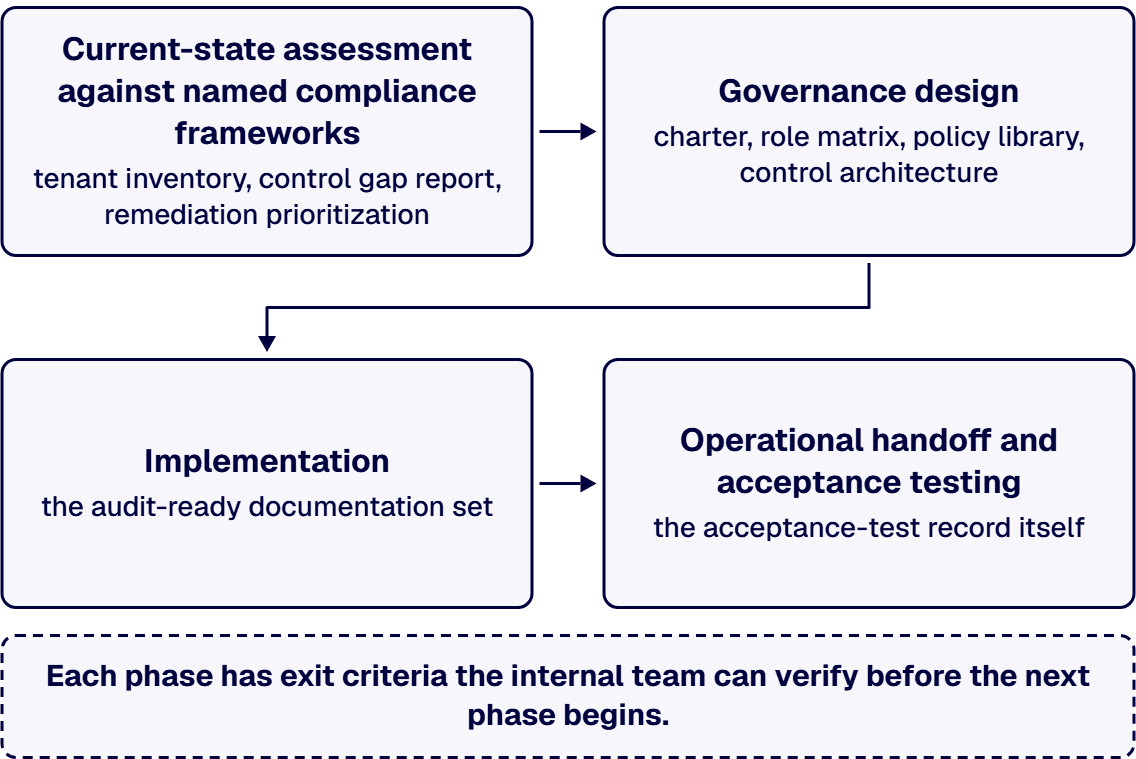
Phase 1 inventories the existing tenant configuration and assesses it against the specific compliance frameworks the organization is obligated to (or expects to be obligated to within the next 18 months). For an aerospace and defense environment, that is typically CMMC Level 2, NIST 800-171, and DFARS 252.204-7012. For a healthcare environment, HIPAA plus the relevant state-level breach-notification frameworks. For financial services, SOC 2 Type II plus FFIEC examination expectations. The assessment produces a control-by-control gap report, a risk-ranked remediation list, and a documented baseline against which Phases 2 and 3 measure progress.
The deliverables at Phase 1 close are: tenant inventory, control gap report, remediation prioritization, and the engagement roadmap that proposes specific Phase 2 design decisions. Exit criteria: the internal team and consultant agree on which controls are in-scope, which are out-of-scope (and why), and which framework-specific requirements drive Phase 2 design decisions.
Phase 2 produces the governance design itself. The charter names the program, its sponsoring executive, its operational owner, and the framework obligations it implements. The role matrix names every individual or function with authority over governance decisions, what decisions they own, and what escalation path applies when authorities conflict. The policy library catalogs every Purview sensitivity label, retention policy, DLP policy, and Conditional Access rule, mapped to the specific framework requirement each implements.
The control architecture is the technical design that the policy library describes operationally: how Purview, Conditional Access, retention, audit log configuration, eDiscovery, and external-sharing controls interact at the platform level. The Phase 2 deliverable set is the design package that Phase 3 implements against. Exit criteria: every charter section, role, policy, and control is named, written, and reviewed by the internal team before implementation begins.
Phase 3 implements the Phase 2 design in the live tenant. Sensitivity labels are deployed and made mandatory for the document classes the design specifies. Conditional Access policies are activated against the named user populations and device-compliance criteria. Retention labels are applied to the SharePoint sites, mailboxes, and Teams channels covered by the framework-specific record-keeping requirements. DLP policies are tuned and deployed against the egress paths the design names. Audit log configuration is set to the retention window the framework requires, with the alert patterns the engagement design specified.
Phase 3 also produces the audit-ready documentation set as engagement deliverables. That set typically includes the policy library mapped to framework controls, the role matrix with named individuals, the control architecture diagram, the operational runbook, and the audit-evidence directory structure that an assessor can navigate. The documentation is produced inside the engagement, not reconstructed under audit deadline. Exit criteria: every Phase 2 design element is implemented, named, and documented, and the internal team can produce evidence for any control without consultant intervention.
Phase 4 transfers operational ownership from consultant to internal team. The runbook delivered in Phase 3 is operationalized: the internal team runs the documented procedures while the consultant observes and corrects. Acceptance testing covers a representative sample of operational events (an exception request, an audit-evidence request, a policy revision, a stakeholder onboarding) with the internal team performing each independently.
Phase 4 closes when the internal team can produce evidence for an assessor request, modify a policy under change-control, and onboard a new in-scope system without consultant intervention. The engagement deliverable at close is the acceptance-test record itself: a written log of every operational scenario tested, every gap surfaced, and every remediation applied. Engagements that skip Phase 4 produce programs that drift within six months because the operational discipline never transferred.
i3solutions’ senior consultants design the governance charter, role matrix, and policy library, then implement across Purview, Conditional Access, retention, and DLP.
Partner evaluation for regulated buyers turns on three dimensions. None of them are visible from a partner’s marketing surface. Each requires the buying team to ask specific questions and listen for specific answers.
The first dimension is whether the partner has delivered governance programs in environments that match the buyer’s specific regulatory obligations. A partner with extensive Microsoft 365 implementation experience in mid-market commercial environments is not the same partner as one who has produced CMMC-compliant Purview deployments for defense contractors, or HIPAA-compliant retention designs for hospital systems, or SOC 2-compliant audit-evidence configurations for financial services.
Ask the partner to name three specific engagements in which they implemented governance against the framework you are obligated to, and to describe the specific deliverable artifacts produced. Partners with regulated-environment delivery experience produce specific answers (the names of the framework controls, the names of the artifacts, the depth of the audit-evidence package). Partners without it produce general answers about Microsoft 365 experience and Microsoft Solutions Partner badging. The latter pattern predicts the failure mode where Phase 1 stalls because the consultant cannot translate framework requirements into specific design decisions.
This is borrowed expertise in the specific sense that the buyer is purchasing pattern recognition from someone who has done this work many times. After 1,500+ Microsoft platform implementations across regulated verticals, the structural patterns repeat: the same three or four compliance-mapping mistakes, the same handful of inherited-tenant drift shapes, the same role-matrix authority conflicts. A regulated-environment partner has seen the catalogue. The buyer is not paying for novel thinking; the buyer is paying for the partner to recognize which structural pattern this engagement matches and to apply the response that worked in the previous instances.
The second dimension is whether the partner thinks in operating-model terms (charter, roles, policies, control architecture, runbook) or thinks in tool-deployment terms (configure Purview, enable Conditional Access, set retention). Tool-deployment literacy is necessary but not sufficient. Governance-program literacy is what produces the artifacts an auditor accepts at depth and what produces an internal team that can operate the program after handoff.
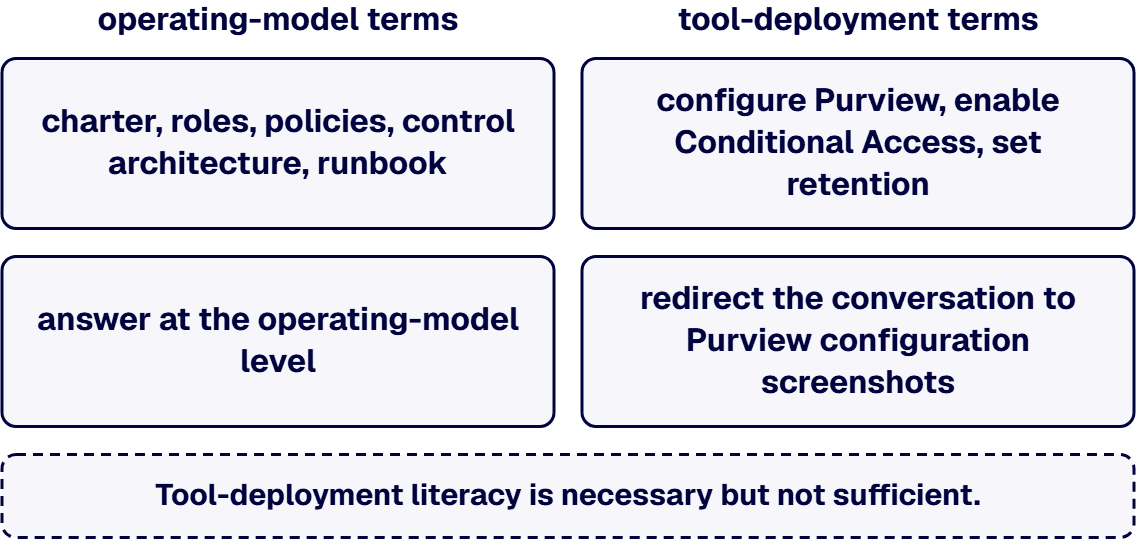
Ask the partner to walk through their proposed governance charter structure, their proposed role matrix template, and their approach to writing policies that map to specific framework controls. Partners with governance-program literacy answer at the operating-model level (the charter sections, the role-matrix dimensions, the policy-library structure). Partners limited to tool-deployment literacy redirect the conversation to Purview configuration screenshots, Conditional Access policy templates, and retention policy wizard walkthroughs. The redirect is the signal.
The third dimension is how the partner thinks about Phase 4. Engagements that fail to transfer operational ownership produce programs that drift within six months. The drift looks like: the internal team cannot answer auditor questions without re-engaging the consultant, policy revisions get deferred because the change-control discipline never transferred, exception requests pile up because the role matrix is treated as a document rather than as authority, and the audit-ready documentation set gets stale because no one owns its maintenance.
Ask the partner to describe the runbook they delivered to a comparable regulated client, what acceptance testing covered, and how the internal team performed against the runbook in the first 30 days of independent operation. Partners who treat handoff as a structured phase produce specific answers; partners who treat handoff as a closing email produce general answers about training sessions and documentation wikis. The latter pattern predicts the drift.
Cost framing for Microsoft 365 governance consulting resolves into four drivers. Tenant complexity is the primary driver: a single-geography tenant with a few hundred users and a clean migration history scopes differently from a multi-geography tenant with tens of thousands of users, multiple acquisition integrations, and a decade of configuration drift. Regulatory framework scope is the second driver: a CMMC-only engagement is narrower than a CMMC plus HIPAA plus SOC 2 engagement. Current-state documentation quality is the third: an environment with reasonably current documentation enters Phase 1 with much of the inventory already produced; an environment with no documentation enters Phase 1 with the inventory as the primary deliverable. Organization size is the fourth: the role matrix, policy library, and operational runbook scale with the user population and the number of business units the program covers.
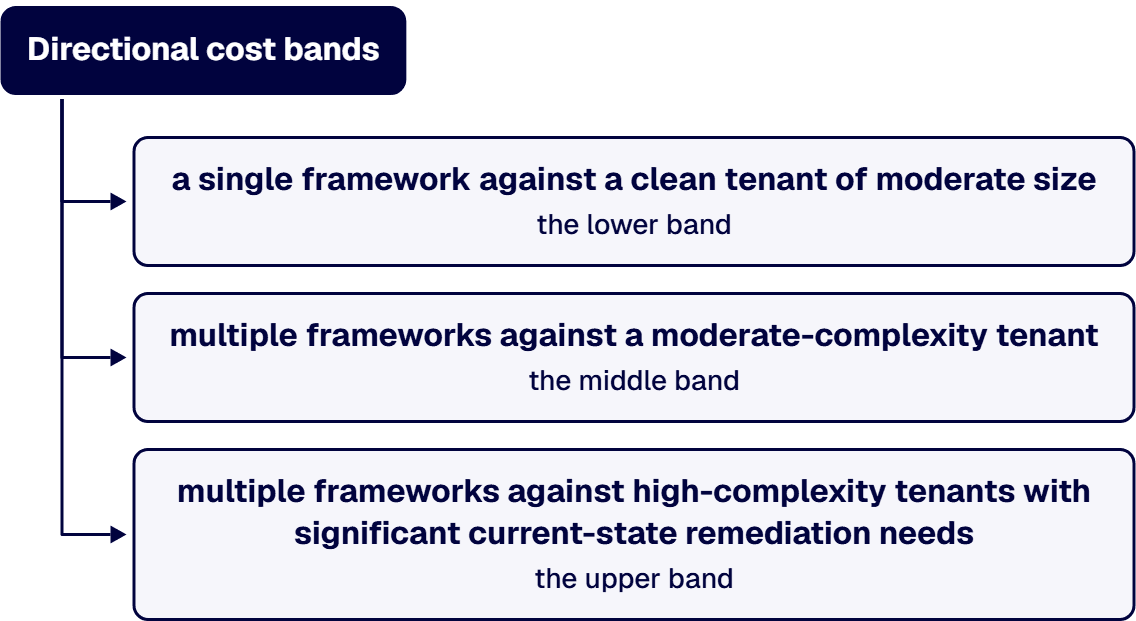
Directional cost bands tend to fall into three structural shapes. Engagements scoped to a single framework against a clean tenant of moderate size sit at the lower band, with Phase 1 and Phase 2 commonly absorbing most of the engagement effort. Engagements scoped to multiple frameworks against a moderate-complexity tenant sit at the middle band, with Phase 3 implementation effort growing relative to design effort. Engagements scoped to multiple frameworks against high-complexity tenants with significant current-state remediation needs sit at the upper band, with all four phases substantial. The buyer’s internal case typically benefits from running the cost conversation in this driver-band-shape format rather than in single-number form, because the band shape is what the executive sponsor needs to evaluate the engagement against the budget envelope.
Microsoft licensing scopes separately from engagement cost. Microsoft 365 E3 versus E5 versus E5 Compliance changes which Purview, Conditional Access, and audit-log capabilities are available; the engagement design depends on the license tier the organization runs on. Buyers building the internal case should price the engagement and the licensing as two distinct lines, because they are two distinct decisions made by two distinct approval paths in most regulated enterprises.
Phase-boundary structure also makes mid-engagement stop points explicit. A buyer can scope Phase 1 as a discrete engagement, take the control gap report and the remediation prioritization to the executive sponsor, and decide whether to proceed into Phase 2 with the same partner, split Phase 2 across an internal team and partner, or pause until budget or organizational readiness improves. The structure is deliberately stopable at each phase boundary; engagements that bury phase transitions inside a single fixed-price commitment remove this optionality and shift risk to the buyer.
Pressure-test the framework scope, phase boundaries, and directional cost bands with our senior delivery leads before the recommendation goes to your sponsor.
Microsoft 365 governance consulting at regulated enterprises is rarely a single-buyer decision. The recommendation typically passes through five to seven stakeholders: the IT director or CISO who scopes the engagement, the security or compliance leader who owns the audit outcome, the CFO or finance partner who approves the spend, the audit team that will eventually evaluate the controls, and the executive sponsor who signs the contract. Stakeholder questions tend to be predictable. Anticipating them shortens the internal review cycle.
Questions the audit team will ask. Which control identifiers does the engagement design against, and how is the evidence configuration produced? What does the audit-ready documentation set look like at the end of Phase 3? How does Phase 4 verify the internal team can produce evidence for an assessor request without consultant intervention?
Questions the CFO or finance partner will ask. What are the directional cost bands, what drives the variance, and at what phase boundaries can the engagement stop? What is in scope versus out of scope, and what does Microsoft licensing (separate from engagement cost) add to the total?
Questions the executive sponsor will ask. What is the audit-readiness outcome the engagement commits to, and how is it verified? Who on the internal team owns the program after handoff, and what does the partner do if the team needs help in the first 30 days? What does the engagement leave behind that the next IT director can pick up cleanly?
Questions the security or compliance leader will ask. Which framework controls does the design implement, and how are exceptions documented? What is the policy-revision change-control process the runbook establishes? How are exception approvals routed when the role matrix shows a conflict between security ownership and compliance ownership?
A defensible engagement structure answers each of these questions in writing before the statement of work is signed.
If you need a clear picture of where your Microsoft 365 tenant stands on governance, an assessment is the practical starting point.
Cost framing for a Microsoft 365 governance consulting engagement centers on four drivers: tenant complexity (number of geographies, business units, and existing Microsoft 365 footprint), regulatory framework scope (single-framework versus multi-framework, with multi-framework engagements requiring more cross-mapping work), current-state documentation quality (a clean tenant with current documentation costs less to assess than an inherited tenant with no operational baseline), and organization size (headcount and stakeholder review surface area). Directional bands fall into three structural shapes: single-framework against a clean moderate-size tenant at the lower band; multi-framework against a moderate-complexity tenant at the middle band; multi-framework against a high-complexity tenant with significant remediation at the upper band. Microsoft licensing scopes separately and should be priced as a distinct line item. The buyer’s internal case typically benefits from running the cost conversation in driver-band-shape format rather than in single-number form, because the band shape is what the executive sponsor needs to evaluate the engagement against the budget envelope.
Microsoft 365 governance consulting typically includes current-state assessment against named compliance frameworks (CMMC, NIST 800-171, HIPAA, SOC 2, DFARS), governance design (charter, role matrix, policy library, control architecture), implementation across Purview, Conditional Access, retention, DLP, and audit log configuration, and operational handoff with acceptance testing. Named deliverables sit at each phase boundary; the audit-ready documentation set is produced inside the engagement rather than reconstructed under audit deadline.
Internal IT can implement Microsoft 365 governance, and many organizations do. The differences that show up under audit pressure are the artifact depth, the framework-mapping rigor, and the operational discipline transfer. Internal teams know the frameworks and know the platform; the work that goes wrong is the connective tissue (the policy library that names which framework requirement each Purview label satisfies, the role matrix that shows authority routing, the runbook that documents operational steps between audits). Producing those artifacts at depth is sustained specialist work that does not match the bandwidth of a security team running its day job.
Engagement duration tracks the same drivers as cost. A single-framework engagement against a moderate-size tenant with reasonable current-state documentation typically completes Phase 1 and Phase 2 in a quarter, Phase 3 in another quarter, and Phase 4 acceptance testing within the subsequent quarter. Multi-framework engagements against complex tenants with significant current-state remediation needs run longer, with Phase 1 alone potentially absorbing a quarter of effort. The phase boundaries are the natural pause points for re-scoping if the engagement uncovers issues the original scope did not anticipate.
Internal IT is the right answer when the team has the framework expertise, the platform expertise, the artifact-production capacity, and the sustained bandwidth to produce the audit-ready documentation set at depth, and when the executive sponsor is comfortable with the internal team owning the audit outcome. Partner engagement is the right answer when one or more of those conditions does not hold, when the inherited-tenant problem applies (governance was never formally designed and current-state documentation is incomplete), or when a specific compliance deadline makes sustained external delivery capacity load-bearing. The decision is rarely binary in practice; many regulated enterprises split the work, with the partner owning Phases 1 and 2 and the internal team owning Phases 3 and 4 with partner oversight.
Complete Microsoft 365 Governance Framework (companion, the framework-level reference that this engagement implements against)
Microsoft 365 Compliance for Regulated Enterprises (companion, the framework-specific control mappings that Phase 1 assesses against)
Power Platform Governance: The New Shadow IT Firewall (adjacent, covers the Power Platform governance scope that interacts with the M365 governance program in regulated enterprises)

US-Based | Est. 1997
© i3solutions. All rights reserved.
US-Based | Est. 1997
© i3solutions. All rights reserved.


