
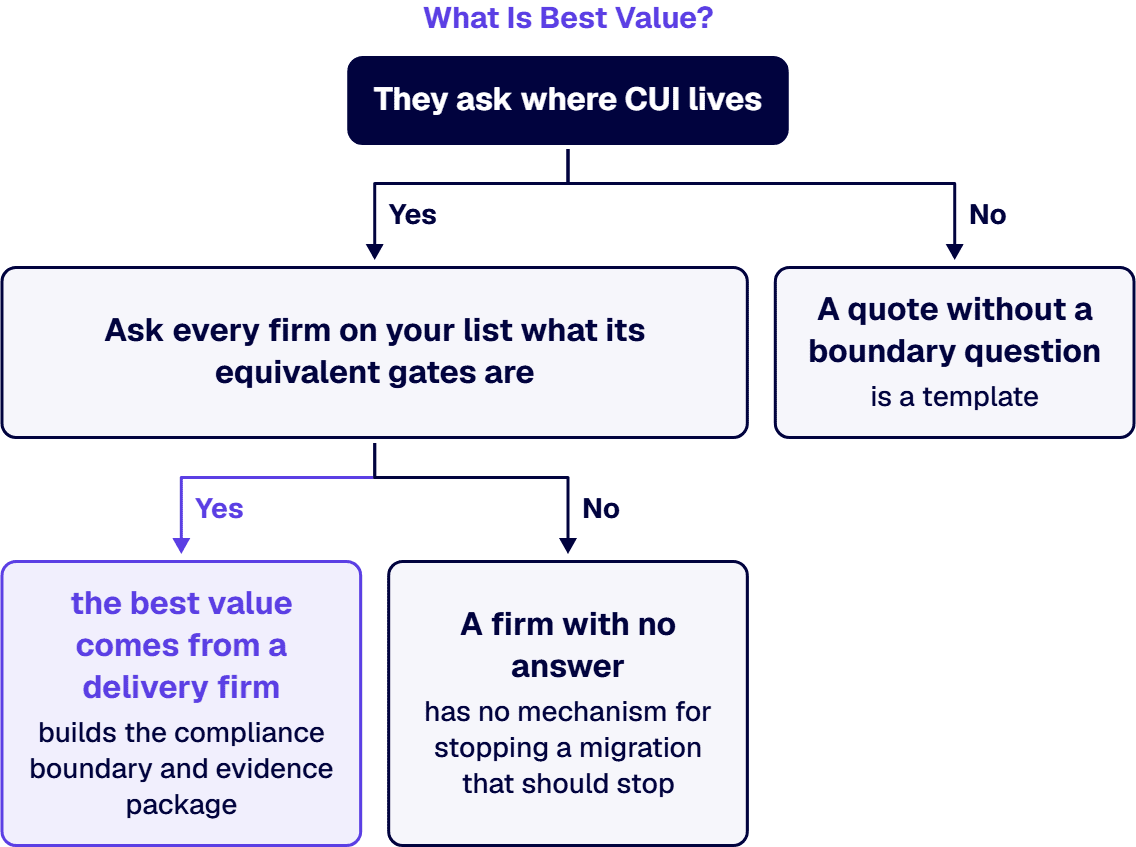
For a government contractor, the best value comes from a delivery firm that builds the compliance boundary and the evidence package as part of the implementation, rather than a staffing supplier billing hours or a reseller optimizing the license order. Value in this market is the total cost of a governed implementation over three to five years, not the rate card: it includes the environment decision, the rework you avoid, the audit evidence you can produce on demand, and whether US-based people can lawfully work on the data at all. Firms that quote only build hours are cheaper on the bid sheet and more expensive by the first affirmation, because DFARS 252.204-7012 and the CMMC self-assessment still have to be evidenced by somebody, and that work costs more retrofitted than designed in. i3solutions delivers under a partner-led engagement model with named accountability and governance that holds up under a client audit, as distinct from contractor-only staff augmentation.
Government contractors evaluate the phrase every week from the other side of the table. The Federal Acquisition Regulation’s best value continuum states that “An agency can obtain best value in negotiated acquisitions by using any one or a combination of source selection approaches”, and that “The less definitive the requirement, the more development work required, or the greater the performance risk, the more technical or past performance considerations may play a dominant role in source selection.”
The tradeoff process is more direct still: “A tradeoff process is appropriate when it may be in the best interest of the Government to consider award to other than the lowest priced offeror or other than the highest technically rated offeror”, with the discipline that “The perceived benefits of the higher priced proposal shall merit the additional cost, and the rationale for tradeoffs must be documented in the file in accordance with 15.406.”
Read those two sentences as a buyer of Microsoft implementation services and the criteria fall out on their own. A Microsoft estate carrying controlled unclassified information is not a clearly definable commodity requirement. Performance risk is high, because the failure mode is a finding rather than a bug. So technical approach and relevant past performance under the same regulatory conditions should dominate price, and if you pay more, you should be able to write down what the extra bought. That last part is the step most shortlists skip.
If your question is the general one, which Microsoft partner type fits a regulated enterprise, the decision framework on choosing among Microsoft consulting companies covers it. This page is about the part that framework does not price: what changes when your contracts, and not only your policies, set the requirements.
A commercial Microsoft implementation and a government contractor’s Microsoft implementation are the same technical work wrapped in a different obligation. The obligation is where the money goes, and every one of these is knowable before you sign anything.
None of the five is exotic. All five are routinely absent from a fixed-fee implementation quote, which is why competing quotes look so unlike one another, and why the cheapest one is usually the one that priced the fewest of them.
The most expensive mistake in this market is not a bad build. It is a correct build in the wrong boundary, discovered after the data has moved.
Two decisions create almost all of it. The first is choosing the environment on the basis of the strictest thing anyone in the company does, rather than on where CUI actually sits. An i3solutions engagement shows the shape. The assessment recommended partial-variant adoption with email and document storage on GCC High and the remainder of the productivity suite on Commercial; the contractor’s licensing economics improved materially relative to a full GCC High migration. That is a scoping outcome rather than a discount, and no rate card produces it.
The second is carrying an ungoverned permission model across the migration. Whatever oversharing exists in the source tenant arrives intact in the destination, except that it now sits inside a boundary where a permission mistake is an assessment finding rather than an inconvenience. The remediation is the same work either way. Doing it before the cutover is a work package. Doing it afterward is an incident with a corrective action plan attached.
This is also where the difference between a governed engagement and a task order shows up in artifacts. i3solutions produces three named artifacts across an Azure Government or AWS GovCloud engagement: an Architecture Fit Assessment at discovery, a Landing Zone Blueprint and Compliance Matrix at design, and a Migration Risk and Cutover Runbook at execution, each one a mandatory gate check before the engagement moves to the next phase. Ask every firm on your list what its equivalent gates are and what happens when one does not pass. A firm with no answer has no mechanism for stopping a migration that should stop.
This is the cheapest thing on your list to check, and the ground moved in July 2026 on the CMMC program page at dodcio.defense.gov. Ask each firm to state the current requirement out loud before you read anybody’s proposal.
That page currently states that “On July 13, 2026 the DoW suspended the implementation of Phase II of the CMMC and established a CMMC reform task force”, that “All Phase I self-assessment requirements remain firmly in place”, and that “During this period the DoW will enforce cybersecurity compliance with NIST 800-171 Rev 2 through self-assessments and select government-led assessments.”
Two things follow, and they point in different directions from the way most vendors are currently selling.
A firm still sequencing your Microsoft roadmap against a third-party assessment date is working from a deck written before July. A firm that cannot state the difference between the two levels will not scope your boundary correctly either. On i3’s side of that line, i3solutions advises clients on federal compliance posture as its own assessment rather than as a restatement of Microsoft’s documentation, including whether SharePoint Online meets NIST 800-53, whether Azure Government is required under the DoD Cloud Computing SRG, and whether a CMMC gap assessment is needed to bid. Advising on posture is not certifying it, and any firm blurring those two is describing a service no consultancy can sell you.
The instrumentation matters more than the calendar. Microsoft describes Purview Compliance Manager as “a solution that helps you automatically assess and manage compliance across your multicloud environment”, and separates “Microsoft managed controls: controls for Microsoft cloud services, which Microsoft is responsible for implementing” from “Shared controls: these are controls that both your organization and Microsoft share responsibility for implementing”. The shared column is what your implementation firm is being paid to close, and it is the column a licensing conversation never reaches.
A shortlist of five for this work will hold five firms selling five different products. Comparing their prices before separating their products is what stalls the decision at the second meeting.
Two capability questions separate the fifth category from the first four faster than any reference call. Ask whether the firm has worked at the higher impact levels: i3 installs and helps configure applications inside IL4 and IL6 government cloud environments and other government networks. Then ask what the compliance deliverable is called, because a firm that has done this before has a name for it. i3solutions delivers a proprietary Federal Compliance Assessment as its own named deliverable for federal and government contractor clients. The i3solutions Federal Compliance Assessment evaluates a client tenant against NIST SP 800-53 and CMMC using automated tenant configuration scripts and a 42-point security checklist. i3solutions engages its Federal Compliance Assessment when the scope spans a FedRAMP Moderate or FedRAMP High boundary, or when the client operates in a GCC High tenant.
Two i3solutions bands are relevant here, and they price different objects. Read the labels before setting either against a competitor’s number.
On the persistent assumption that a government boundary carries a surcharge, i3’s position is narrower and more useful than the marketing version. Analytics engagements delivered inside a government cloud boundary are the same type of services work as commercial engagements; the difference is additional compliance steps, not a pricing premium. That statement is about analytics engagements and about the type of work, not a guarantee about a final invoice. More compliance steps can mean more hours. What it rules out is the idea that a government boundary is a category justifying a different rate.
The inputs that move any of these numbers are countable before you talk to anyone: how many users sit inside the CUI boundary, whether GCC High eligibility has been validated, how many SharePoint sites need permission remediation, whether Purview and the higher compliance licenses are already held, how many teaming partners need external access, and whether an affirmation date is already on a contract. Of those, permission remediation scope is the one that scales with the size of the estate. The rest are fixed costs you pay once.
A reseller and a staffing supplier will both quote this work, and both will be selling something other than governed delivery. Six requirements separate the firm you want, and each one is testable in the first conversation, before any proposal exists.
The data decides, not the size of the company: what you hold, where it sits, and what your contracts require you to protect. Microsoft positions GCC High and DoD for the Department of Defense “as well as contractors holding or processing DoD controlled unclassified information (CUI) or subject to International Traffic in Arms Regulations (ITAR)”, and positions the Government Community Cloud for “contractors holding or processing data on behalf of the US Government”. The practical answer is a boundary rather than a company, and an i3solutions engagement shows it. The assessment recommended partial-variant adoption with email and document storage on GCC High and the remainder of the productivity suite on Commercial; the contractor’s licensing economics improved materially relative to a full GCC High migration. Any firm that answers this question before looking at your data map is guessing.
No, and reading it that way is expensive. The CMMC program page at dodcio.defense.gov states that “This action does not eliminate the requirement for companies to protect information in accordance with DFARS clause 252.204-7012”, and that Level 2 requires “A self-assessment every three years, with annual affirmation of compliance with the 110 security requirements in NIST SP 800-171 Revision 2.” What the pause changed is the assessment mechanism, not the control set. The tenant work, the permission remediation, and the evidence chain are identical either way, and doing them while schedule is available is the only version that is cheap.
The hours can be higher and the work is the same category of services work. What adds hours is named and countable: eligibility validation, boundary definition, control mapping, and the evidence package. i3’s attested position is narrow and specific: analytics engagements delivered inside a government cloud boundary are the same type of services work as commercial engagements; the difference is additional compliance steps, not a pricing premium. Treat any quote that prices a government boundary as a different class of service, at a different rate, as a claim the firm should have to explain. An honest cost difference shows up as hours against named compliance tasks, and those tasks should be listed on the quote.
Convert both to the total cost of a governed outcome, including the work the staffing quote leaves with you. A rate card prices a person. A fixed-scope engagement prices a result: fixed-scope engagements for architecture documentation, governance framework build, or bounded modernization typically run $85,000 to $245,000 against signed scope and signed delivery schedule. The comparison only becomes meaningful once you have added the architecture decisions, the compliance documentation, and the remediation that an hourly model expects your own team to absorb. If nobody on your side has capacity to own those, price them into the staffing quote before you compare the two numbers.
The obligation reaches you through the contract rather than directly. DFARS 252.204-7012 requires the prime to “Include this clause, including this paragraph (m), in subcontracts, or similar contractual instruments, for operationally critical support, or for which subcontract performance will involve covered defense information, including subcontracts for commercial products or commercial services, without alteration, except to identify the parties.” In practice your prime sets the evidence format and the timeline, and your Microsoft environment has to produce what they ask for on their schedule. Scope the smallest defensible boundary that satisfies the flowdown, and get the reporting artifacts specified in writing before the build starts.

US-Based | Est. 1997
© i3solutions. All rights reserved.
US-Based | Est. 1997
© i3solutions. All rights reserved.


