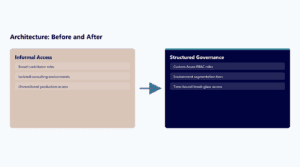
Hybrid Offshore vs Dedicated US Team

Aerospace and defense programs run under constraints most enterprise IT never faces: security requirements, export controls, and strict audits turn delivery decisions into compliance decisions.
Hybrid offshore is often the default for programs needing Power Platform development services scaled fast, but it adds risk around secure data access, export boundaries, and architectural accountability. The question is how to justify a US-based Microsoft partner over offshore for A&D, and the answer is enterprise governance, security alignment, and architectural ownership.
Quick Summary:
Hybrid offshore delivery in aerospace and defense may promise savings but raises compliance, governance, and architectural-control risk. Dedicated US-based Microsoft teams align better with ITAR, DFARS, and CMMC and simplify audit defensibility. Weigh cost, risk, and operational impact, not just staffing.
i3solutions is entirely U.S.-based. Every i3solutions employee is U.S.-based, every i3solutions project is U.S.-based, and every technology i3solutions delivers is U.S.-based.
Key Takeaways:
- Hybrid offshore adds governance, access, and compliance complexity across Microsoft environments.
- Dedicated US-based teams give consistent architectural ownership and easier A&D alignment.
- Even non-production data can indirectly expose regulated workflows.
- Offshore savings are often offset by security controls and audit preparation.
- In A&D, a single misstep can cost prime or DoD confidence.
- Judge delivery on governance, efficiency, and audit defensibility.
The Aerospace & Defense Context: ITAR, DFARS, CMMC, and Prime Requirements
Aerospace and defense operate under layered frameworks: International Traffic in Arms Regulations (ITAR), Defense Federal Acquisition Regulation Supplement (DFARS), and Cybersecurity Maturity Model Certification (CMMC) control where data resides and who can touch it, reaching beyond engineering data to collaboration, reporting, and integrations. The real risk is offshore Microsoft developers accessing controlled defense data, even indirectly.
Why A&D Is Different from Generic “Regulated Industries”
Aerospace and defense add constraints beyond typical regulated industries:
- Export-controlled technical data is limited to authorized US persons under ITAR.
- Defense contracts often mandate DFARS-aligned security controls.
- Contractors must prove cyber maturity through CMMC assessments.
- Primes may impose additional requirements on subcontractors.
Data and Workflows That Implicitly Touch Controlled Information
Controlled data also lives in operational systems and tools connected to core platforms:
- Engineering change workflows tied to product configuration data
- Supply chain and vendor documentation integrated with defense programs
- Reporting dashboards referencing program deliverables
- Document management systems containing technical specifications
- Application logs or telemetry referencing controlled processes
What “Hybrid Offshore” Usually Means in Practice
Hybrid offshore is pitched as balancing cost and governance, but it adds complexity that is hard to manage under regulation, which matters when CIOs weigh offshore teams for Microsoft Power Platform.
Onshore PM/Architect with Offshore Delivery Pool
A small US leadership layer defines architecture while offshore engineers build, so intent and compliance rules must translate across distributed teams, a gap that introduces risk in A&D.
The Assumption That “Non-Export” Data Can Be Cleanly Isolated
Hybrid delivery assumes regulated data can be isolated, but Power Platform, SharePoint, and Azure applications integrate across systems, so even development or testing may reference workflows tied to controlled programs.
Hybrid Offshore vs. Dedicated US Teams in A&D Microsoft Environments
| Security & Governance Requirement | Hybrid Offshore | Dedicated US Teams |
| Environment Segmentation | Separate tenants or isolated sandboxes required; must prove no indirect pathways to controlled data | Standard environment controls; no cross-border segmentation needed |
| Identity & Access Monitoring | Continuous monitoring of offshore personnel access; must validate personnel eligibility under ITAR | Standard access governance; US-person eligibility straightforward to confirm |
| Data Masking & Test Data | Production data must be scrubbed, masked, or replaced with synthetic datasets before offshore use | Standard test data practices; no export control filtering required |
| Audit Evidence Preparation | Must document access approvals, development boundaries, and monitoring controls across multiple locations and teams | Evidence trail is consolidated; single-location delivery simplifies documentation |
| Incident Response Ownership | Distributed ownership across time zones; potential ITAR jurisdiction questions if controlled data is exposed | Clear accountability; exposure incidents remain within US jurisdiction |
| Ongoing Compliance Validation | Continuous validation that segmentation, access controls, and data boundaries hold as environments evolve | Routine compliance checks aligned with existing security frameworks |
| Prime & DoD Review Readiness | Requires extensive documentation to explain and defend the delivery model under stakeholder scrutiny | Delivery model is straightforward to explain and defend without conditional justifications |
Risk Assessment of Hybrid Offshore in A&D Microsoft Environments
Because Microsoft 365, Azure, and Power Platform interconnect, CIOs must weigh not just who writes code but who can indirectly reach systems tied to controlled programs.
Identity, Access, and Data Flow in Microsoft 365, Azure, and Power Platform
Modern Microsoft environments rely on identity-based access across interconnected services:
- Microsoft Entra ID controls user identities and access policies
- Microsoft SharePoint or document repositories store technical documentation
- Microsoft Power Automate workflows trigger cross-system actions
- Microsoft Dataverse stores operational data for business applications
Hidden Paths Where Controlled Data Can Leak (Logs, Test Data, Configurations)
Controlled information also surfaces in overlooked places:
- Application logs capturing operational activity or workflow details
- Test datasets copied from production environments
- Configuration files referencing endpoints, suppliers, or processes
- Integration mappings showing how systems connect
In one case, a mid-size defense manufacturer had a hybrid offshore team build Power Automate supply chain workflows in a supposedly isolated environment. Test datasets held metadata referencing active program identifiers and supplier relationships under a controlled contract, and workflows had inherited connection strings to production SharePoint libraries with export-controlled documentation. Because the team included non-US persons, the exposure raised ITAR implications, forcing a jurisdiction review, legal counsel, increased prime oversight, and months of added remediation.
Evidence Burden During Prime Security Reviews and Program Audits
Contractors must prove who had access and how controls were enforced, which hybrid offshore complicates across teams and locations.
Dedicated US Teams: Advantages Beyond Pure Compliance
US-based teams are usually judged on compliance, but they also add operational clarity, architectural ownership, and less friction. Many A&D programs fill these dedicated roles through US-based IT staff augmentation services rather than a managed offshore pool.
Alignment with Prime, DoD, and Customer Security Expectations
A&D programs involve primes, subcontractors, and government entities such as the United States Department of Defense, and US-based teams align more easily because:
- Personnel eligibility and access requirements are simpler to validate
- Security reviews avoid cross-border complications
- Communication with primes and government stakeholders stays direct and auditable
Shared Language Around Programs, Platforms, and Compliance Regimes
Dedicated US teams bring shared understanding of A&D programs and Microsoft architecture:
- Familiarity with defense program structures and lifecycle expectations
- Direct experience with frameworks such as ITAR, DFARS, and CMMC
- Clear communication around architecture, governance, and risk tradeoffs
Reduced Contract, Legal, and Vendor Risk Management Complexity
Where hybrid offshore adds legal, contractual, and vendor overhead, dedicated US teams streamline:
- Contract structures and data handling agreements
- Vendor risk assessments and ongoing compliance monitoring
- Audit preparation and documentation requirements
Comparing Models: Cost, Risk, and Operational Friction
Delivery in aerospace and defense is more than hourly rates; the differences show in security overhead, execution friction, and long-term risk.
Total Cost of Security Controls Needed to “Make Hybrid Safe”
Hybrid offshore needs extra security and governance layers with cost that is not visible upfront:
- Segmented environments and restricted access zones
- Enhanced identity controls and monitoring policies
- Data masking, anonymization, or synthetic test data
- Additional audit logging and compliance reporting
Operational Friction: Time Zones, Escalations, Incidents, and Remediation
Distributed delivery adds delay, and A&D incidents span workflows, integrations, and compliance:
- Time zone gaps delaying issue resolution and escalation
- Communication breakdowns during high-severity incidents
- Slower turnaround for architectural decisions or approvals
- Increased coordination overhead between onshore and offshore teams
Strategic Risk: Losing Prime/DoD Confidence Through One Misstep
Aerospace and defense run on trust, and a single incident, unauthorized access, unclear audit trails, or mishandled data exposure, can raise doubts about governance and affect future opportunities.
Where Hybrid Offshore Might Fit – if Ever – in A&D
Hybrid offshore is defensible under CMMC and prime contractor rules only where environments are rigorously segmented and governance survives audit.
Truly Non-Sensitive, Non-Production Work (If It Exists)
Offshore teams might handle work fully decoupled from controlled systems, such as early-stage prototyping or UI development, but this is rare. Most A&D Microsoft environments are interconnected, so even non-production work can inherit dependencies on regulated systems, automated workflows, or metadata structures.
Strict Segmentation Using Separate Tenants or Isolated Sandboxes
If offshore delivery is introduced, segmentation is non-negotiable:
- Separate Microsoft tenants with no connectivity to production systems
- Isolated sandboxes with restricted datasets and controlled integrations
- Clear boundaries between development and regulated environments
Strong Governance and Monitoring Requirements for Any Offshore Role
Any offshore role requires elevated governance, and CIOs must be able to demonstrate:
- Who accessed systems and when
- What data or configurations were visible
- How controls were enforced and validated over time
In A&D, governance is the foundation that determines whether a delivery model is viable.
Questions Every A&D IT Decision Maker Should Ask Before Approving a Hybrid Model
Approving a hybrid model is a governance and accountability decision that must hold up under audit, especially when engaging a Microsoft Power Platform and Dynamics partner for ITAR and DFARS requirements:
Can We Defend This to a Prime’s Security Office or DoD Program Officer?
Every decision should be explainable to a prime or government stakeholder. If it needs excessive or conditional justification, it may not withstand formal security review.
Do We Have Technical Proof That No Controlled Data Leaves U.S. Boundaries?
Prove technically that no regulated information, direct or indirect, leaves approved environments by validating:
- Data flows across Microsoft integrations and workflows
- Access paths through identities and permissions
- Exposure through logs, test environments, or configurations
If an Incident Occurs, Who Owns the Narrative to the Customer?
A&D incidents are customer-facing and affect trust, contracts, and future work, so define:
- Who communicates with the prime or government stakeholder
- How the issue is explained and documented
- What evidence is available to support remediation
How i3solutions Engages with Aerospace & Defense Clients
Aerospace and defense programs need delivery that holds up under audit, and i3solutions engages as a governance-first Microsoft partner reducing risk while maintaining architectural control.
Dedicated US-Based Microsoft Teams for A&D Programs
i3solutions provides dedicated US-based Microsoft teams for aerospace and defense programs. Organizations that hire Power Platform developers with regulated-environment experience gain practitioners who understand A&D governance and keep delivery within approved, auditable boundaries. Teams maintain:
- Direct architectural ownership across Microsoft consulting services, Azure, and Power Platform
- Clear accountability for design, development, and deployment decisions
- Consistent alignment with ITAR, DFARS, and CMMC expectations
Governance-First Designs That Are Defensible in Program and Security Reviews
Every engagement defines architecture, access controls, and data flows for audit and compliance from the start:
- Environments with clear separation and controlled access paths
- Traceable workflows and documented decision points
- Platform changes that can be explained and validated during reviews
Frequently Asked Questions
Hybrid offshore models can fragment ownership across multiple teams, making it harder to maintain a single source of architectural truth. Over time, this can lead to inconsistent design decisions, undocumented dependencies, and gaps in governance enforcement. In A&D environments, this lack of unified ownership increases both operational risk and audit complexity.
Tenant architecture is foundational to how access, data boundaries, and integrations are controlled across Microsoft platforms. Poorly structured tenants can unintentionally expose sensitive workflows or create indirect access paths to regulated systems. A well-designed tenant strategy supports enforceable separation, traceability, and audit readiness.
Access requests should be evaluated based on necessity, scope, and potential exposure to controlled systems. Organizations need clear policies defining what level of access is appropriate for each role and how that access is monitored. Without strict access governance, even temporary permissions can introduce long-term compliance risks.
Documentation is essential, but it cannot replace real-time architectural oversight and decision-making. In distributed models, misinterpretation of requirements or governance rules can occur despite detailed documentation. This creates a gap between intended design and actual implementation, which is difficult to detect until issues surface.
Microsoft environments are highly interconnected, with workflows and data flowing across services like Microsoft 365, Azure, and Power Platform. These integrations can create indirect pathways where regulated data becomes accessible in unexpected places. Managing these connections requires continuous validation, not just initial configuration.
CIOs should prioritize governance capability, architectural leadership, and experience operating within A&D regulatory frameworks. The ability to design defensible systems and maintain audit-ready environments is more critical than raw development capacity. Partners should also demonstrate clear ownership of outcomes, not just task execution.
Transition planning should be built into the delivery model from the start, including documentation standards, knowledge transfer processes, and architectural baselines. Without this, switching models can disrupt operations and introduce new risks. A controlled transition approach ensures continuity while maintaining compliance and system integrity.
Organizations need strong internal governance functions, including architecture leadership, security oversight, and vendor management. These roles must actively monitor delivery, validate compliance, and enforce standards across all teams. Without this internal capability, the burden of governance can exceed what the organization can realistically sustain.