Microsoft InfoPath Retirement: Migration Guide for Enterprise IT

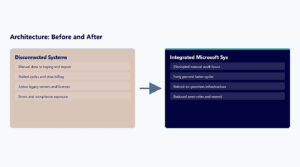
InfoPath is at the end of its life, so the question is not whether to move off it but what to move to and how to carry the logic across, not just the forms. For most enterprises the destination is Power Apps for the interface and Power Automate for the process, and the real risk is treating an InfoPath form as content to copy rather than business logic to rebuild. The disciplined approach inventories every form, retires the dead ones instead of migrating them, and rebuilds the active ones on a supported platform. i3solutions has done exactly this, moving InfoPath forms onto Power Apps and Power Automate with a purpose-built migration tool.
InfoPath has been on a long goodbye, and Microsoft has made clear it is not the future, which removes the only question worth not asking: whether to stay. You cannot, not safely, because running a critical business process on a retiring technology is an exposure that grows with every year of deferred support. The questions that remain are what to move to and how to move without losing the logic your forms carry, and those are where this migration is won or lost.
Start with what the destination actually is. An InfoPath form is rarely just a form; it is a form plus the logic around it, validation, conditional fields, routing, approvals, the rules that made it useful. The modern equivalent is a pair of tools. Power Apps provides the interface, and Power Automate provides the process and the routing. For the data, SharePoint lists or Dataverse usually replace the InfoPath form library. The mistake to avoid is looking for a one-to-one InfoPath replacement, because there is not one, and trying to force the old model onto the new tools fights both.
The how is an assessment before a migration, and in this case the assessment does something specific and valuable: it tells you which forms are worth moving at all. Most InfoPath estates have accumulated forms over a decade, and a meaningful share of them are dead, used once, superseded, or abandoned, and the worst thing you can do is faithfully migrate forms nobody uses. Inventory every form, sort them into retire, rebuild, and consolidate, and you often find the real migration is smaller than feared because much of the estate should simply be turned off. That triage is the single highest-value step, because it removes work rather than adding it.
For the forms that earn a rebuild, the logic has to be rebuilt, not copied. This is the part that distinguishes a real migration from a lift that breaks on landing. The validation rules, the conditional logic, the routing and approvals all have to be reconstructed on Power Apps and Power Automate, which is genuine work, and a purpose-built migration approach speeds it but does not erase it. Rebuilding that routing and approval logic is the core of i3Solutions workflow automation services. On a state National Guard modernization, i3solutions moved InfoPath forms onto Power Apps and Power Automate using a purpose-built migration tool, precisely because the logic, not just the layout, had to come across intact. On a separate engagement, a global analytic research provider was moved off InfoPath onto a supported SharePoint-based platform, again by rebuilding on supported technology rather than preserving the dead-end form model.
The honest framing is that the InfoPath retirement is not optional, but the migration should still be deliberate rather than panicked. The deadline pressure tempts teams into a wholesale lift of everything, which migrates dead forms and copies fragile logic, producing a new estate that is as messy as the old one and now also rebuilt under time pressure. The better path uses the forced migration as the occasion to triage hard, rebuild the forms that matter cleanly, and retire the rest, so you come out of it with a smaller, supported, better estate rather than a hurried copy of the one you were forced to leave.
What Actually Replaces InfoPath: Power Apps, Microsoft Forms, or a Third-Party Forms Engine?
If forms are still running on InfoPath today, they are running on a retired product, and the replacement question is now triage. The answer has three lanes. Forms that carry validation rules, conditional fields, or an approval chain move to Power Apps for the interface and Power Automate for the routing, with SharePoint lists or Dataverse holding the data. Flat questionnaires that feed a list move to Microsoft Forms. Dead forms, which the inventory step above exists to find, move nowhere: they are retired, not replaced.
The sorting rule is the logic, not the layout. An approval that lives in an InfoPath rule becomes a Power Automate approval flow. A form library with a repeating table becomes a Power Apps form over a SharePoint list, or over Dataverse when the data needs relational structure or row-level security, which is typically the moment multiple departments submit into the same process. A flat survey needs nothing more than Microsoft Forms, and rebuilding one in Power Apps is wasted effort. That is why there is no one-to-one replacement: InfoPath bundled the interface and the process in one product, and its successors split those into two. It is also why the National Guard migration described above needed a purpose-built tool: the logic, not the layout, was the work.
The same sorting question applies to HCL Domino (Lotus Notes) applications, and which of them go to Power Apps, SharePoint or .NET is covered in a separate guide.
A third-party forms engine earns its place only where it already governs the majority of your workflow estate. Do not buy Nintex or a similar platform just to exit InfoPath; that adds a second vendor and a second governance surface to a problem the Microsoft 365 licenses you already own can cover.
The deadline has passed. Per Microsoft’s support update, InfoPath Forms Services was removed from SharePoint Online for all tenants after July 14, 2026, aligned with the extended support end date of the InfoPath 2013 client, and the removal applies to government cloud environments as well. Anything still on InfoPath is now unsupported, which converts the migration from a planning exercise into live-exposure triage.
How Long an Enterprise InfoPath Migration Takes
Plan the calendar before the tooling. Enterprise InfoPath migration engagements at i3solutions typically run 13 to 16 weeks elapsed time across four phases. All i3solutions SharePoint developers, architects, and consultants are 100% U.S.-based.
Readers who are past the planning question and into scoping the work should start at our InfoPath migration services page, which is the service behind the migration approach described above.
InfoPath Alternatives Compared: Power Apps, Microsoft Forms, and Third-Party Forms Engines
The three replacement routes differ less on features than on who builds and who maintains. Read the table by the row that matches your form, not by the column that looks strongest.
| Criterion | Power Apps and Power Automate | Microsoft Forms | Third-party forms engine |
|---|---|---|---|
| Best fit | Business processes with branching logic, approvals, and line-of-business data | Simple data capture: surveys, sign-ups, single-step requests | Document-generation heavy or high-volume workflow already standardized on that platform |
| Data residency | Stays inside your Microsoft 365 tenant and Dataverse | Stays inside your Microsoft 365 tenant | Depends on the vendor; verify before any regulated workload |
| Who can build it | Trained business users for simple apps, developers for complex ones | Any business user | Trained administrators, usually with vendor-specific skills |
| Conditional logic and validation | Full, including business rules and calculated fields | Basic branching only | Full, and often stronger on document assembly |
| Rebuild effort from InfoPath | Moderate to high: logic is re-expressed, not imported | Low, because only simple forms qualify | Moderate to high, plus a new platform to govern |
| Ongoing ownership | Requires a Power Platform governance model as usage grows | Minimal | A separate vendor relationship, licensing, and upgrade path |
Inventory and Triage Your InfoPath Forms Before Choosing Anything
No platform decision survives contact with an unmeasured form estate. Inventory first, then triage, then decide per tier.
- Inventory every form and where it lives. Enumerate the form templates published across your SharePoint sites, and record for each one the owner, the last submission date, the data source it writes to, and any code-behind or web service call.
- Retire before you rebuild. In most estates a meaningful share of forms have not been submitted in a year. Those are decommission candidates, and every one you retire is a rebuild you do not pay for.
- Triage what remains into three tiers. Simple forms are single-screen capture with no logic and move to Microsoft Forms or a basic Power App. Medium forms carry branching, validation, and an approval and move to Power Apps with Power Automate. Complex forms carry code-behind, external data calls, or document generation and need a design decision, not a conversion.
- Rebuild the logic, do not transcribe it. Complex InfoPath forms usually encode a process that changed years ago. Rebuilding is the only point at which you get to fix it.
Replacing 32 outdated InfoPath forms with Power Apps reduced maintenance demands by 40%, saving an estimated $150K-$200K annually in IT labor and support.
InfoPath Migration Evaluation Checklist
- Is there a complete form inventory with an owner named for each form?
- Have forms with no submissions in the last twelve months been removed?
- Does each surviving form have a tier, and does each tier have a target platform?
- For each complex form, is it known what the code-behind and external calls actually do?
- Which licenses does the target platform require for the people who will use the form, not just the people who build it?
- Is there a governance model for the target platform before the first form ships?
- Is there a cutover plan per form, including how long the old and new forms run in parallel?
- Who owns the forms after go-live, and is that a named role rather than a project team?
Key Takeaways
- InfoPath is retiring, so the open questions are what to move to and how to carry the logic across, not whether to move.
- The destination is a pair, not a tool: Power Apps for the interface, Power Automate for the process, with SharePoint or Dataverse for the data. There is no one-to-one InfoPath replacement.
- Assess first to triage: a meaningful share of most InfoPath estates is dead and should be retired, not migrated. This is the highest-value step because it removes work.
- For forms worth keeping, rebuild the logic (validation, conditional fields, routing, approvals); do not copy it. A purpose-built migration approach speeds this but does not erase it.
- Use the forced migration to come out with a smaller, supported, better estate rather than a hurried copy of the old one. (i3solutions moved InfoPath onto Power Apps and Power Automate with a purpose-built tool.)
Frequently Asked Questions
What replaces InfoPath?
Not a single tool. Power Apps provides the interface, Power Automate provides the process and routing, and SharePoint lists or Dataverse hold the data. Looking for a one-to-one InfoPath replacement is the common mistake.
Do we have to migrate off InfoPath?
Yes. InfoPath is a retiring technology, and running critical processes on it is a growing exposure. The choice is not whether to move but how to move without losing the logic your forms carry.
Should we migrate every InfoPath form?
No. Most estates contain forms that are dead or superseded. The highest-value step is triage: inventory every form and sort into retire, rebuild, and consolidate. Faithfully migrating unused forms is wasted work.
Why rebuild the logic instead of copying it?
Because an InfoPath form is form plus logic, validation, conditional fields, routing, approvals, and that logic does not survive a lift-and-shift onto different tools. It has to be reconstructed on Power Apps and Power Automate to work correctly.
How do we avoid a rushed, messy migration?
Use the forced deadline as the occasion to triage hard and rebuild cleanly, rather than lifting everything under time pressure. The goal is a smaller, supported, better estate, not a hurried copy of the old one.
When does InfoPath retire?
Microsoft set July 14, 2026 as the end of extended support for InfoPath 2013, and InfoPath Forms Services in SharePoint Online retired on the same date. Because running critical processes on a retiring technology is a growing exposure, the migration should have been planned ahead of the deadline rather than after it.
What are the main InfoPath alternatives?
Within Microsoft 365, the common destinations are Power Apps for the form interface, Power Automate for routing and approvals, and SharePoint lists or Dataverse for the data. Microsoft Forms covers simple surveys and lightweight data capture, and third-party form and workflow platforms such as Nintex also replace InfoPath forms. For most enterprises the practical replacement is the Power Apps and Power Automate pair, because an InfoPath form is form plus logic and both halves need a supported home.
If InfoPath is still running business-critical forms in your environment, the first move is an inventory that tells you which forms to rebuild, which to consolidate, and which to retire, so the migration is smaller and cleaner than a wholesale lift. Bring us your InfoPath estate and we will produce that triage and a rebuild plan on Power Apps and Power Automate, so you exit a forced migration with a better estate than you started with.
About the Author
Michael Branson, Founder and COO, i3solutions. LinkedIn