
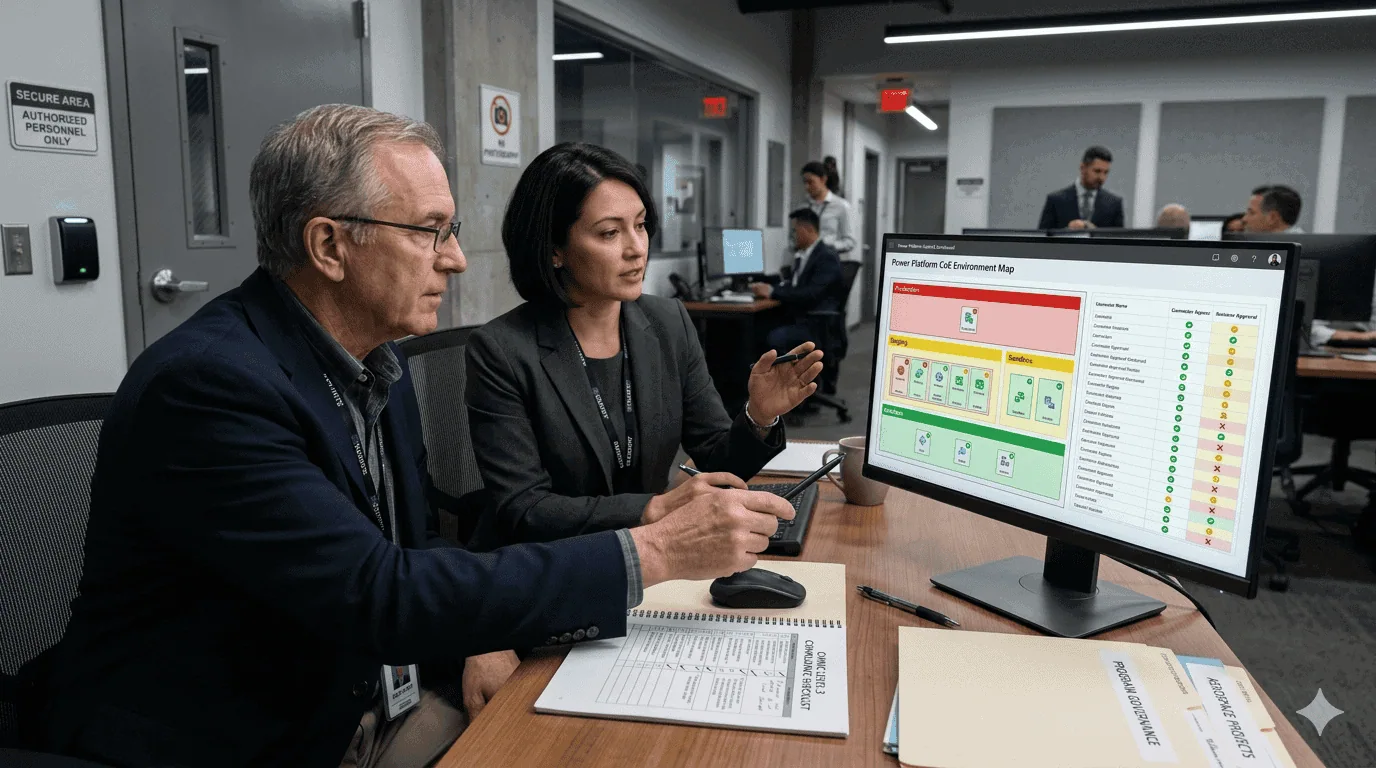
In aerospace and defense environments, the appeal of citizen development is immediate. Engineering teams and program managers face constant workflow delays. Central IT backlogs cannot always keep pace. Power Platform enables faster solution delivery: teams build apps and automate processes within days, creating early momentum and visible progress. But at enterprise scale, the risks change. Aerospace and defense systems are deeply connected. A simple app or workflow can touch control data or program reporting. Without oversight, these solutions can bypass security controls and create gaps in audit trails. Citizen development alone does not fail due to a lack of skill. It fails due to a lack of structure.
Quick Answer
In aerospace and defense, citizen development on Power Platform can accelerate innovation but introduces compliance and operational risks if unmanaged. A Center of Excellence (CoE)-led approach provides governance, oversight, and standardized patterns that maintain ITAR, DFARS, and CMMC compliance while enabling speed. CoE models allow organizations to scale safely, maintain audit readiness, and reduce long-term rework.
Aerospace and defense environments operate under strict regulatory control. Frameworks such as ITAR, DFARS, and CMMC define how data is accessed, stored, and shared, and they directly affect how applications are built and how workflows operate inside Microsoft environments.
Power Platform sits inside this reality. Every app, flow, or data connection must align with these controls, including how connectors are used, how data is classified, and how access is granted. Even small solutions can introduce compliance exposure if not governed properly.
Prime contractors add another layer of expectation. They require a consistent security posture across suppliers and partners, including auditability, traceability, and proof of control enforcement. Without clearly defined and enforced governance requirements for Power Platform in CMMC and prime contractor contexts, organizations risk failing audits or losing contract eligibility.
Most citizen development ideas do not start in IT. They come from program teams trying to solve immediate problems. Engineers track issues in spreadsheets. Operations teams manage approvals through email. Program managers build manual reports under tight deadlines.
The risk is not the idea itself; it is how the solution is implemented. Without guidance, users may connect to sensitive data or create unmanaged workflows. Over time, these solutions grow without visibility. A CoE-led model channels these ideas into governed delivery, enabling innovation while maintaining control.
In one defense program, an operations team built a Power App to track supplier deliverables using standard connectors to pull data from a shared environment. Access controls were not aligned with data classification requirements. As a result, controlled supplier information became visible to users outside the approved program boundary. The issue was identified during a security review, which delayed program reporting and required rework to meet compliance expectations.
Common patterns include users connecting apps to sensitive data sources without proper classification or controls, sharing Power Apps or Power Automate flows outside of approved security boundaries exposing controlled technical information, and unmanaged connectors increasing the likelihood of untracked data transfers that raise ITAR, DFARS, or CMMC compliance concerns.
Ungoverned environments, app sprawl, and undocumented automations don't plateau. They accelerate. i3solutions delivers senior-level Power Platform development, governance, and modernization services built for enterprise environments where platform complexity has already outpaced internal capacity.
Assess i3solutions Power Platform ServicesCitizen-developed solutions often skip structured testing and quality assurance steps. Documentation may be limited or absent, leaving IT and program teams without insight into how an app functions. Changes are frequently made ad hoc, creating versioning issues and inconsistent behavior across programs. This lack of process increases long-term maintenance burden and can slow enterprise-scale adoption.
Security offices, auditors, and prime contractors require proof that controls are enforced consistently. Unmanaged citizen development makes it difficult to demonstrate auditability, traceability, and alignment to regulatory frameworks. Programs may face delayed approvals, additional scrutiny, or failed audits if solutions cannot be tied to documented governance processes.
Scaling citizen development safely in aerospace and defense requires structured governance. A Center of Excellence provides the oversight, standards, and support needed to turn business-led ideas into enterprise-ready solutions.
Predefined app and workflow templates reduce risk by embedding security and compliance standards from the start. Sandboxes allow makers to experiment without impacting production data or environments. Standardized patterns enforce consistency across programs, making solutions easier to maintain and audit. These practices give teams a controlled playground to innovate while staying within enterprise guardrails.
App sprawl, ungoverned environments, and brittle automations don't get fixed by adding more contractors. They get fixed by senior specialists who understand enterprise Power Platform architecture, governance, and compliance. i3solutions provides senior-level, 100% US-based Power Platform specialists experienced in regulated-industry delivery.
Hire i3solutions Power Platform SpecialistsCoEs define which connectors are approved for use with sensitive data and implement environment-level Data Loss Prevention (DLP) policies. Automated and manual review processes ensure that apps follow governance rules before moving from the sandbox to production. Tracking and approval workflows provide traceability for every app promotion, giving auditors and prime contractors confidence in control enforcement. Oversight extends to monitoring usage patterns, permissions, and external sharing to prevent unintended exposure.
CoEs establish structured training programs to ensure makers understand compliance requirements, secure development practices, and enterprise architecture. Certification paths recognize proficiency and provide incentives for developers to follow best practices consistently. Continuous learning programs reduce errors, increase solution quality, and build a culture of accountable innovation.
Difficult to prove during audits. Limited visibility into app usage and sharing creates audit gaps. Security controls applied unevenly across environments and programs.
Built-in auditability and traceability. Centralized visibility ensures all apps and flows are tracked, governed, and audit-ready with clear documentation.
Lack of testing and standards leads to frequent rework. Incidents take longer to resolve due to poor documentation and unclear ownership. IT operates reactively.
Standard patterns reduce defects and minimize rework. Clear ownership and documentation accelerate incident response. IT operates proactively, reducing long-term support burden.
Increases due to rework, risk remediation, and reactive IT support. Duplicate solutions emerge across teams, compounding maintenance effort and cost.
Lower through predictability and control. Reusable components prevent duplication. Standard patterns reduce defects. Total cost of ownership decreases as adoption scales.
A successful CoE is not built from templates alone. It must reflect the regulatory, operational, and organizational realities of aerospace and defense. i3solutions approaches this with a governance-first model that aligns delivery with compliance, security, and program execution from the start.
Security, compliance, and program stakeholders are engaged early in the design process. Environment strategy, access models, and DLP policies are defined based on regulatory requirements. Power Platform usage is aligned with ITAR, DFARS, and CMMC expectations from day one. Clear ownership is established across IT, CoE teams, and business units. Governance is designed as an operational model, not just a policy document, ensuring that controls are built into how solutions are created and managed, not added later.
All environments, connectors, and app deployments managed centrally by a single governing body. Ideal for organizations handling highly sensitive or export-controlled data. Simplifies audit readiness through unified policies. Tradeoff: requires efficient intake and approval processes to avoid slowing delivery.
Central governance with distributed execution. Core CoE defines standards and guardrails; program teams build within those boundaries. Works well with multiple programs at different classifications or speeds. Tradeoff: requires active monitoring to prevent governance drift.
Core governance centrally managed with selective program autonomy. High-risk solutions routed through central oversight; lower-risk use cases delivered more independently. Often the most practical model for large defense manufacturers. Tradeoff: requires clear classification of solution types.
Each model is designed based on organizational structure, regulatory exposure, and program complexity. The goal is not to force a single approach, but to align governance with how the business actually operates. In many defense organizations, initial citizen-developed solutions must be reworked or retired once security reviews begin, reinforcing the need for governance from the start.

Scot Johnson co-founded i3solutions 30 years ago with a focus on expert-led delivery, strategic advisory, and complex Microsoft-centered solutions for organizations where technology decisions carry operational, financial, and mission risk. His insights focus on the leadership, governance, integration, automation, data, and delivery decisions that determine whether technology investments become reliable business systems.
View LinkedIn ProfileMost organizations see an initial framework in place within 6 to 12 weeks, including environment strategy, DLP policies, and governance processes. However, full maturity takes several months as adoption scales. The timeline depends on regulatory complexity and stakeholder alignment.
A strong CoE requires both technical and governance roles: a CoE lead, solution architects, platform engineers, and security stakeholders. Business representatives ensure alignment with program needs. Without cross-functional ownership, governance often remains theoretical. Clear accountability is what makes the model operational.
Yes, but the structure should match the organization’s size. A lightweight CoE can still enforce key controls like environment separation and DLP policies. The goal is not complexity, but consistency. Even smaller contractors face compliance requirements from primes and regulators. A right-sized CoE helps meet those expectations without overengineering.
There is often a slight slowdown at the beginning as teams align with standards and approval processes. However, once patterns and templates are established, delivery accelerates with fewer errors. Over time, the CoE actually improves speed by reducing rework and confusion.
One common mistake is treating governance as documentation only: without enforcement mechanisms, policies are ignored. Another issue is excluding security teams from early design decisions. Organizations also fail when they over-restrict the platform, limiting adoption. A successful CoE balances control with enablement.
Most organizations start with an assessment phase. Existing apps and flows are reviewed for risk, usage, and data exposure. High-risk solutions are remediated or redesigned. Others may be brought under governance with minimal changes. This process helps reduce immediate exposure while building a path to standardization.
External support is valuable when internal teams lack experience with enterprise-scale governance, especially in regulated environments like aerospace and defense. A partner can accelerate design, avoid common pitfalls, and bring proven patterns aligned with compliance frameworks, reducing trial-and-error and speeding up the time to a stable operating model.


The faster Power Platform adoption scales, the faster ungoverned environments, undocumented apps, and unmanaged connectors become enterprise liabilities. i3solutions' senior Power Platform delivery advisors work with IT leaders who already know the environment has outgrown its controls and need a structured approach to regaining operational command.
Talk to a Power Platform Delivery Advisor
US-Based | Est. 1997
© i3solutions. All rights reserved.
US-Based | Est. 1997
© i3solutions. All rights reserved.


