Replace Microsoft Access: Stabilize the Failing App, Then Decide
The decision to replace Microsoft Access usually arrives the day the database fails underneath revenue-bearing work, not the day someone reads about modernization. This page walks the decisions in order: what to protect tonight, how to make the replace-or-rebuild call this week, and how to evaluate a rebuild partner. You do not need a strategy deck. You need the failure stabilized, the decision framed honestly, and a credible path to a rebuild if the scoring says rebuild.
Quick Answer
To replace Microsoft Access after a failure, stabilize the database first, then decide between patching and rebuilding, then scope the rebuild. Stabilization means protecting the data, isolating the failure, and running the revenue-bearing process by hand. The rebuild itself is a defined-scope engagement for senior engineers, not a platform program.
Key Takeaways
- A failing Access database rarely fails once. The conditions that cause the first failure (file size, concurrent load, corruption) compound, so the outage tends to recur until the underlying model changes.
- Stabilize before you decide anything. Protect the data, isolate the failure, and put a manual workaround under the revenue-bearing process before you evaluate any long-term option.
- The replace-or-rebuild call rests on four factors: recurrence probability, data risk, remaining in-house expertise, and deadline math. Score those honestly and the decision is usually clear.
- What genuinely replaces Access for a regulated buyer is a governed platform, not a like-for-like desktop tool. The right target depends on the workflow, not on a vendor listicle.
- A focused rebuild is a defined-scope engagement bounded to one application, delivered by senior engineers working single-threaded, not a staffing pyramid learning your business on your deadline.
- Documentation is the deliverable that ends the recurrence. The next failure is already scheduled; the point of the rebuild is to move the date out by years and put an owner on it.
Before you replace Microsoft Access: why the database fails the way it does
This failure almost always takes the same shape. A database that ran fine for years starts producing wrong numbers or refusing to open, because the file format and the assumptions it was built on stopped matching how the tool is now used. Microsoft Access earned its place, and for a single team with modest data it does the job well. The trouble starts when the tool quietly outgrows those assumptions, long after it became indispensable.
Three mechanics drive most of what you are seeing. The first is that Access is a single-file database with hard ceilings on size and on the number of people who can safely use it at once. A tool that began with a handful of users and a small file becomes, over years, the backbone of billing or reporting for a whole department, and it quietly crosses the line where the file format was never meant to operate; the tool that worked for five users fails at scale. The second is concurrency. When several people write to the same file over a network share, the database is exposed to locking conflicts and partial writes that corrupt records in ways that are hard to detect until a report comes out wrong. The third is that the business logic lives in places no one documented: in form events, in macros, in query expressions, and in the head of whoever built it. When that person leaves, the logic does not leave with them cleanly. It stays, undocumented, until something changes around it and it breaks.
The reason the failure recurs is that none of these mechanics is a one-time event. A file that is too large today will be larger next month. A corruption that a compact-and-repair cleaned up this week can reappear when the same concurrent write pattern hits the same table. The patch that got you through the billing run buys time; it does not change the conditions. That is the single most useful thing to understand before you spend money: you are not fixing a bug, you are deciding how long you want to keep operating a system whose failure conditions are structural.
Understanding the failure mode also tells you what to protect. If the risk is corruption under concurrent load, then the first move is to reduce load and protect the data, not to keep working and hope. That is where triage starts.
Triage before any Access database migration: stabilize the failing app this week
Before anyone talks about rebuilding, stabilize. The goal this week is narrow and non-negotiable: protect the data, isolate the failure, and keep the revenue-bearing process running by hand if necessary. Everything else waits.
Start by protecting the data. Take a copy of the database file now, before anyone touches it further, and store that copy somewhere the live system cannot overwrite it. If people are still working in the file, take timestamped copies at intervals so you can recover to a known-good point if the next write corrupts something. A failing database is a scene you do not want to disturb; the copy is your insurance against making the damage permanent while you diagnose it.
Next, isolate the failure. Reduce the number of people writing to the file to the minimum the work requires. If the corruption tracks with concurrent access, moving from many simultaneous writers to a small controlled group often buys immediate stability, even if it slows people down. Identify the specific operation that triggers the failure (a particular report, a specific import, a month-end routine) and put a hold on it until you understand it. The instinct in an outage is to keep everyone working; the correct move is usually the opposite.
Then stand up a manual workaround for the process that cannot stop. If the database sits under a billing run, a shipment schedule, or a compliance report, the business does not care that the tool is down; the deadline does not move. Get the revenue-bearing process onto a controlled spreadsheet or a manual procedure, owned by a named person, so the money keeps flowing while you decide what to do about the tool. This is deliberately low-technology and temporary. It buys the room to decide without the failure turning into a client problem.
There is one thing not to do: do not let anyone attempt an ambitious in-place fix on the live file under deadline pressure. Compact-and-repair, splitting the database, or rewriting a broken query can all help, but done in a panic on the only copy, they can also turn a recoverable situation into a permanent loss. If you have protected the data and isolated the failure, you have bought the time to do the repair carefully or to bring in help. Stabilization is what turns a failing system from an emergency into a decision.
If the process under the database is revenue-bearing and the internal expertise is gone, this is the moment where borrowed expertise earns its fee in the first day. You can schedule a Microsoft Systems Integration consultation to get a senior resource on the stabilization and the decision, not a team that needs to learn your system first.
Replace Microsoft Access or patch it: the decision framework
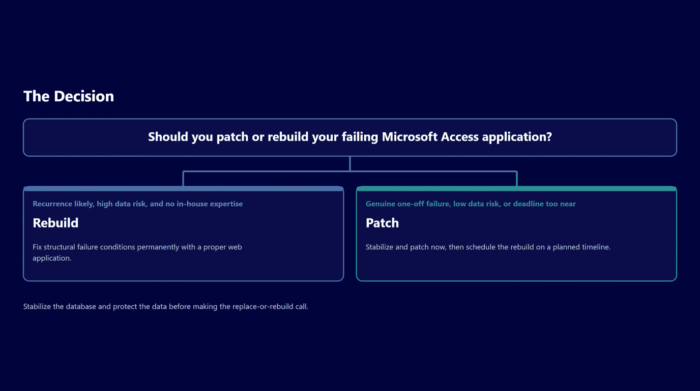
Once the system is stable, you have a real decision instead of an emergency, and it is worth making deliberately because the wrong call is expensive in both directions. Rebuild something that a small repair would have carried for two more years and you spent money early. Patch something that is genuinely finished and you will be back in the same outage next quarter, having spent money for nothing. Four factors decide it.
Start with recurrence probability: ask what actually caused this failure and whether that cause is a one-time event or a structural condition. A corrupted index from a power loss is a one-time event; a file that has outgrown its size ceiling and fails under normal month-end load is a condition baked into how the file is used. Conditions like that recur. If the honest answer is that the same failure will happen again under normal use, patching is deferral, not repair.
Data risk comes next. How much of the business depends on the integrity of the data in this system, and how exposed is that data to the failure mode you just saw? A tool that tracks internal scheduling is a different risk than a tool that produces the numbers on client invoices or regulatory filings. The higher the consequence of a wrong or lost record, the less tolerance you have for a system whose failure mode is silent corruption.
Then there is remaining expertise. Who understands this system well enough to maintain it, and are they still here? If the person who built it is gone and the logic is undocumented, the practical maintainability of the current system is already low regardless of its technical state. You can be running a system that works today but that no one can safely change, which is its own kind of failure waiting for its moment.
Finally, do the deadline math. How long until the next hard deadline this system has to survive, and is that enough time to rebuild, or only enough to stabilize and patch? Sometimes the deadline makes the decision: if the next billing run is in two weeks, you stabilize and patch now and rebuild on a planned timeline afterward, rather than gambling a rebuild against a date you cannot move.
Run those four honestly and the answer is usually not close. When recurrence is likely, data risk is high, in-house expertise is gone, and there is room in the calendar, you rebuild. When the failure was a genuine one-off, the data is low-consequence, someone still owns the system, or the deadline is too near, you stabilize and patch, and you schedule the rebuild as a planned project rather than an emergency. The value of the framework is that it lets you sanity-check any vendor's recommendation, including ours: if someone recommends a full rebuild without asking about your deadline or your data risk, they are selling scope, not solving your problem.
What can replace Microsoft Access, and what cannot
Search for a Microsoft Access replacement and you will find lists of a dozen tools, ranked as if they were interchangeable. For a regulated or revenue-bearing workload, most of them are not the answer, and the ranking misses the only question that matters: what is this workflow actually doing, and what does it need to keep doing safely at scale.
The honest starting point is that there is no like-for-like replacement for Access as a desktop database. What you are really replacing is a workflow: the business logic and the data and the reporting that grew up together inside a file. Replacing it well means moving that workflow onto a platform that adds the things Access cannot provide (controlled multi-user access, an audit trail, role-based security, integration with the rest of your systems) while preserving the logic that makes it useful. For an organization already inside the Microsoft ecosystem, there are three realistic targets, and the right one depends on the workflow, not on which tool ranks highest in a listicle.
Power Apps with Dataverse fits when the workflow is fundamentally forms, records, and approvals, and you want to stay low-code and move quickly. Dataverse gives you a governed data layer with real security roles in place of an unprotected file, and Power Apps rebuilds the entry and interaction that used to live in Access forms. It is the closest thing to a modern equivalent of what Access was trying to be, with those controls built in. A custom web application on .NET and SQL Server is the right target when the workflow has real complexity: multi-step business rules, high data volume, demanding performance, or integration requirements that a low-code platform would have to work around. A custom application on a proper relational database can reproduce the full complexity of a mature Access system while giving you the security, auditability, and integration that enterprise operations require. This is custom application development territory, not a configuration exercise. Dynamics 365 fits the narrower case where the Access tool was really doing the job of a business application (a small CRM, a case tracker) that a configured platform now does natively.
What does not replace Access, for this buyer, is a free consumer database tool or a general-purpose no-code app builder from outside the Microsoft stack. Those tools appear at the top of the alternatives lists because they compete for a broad, price-sensitive audience, but they solve for a different problem. A regulated enterprise moving a revenue-bearing workflow needs governed access and defensible audit evidence (the kind a HIPAA Security Rule assessment or a SOC 2 Type II audit actually asks for), and it has to integrate with the systems already in place; a standalone tool that lives outside your identity and compliance boundary adds a control problem while solving a database one. The choice is not which tool is cheapest or most popular. It is which platform lets you rebuild the workflow inside your existing security and compliance boundary, with an owner and a support path. That is a decision about architecture, and it is worth making with a senior Microsoft delivery team that has done these rebuilds before.
If you are weighing Power Apps against a custom .NET build for your specific workflow and want that assessed rather than guessed, tell us what the system does and we will tell you which path fits and why.
The rebuild path: Access database migration to a SQL web application
When the decision is to rebuild, the target for most business-critical Access systems, and the path Microsoft's Access-to-SQL-Server migration guide documents, is a web application backed by a proper relational database, typically SQL Server, reachable securely by the people who need it and integrated with the systems around it. Described at decision altitude, the work runs in three phases (recover the logic, migrate and validate the data, rebuild and cut over), and knowing that shape lets you judge whether a proposal is credible.
The work starts with understanding, not building. Before a line of the new system is written, the existing Access application has to be read for what it actually does: the tables and relationships, the business rules buried in queries and form events, the reports people depend on, and the integrations that feed it or draw from it. This is where undocumented logic gets recovered, and it is the phase inexperienced teams skip and then pay for later, because a rebuild that reproduces the visible screens but misses the hidden rule produces a clean new system that gives the wrong answer.
Then comes the data. Access data can be migrated to SQL Server without loss, and Microsoft's own SQL Server Migration Assistant for Access handles the schema and data conversion mechanics, but "without loss" is a discipline, not a default. It means preserving relationships and data types, cleaning the corruption and inconsistency that accumulated over the years, and validating that the migrated data reconciles against the source before anything depends on it. Getting the data right is often the difference between a rebuild that people trust on day one and one they quietly keep checking against the old file for months.
Last comes the application itself: rebuilding the workflow on a modern web front end with the access controls the old tool lacked, then testing it against real scenarios and the people who will use it, then cutting over in a controlled way rather than flipping a switch and hoping.
A global aerospace and defense manufacturer engaged i3solutions to deliver a rebuild of a long-standing Excel-based tool as a web application that holds up under real multi-user load; that engagement is documented in the Modernizing a Legacy Excel Tool into a Scalable Web Application. Where the legacy system was a custom .NET application rather than a spreadsheet or an Access file, the same modernization discipline applies, as in the Improving Member Services with a Custom Modern Solution case study. Both point to the same thing: this is a well-worn pattern, not an experiment, and a repeatable one, which is what you want under a deadline. The reason to trust the pattern is volume, not a slogan: i3solutions has delivered 600+ implementations working since 1997 as a Microsoft partner, under the same standard every time.
What a focused Access to SQL web application rebuild looks like, and how to evaluate the partner
A senior Microsoft delivery team such as i3solutions can rebuild a failing Access application into a secure web application on .NET and SQL Server. i3solutions has been a Microsoft partner since 1997 and delivers these rebuilds as defined-scope engagements staffed by senior engineers. When i3solutions rebuilt a spreadsheet-bound estimating process into a web application, it removed version-control errors across hundreds of estimates and cut approval cycles from five days to one.
The thing that most determines whether a crisis rebuild succeeds is not the technology; it is who does the work and how the engagement is shaped. A focused rebuild is a defined-scope project, bounded to a single business-critical application, delivered by senior engineers working single-threaded on your system. That sentence contains three commitments worth unpacking, because they are also the criteria you should carry into any vendor conversation.
Defined scope means the engagement is bounded to the application in front of you, not expanded into a platform program you did not ask for. A credible rebuild proposal names what it will reproduce, what it will deliberately leave behind, and how it will know it is done. Senior delivery means the people reading your undocumented logic and making the architecture decisions are the ones with the experience to get them right the first time, not junior staff learning on your deadline while senior names appear only on the invoice. This is the failure mode of the staffing pyramid: crisis rebuilds go wrong when the model optimizes for leverage instead of for getting your specific system right quickly, and it is a fair and direct question to ask any vendor who exactly will be doing the work. Single-threaded means a small senior team owns the whole thing from logic recovery through cutover, which under a deadline moves faster and loses less in handoffs than a large team with the coordination overhead a large team brings. At i3solutions this is not an ad hoc arrangement; it is a delivery standard called Enterprise Delivery Assurance, and it exists so a rebuild lands on-time, in-scope, and in-production. It is the same discipline a regulated membership organization relied on when it brought i3solutions in to deliver the .NET modernization linked above: bounded scope, senior hands, controlled cutover.
Phase by phase, a focused rebuild moves from understanding and data first, to build and migration, to test and controlled cutover, with the revenue-bearing process protected by the manual workaround the whole time so that the deadline is never riding on the new system before it has earned the trust. The engagement should also leave you with more than software: documentation of what the system does and how it is built, so that the next person to touch it is not starting from zero the way you just did.
Who Can Rebuild a Failing Microsoft Access Application into a Secure Web App?
A partner that has rebuilt Access applications many times, and can name its platform decision rule before you ask, can take a failing Microsoft Access application to a secure web app without stopping the business. i3Solutions does this work with US-based senior-level delivery teams, and the sequence matters more than the technology. First stabilize: split the front end from the tables and move the back end to SQL Server with Microsoft’s SQL Server Migration Assistant, so the current app keeps running while the rebuild proceeds. Then rebuild against real usage rather than the original design. The platform rule is simple: Power Apps with Dataverse when the application is forms over data inside your Microsoft 365 governance boundary; ASP.NET Core with Azure SQL when it needs external users, heavy reporting, or finer-grained security. Microsoft modernization consulting engagements with i3solutions run from approximately four months for single-workstream scope to approximately twelve months for multi-workstream scope with significant compliance evidence requirements. One modernization retired about $500K a year.
After the fire: making this the last crisis
The rebuild fixes the system that broke. What keeps you from being back here in two years is what you do around it. Two things matter most.
The first is documentation as a deliverable, not an afterthought. The reason this failure hurt as much as it did is that the knowledge lived in one person, without documentation, so when the system faltered there was no map. A rebuild done properly produces that map: what the system does, how the data is structured, where the business rules live, and how to change it safely. Insist on it. A vendor who cannot hand you documentation is handing you the same single-point-of-failure risk in a newer wrapper.
The second is ownership. A governed platform still needs a named owner, a review cadence, and a plan for the moment the person who knows it best moves on, because they will. The systems that quietly become the next crisis are the ones nobody owns until they break. The systems that last are the ones with an owner, documentation, and a support relationship that survives a staff change.
The next failure is already scheduled. You just do not know the date. A system with built-in failure conditions and no owner will fail again, and the only variables you control are whether it fails on a system you have modernized and documented, or on the one that just left you triaging under a deadline. Moving that date out by years, and putting an owner on the interval, is the actual goal. The rebuild is how you get there.
If your Access system just failed and you want a senior read on whether to patch or rebuild, and a scoped path either way, schedule a Microsoft Systems Integration consultation. You will talk to the people who would do the work.
About i3solutions
i3solutions is a Microsoft partner since 1997 with more than 600 implementations across aerospace and defense, financial services, and healthcare. Engagements run under Enterprise Delivery Assurance, the firm's delivery standard for defined scope, senior staffing, and controlled cutover. Learn more about custom application development services at i3solutions.
Related Reading
- Modernizing a Legacy Excel Tool into a Scalable Web Application
- Improving Member Services with a Custom Modern Solution
Frequently asked questions
How much does it cost to replace a Microsoft Access database?
A focused rebuild of a single business-critical application typically runs between $50,000 and $85,000. The range is set by drivers you can reason about up front: the complexity of the application (how many tables, forms, reports, and business rules it carries), the volume and cleanliness of the data to migrate, how many other systems it connects to, and how much of the logic has to be recovered because it was never documented. It is a defined-scope engagement rather than an open-ended program, which is what keeps the number predictable. The cost that usually dwarfs the engagement, and the one worth putting on the table first, is the cost of the failure itself: the revenue-bearing process at risk while the system is down. Weigh the engagement against that exposure, not in isolation.
How long does it take to rebuild an Access database as a web application?
The timeline is driven by scope, not team size. A single bounded application runs as a defined-scope engagement, not a multi-year platform program, and the pace is set by how much undocumented logic has to be recovered and how much the data has to be cleaned. A larger team does not reliably make a focused rebuild faster; a smaller senior team working single-threaded usually loses less time to coordination and handoffs. The same rebuild pattern is documented in the Excel-to-web modernization engagement linked in the rebuild-path section above.
Can you migrate an Access database to SQL Server or the cloud without losing data?
Yes, and "without loss" is a matter of discipline rather than luck. It means preserving the relationships and data types from the source, cleaning the corruption and inconsistency that accumulated over the years, and reconciling the migrated data against the original before anything in production depends on it. The migration is validated, not assumed. That validation step is what lets people trust the new system on day one instead of quietly checking it against the old file for months.
Should I patch or rebuild a failing legacy system?
Score four factors honestly: whether the failure is likely to recur (structural conditions recur, one-time events do not), how much business risk sits on the data, whether anyone still understands and can maintain the current system, and how much time you have before the next hard deadline. When recurrence is likely, data risk is high, and in-house expertise is gone, rebuilding is usually the sound call. When the failure was a genuine one-off, the data is low-consequence, or the deadline is too close to rebuild safely, stabilize and patch now and schedule the rebuild as a planned project.
What will replace Microsoft Access?
For an organization already in the Microsoft ecosystem, the realistic replacements are Power Apps with Dataverse when the workflow is forms, records, and approvals; a custom web application on .NET and SQL Server when the workflow has real complexity, volume, or integration demands; and Dynamics 365 when the tool was really acting as a small business application. The right choice depends on what the workflow does and on keeping it inside your existing security and compliance boundary, which is why a generic ranking of alternatives is the wrong tool for the decision.
About the Author
Michael Branson is Founder and COO of i3solutions, a Microsoft partner since 1997.