
By Justin Bowen, Sr. Vice President, Delivery Services, i3solutions
Budget in engagement shapes, not in one number. Stabilizing a partly built Microsoft estate typically runs $85,000 to $175,000 for an environment of four to six Microsoft platforms with 40 to 120 integration touchpoints. A focused rebuild of a single business-critical application typically runs $50,000 to $85,000. Holding the system with embedded senior people runs $28,000 to $48,000 per specialist per month. Which of the three you need is decided by an assessment of the code and the environment, not by a proposal, and any firm quoting a remediation total before reading the repository is guessing.
Remediation is priced differently from new development because the unknown is not the requirement, it is the artifact. On a greenfield build the scope is the thing you are arguing about. On a remediation the scope is whatever the previous team left behind, and nobody knows what that is until someone reads it. That single fact drives every honest number on this page and explains why fixed fee quotes offered before an assessment tend to be either padded or wrong.
This page describes what i3solutions charges for the engagement shapes that remediation work actually takes, what makes the number move, and where the money goes. It does not characterize the firm that built the system, and it does not attempt to price your specific estate from a distance.
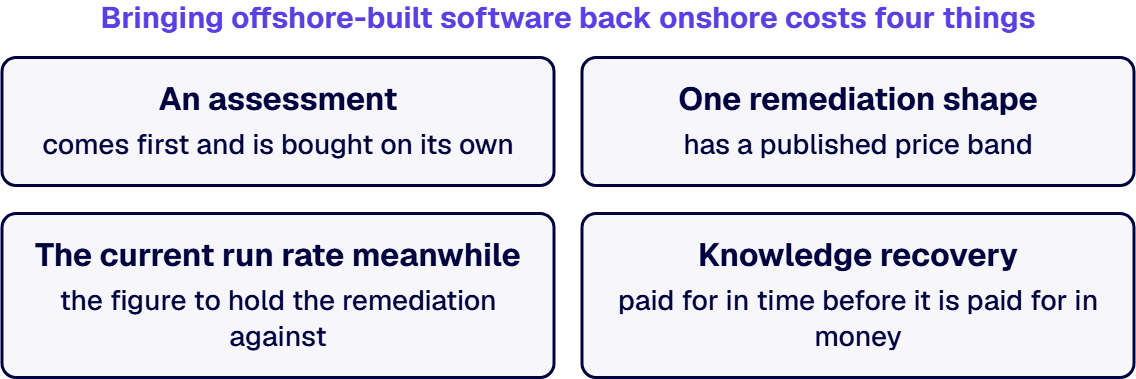
Bringing offshore-built software back onshore costs four things: an assessment, one remediation shape, the current run rate meanwhile, and knowledge recovery. Each shape has a published price band in its section below. Embedded specialists are priced per specialist per month.
The other three lines carry no published price here, and a budget that leaves them out is the budget that doubles later. The assessment comes first and is bought on its own, as set out under “How to run the decision”. The current system keeps costing what it costs until the fix lands, and that run rate, not zero, is the figure to hold the remediation against, as the section on the return explains. Knowledge recovery is the identity and business-rule work listed under “What actually moves the number”, and it is paid for in time before it is paid for in money. The three shapes are alternatives rather than parts to add up, with one exception: embedded specialists can hold the system while a stabilization or a rebuild is scoped.
The offshore rate priced the build. The fix is priced by what the build left behind: the count of places where systems connect, whether a test environment behaves like the live one, whether anyone wrote down who owns the service accounts and permissions, and whether the business rules can be recovered at all. A low rate tells you nothing about any of the four, so it is not an input to the remediation budget. For the rate and risk comparison itself, see Onshore vs Offshore for Microsoft Power Platform in Regulated Industries.
A Stabilization Protocol engagement (Phase 1 dependency mapping plus Phase 2 risk-sequenced triage) typically costs between $85,000 and $175,000 for enterprises running four to six Microsoft platforms with 40 to 120 integration touchpoints. Phase 1 establishes what actually calls what: the Power Automate flows firing on SharePoint list events, the Dataverse tables with no plugin registration record, the Azure Function that a developer stood up under a personal subscription, the service principals holding permissions nobody documented. Phase 2 then triages by blast radius rather than by ticket age, which is the sequencing decision most internal remediation efforts get backwards.
The range moves with touchpoint count more than with line count. An estate at the low end of that touchpoint band, on four platforms, lands near the bottom of the price range. An estate at the top of the band, spanning six platforms with authentication crossing tenant boundaries, lands near the top. If your environment is materially outside that shape, the band does not apply to you and we will say so rather than stretch it.
A focused rebuild of a single business-critical application typically runs between $50,000 and $85,000. This is the right shape when the code is small enough to replace and bad enough that reading it costs more than rewriting it. The test is not code quality in the abstract. It is whether the business rules are recoverable from the artifact, from documentation, or from people who are still employed. When all three fail, rebuilding is cheaper than archaeology.
Fixed-fee project consulting for modernization initiatives ranges $55K-$450K depending on scope. A focused rebuild sits at the low end of that spread by design. A rebuild that starts drifting toward the middle of that range is usually a rebuild that quietly turned into a modernization program, which is a different decision and deserves to be made on purpose. If you are writing the contract for the rebuild, add the secure development requirements for a custom application contract so the next build can be audited.
Typical engagement ranges land at $28,000 to $48,000 per specialist per month for senior US-based Microsoft specialists with named platform depth (SharePoint, Power Platform, Microsoft 365 compliance, Azure security, Dataverse, .NET enterprise integration) and compliance literacy in CMMC 2.0 Level 2, HIPAA Security Rule, NIST 800-171 Rev 2, SOC 2, or DFARS 252.204-7012. This is the shape for organizations that need the system to keep running while the stabilize or rebuild decision is being made, or that have a regulated deadline the remediation itself cannot move.
Per specialist per month is the honest unit here and it is worth reading carefully. Two specialists for three months is six specialist months, not three. Firms that quote remediation staffing as a blended monthly team rate are usually hiding the seniority mix, and seniority mix is the whole variable on inherited code.
i3solutions mid-migration SharePoint rescue engagements run eight to fourteen weeks. That is a duration, and it is worth stating plainly that it is not convertible into a cost at any hourly rate. A fourteen week engagement with two embedded specialists and a fourteen week engagement running a fixed scope stabilization are the same calendar and very different invoices. When a firm hands you a week count and invites you to multiply, ask what is being multiplied.
What the eight to fourteen week figure is useful for is planning the things around the remediation: contract dates, audit windows, the point at which you can credibly tell a customer the system is stable.
One rescued program for a nuclear operator saved about $293K a year and returned its full cost within three months. That is a savings figure from one engagement in one regulated sector, and it is deliberately not presented here as what remediation costs or as a result you should expect. It is presented because remediation is usually evaluated against the wrong alternative. The comparison that matters is not remediation cost against zero, it is remediation cost against another year of the current run rate, which on a failing system is rarely small and is rarely measured.
i3solutions has no published case study of repatriating a specific offshore program, and this page does not imply one. The attested rescue and stabilization work above is real and is priced from engagements that happened. Whether the work being rescued was originally built offshore, onshore, or in house is not something the record establishes, and inflating it into an offshore repatriation credential would be exactly the kind of claim this page exists to help you interrogate in other proposals.
This page also does not characterize any offshore vendor, named or implied. The reason is practical rather than diplomatic. A remediation engagement that begins with a theory about who was at fault tends to produce a report about who was at fault, and you are paying for a working system.
The firm level facts are simple and verifiable. i3solutions is a Microsoft Solutions Partner. i3solutions has completed 1,500+ Microsoft platform implementations. All delivery is by senior US-based specialists, which is the relevant fact for an organization moving work back onshore, and it is a staffing model rather than a certification.
Honest disqualification is cheaper than a bad engagement. This is not the right vehicle when what you want is a fixed remediation price before anyone has read the repository, when the requirement is lowest price technically acceptable staffing, when the platform direction is away from Microsoft, or when the real goal is a report assigning blame for the original build. An i3solutions engagement does not produce managed-service ownership, a replacement for the internal team, open-ended scope expansion, or vendor lock-in. Remediation buyers in particular should confirm that constraint in writing with whoever they hire, because a firm that inherits your system is unusually well placed to keep it.
Get the assessment scoped and priced separately from the remediation, and keep the two decisions separate on paper. Ask each candidate firm for the three artifacts that reveal whether they have done this before: a dependency map from a comparable engagement, redacted; the triage sequence they used and why blast radius beat ticket age; and the point in a prior engagement where they recommended rebuilding rather than repairing. A firm that has never recommended a rebuild has either been very lucky or is not in the habit of saying the expensive thing.
Adjacent reading if you are earlier in the decision: comparing costs of in house IT against external consultants covers the run rate side of the comparison, internal team versus a systems integrator hybrid delivery model covers who holds the work afterward, Microsoft Access application rebuild cost prices the narrowest rebuild case, and custom application development services describes the build practice the rebuild shape draws on. When you want to test fit, i3solutions routes a senior U.S.-based engineer to a client call usually within one to two weeks. You can reach the team by phone at 703.652.8966.
It depends which engagement shape your situation calls for. A Stabilization Protocol engagement (Phase 1 dependency mapping plus Phase 2 risk-sequenced triage) typically costs between $85,000 and $175,000 for enterprises running four to six Microsoft platforms with 40 to 120 integration touchpoints. A focused rebuild of a single business-critical application typically runs between $50,000 and $85,000. Embedded senior specialists run $28,000 to $48,000 per specialist per month. Which shape applies is determined by reading the code and the environment, not by a proposal, so scope and price the assessment first and keep it separate from the remediation.
Usually, and the test is specific rather than general. Remediation wins when the business rules are recoverable from the artifact, from documentation, or from people still employed. When all three fail, reading the system costs more than rewriting it and a focused rebuild at $50,000 to $85,000 for a single business-critical application is the cheaper path. The mistake to avoid is deciding this by code quality impression. Decide it by whether the rules are recoverable, because that is what you are actually buying back.
i3solutions mid-migration SharePoint rescue engagements run eight to fourteen weeks. That is a duration and not a price, and it does not convert into one at any hourly rate, because the same calendar covers very different staffing shapes. Use the week count to plan the things around the remediation, such as contract dates and audit windows, and price the engagement from its shape instead.
No, and neither should anyone else. On a remediation the scope is whatever the previous team left behind, and the two findings that most often reset a plan are that no non production environment matches production and that identity and permission ownership is undocumented. Both are discovered by looking. What can be fixed in advance is the assessment: scope it, price it, and keep the decision to proceed genuinely open once it reports.
No. i3solutions has no published case study of repatriating a specific offshore program and does not claim one. The published record covers rescue and stabilization work whose origin the record does not establish as offshore. One program for a nuclear operator saved about $293K a year and returned its full cost within three months, which is a savings figure from a regulated sector engagement rather than a remediation price or a promised outcome.
Because the rate priced the original build, and the fix is priced by what that build left behind. Four things move a remediation: how many integration touchpoints the estate has, whether any non-production environment matches production, whether identity and permission ownership is documented, and whether the business rules survive outside the code. None of them shows in the rate you paid.
Five things: a dependency map of what calls what; a finding on whether production can be reproduced safely; an inventory of the identities, app registrations and connections no one owns; a verdict on whether the business rules are recoverable; and a recommended shape, stabilize, rebuild or hold with embedded specialists. Scope and price the assessment on its own, and keep the decision to proceed open once it reports.

US-Based | Est. 1997
© i3solutions. All rights reserved.
US-Based | Est. 1997
© i3solutions. All rights reserved.


