

Senior US-based Microsoft delivery assurance verification occurs in three domains: pre-contract inspection, artifacts that demonstrate seniority, and enforceable contract language. Commitments lacking all three describe a staffing role rather than a binding obligation. Six pre-contract inspection requests, four artifacts that prove seniority, and specific contract terms turn the claim into something a buyer can hold a vendor to.
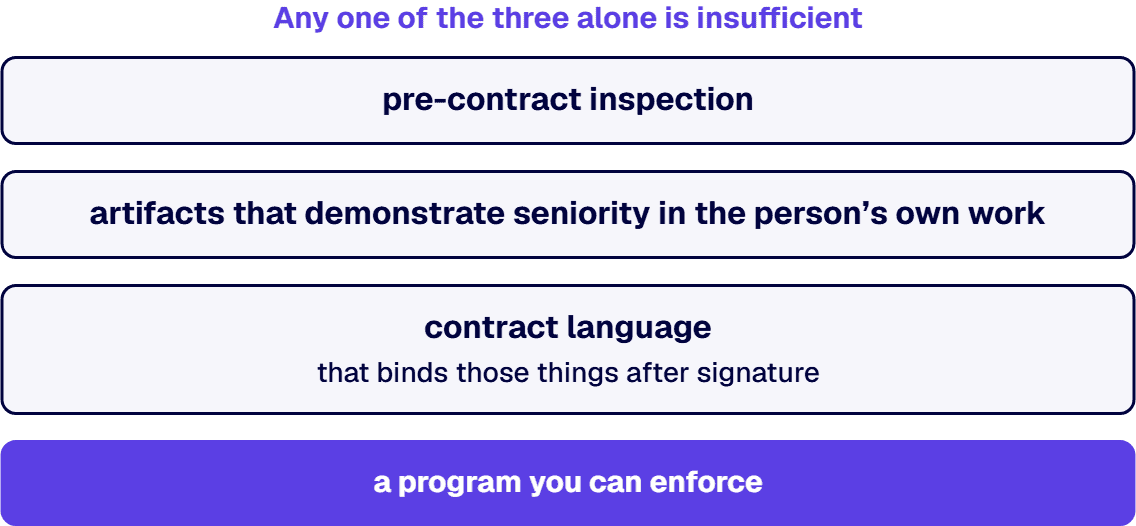
Senior US-based Microsoft delivery assurance is the phrase every proposal carries and the one no proposal makes verifiable on its own. Verification is what turns the claim into something a buyer can hold a vendor to: pre-contract inspection that separates programs with specific senior people from generic reassurance, artifacts that demonstrate seniority in the person’s own work, and contract language that binds those things after signature. Any one of the three alone is insufficient; a program described in all three is a program you can enforce.
Named individuals and allocation clarity. Request the proposed architects and leads by name, along with their other concurrent commitments and their weekly time allocation to your program. A name with no allocation figure beside it is a role, not a person. A person with 25 percent allocation shared across three programs is being asked to do senior work in half a day a week.
Architecture decision records from comparable work. Request a redacted decision record from a similar engagement. Meaningful records document rejected options with justifications; a summary of the selected approach is a case study, not a decision record. The redaction removes the client, not the reasoning.
Review evidence for senior contributors. Request demonstration that the most senior person’s own work undergoes peer review with documented changes resulting from that review. A senior contributor nobody reviews is a senior contributor whose defects reach production.
Direct environment engagement dates. Request the specific dates when the proposed personnel last worked inside a live production environment, versus a demonstration or training environment. This establishes whether they operate inside systems or supervise others who do.
Rotation procedures and mechanics. Rather than confirming that rotation occurs, request the details: notification period, approval requirement for replacements, overlap duration, documented handover procedure. A firm that rotates people freely without notice can move your architect onto another account the week before your cutover.
Failed escalation documentation. Request an escalation that proceeded poorly. The value is in learning whether escalations reach definitive decisions and who the decision-maker was. Firms with clean escalation records either have never had one or filed them somewhere else.
| Property | What it determines | Required specification |
|---|---|---|
| Assignment | Whether staff possess decision-making depth or merely implement external decisions | Observable seniority behaviors, not job titles |
| Continuity | Whether staffing survives competing demands and retains knowledge | Active knowledge capture practices throughout the engagement |
| Architectural coherence | Whether design integrates across workstreams or fragments into incompatible decisions | Single named design owner with documented decisions |
| Accountability | Whether escalations terminate in decisions or cycle unresolved | Named escalation endpoint with a time constraint |
Design authority. Architecture decision records bearing the author’s name, rejected alternatives, and conditions for revisitation. Senior personnel produce these by role requirement.
Authority to refuse. Documented declined requests showing who could overturn the refusal and whether they did. This distinguishes recorded refusals from undocumented ones the seller will not admit to.
Bidirectional review. Two records demonstrating both this person reviewing others’ work and their own work undergoing review with resulting changes. Seniority that only reviews others is a title; seniority whose work is reviewed is a discipline.
Direct estate access. Environment logs showing account names, dates, and changes. This establishes whether the person works inside systems or supervises remotely.
i3solutions has run more than 1,500 Microsoft engagements over 30 years, with senior, 100% US-based teams accountable from strategy through production.
Architecture ownership across all workstreams with documented decisions, including rejected options.
Review standards specifying what receives review, who conducts it, the measurement criteria, and the consequences of failing them.
Environment and change control procedures defining deployment permissions, change progression through environments, and reversal mechanisms.
Ongoing knowledge capture as decisions occur, not as post-engagement documentation nobody writes.
Escalation path with a named endpoint and a stated time boundary for decision-making.
Regulated-environment competence held by the assigned individuals, not merely by the organization at large.
Three scopes use identical language.
Firm-wide. All employees, all projects, all technologies. The strongest form. Verify by asking directly whether any subcontractors perform program work.
Program-specific. The people assigned to this engagement are US-based, but other programs at the same firm may not be. Workable, but the boundary needs to be in writing.
Practice-specific. One capability area is US-based; others are not. Problematic when work crosses domains, because integration touches multiple practices and a US-based capability that hands off to a non-US one at the seam has broken the guarantee at the point that mattered.
Named individuals requiring written consent for substitution, not notification.
Minimum allocation expressing each person’s committed weekly percentage across specific dates.
Rotation provisions specifying notice periods, overlap duration, and required written handovers.
Decision records as deliverables with acceptance tied to milestone completion.
Escalation endpoint with a named role and a stated decision timeframe.
Specific remedies for staffing non-compliance: re-staffing deadlines, credits, or termination rights.
Individual competence attachment for regulated environments, held to the person rather than to the organization.
i3solutions has delivered on the Microsoft stack since 1997. Delivery is senior and US-based: every employee, every project, every technology, with no practice-by-practice qualification. The proposals name the people, the decision records travel with the engagement, and the contract language above is what makes the claim enforceable rather than reassuring. Ask any firm for the same evidence; the ones that can produce it are the ones the claim describes accurately.
In three domains together: pre-contract inspection (six requests including named individuals with weekly allocation, redacted decision records, review evidence for the most senior contributor, environment engagement dates, rotation mechanics, and a documented failed escalation), artifacts that demonstrate seniority (decision records, declined requests, bidirectional review, environment logs), and enforceable contract language (named individuals, minimum allocation, rotation provisions, remedies).
Observable behaviors, not job titles. Senior contributors produce architecture decision records with rejected alternatives; refuse requests they can defend the refusal of; have their own work reviewed with resulting changes; and work inside live production environments, not demonstration or training ones. A person the proposal describes as senior but who cannot produce those artifacts is a staffing description, not a seniority claim.
No. Three scopes use identical language. Firm-wide (all employees, projects, technologies; the strongest form). Program-specific (only the people on this engagement, workable but the boundary belongs in writing). Practice-specific (one capability, problematic when work crosses domains because integration touches multiple practices). Ask which scope applies and whether subcontractors perform program work.
Named individuals requiring written consent for substitution rather than notification; minimum weekly allocation across specific dates; rotation provisions with notice periods, overlap duration, and required written handovers; decision records as deliverables tied to milestone completion; an escalation endpoint with a named role and stated decision timeframe; specific remedies for staffing non-compliance; and individual competence attachment for regulated environments held to the person, not the organization.
Six things: named individuals with concurrent commitments and weekly allocation figures; a redacted architecture decision record from a comparable engagement; evidence that the most senior person's own work undergoes peer review; the specific dates the proposed personnel last worked inside a live production environment; the rotation procedure (notice, approval, overlap, handover); and a documented escalation that proceeded poorly. Programs that can produce all six are describing a specific engagement, not a template.
Every rotation off your program resets context you already paid to build. i3solutions embeds senior specialists who stay, and structures the engagement so they can.
Request a Staffing Scoping Discussion
US-Based | Est. 1997
© i3solutions. All rights reserved.
US-Based | Est. 1997
© i3solutions. All rights reserved.


