Staff Augmentation vs Strategic Delivery Partnership Microsoft

Microsoft transformation programs rarely fail because of platform capability. They fail when the delivery model cannot sustain architectural integrity, governance alignment, and coordinated execution across an increasingly complex Microsoft estate. Many organizations default to staff augmentation to accelerate delivery, assuming that adding capacity will resolve execution pressure. But as environments expand across Azure, Power Platform, Microsoft 365, and emerging AI workloads, the choice between staff augmentation and a strategic delivery partnership becomes a structural risk decision. The practical question for CIOs is not which model is better in isolation, but where staff augmentation still makes sense within a broader Microsoft transformation strategy, and where accountable ownership across architecture, governance, and execution is what the program actually needs.
Key Takeaways
- Staff augmentation is primarily a capacity model designed for short-term execution needs, not long-term transformation ownership. Contractors typically operate within assigned tasks rather than owning outcomes, creating fragmented knowledge and inconsistent implementation patterns over time.
- Strategic delivery partnerships focus on accountable outcomes, unified architecture, and embedded governance across Microsoft environments. The focus shifts from adding capacity to establishing a delivery model that can sustain integrity, governance, and coordinated execution.
- Research from McKinsey shows that large-scale transformations typically fail to achieve intended value in up to 70% of cases, often due to weak alignment between execution effort and measurable business outcomes, a structural gap that staff augmentation models rarely address.
- Strategic partners improve resilience by maintaining continuity in governance, architecture standards, and delivery oversight despite team changes, whereas contractor turnover degrades accumulated knowledge and creates compounding rework.
- Executive visibility improves significantly under strategic partnerships through outcome-based reporting instead of utilization-based tracking, making it easier to defend spend and report transformation progress to boards and audit committees.
- The most effective approach for Microsoft transformation is often a hybrid model where augmentation handles execution within controlled scopes while strategic partners ensure overall delivery integrity, architecture ownership, and governance alignment.
Quick Answer
Staff augmentation and strategic delivery partnerships serve very different roles in Microsoft transformation programs. Augmentation provides short-term capacity but often leads to fragmented ownership, inconsistent governance, and limited architectural control. Strategic delivery partnerships introduce accountable ownership across architecture, governance, and outcomes, enabling more scalable and defensible transformation. Most enterprises benefit from a hybrid model where augmentation is used for execution, while strategic partners ensure overall delivery integrity.
How Staff Augmentation Is Typically Used Today
Filling Seats and Closing Short-Term Gaps
Staff augmentation is most commonly used as a rapid response to delivery pressure. When timelines slip or internal teams lack specific Microsoft expertise, organizations bring in contractors to maintain momentum. This approach works best in well-defined environments where governance and delivery standards are already established and enforced internally.
In practice, augmentation is often deployed to backfill capacity during peak delivery periods, add niche skills across Azure, SharePoint, Power Apps, or Microsoft 365 workloads, and support ongoing development where requirements are stable and clearly scoped. While this can stabilize short-term execution, it rarely addresses underlying delivery risks. Contractors typically operate within assigned tasks rather than owning outcomes. Over time, this creates fragmented knowledge, inconsistent implementation patterns, and increased dependency on individual contributors rather than repeatable systems.
Procurement-Driven Vendor Selection and Rate Focus
Staff augmentation is also shaped by procurement models that prioritize cost efficiency and rate optimization. Vendors are selected based on hourly rates, availability, and role matching rather than their ability to influence architecture quality or delivery outcomes.
This introduces structural limitations: success is measured by utilization and cost control rather than transformation impact, accountability for long-term platform health or governance alignment is limited, and delivery standards vary across teams sourced from multiple vendors. As Microsoft environments scale, these constraints become more visible. Disconnected contributors may deliver functional outputs, but without unified oversight, organizations experience rework, integration challenges, and governance gaps.
Structural Limits of Staff Augmentation for Transformation
Diffused Accountability for Architecture and Outcomes
One of the most significant constraints is the lack of clear, accountable ownership for architecture and end-to-end delivery outcomes. Augmented resources are typically aligned to tasks or components, not to system-wide responsibility. Common issues include no single point of accountability for cross-workstream architecture decisions, inconsistent interpretation of standards across teams and vendors, escalations that stall due to unclear ownership boundaries, and delivery success measured at the task level rather than the outcome level.
In Microsoft environments where services are deeply interconnected, these gaps introduce compounding risk. Architectural drift, misaligned integrations, and governance inconsistencies often emerge gradually, making them difficult to detect until they impact stability or scalability.
Fragmented Knowledge and Inconsistent Patterns
Staff augmentation also introduces challenges in knowledge continuity and implementation consistency. Contractors cycle in and out of programs, often without structured knowledge transfer or alignment to a unified delivery model. Typical patterns include multiple approaches to solving similar problems across teams, limited reuse of components and integration patterns, knowledge silos tied to individuals rather than institutionalized practices, and increased onboarding overhead as new resources join the program.
While individual contributors may deliver quality work in isolation, the absence of coordinated standards and retained knowledge weakens the overall system. Transformation requires consistency, traceability, and governed evolution – outcomes that are difficult to sustain when delivery is distributed across loosely connected, independently operating resources.
What Strategic Delivery Partnerships Look Like
Shared Roadmaps, Governance, and Architecture Ownership
A defining characteristic of a strategic delivery partnership is shared accountability for the roadmap, architecture, and governance model. Rather than operating as external contributors, the partner works alongside internal leadership to shape and enforce how the platform evolves.
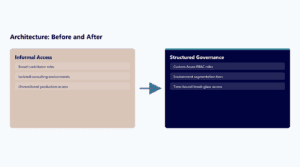
This typically includes joint ownership of transformation roadmaps aligned to business priorities, centralized architecture oversight across Azure, Dynamics 365, and Microsoft 365, governance frameworks that ensure security, compliance, and auditability, and standardized delivery patterns applied consistently across workstreams. This structure reduces ambiguity and ensures that decisions are made with system-wide impact in mind – and strengthens internal control by making governance explicit, measurable, and continuously enforced.
Outcome-Oriented Engagements vs Hourly Utilization
Strategic delivery partnerships change how success is defined and measured. Instead of focusing on hourly utilization or resource output, engagements are aligned to outcomes that reflect transformation progress and platform health. Success is measured by delivery milestones, adoption, and operational stability. Incentives align to reducing risk, improving integration, and accelerating time-to-value. Embedded accountability exists for resolving cross-team dependencies and blockers. Delivery is continuously optimized based on evolving business and technical needs.
This outcome-oriented model is where the benefits of a strategic delivery partnership with a Microsoft specialist firm become most visible. Organizations gain a structured mechanism for maintaining consistency, reducing rework, and ensuring that transformation efforts remain aligned to enterprise objectives.
Risk and Value Comparison: Staff Augmentation vs Strategic Delivery Partnership
Individual contributor accountability for assigned tasks. No single point of accountability for cross-workstream architecture decisions or end-to-end delivery outcomes.
Shared ownership of governance, architecture, and outcomes. Clear escalation paths and accountability for resolving cross-program risks and delivery dependencies.
Dependent on internal enforcement. Inconsistent standards across vendors and contractors. Compliance alignment requires constant manual oversight from internal leadership.
Built-in, actively managed, and continuously improved. Architecture standards, security controls, and compliance requirements are core components of delivery, not overlays.
Impacted by turnover and onboarding cycles. Knowledge tied to individuals is lost on exit. New contractors must reverse-engineer prior decisions, increasing overhead and rework.
Stable delivery regardless of team changes. Knowledge institutionalized through documented patterns, frameworks, and governance models that persist beyond individual contributors.
Limited to resource tracking and spend. Progress narratives must be reconstructed from disparate vendor inputs, weakening clarity and slowing decision-making at the executive level.
Clear linkage between investment, progress, and outcomes. Structured reporting tied to governed milestones, risk reduction, and platform stability that resonates with boards and audit committees.
Lower hourly rates but rework, integration failures, and governance gaps raise real cost across the program lifecycle. Cost appears predictable at the rate level but compounds over time.
Spend tied to defined transformation outcomes. Investment is offset by reduced rework, faster delivery, and fewer architectural corrections. Total cost of ownership is lower and more defensible.
Hybrid Models That Use Both Staff Augmentation and Strategic Partners
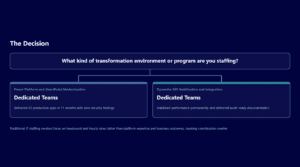
For most enterprises, the decision is not binary. The most effective Microsoft transformation programs use a hybrid model that combines the flexibility of staff augmentation with the structure and accountability of a strategic delivery partner. The goal is to align each model to the type of work being performed while maintaining centralized control over governance and outcomes.
- Enterprise architecture and cross-workstream design decisions
- Governance frameworks, compliance alignment, and audit readiness
- Delivery standards, patterns, and integration models
- Outcome tracking, risk management, and escalation paths
- Execution within defined architecture and delivery standards
- Feature development, enhancements, and backlog acceleration
- Specialized skills applied within controlled, governed scopes
This coordination model preserves internal control and flexibility while introducing the structure required to scale transformation. Augmented resources operate within the delivery system the strategic partner establishes – rather than operating independently without system-wide visibility.
How i3solutions Operates as a Strategic Microsoft Delivery Partner
i3solutions is designed to function as an extension of enterprise leadership, with clear accountability for outcomes and long-term platform integrity. Engagements are structured around defined outcomes, not open-ended resource allocation. Each program is anchored by shared roadmaps, architecture ownership, and governance frameworks enforced across all workstreams. Metrics are tied to transformation progress, not utilization – giving CIOs visibility into delivery milestones, risk reduction, integration stability, and operational improvements.
In one case, a global financial services organization heavily dependent on multiple staff augmentation vendors was experiencing inconsistent governance and fragmented architecture ownership across Power Platform and Azure. A strategic delivery partnership was introduced to stabilize execution and centralize architecture oversight. The partner aligned workstreams under a unified roadmap, standardized delivery patterns, and placed augmentation resources within clearly defined execution boundaries – improving consistency, reducing rework, and strengthening governance across the Microsoft environment.
i3solutions typically takes ownership of architecture and governance first, while existing augmented teams continue execution inside the new standards. Over time, delivery tightens, fragmentation drops, and accountability consolidates under a single partner. The result is a delivery model that is predictable, defensible, and aligned to enterprise objectives.
Frequently Asked Questions: Staff Augmentation vs Strategic Delivery Partnership
How do internal team maturity levels influence the right delivery model?
Internal maturity sets the ceiling on how far staff augmentation can carry a program. Enterprises with established architecture standards, enforced governance, and senior internal delivery leadership can run augmentation effectively within defined boundaries. Enterprises still building those capabilities need a strategic partner to hold the architecture and governance line – which is why internal readiness is the first factor to assess. A middle path for teams closing that maturity gap is an embedded senior who upskills your team while delivery continues, raising internal readiness rather than substituting for it.
Can staff augmentation support large-scale Microsoft transformation programs long-term?
Not on its own. Augmentation adds capacity but does not own architecture, governance, or cross-workstream outcomes – and those are the exact controls large programs depend on as complexity grows. Most enterprises eventually introduce a strategic layer to consolidate accountability and protect delivery integrity across the Microsoft estate.
What are the early warning signs that a delivery model is breaking down?
Watch for rework climbing across workstreams, inconsistent solution patterns between teams, stalled integrations, and decisions that lack a clear owner. A second signal usually surfaces simultaneously: progress becomes harder to report and outcomes become harder to defend. These indicators appear well before a program fails and are the point at which the delivery model needs reassessment.
Is a strategic delivery partnership more expensive than staff augmentation?
Not when measured by total cost of ownership. Staff augmentation shows lower hourly rates, but rework, integration failures, and governance gaps raise the real cost across the life of the program. A strategic partnership ties spend to defined outcomes, which makes cost predictable and defensible at the executive level.
How do these models impact Microsoft platform standardization?
Staff augmentation produces varied implementation approaches unless internal teams enforce standards tightly across every vendor and contractor. A strategic partner enforces standardized patterns directly, keeping Azure, Microsoft 365, and Power Platform workloads consistent, scalable, maintainable, and auditable.
Can organizations transition gradually from staff augmentation to a strategic partnership?
Yes, and phased transitions are the norm. i3solutions typically takes ownership of architecture and governance first while existing augmented teams continue execution inside the new standards. Over time, delivery tightens, fragmentation drops, and accountability consolidates under a single partner.
What role does leadership play in choosing the right model?
Leadership owns the decision. The delivery model determines risk exposure, audit posture, and how transformation progress gets reported to the board – which places the choice with CIOs and CTOs rather than procurement. This is a strategic decision, not a sourcing one.
The augmentation-versus-partnership choice is a scoping question; thirty minutes tells you which model your program needs.