Microsoft Program Risk: When Should You Bring In a Specialist Team?

i3solutions puts senior US-based Microsoft specialists on the delivery teams that carry program risk, for CIOs and IT leaders running Power Platform, Dynamics 365, and SharePoint modernizations under board visibility. Those programs carry a risk profile routine infrastructure work does not, because Microsoft platforms touch finance and operations, customer service, and compliance reporting at once, and they change how employees work and how regulators read the compliance posture. Every delay gets explained to an audience that reads program outcomes as a measure of IT leadership, which makes this a career risk as much as a delivery risk.
Key Takeaways
- Large Microsoft programs with board visibility have failure rates 40 to 60% higher than routine IT projects due to stakeholder complexity and integration requirements, and every delay, scope change, or technical issue requires explanation to audiences who evaluate IT leadership competence based on program outcomes.
- Failed Microsoft transformations averaging $2 to 5M in sunk costs often trigger executive departures within 12 to 18 months, making program success critical not just for the organization but for the CIO’s career standing.
- Senior Microsoft specialists can reduce integration rework by 30 to 50% through architecture-first design and early pattern validation, identifying risks before they become expensive problems rather than discovering them in production.
- Programs with dedicated Microsoft expert pods show 70% fewer scope surprises and change orders compared to internal-only delivery teams, because pattern recognition from similar enterprise environments prevents the architectural decisions that generate rework.
- Organizations using specialist pods for compliance-critical workflows report 90% fewer audit exceptions and faster regulatory approval cycles due to proactive governance implementation rather than reactive remediation.
- Positioning specialist teams as risk controls rather than additional capacity creates CFO and board alignment by framing the investment as a governance mechanism rather than a consulting service.
Quick Answer
High-stakes Microsoft programs create unique career risk for CIOs because they are highly visible to boards, regulators, and customers while requiring specialized expertise that internal teams often lack. Microsoft specialist teams de-risk high-stakes programs by providing architect-led governance, handling the highest-risk integrations, and establishing audit-ready frameworks that reduce the probability of visible failures that could damage executive credibility.
The Personal Risk Profile of High-Stakes Microsoft Programs
Visibility to the Board, Regulators, and Customers
High-stakes Microsoft programs operate under a microscope that most IT initiatives never experience. Board members expect quarterly updates on transformation progress, particularly when initiatives exceed $2M in total investment or affect customer-facing operations. Regulatory bodies increasingly scrutinize how organizations manage data flows, access controls, and audit trails within Microsoft environments, scrutiny that is especially intense in financial services, healthcare, and defense sectors.
Customer expectations add another layer of visibility. When Microsoft platforms power customer portals, service delivery workflows, or regulatory reporting systems, any disruption becomes immediately apparent to external stakeholders. A failed SharePoint migration that disrupts customer document access, or a Power Platform rollout that breaks automated compliance reporting, creates reputational risk that extends far beyond the IT organization. Large Microsoft programs with board visibility have failure rates 40 to 60% higher than routine IT projects due to stakeholder complexity and integration requirements. The visibility itself becomes a risk multiplier.
How Large Microsoft Failures Become Career-Defining
The career impact of failed Microsoft transformations is disproportionately severe compared to other technology initiatives. Failed Microsoft transformations averaging $2 to 5M in sunk costs can trigger executive departures within 12 to 18 months. The “career defining” nature stems from how these programs are positioned internally: they are typically sold as strategic initiatives that will modernize operations, improve efficiency, and reduce compliance risk. When they fail, the failure is interpreted as a strategic misjudgment, not just a technical setback.
Failed Microsoft Dynamics 365 implementations cost organizations an average of $1.2M in consulting fees before rescue teams can stabilize the program. For the CIO who championed the initiative, this represents not just financial loss, but a visible demonstration of poor vendor selection, inadequate risk assessment, or insufficient program oversight.
Why Internal Teams Alone May Not Be Enough
Capacity, Experience Gaps, and Conflicting Priorities
Internal teams operate under capacity constraints that become critical during Microsoft transformations. Senior architects and developers who understand both Microsoft platforms and the organization’s business requirements are typically already committed to maintaining existing systems, supporting ongoing operations, and managing routine technology initiatives. Adding a major Microsoft transformation to their workload creates competing priorities that compromise both transformation quality and operational stability.
The experience gap is equally challenging. Internal teams may have deep knowledge of existing systems and business processes, but they often lack experience with the specific patterns, pitfalls, and governance requirements of large-scale Microsoft implementations. Senior Microsoft specialists often identify numerous critical architectural risks in the first 30 days that internal teams missed during initial planning phases, ranging from data model conflicts and security boundary violations to integration bottlenecks and governance gaps that could compromise audit readiness.
Limited Experience with Complex Cross-Platform Microsoft Patterns
Successful enterprise implementations require understanding how Power Platform governance affects Microsoft Entra ID policies, how Dynamics 365 data flows impact SharePoint permissions, and how Power Automate workflows interact with existing line-of-business systems. These cross-platform dependencies require specialized knowledge of Microsoft’s security boundaries, licensing implications, and environment topology patterns that internal teams rarely encounter in routine maintenance work.
Programs with dedicated Microsoft expert pods show 70% fewer scope surprises and change orders compared to internal-only delivery teams. The difference stems from pattern recognition: experienced Microsoft specialists can anticipate integration challenges, governance requirements, and deployment complexities that internal teams discover only after encountering them in production environments.
The Role of Microsoft Specialist Teams in Risk Reduction
Architect-Led Design and Governance Oversight
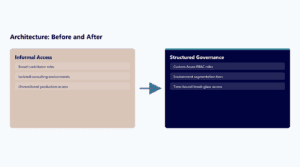
The most critical protection specialist teams provide is architectural leadership during the design phase. Senior Microsoft architects bring pattern recognition from dozens of similar implementations, allowing them to identify potential failure points that internal teams typically miss during initial planning. They establish governance frameworks that align with Microsoft’s enterprise best practices while addressing the specific compliance and operational requirements of regulated industries.
This oversight extends beyond technical design to include risk management frameworks that CIOs can present to boards and audit committees. Architect-led teams document design decisions, establish acceptance criteria for each phase, and create audit trails that demonstrate due diligence in vendor selection and implementation approach.
- Cross-platform integrations involving more than 3 systems or real-time data synchronization requirements
- Compliance frameworks that require specific audit trails, data retention policies, or access control documentation
- First-time implementations of Microsoft platforms in regulated environments or customer-facing operations
- Programs affecting more than 500 users or requiring integration with mission-critical business processes
- Timeline constraints that don’t allow for learning curves or architectural rework during development phases
Dedicated Pods for the Highest-Risk Work Streams
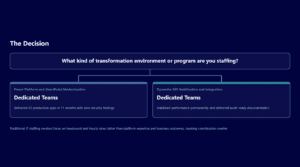
Rather than spreading specialist resources across the entire program, the most effective approach concentrates senior Microsoft expertise on the work streams that pose the greatest risk to overall program success. A Power Platform integration pod might own all connections between Dataverse and existing ERP systems, ensuring data flows are secure, performant, and auditable. A Dynamics 365 configuration pod might focus on the customer data model and business process automation that affects regulatory reporting requirements.
This concentrated approach allows internal teams to continue managing lower-risk components while ensuring that the most complex technical challenges receive appropriate expertise. Time-to-production for complex Power Platform rollouts improved by 25 to 40% when architect-led external teams handled the highest-risk integration work streams, primarily because these teams could work in parallel with internal teams without creating coordination overhead or knowledge transfer delays.
Where Specialist Teams Add the Most Protection
Cross-Platform Integrations and Data Flows
Microsoft transformations must integrate with existing ERP systems, CRM platforms, manufacturing execution systems, and regulatory reporting tools. These integrations represent the highest technical risk because they involve systems that the Microsoft platform team cannot fully control, data transformation requirements that are difficult to validate until production load, and security boundaries that affect compliance posture.
Cross-platform integrations also create the highest operational risk because failures affect multiple business processes simultaneously. When a Power Platform app cannot reliably sync data with the ERP system, the failure disrupts order processing, inventory management, and financial reporting workflows that executives monitor daily.
- Data volume exceeding 100,000 records per day or real-time synchronization requirements
- Integration with systems that lack modern APIs or require custom middleware development
- Cross-system workflows that affect regulatory reporting or customer-facing operations
- Security boundaries that span multiple authentication domains or compliance frameworks
- Integration patterns that haven’t been validated in production environments similar to yours
Compliance-Critical Workflows and Reporting
In regulated industries, Microsoft platform implementations must satisfy specific audit requirements for data handling, access controls, and process documentation. Regulatory audit findings related to Microsoft platform governance decreased by 80% when organizations embedded compliance-experienced Microsoft specialists who understood both the platform capabilities and the specific regulatory frameworks.
Specialist teams bring experience with compliance frameworks like SOC 2, HIPAA, and CMMC, allowing them to implement governance controls that satisfy audit requirements without creating operational friction for business users. They establish documentation standards, approval workflows, and access control policies that demonstrate due diligence to regulatory bodies and internal audit teams.
First Deployments into New Regions, Business Units, or Platforms
The initial deployment of Microsoft platforms into new organizational contexts carries disproportionate risk because it establishes architectural patterns, governance frameworks, and operational procedures that affect all subsequent rollouts. Specialist teams provide protection by implementing proven architectural patterns rather than experimenting with approaches that might work in development but fail at enterprise scale.
Board-level program reviews showed 3x higher confidence scores when CIOs could demonstrate external Microsoft expertise validation of critical design decisions, particularly for first deployments that would affect multiple business units or customer-facing operations.
Real-World Examples of De-Risked Microsoft Programs
Turning Around a Struggling Dynamics 365 Initiative
A mid-sized aerospace manufacturer had spent eight months and $1.8M on a Dynamics 365 implementation that was failing to meet basic functional requirements. The customization strategy violated Dynamics 365 best practices, creating upgrade paths that would require complete reimplementation. The data integration approach used point-to-point connections that couldn’t scale beyond the pilot department. The security model didn’t align with the organization’s existing access control frameworks, creating audit findings that required immediate remediation.
The specialist team implemented a rescue strategy that salvaged the business process analysis and user training investments while rebuilding the technical foundation using proven enterprise patterns: establishing a hub-and-spoke integration architecture that could scale across business units, implementing governance controls that satisfied audit requirements, and creating deployment procedures that the internal team could manage ongoing. The program completed successfully six months later, within the original budget, and became the template for subsequent Dynamics 365 deployments across other business units.
Preventing Issues in a Large Power Platform Rollout
A regional financial services firm was planning a Power Platform rollout that would replace Excel-based risk reporting processes with automated workflows connected to multiple trading systems. Senior Microsoft specialists embedded as a governance overlay identified several critical risks during the first 30 days: the proposed data model couldn’t handle transaction volumes during market volatility, the integration approach created security vulnerabilities that would fail compliance review, and the deployment strategy didn’t include rollback procedures required for customer-facing applications.
Working with the internal team, the specialists redesigned the data architecture, implemented integration patterns that satisfied regulatory security requirements, and established deployment gates with automated testing and rollback capabilities. The program deployed successfully on schedule and passed regulatory review without findings. Organizations using specialist pods for compliance-critical workflows report 90% fewer audit exceptions and faster regulatory approval cycles, precisely because this type of proactive governance implementation prevents the findings that reactive remediation creates.
Communicating Risk and Mitigation to Finance, Risk, and the Board
Positioning Specialist Teams as Risk Controls, Not Just Extra Capacity
The key to securing executive support lies in framing specialist teams as risk controls rather than additional development resources. CFOs and risk committees understand the language of controls, audit findings, and regulatory compliance, concepts that translate directly into budget justification when specialist teams are positioned as governance mechanisms rather than consulting services.
When presenting specialist team recommendations to finance stakeholders, successful CIOs frame the investment in terms of risk reduction rather than delivery acceleration. Instead of “we need external developers to go faster,” the conversation becomes “we need specialized controls to ensure audit readiness and regulatory compliance.” The cost-benefit analysis becomes compelling when specialist teams are positioned against the potential cost of program failure: the investment in specialist oversight represents insurance against career-defining failures that significantly exceed the cost of prevention.
Aligning Program Assurance with Internal Audit and Risk Committees
Smart CIOs involve internal audit and risk committees in specialist team selection and oversight, creating alignment that supports both program success and executive defensibility. Internal audit teams become natural allies for specialist team engagements because they understand the documentation and control requirements that support audit readiness. When specialist teams produce risk registers, control matrices, and governance documentation that align with internal audit standards, they strengthen overall program governance while providing audit teams with evidence of due diligence.
Risk committees provide another alignment opportunity: establishing specialist team engagement criteria that mirror other risk management decisions. This alignment also creates accountability mechanisms that protect the CIO’s decision-making: when internal audit and risk committees participate in scope definition and progress reviews, the CIO can demonstrate that external expertise deployment followed established governance processes rather than ad-hoc resource decisions.
How i3solutions Provides Program Assurance for Microsoft Transformations
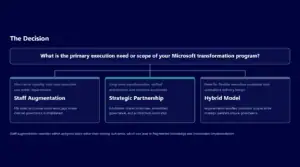
i3solutions structures specialist engagements around three primary formats that address different risk profiles and program maturity levels. Program Assurance Pods embed senior Microsoft specialists with internal teams from program initiation, providing architecture guidance and governance oversight throughout the implementation lifecycle while focusing on the highest-risk work streams. Rescue Teams intervene when existing programs show signs of failure or significant risk exposure, beginning with rapid assessment to identify root causes before proceeding to architecture stabilization. Governance Overlays provide compliance and audit readiness support for programs that have solid technical foundations but require specialized documentation and control frameworks.
The architect-led model ensures that specialist expertise influences daily design decisions, code reviews, and architectural choices while building internal team capabilities through direct collaboration and knowledge transfer. Embedded teams provide continuous risk monitoring rather than periodic assessments, identifying architectural risks and governance gaps as they emerge rather than during formal review cycles. Rather than creating dependency on external resources, the embedded model builds internal capabilities that support long-term platform governance and reduce the need for ongoing external support after initial implementation phases complete.
Frequently Asked Questions: Microsoft Specialist Teams and Program Risk
What happens if our Microsoft transformation fails during board review cycles?
Failed Microsoft programs create immediate executive credibility issues because they affect every business function and carry high visibility to stakeholders. The career impact extends beyond IT when promised efficiency gains, compliance improvements, or customer experience enhancements don’t materialize. Senior architect oversight identifies risks before they become board-level issues, and governance frameworks produce audit trails and risk documentation that demonstrate due diligence even when programs encounter unexpected challenges.
When does it make sense to bring in external Microsoft specialists versus handling implementation internally?
External specialists become essential when programs involve cross-platform integrations, compliance-critical workflows, or first deployments that establish enterprise patterns. Internal teams excel at routine development but often lack experience with complex Microsoft governance frameworks and enterprise integration patterns at scale. The most effective approach focuses specialists on the highest-risk work streams while internal teams handle familiar components, particularly for programs exceeding $2M investment, affecting multiple business units, or requiring regulatory compliance validation.
What does the first 30 days look like when embedding specialist teams?
The initial phase focuses on rapid risk assessment and architecture validation rather than immediate development work. Senior Microsoft architects review existing designs, identify critical risks that internal planning missed, and establish governance frameworks for the highest-risk components. The first month produces risk registers, architectural recommendations, and governance documentation that supports ongoing program oversight and audit readiness.
What specific deliverables prove that specialist oversight is working?
Effective specialist engagement produces measurable governance artifacts including risk registers with mitigation strategies, integration architecture documentation that passes audit review, and deployment procedures that internal teams can replicate. These include compliance matrices mapping platform configurations to regulatory requirements, automated testing frameworks validating integration reliability, and governance controls demonstrating due diligence to internal audit teams.
How is this different from hiring a generic consulting firm or adding contract developers?
Generic consulting firms typically lack deep Microsoft platform expertise and enterprise governance experience that high-stakes programs require. Contract developers add capacity without providing architectural oversight or risk management capabilities. i3solutions provides senior Microsoft architects with proven experience in regulated environments who embed directly with internal teams rather than operating as separate workstreams, understanding both Microsoft platform capabilities and enterprise compliance requirements, enabling governance frameworks that satisfy audit requirements while building internal team capabilities.