Dedicated Microsoft Teams vs Traditional IT Staffing

Most enterprise IT leaders have sat through the same staffing vendor pitch: “We’ll find you the right people at the right rate.” The conversation centers on headcount, hourly rates, and skill keywords pulled from job descriptions. The vendor promises to deliver “SharePoint developers” or “Power Platform consultants” within two weeks, often without understanding the specific Microsoft environment, governance requirements, or integration constraints that define success in your organization. This transactional approach treats technical talent like interchangeable units, creating a fundamental mismatch for complex Microsoft-based transformation programs where platform expertise, architectural alignment, and institutional knowledge determine outcomes more than raw coding capacity.
Key Takeaways
- Traditional staffing vendors focus on headcount and hourly rates rather than platform expertise and business outcomes, creating coordination overhead and architectural drift in complex Microsoft environments where fragmented ownership is a compliance liability.
- Contractor turnover rates of 40-60% on long-term Microsoft transformation programs force repeated knowledge transfer cycles and compliance re-training, consuming 15-20% of available project time.
- Regulated industries face 2-3x higher vendor risk management overhead with individual contractors versus dedicated teams, plus extended security approval cycles that delay critical initiatives.
- Dedicated Microsoft-specialist teams deliver 25-40% faster delivery velocity through reduced context-switching and consistent platform expertise across Power Platform, SharePoint, Dynamics 365, and Azure integrations.
- Stable team pods with end-to-end accountability eliminate the fragmented ownership that causes integration failures and compliance gaps in enterprise transformation programs.
- Organizations using dedicated teams report 60% reduction in audit preparation time due to established governance documentation and clear accountability chains versus individual contractor arrangements.
Quick Answer
Traditional IT staffing fails enterprise Digital Transformation because it treats technical talent like interchangeable units, creating fragmented ownership, knowledge loss through high contractor turnover, and compliance gaps in regulated environments. The solution is dedicated Microsoft-specialist teams that provide stable expertise, end-to-end accountability, and deep platform knowledge aligned with enterprise governance requirements.
How Traditional IT Staffing Is Sold to Enterprises
The Headcount Mindset
When an IT Director says “We need three Power Platform developers for six months,” the staffing firm focuses on finding individuals with Power Apps and Power Automate on their resumes. They do not focus on understanding how those developers will integrate with existing SharePoint governance, align with enterprise architecture standards, or navigate the organization’s specific compliance requirements.
This headcount-first approach assumes that adding more individual contributors automatically increases delivery capacity. In practice, it creates coordination overhead, knowledge fragmentation, and architectural drift as contractors work in isolation from broader platform strategy and organizational context.
Rate Cards, Generic Skill Tags, and Minimal Context
Staffing vendors present standardized rate cards with skill categories like “Senior SharePoint Developer” or “Power Platform Architect” without differentiating between someone who has built departmental Power Apps and someone who has architected enterprise-grade Dataverse solutions with complex security boundaries. The evaluation process relies on generic skill tags and brief interviews that cannot assess deep Microsoft platform expertise, regulatory compliance experience, or the ability to work within established governance frameworks.
A contractor may have five years of “Power Platform experience” but lack exposure to the ALM practices, environment management disciplines, and architectural patterns that enterprise Microsoft transformations require.
Where Traditional IT Staffing Breaks in Microsoft-Centric Transformation
Fragmented Ownership Across Contractors and Internal Teams
When contractors are sourced individually through different vendors, accountability becomes diffused across multiple parties. A Power Platform modernization might involve contractors from three different staffing firms plus internal resources, each with different reporting structures, contract terms, and success metrics. When integration issues surface between SharePoint, Dataverse, and legacy systems, determining responsibility becomes a committee exercise rather than a technical one.
Some financial services firms report spending 40-60% of project management time on contractor coordination rather than delivery oversight when using traditional staffing models. The result: longer decision cycles, unclear escalation paths, and increased risk of scope gaps falling between contractors.
Lack of Deep Microsoft Platform Expertise
Generic staffing vendors treat Microsoft platforms as interchangeable skill tags. A contractor labeled “Power Platform Developer” might have built basic canvas apps but lack experience with Dataverse security models, ALM pipelines, or enterprise governance patterns. Similarly, “SharePoint expertise” often means familiarity with basic site creation, not modern SharePoint architecture, hybrid scenarios, or compliance frameworks.
The platform depth gap becomes critical during integration work. Connecting Dynamics 365 to Power Platform requires understanding licensing boundaries, API rate limits, and security contexts that generic contractors rarely possess. A manufacturing company’s SharePoint modernization required 8 weeks of rework when contractors delivered solutions that failed internal architecture reviews, versus 2-week iterations with dedicated Microsoft-specialist teams.
High Churn and Knowledge Loss Across Long Programs
Traditional staffing contracts optimize for vendor margin, not program continuity. Contractors rotate off projects when their rates reset, market opportunities arise, or staffing vendors reassign them to higher-margin engagements. Traditional staffing models typically show 40-60% contractor turnover on 12+ month Microsoft transformation programs, compared to under 15% turnover with dedicated team models.
Healthcare organizations operating under HIPAA requirements report that contractor churn forces repeated security training, access provisioning, and knowledge transfer cycles that consume 15-20% of available project time. Each rotation introduces new compliance risk as replacement contractors learn organizational policies, data handling requirements, and approval processes from scratch.
Why Regulated Environments Raise the Stakes
Governance, Security, and Compliance Requirements That Contractors Often Miss
Many IT contractors understand basic security hygiene but lack deep familiarity with industry-specific compliance frameworks. A financial services firm experienced audit findings when individual contractors implemented Power Apps without proper data classification, requiring $180K in remediation and compliance documentation. Individual contractors struggle with CMMC requirements, ITAR data handling restrictions, and export control boundaries that are second nature to specialists in that domain.
The problem compounds when contractors rotate through assignments every 6 to 12 months. Each new contractor must learn not just the technical environment, but the regulatory context, the audit history, and the specific compliance interpretations your organization has developed over years of working with auditors. This learning curve creates gaps where compliance requirements get missed or misunderstood.
Auditability, Access Control, and Vendor Risk Management
Regulated environments require detailed audit trails, documented decision rationales, and clear accountability chains. When an auditor asks “who made this architecture decision and why,” pointing to a contractor who left six months ago is not an acceptable answer.
Regulated industries face 2-3x higher vendor risk management overhead with traditional staffing due to individual contractor vetting requirements versus single-vendor team relationships. Healthcare organizations report 3-5x longer security approval cycles when using individual contractors versus pre-vetted dedicated teams with established compliance frameworks.
Dedicated Microsoft-Specialist Teams as the Alternative Model
Stable Pods with End-to-End Accountability
Dedicated teams operate as stable pods with consistent membership across the engagement lifecycle. A typical pod includes a senior architect, 2 to 3 developers with complementary Microsoft platform expertise, and a delivery lead who owns sprint planning and stakeholder communication. The pod takes end-to-end accountability for defined outcomes, not just hours delivered.
This stability eliminates the knowledge transfer overhead that plagues contractor-heavy programs. When the same team owns discovery, architecture, build, and deployment, they accumulate context that translates directly into faster delivery and fewer integration surprises. Enterprise Power Platform implementations show 25-40% faster velocity with dedicated teams due to reduced context-switching and consistent Microsoft platform expertise.
Platform and Domain Expertise Built Around Microsoft Ecosystems
Dedicated Microsoft teams bring deep, current expertise across the Microsoft ecosystem: Power Platform, SharePoint, Dynamics 365, Azure DevOps, and the integration patterns that connect them. This is platform-native expertise that understands Microsoft licensing implications, security boundaries, ALM patterns, and the governance frameworks that enterprise environments require.
Team members understand how Power Apps integrates with Dataverse, how SharePoint permissions interact with Microsoft Entra ID groups, and how to structure Power Automate flows that survive audit review. This depth reduces architectural rework and prevents the integration debt that accumulates when contractors treat Microsoft platforms as generic development environments.
Alignment with Internal Architecture, Governance, and Risk Owners
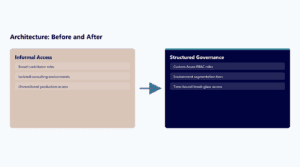
Dedicated teams integrate directly with internal architecture, security, and compliance stakeholders rather than operating in isolation. The team lead participates in architecture review boards, the security specialist aligns with internal security policies, and the delivery lead provides transparent progress reporting that supports internal governance requirements. The dedicated team becomes an extension of internal capabilities rather than an external black box.
Scenario Comparisons: Traditional Staffing vs Dedicated Teams
Scenario 1: Power Platform and SharePoint Modernization
A financial services firm hired individual contractors through three different staffing vendors to modernize 47 Excel-based workflows into Power Apps and migrate SharePoint 2016 to SharePoint Online. Each contractor worked independently with minimal coordination. After 14 months, only 12 workflows were production-ready. The remaining apps failed security review due to inconsistent data governance patterns. Total rework: 6 months and $340K in additional budget.
A similar organization used a dedicated Microsoft-specialist team of 4 developers with shared accountability. The team established governance patterns upfront, delivered 45 production apps in 11 months, and completed SharePoint migration with zero security findings. No rework required.
Scenario 2: Dynamics 365 Stabilization and Integration
An aerospace manufacturer added individual Dynamics consultants to fix performance issues and integrate with their ERP system. Each contractor focused on isolated components without understanding the broader architecture. Performance improved temporarily but degraded again within 3 months. When 3 of 4 contractors left mid-project, complete knowledge transfer and rework of governance frameworks consumed 6 additional months.
A dedicated team with Dynamics and integration expertise stabilized performance permanently, delivered audit-ready documentation, and established monitoring that prevented future degradation.
The pattern is consistent: fragmented ownership creates fragmented outcomes, while dedicated teams deliver sustained results with lower risk.
How to Transition Away from Traditional Staffing Vendors
Start with programs where traditional staffing creates the highest risk. Power Platform governance initiatives are particularly vulnerable: individual contractors lack the cross-platform expertise to implement proper ALM pipelines, environment boundaries, and data loss prevention policies. Dynamics 365 integrations with existing ERP or CRM systems require deep understanding of both platforms that generic staffing rarely provides.
Implement a parallel approach rather than wholesale replacement. Begin with a pilot dedicated team on your highest-risk Microsoft initiative while existing contractors continue lower-risk maintenance work. Structure the transition with clear acceptance criteria: architecture documentation, security compliance artifacts, user adoption metrics that demonstrate the dedicated team’s superior outcomes.
How i3solutions Structures Dedicated Microsoft Teams
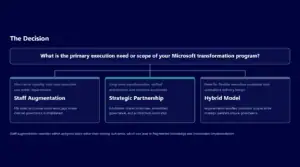
i3solutions structures dedicated Microsoft teams around three core engagement models, each designed to integrate seamlessly with existing internal stakeholders while maintaining clear accountability for outcomes.
Surge Capacity provides 2 to 4 senior Microsoft specialists who embed directly with internal teams during critical phases: architecture definition, go-live preparation, or post-launch stabilization. i3Solutions provides this embedded senior talent through its IT staff augmentation services. This model works best when internal teams have strong project management and architecture leadership but need deep Microsoft platform expertise for complex integrations.
Transformation Pods deliver complete 4 to 6 person teams with their own technical lead, architect, and delivery manager. The pod takes end-to-end ownership of defined workstreams such as a Power Platform modernization initiative or SharePoint governance implementation while coordinating closely with internal stakeholders.
Hybrid Teams combine dedicated i3solutions specialists with selected internal team members in a unified delivery structure. Internal team members gain hands-on Microsoft expertise while maintaining institutional knowledge, and i3solutions specialists ensure delivery quality and timeline adherence.
Regardless of engagement model, i3solutions teams integrate with existing governance structures. Our architects work directly with Enterprise Architecture teams to ensure solution patterns align with organizational standards. For regulated environments, this includes maintaining audit trails, access control documentation, and vendor risk assessments that support internal compliance reporting. Organizations report 60% reduction in audit preparation time when using dedicated teams with established governance documentation versus individual contractor arrangements.
Frequently Asked Questions: Dedicated Microsoft Teams vs Traditional IT Staffing
What operational risks do we face if we continue using traditional staffing vendors for Microsoft transformation?
Fragmented accountability across multiple vendors, knowledge loss from 40-60% contractor turnover, and compliance gaps that create audit exposure. Traditional staffing creates coordination overhead where 40-60% of project management time goes to contractor management rather than delivery oversight. Architectural drift, security vulnerabilities, and integration failures requiring expensive rework are the predictable outcomes.
When is i3solutions not the right fit for Microsoft transformation programs?
We are not the right fit for basic maintenance work, simple single-platform requirements, or organizations that prefer managing individual contractors directly. Our dedicated team model is designed for complex, multi-platform Microsoft transformations where governance, integration complexity, and compliance requirements demand deep expertise and stable ownership, primarily regulated environments with 1,000+ employees.
What does the first 30 days look like when transitioning from traditional staffing to dedicated teams?
The first 30 days focus on knowledge transfer, governance alignment, and establishing delivery rhythms with your internal stakeholders. i3solutions conducts architecture reviews, stakeholder mapping, and compliance framework alignment during this period to ensure seamless integration with your existing governance structures. We deliver a formal transition plan with defined acceptance criteria and success metrics that demonstrate improved outcomes versus your previous staffing approach.
What specific artifacts do dedicated teams produce that traditional contractors don’t?
Comprehensive architecture documentation, security compliance mappings, audit-ready governance frameworks, and institutional knowledge repositories that survive team transitions. i3solutions delivers documented decision rationales, vendor risk assessments, access control documentation, and compliance audit trails that support your internal governance reporting requirements.
How do you handle governance and compliance requirements that caused problems with previous contractors?
We embed governance and compliance into our delivery process rather than treating it as an afterthought, with formal security reviews at each sprint gate and documented compliance mappings delivered alongside functional requirements. Our teams maintain dedicated compliance specialists who understand CMMC, HIPAA, SOC 2, and financial services regulations within Microsoft environments, providing audit trail documentation and access control frameworks that reduce audit preparation time by 60%.
Deciding between a dedicated team and another contractor round is a numbers question: a scoping call prices both paths against your backlog.