Onboarding External Agile Teams in Regulated Enterprises
For IT leaders in aerospace, defense, financial services, and other regulated industries, bringing in external Microsoft specialists feels like opening a controlled environment to unknown variables. The stakes are high: a single access misstep can trigger audit findings, compliance violations, or security incidents that take months to remediate. Yet internal teams often lack the specialized Microsoft expertise needed for Power Platform modernization, SharePoint migrations, or Dynamics 365 integrations. The question is not whether to engage external teams – it is how to do it without compromising the controls that protect your organization.
Key Takeaways
- External team onboarding in regulated environments takes 3 to 6 weeks when done properly, but prevents 80–90% of accidental production access violations through proper environment segregation – making it time well spent before productive delivery begins.
- Organizations report 40–60% reduction in security incidents when using structured vendor onboarding processes with least-privilege access controls, primarily because contractors cannot accidentally access systems outside their defined scope of work.
- Failed vendor onboardings cost an average of 2 to 4 weeks of project delays and $25K–$75K in rework for mid-enterprise organizations, primarily due to access violations and compliance gaps discovered during audits rather than during setup.
- Clear role definitions and RACI matrices reduce vendor-related access disputes by 70–80% during project execution by establishing decision authority upfront rather than negotiating it in the middle of delivery.
- Shadow IT tool usage by vendors occurs in 60–70% of engagements without explicit tooling guidelines, but can be prevented through proactive capability gap analysis before external teams arrive.
- Structured onboarding with security orientation reduces vendor-related compliance findings by 50–60% in regulated industries by establishing monitoring and audit trails from day one rather than retrofitting them after issues arise.
Quick Answer
Onboarding external agile teams in regulated enterprises requires a structured 4 to 6 week process that establishes least-privilege access controls, segregated environments, and clear governance boundaries before productive work begins. The key is treating security and compliance requirements as delivery enablers rather than obstacles, using role-based access control and comprehensive monitoring to create audit trails while maintaining development velocity.
Why Onboarding External Teams Feels Risky in Regulated Enterprises
Concerns from Security, Compliance, and Vendor Risk Management
Security teams worry about expanding the attack surface. External consultants need access to development environments, potentially production data for testing, and collaboration tools that connect to internal systems. Each new user account represents a potential entry point for unauthorized access, especially when vendors bring their own devices, networks, and security practices that may not align with enterprise standards.
Compliance officers focus on audit trails and data handling. External teams often need access to systems containing regulated data – financial records, healthcare information, or controlled technical data in defense environments – and the controls governing that access must be demonstrable to auditors before, during, and after the engagement.
Vendor risk management teams have seen the patterns: external teams that request broader access than needed, use unapproved collaboration tools, or fail to follow established change control processes. In regulated environments, these failures can cascade into compliance violations, failed audits, or security incidents that damage both the project and the organization’s reputation.
Past Experiences with Vendors Who Did Not Respect Controls
Common failure patterns include consultants who bypass approved communication channels, request administrative access “to work faster,” or install unapproved software on enterprise devices. The most damaging pattern involves vendors who establish shadow access to systems – using personal accounts, unapproved cloud services, or direct database connections that circumvent established security boundaries.
These shortcuts may accelerate initial development, but they create untracked access paths and compliance gaps that surface during audits or security reviews. Organizations report that failed vendor onboardings cost an average of 2 to 4 weeks of project delays and $25K–$75K in rework for mid-enterprise organizations, primarily due to the need to remediate access violations, rebuild environments with proper controls, and satisfy compliance requirements that were bypassed during initial setup.
Designing an Onboarding Playbook for External Microsoft Teams
Defining Roles, Scope, and Allowed Systems
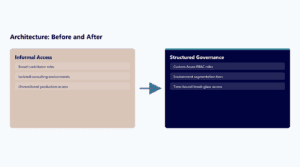
Start by mapping the external team’s responsibilities to specific Microsoft systems and environments. A Power Platform development team might need access to development and test environments in Dataverse, Power Apps, and Power Automate, but should never require production access during normal development activities. Document these boundaries explicitly: which environments, which data sets, which administrative functions, and which integration endpoints.
Role-based access control (RBAC) provides the technical framework for implementing these boundaries. For external Microsoft teams, this typically means developer-level access to non-production environments, read-only access to production for troubleshooting, and no access to user administration or security configuration.
Create a RACI matrix that defines who owns access decisions, who approves changes, and who monitors ongoing activity. External teams should never have the authority to grant themselves additional access or modify security configurations – these decisions must remain with internal IT and security teams throughout the engagement.
Aligning Contracts with Security, Compliance, and Audit Requirements
Technical controls are only effective when supported by contractual requirements that make security and compliance obligations legally binding. The contract should specify data handling requirements, acceptable use policies, and incident response procedures that align with your organization’s regulatory obligations.
Include specific language about approved tools and communication channels. External teams should be contractually required to use enterprise-managed Microsoft Teams, SharePoint, and Azure DevOps rather than their own collaboration platforms. This ensures that all project communication and file sharing occurs within your organization’s security boundary and audit logging framework.
Define clear consequences for control violations, including immediate access revocation and potential contract termination. Organizations with formal vendor onboarding checklists report 50% faster time-to-productivity for external agile teams because both sides understand expectations from day one, reducing the friction and delays that occur when access requirements are negotiated during project execution.
Access Control and Identity Management for External Teams
Least-Privilege Access and Role-Based Access Control
External teams should receive the minimum access required to complete their specific deliverables, with permissions granted at the resource level rather than broadly across your Microsoft environment. Start with role-based templates that map to common engagement types: Power Platform Developer (Canvas Apps and Dataverse), SharePoint Migration Specialist (specific site collections only), or Dynamics 365 Integrator (limited to designated environments). Each role template should specify exactly which resources, environments, and operations are permitted, with explicit deny rules for everything else.
Organizations report 40–60% reduction in security incidents when using structured vendor onboarding with least-privilege access controls, primarily because contractors cannot accidentally access systems outside their scope of work. The key is making permissions specific enough to prevent environment bleed while broad enough to avoid constant access requests that slow down delivery.
Regular access reviews – typically weekly during active development – ensure that permissions remain aligned with current work. External teams often need temporary elevated access for specific tasks like environment setup or data migration, but these permissions should be time-limited and automatically revoked rather than becoming permanent fixtures.
Segregated Environments for Development, Testing, and Production
Environment segregation is non-negotiable for external teams in regulated industries. Contractors should never have direct production access, and their development work should occur in isolated environments that mirror production without containing live data or integrated systems. Proper environment segregation prevents 80–90% of accidental production access violations by external teams.
Create dedicated vendor environments that are functionally equivalent to your production systems but completely isolated from live operations. For Power Platform engagements, this means separate environments with their own Dataverse instances, connection references, and security groups. For SharePoint modernization, provide isolated site collections or separate tenants that contain representative data structures without sensitive information.
The segregation model should include clear promotion pathways: vendor development environment, then internal testing environment, then production deployment by internal teams. External teams should never deploy directly to production regardless of their experience level or contract terms. This creates a natural checkpoint where internal teams validate deliverables against security, compliance, and operational requirements before go-live.
Tooling and Communication Channels
Enterprise-Approved Collaboration Tools
External teams should use your enterprise-approved collaboration platforms rather than bringing their own tools. Microsoft Teams provides secure communication channels with built-in compliance features, while SharePoint Online offers document collaboration with proper version control and access logging. Organizations using Microsoft Teams and SharePoint for vendor collaboration report 30–40% better audit trail completeness compared to those allowing vendors to choose their own tools.
Create dedicated Teams channels or SharePoint sites for vendor collaboration, with membership limited to authorized internal staff and external team members. Configure retention policies and legal hold capabilities according to your compliance requirements. Establish explicit guidelines: email for formal notifications only, real-time collaboration through Teams, file sharing through SharePoint or Teams file repositories – never through external services like Dropbox or Google Drive.
Logging and Monitoring of Vendor Activity
Enable audit logging across all systems that external teams access: Azure AD sign-in logs, SharePoint access logs, Power Platform activity monitoring, and Teams communication records. Configure alerts for unusual access patterns such as after-hours activity, access from unexpected locations, or attempts to access out-of-scope resources.
Create monitoring dashboards that provide visibility into vendor activity without requiring manual log review. Track metrics like resource access patterns, development velocity, and compliance with approved tooling guidelines. Structured onboarding with security orientation reduces vendor-related compliance findings by 50–60% in regulated industries, primarily because monitoring and logging requirements are established upfront rather than retrofitted after issues arise.
Example Onboarding Timeline for a Microsoft-Specialist Agile Pod
Contract execution with technical appendices. Submit access requests immediately – identity provisioning typically requires 5 to 10 business days in regulated environments. Create external user accounts in Azure AD, provision designated environments, configure conditional access policies, and set up collaboration spaces with audit logging.
Architecture walkthroughs covering environment topology, integration patterns, and security boundaries. Review development and deployment standards: coding conventions, solution packaging, testing procedures, and documentation expectations specific to your Power Platform, SharePoint, or Dynamics 365 environment.
Teams operating independently within established guardrails with minimal access management overhead. Teams that complete structured onboarding typically achieve 80–90% of expected velocity by week 6, compared to 60–70% for teams that skip orientation and learn your environment through trial and error.
Weekly access reviews during active development, monthly during maintenance phases. Monitor development velocity within approved environments, compliance with tooling guidelines, and absence of security or access violations. Regular checkpoints prevent the permission drift that creates audit findings.
Common Failure Points and How to Avoid Them
Unclear Ownership of Access and Governance Decisions
The most common onboarding failure involves ambiguous decision authority between internal stakeholders and external teams. When external Microsoft specialists encounter technical roadblocks or need elevated permissions, unclear ownership creates delays while stakeholders debate who has authority to approve access changes.
The solution requires explicit decision matrices that address common scenarios: “Who approves Power Platform connector additions?” “Who authorizes production environment access for troubleshooting?” “Who decides whether to modify SharePoint permission inheritance patterns?” Clear role definitions and RACI matrices reduce vendor-related access disputes by 70–80% during project execution, but only when the matrices address realistic operational scenarios rather than generic governance categories.
Shadow Access and Unapproved Tool Usage by Vendors
Shadow IT adoption by external teams represents the most persistent compliance risk in vendor onboarding. External Microsoft specialists often arrive with preferred collaboration tools, development utilities, or file-sharing services that accelerate their internal workflows but violate enterprise governance policies.
Prevention requires proactive tooling evaluation rather than reactive policy enforcement. Before external teams arrive, IT leaders should review their standard tool sets and identify capability gaps that might encourage shadow IT adoption. Shadow IT tool usage by vendors occurs in 60–70% of engagements without explicit tooling guidelines and monitoring. The response to shadow IT discovery should focus on understanding the underlying need rather than simply enforcing policy compliance – if an external team is using an unapproved tool, there is usually a legitimate capability gap that can be addressed through approved alternatives.
How i3solutions Handles Onboarding into High-Control Environments
i3solutions approaches regulated environment onboarding as a competitive differentiator rather than compliance overhead. Our experience with defense contractors, financial services firms, and healthcare organizations has taught us that structured onboarding processes actually accelerate delivery velocity while strengthening governance and audit readiness.
Security team collaboration focuses on technical controls rather than policy compliance. We provide detailed access request documentation that maps business requirements to specific Microsoft permissions, propose least-privilege access models that satisfy both delivery needs and security constraints, and offer monitoring and logging configurations that provide visibility without creating operational overhead.
Compliance team engagement addresses audit readiness from project initiation rather than post-implementation remediation. We provide documentation templates that satisfy common audit requirements, propose work product organization that supports regulatory review processes, and establish communication protocols that ensure compliance stakeholders receive appropriate visibility into project progress. Compliance-ready documentation is a standard deliverable, not an optional add-on.
Our onboarding methodology includes standardized artifacts – technical runbooks covering Microsoft-specific operational procedures, security checklists mapping regulatory requirements to technical controls, training materials addressing the intersection of platform functionality and regulatory constraints, and documentation templates ensuring work products satisfy audit requirements. This collaborative approach typically reduces onboarding timelines by 30–40% compared to adversarial vendor relationships where security and compliance teams must discover and remediate gaps after project initiation.
Frequently Asked Questions: Onboarding External Agile Teams in Regulated Enterprises

What happens if our external Microsoft team accidentally accesses production data during development?
Accidental production access triggers immediate access review and potential compliance violations that can take weeks to remediate. Proper environment segregation with isolated development environments prevents this scenario entirely. Dedicated vendor environments that mirror production functionality without containing live data ensure development work occurs within safe boundaries, with detailed incident response procedures and audit documentation that demonstrate proactive risk management to compliance teams.
How do we maintain audit trails when external teams use multiple Microsoft platforms simultaneously?
Comprehensive audit trails require centralized logging across Azure AD, SharePoint, Power Platform, and Teams with automated correlation and retention policies. Without proper logging configuration, compliance teams cannot demonstrate adequate oversight of vendor activities. Unified monitoring dashboards that track vendor activity across all Microsoft platforms with automated alerts for unusual access patterns and pre-configured reports satisfy common audit requirements without requiring manual log review.
What does the first 30 days look like when onboarding external Microsoft teams?
The first 30 days focus on administrative setup, security reviews, and environment orientation rather than immediate development work. Weeks 1 to 2 cover contract execution, access provisioning, and collaboration space setup. Weeks 3 to 4 involve architecture walkthroughs, governance training, and development standard reviews. This investment in structured onboarding enables 80–90% expected velocity by week 6, compared to 60–70% for teams that skip orientation.
What specific artifacts prove compliance readiness and governance oversight?
Compliance-ready documentation includes architecture decision records with security impact assessments, role-based access control matrices with approval workflows, monitoring dashboards with automated compliance reporting, and incident response procedures with escalation paths. These artifacts demonstrate proactive risk management and provide the audit trails that regulatory reviewers require.
When is external Microsoft expertise the right fit despite high-control environment requirements?
External specialists become the right fit when internal teams lack the specialized Microsoft platform expertise required for the initiative, when program timelines cannot accommodate the internal learning curve, or when regulatory deadlines require delivery velocity that internal capacity cannot provide. Structured onboarding processes make the compliance requirements manageable while preserving the delivery benefits of specialist expertise.
What makes i3solutions different from generic implementation firms for regulated environment onboarding?
Generic consulting firms treat compliance as overhead to be minimized. i3solutions treats regulatory requirements as delivery constraints that require specialized expertise to navigate effectively – maintaining standardized onboarding artifacts specifically designed for regulated environments, established relationships with Security and Compliance teams, and Microsoft-specific governance procedures that address common audit scenarios. Our approach reduces onboarding timelines while strengthening compliance posture rather than forcing trade-offs between delivery speed and regulatory requirements.
Scot co-founded i3solutions nearly 30 years ago with a clear focus: US-based expert teams delivering complex solutions and strategic advisory across the full Microsoft stack. He writes about the patterns he sees working with enterprise organizations in regulated industries, from platform adoption and enterprise integration to the operational decisions that determine whether technology investments actually deliver.
Leave a Comment