
By Matt Lawson, Senior Consultant, i3solutions
Matt Lawson has spent more than 14 years at i3solutions guiding complex enterprise technology work from scope and system design through development, acceptance, and long-term support. His expertise spans technical oversight, solution architecture, SharePoint and Microsoft 365 delivery, Power Platform implementation, business intelligence, enterprise search, and the practical application of AI to solve real business and operational challenges.
An enterprise analytics operating model is the set of decisions that defines who owns analytics, how Power BI and Microsoft Fabric content is built and certified, and what controls apply across the estate. It turns scattered, ungoverned reporting into analytics that is owned, certified, and audit-defensible. For a regulated enterprise the choice is rarely centralized or self-service: most land on a hybrid model where a central platform team owns certified Power BI and Microsoft Fabric datasets, sensitivity labels, and Purview controls, while domain teams build self-service reports on top of them.
A new CIO asks for a single trustworthy view of the business and discovers there are four versions of the revenue number, each from a different report, each defended by the team that built it. That is the failure pattern an analytics operating model exists to prevent, and it is where most large Microsoft estates end up. Power BI is enabled, a few teams build useful reports, the reports get shared, and within a year there are hundreds of them spread across personal workspaces with no one able to say which dataset is the source of truth. The capability arrived; the operating model did not. By the time a CoE leader or enterprise architect is asked to bring it under control, the estate is already ungoverned, and the question on the table is no longer whether to govern analytics but how to do it without breaking the reporting the business now depends on.
This is rarely the result of a careless team. It is the predictable outcome of a platform that makes self-service easy and governance optional. A domain analyst builds a report against a copy of the data because that was the fastest path to an answer. A second team builds a near-duplicate dataset because they could not tell whether the first one was trustworthy. Sensitive figures end up in an export because nothing at the dataset layer stopped them. None of these are visible in a demo; they surface when an executive gets two different numbers for the same metric, or when an auditor asks who can see the underlying data and no one can produce the answer.
An enterprise analytics operating model is the artifact that replaces those implicit, per-team choices with explicit, estate-wide ones. It answers a fixed set of questions: who owns the platform, who is allowed to build certified content, how a report moves from development to production, which datasets are the certified source of truth, and how access to the data underneath them is controlled and logged. The model does not slow the business down by centralizing every report. It draws the line between what the platform team governs and what domain teams are free to build, so that self-service continues without producing an estate no one can defend.
The first and most consequential decision in an analytics operating model is how report ownership is distributed. There are three patterns, and the choice among them shapes every control that follows.
Recommended column reflects analysis from i3solutions.
Centralized ownership puts all report building inside a single BI team. Quality and consistency are high because one team controls every artifact, but the team becomes a delivery bottleneck and sits at a distance from the domains that actually understand the data. Federated ownership pushes building out to the domain teams who know the business. Delivery is faster and more relevant, but without shared controls the estate fills with inconsistent, duplicated, unmanaged content, which is the drift described above. Hybrid ownership is where most regulated enterprises land: a central platform and governance team owns the workspace structure, the certified datasets, and the controls, while domain teams build their own reports on top of those governed datasets.
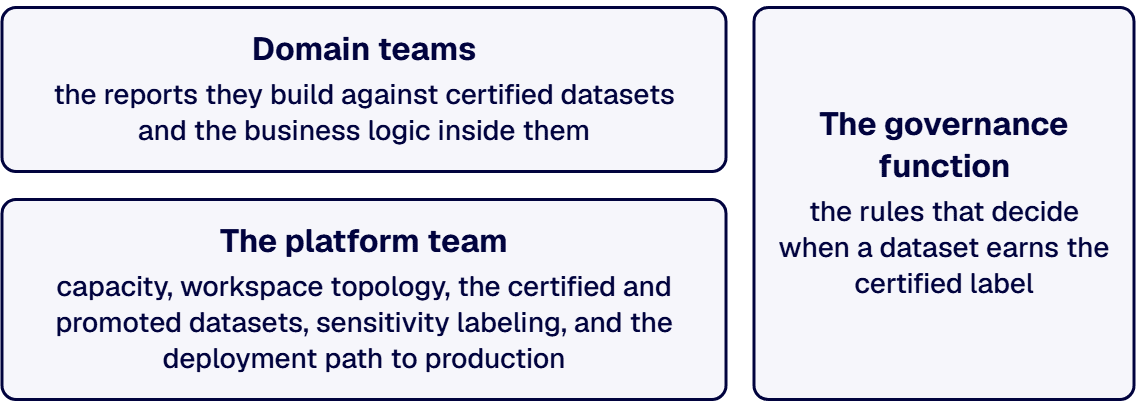
The hybrid model works only because the operating model names where each responsibility sits. The platform team owns capacity, workspace topology, the certified and promoted datasets, sensitivity labeling, and the deployment path to production. Domain teams own the reports they build against certified datasets and the business logic inside them. The governance function owns the rules that decide when a dataset earns the certified label and audits whether the estate is following them. We design this distribution as part of an enterprise Power Platform Center of Excellence, where the same ownership logic governs apps, automation, and analytics under one framework rather than three disconnected ones.
Once ownership is settled, the operating model specifies the controls that enforce it. Microsoft already provides every one of these in Power BI; the model is the decision about which apply, where, and who is accountable for them.
Workspace and capacity structure is the foundation: development, test, and production workspaces are separated, and Premium or Fabric capacity is allocated deliberately rather than by whoever clicked first. Deployment pipelines move content through those stages so that a certified production report is the output of a controlled promotion, not an edit made directly in production. Certified and promoted datasets give consumers a visible signal of which data is governed, so a domain team builds against the certified source of truth instead of cloning it. Row-level security and sensitivity labels are applied at the dataset layer, where they hold regardless of which report or export the data flows into, rather than being re-implemented per report where they inevitably diverge.
Underneath all of this sits monitoring. The Power BI and Microsoft 365 audit logs record who accessed which content and when, and the tenant settings constrain what self-service users can do, such as export, publish to web, or share externally. Microsoft documents these controls in its Power BI implementation planning guidance, which an operating model maps onto the organization’s own regulatory obligations rather than treating the platform defaults as sufficient. The result is the difference between an analytics estate you hope is governed and one whose ownership, certification, and access you can demonstrate. We build this control layer into enterprise reporting system design so that governance is part of the architecture, not retrofitted after an audit asks for it.
An operating model written for Power BI alone governs the report layer. Microsoft Fabric extends the estate downward into the data layer, and an operating model that does not follow it leaves the most sensitive part of the estate ungoverned.
Power BI governs reports, datasets, and workspaces. Fabric brings lakehouses, warehouses, data pipelines, and notebooks under the same capacity and tenant, which means the operating model now has to govern how raw and curated data is organized, accessed, and traced, not just how it is visualized. Workspaces become domains that organize data items as well as reports. OneLake holds the data the whole estate draws on, so data access and lineage become governance concerns in their own right. Capacity is now shared across analytics, data engineering, and data science workloads, so capacity management is an operating decision rather than a license detail. The same discipline that certifies a dataset has to extend to certifying the data items beneath it.
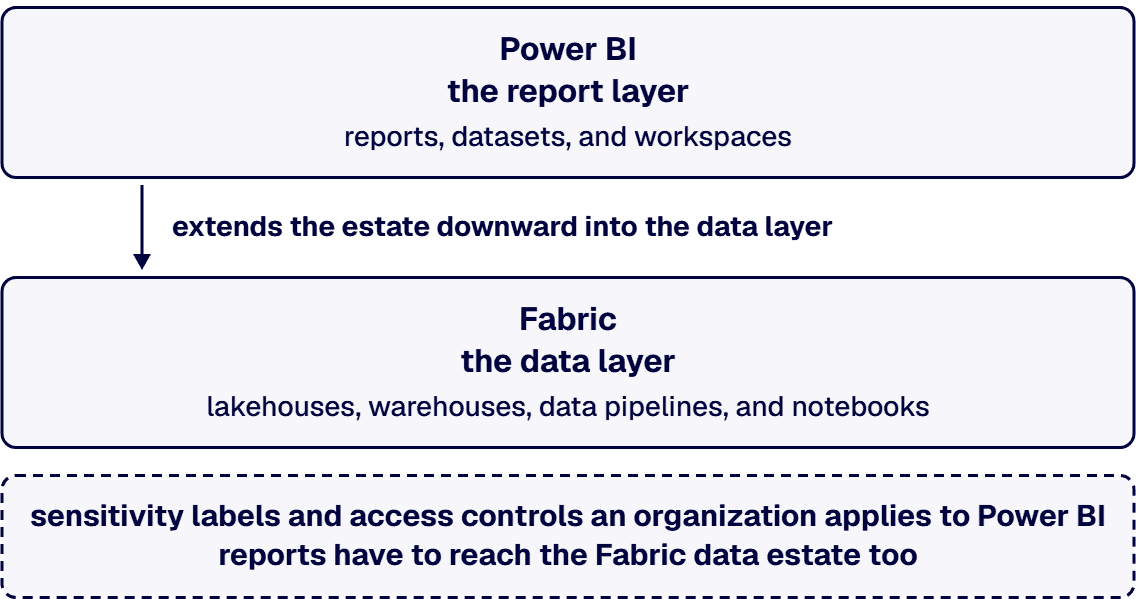
The practical implication is that the sensitivity labels and access controls an organization applies to Power BI reports have to reach the Fabric data estate too, or the governance stops exactly where the data is most exposed. We treat Microsoft Fabric development and Power BI governance as one operating model rather than two, because in a unified Fabric tenant they are no longer separable. Microsoft’s own Fabric governance and compliance guidance describes the controls; the operating model decides how they apply across the organization’s domains.
For a regulated organization, the cost of skipping the operating model is not abstract. It surfaces as an audit finding, and the questions an assessor asks map directly onto the controls an analytics operating model puts in place.
An assessor asks who owns a given report and the data behind it, how access to that data is controlled, and whether that access is logged and reviewable. An ungoverned estate fails all three: ownership is diffuse because reports live in personal workspaces, access control is inconsistent because row-level security was implemented per report or not at all, and the audit trail is incomplete because no one configured monitoring before the estate grew. The same failure pattern shows up across the broader platform, which we document in our analysis of the Power Platform governance gaps that create audit exposure, where capability ships, governance lags, and the audit finds the gap.
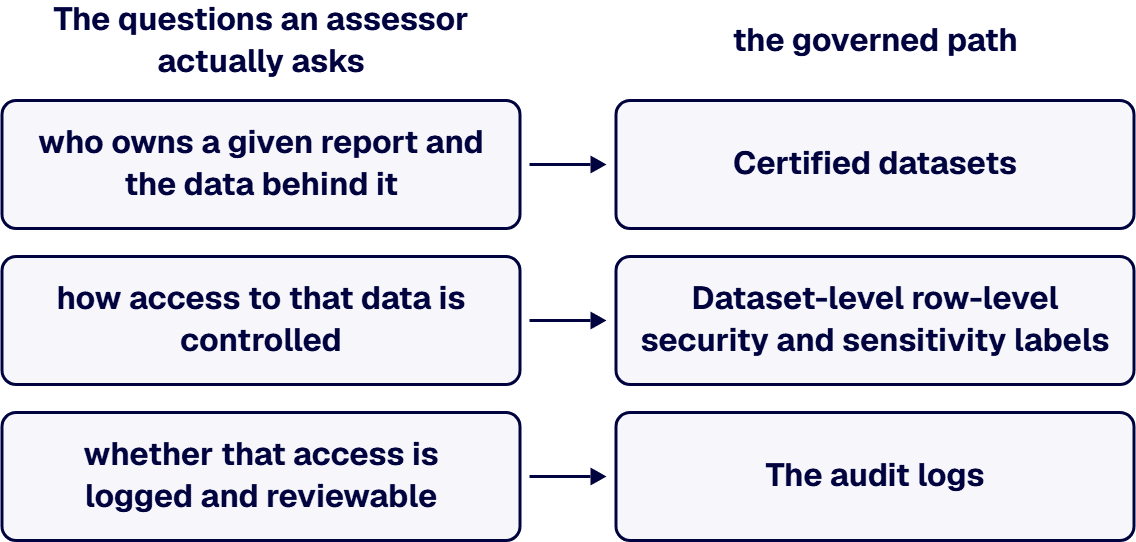
An enterprise analytics operating model closes the gap by making the governed path the default. Certified datasets give the assessor a clear answer to who owns the source of truth. Dataset-level row-level security and sensitivity labels give a defensible answer to how access is controlled. The audit logs give the reviewable record of who accessed what. This is the same governance-first discipline we apply to Power Platform governance generally: the controls that make the estate safe are the same controls that make it defensible, and they are far cheaper to design in than to retrofit under audit pressure.
Designing an analytics operating model is senior architecture work, not a configuration task, because the decisions are about ownership, accountability, and control across the organization, not about which checkbox to tick. i3solutions delivers it as a structured engagement with explicit artifacts the organization keeps.
The work begins with an assessment of the current estate: how many workspaces and datasets exist, where the duplication and exposure sit, which reports the business actually depends on, and where the governance gaps map to regulatory obligations. From there the engagement defines the target operating model, the ownership distribution, the workspace and capacity structure, the certification rules, and the control layer across Power BI and Fabric, expressed as documentation the organization can defend at a board or audit level. The final phase establishes the operating discipline that keeps the model intact: the monitoring, the certification process, and the lifecycle that prevents the estate from drifting back into the ungoverned state it started in.
i3solutions has been the Microsoft Solutions Partner of choice for regulated enterprises since 1997, with US-based senior architects who have designed analytics and governance frameworks across aerospace and defense, financial services, and healthcare. The value for a CoE leader or enterprise architect is borrowed expertise: an operating model designed by people who have built and defended one before, rather than learned on the organization’s production estate. The deliverable is a Microsoft-native, documented, and supportable analytics operating model, the kind of artifact a leader can take to an audit or a board and defend. In a regulated financial-services reporting engagement i3solutions closed SOC 2 trust-services criteria and recovered 10 to 18 hours per week per analyst while cutting reporting errors 75 to 90 percent.
An enterprise analytics operating model is the set of decisions that defines who owns analytics, how content is built and certified, and what controls apply, across an organization’s Power BI and Microsoft Fabric estate. It names the operating roles (a central platform team, the domain teams that build reports, and the governance function that certifies them), the rules that govern workspaces, datasets, and data access, and the lifecycle that moves a report from development to a certified production asset. The model is the difference between an estate where every team builds its own ungoverned reports and one where analytics is owned, versioned, and defensible.
You govern Power BI at scale by deciding the operating model before the tenant fills with content rather than after. That means defining workspace and capacity structure, separating development from certified production with deployment pipelines, applying sensitivity labels and row-level security at the dataset rather than the report, designating certified and promoted datasets so consumers can tell a governed asset from a personal one, and monitoring tenant activity through the admin and audit logs. Microsoft provides the controls in Power BI and Fabric; the operating model is the decision about which controls apply, who enforces them, and how a report earns the certified label.
Centralized ownership concentrates report building in a single BI team, which keeps quality consistent but creates a delivery bottleneck and distances analytics from the domains that understand the data. Federated ownership pushes building out to domain teams, which is faster and closer to the business but produces inconsistent, unmanaged content when no shared controls exist. Most regulated enterprises land on a hybrid: a central platform and governance team owns the workspace structure, the certified datasets, and the controls, while domain teams build reports on top of those governed datasets. The operating model is what makes the hybrid work, by naming where each responsibility sits.
Microsoft Fabric widens the surface that an analytics operating model has to govern. Power BI governs reports, datasets, and workspaces; Fabric adds lakehouses, warehouses, data pipelines, and notebooks under the same capacity and tenant. That means the operating model has to extend governance from the report layer down to the data layer: workspace and domain organization, OneLake data access and lineage, capacity management across workloads, and the same sensitivity labels and certification discipline applied to data items, not just visuals. An operating model written only for Power BI reports will leave the Fabric data estate ungoverned.
Enterprise analytics deployments become audit findings when reporting grows faster than the governance around it. Reports proliferate across personal workspaces, datasets duplicate with no certified source of truth, sensitive data lands in exports and email with no label or row-level security enforcing access, and no one can produce a record of who accessed what. An auditor asks who owns a report, how access to the underlying data is controlled, and whether that access is logged; an ungoverned estate cannot answer. An enterprise analytics operating model closes the gap by making ownership, certification, and access control the default rather than the exception.
A hybrid model. A central platform team certifies the Power BI and Microsoft Fabric datasets, sensitivity labels, and Purview controls, and domain teams build self-service reports on top of them, so you get governed self-service rather than either a bottleneck or uncertified sprawl.
The policy decisions belong to your organization, and the place for a partner is the build work that turns those decisions into tenant controls. On its Center of Excellence guidance, last updated on 2024-12-30, Microsoft states that a data or analytics Center of Excellence is an internal team of technical and business experts. On its governance guidance, last updated on the same date, Microsoft adopts the Data Governance Institute definition of data governance as a system of decision rights and accountabilities for information-related processes, and states that the objectives of governance include ensuring that content ownership and stewardship responsibilities are clear. So compliance, legal and IT own what is allowed, who decides and who is accountable, and that ownership does not move to a partner. A partner earns its place in the parts that need build experience: translating the policy into tenant settings scoped to security groups, the sensitivity label and protection design, the workspace and deployment structure, and the evidence an assessor asks for. On its tenant settings page, last updated on 2026-09-29, Microsoft states that tenant settings enable fine-grained control over the features that are made available to your organization, and that a setting can be enabled for a subset of the organization so that specific security groups are allowed to use a feature. Internal teams can run this with guidance when they already own a labeling program and a tenant settings baseline. A partner is worth it when the estate is large and has already drifted out of governance, as the drift section of this page describes, because the work is then remediation as well as policy.

US-Based | Est. 1997
© i3solutions. All rights reserved.
US-Based | Est. 1997
© i3solutions. All rights reserved.


