
By Matt Lawson, Senior Consultant, i3solutions
Matt Lawson has spent more than 14 years at i3solutions guiding complex enterprise technology work from scope and system design through development, acceptance, and long-term support. His expertise spans technical oversight, solution architecture, SharePoint and Microsoft 365 delivery, Power Platform implementation, business intelligence, enterprise search, and the practical application of AI to solve real business and operational challenges.
Enterprise reporting system design runs on three architectures: Power BI alone, Power BI over an Azure warehouse, or a Microsoft Fabric lakehouse. Which one scales depends less on the tool than on sequencing governed data definitions, a semantic layer, and audit-ready access controls before the build.
The most common enterprise reporting system design failure is not technology selection, it is architecture sequencing. Organizations select Power BI, build dashboards, and discover six months later that the data model cannot support the business’s actual reporting requirements. The problem is not Power BI. It is a reporting system designed without governed data definitions, without a semantic layer, and without a plan for the metric variations each business unit wants.
i3solutions has architected enterprise reporting environments for organizations running everything from SQL Server Reporting Services to Power BI to hybrid Excel-plus-database arrangements. As a Microsoft Partner, with 30 years of delivery across 1,500+ Microsoft platform implementations spanning aerospace, defense, financial services, and healthcare, we have seen the same architecture sequencing failures recur across industries. An aerospace and defense manufacturer, a financial services firm, and a national healthcare system all faced variations of the same problem. The architectural framework below is what we apply, with the pattern recognition from those engagements built in.
Enterprise reporting system design on the Microsoft stack comes down to three architectures: Power BI alone, Power BI over a warehouse, or a Microsoft Fabric lakehouse. Each fits a specific scale and fails outside it, so the design decision is matching the pattern to your real reporting load. The pattern recognition we apply at engagement intake draws from how Microsoft Consulting Services Built for Enterprise Complexity frames the broader Microsoft modernization discipline.
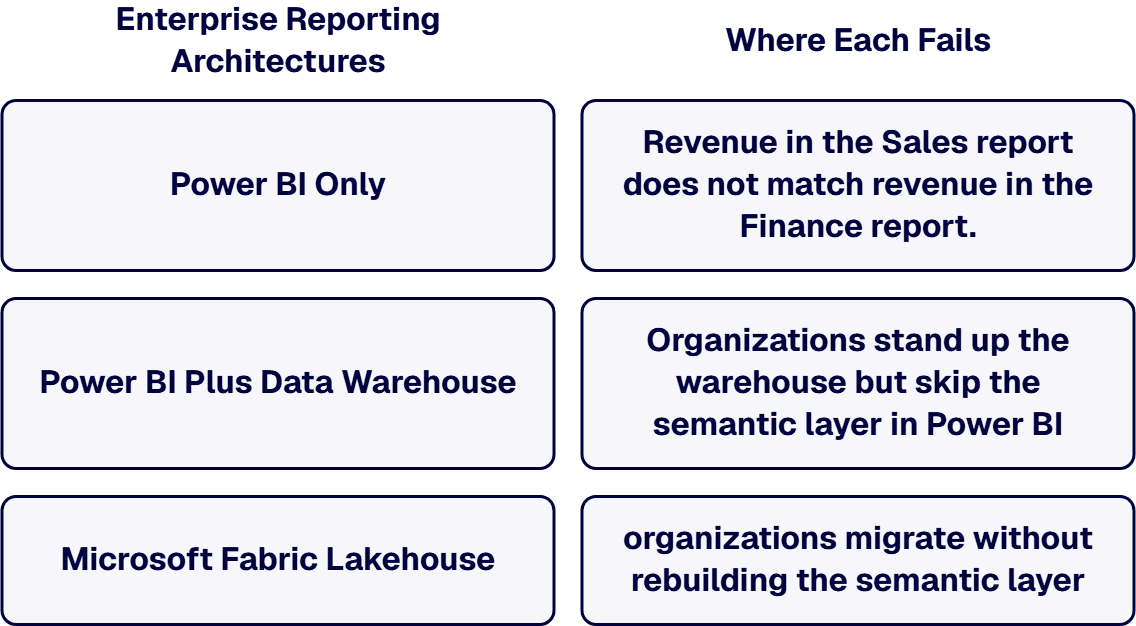
Power BI connects directly to operational source systems (Dynamics 365, SharePoint, SQL Server line-of-business databases, occasionally Excel) and reports run live against those sources. The data model lives inside individual Power BI semantic models, often duplicated across report authors. This pattern works for organizations under approximately 1,000 reporting users where governance is light and analytic workload is small enough that operational systems can absorb the query load. The failure mode is predictable: as the number of reports and authors grows, the same business metric is defined three different ways in three different semantic models. Revenue in the Sales report does not match revenue in the Finance report. The IT Director and the CFO are looking at different numbers in the same meeting, and neither knows which is right. Performance degrades as semantic models grow without the discipline of a central warehouse. Compliance auditors find no consistent data lineage. Architecture A scales until it does not, and the rebuild costs more than the original implementation.
Power BI connects to a centralized data warehouse (most commonly Azure Synapse Analytics or on-premises SQL Server) where dimensional star-schema models hold conformed dimensions and fact tables sourced from operational systems via ETL or ELT pipelines. Power BI semantic models sit above the warehouse, providing the analytic layer for self-service report authors. This is the most common enterprise pattern in 2026 and the architecture we recommend for most 5,000-20,000 employee organizations with governed reporting requirements. The failure mode here is not the architecture, it is the implementation gap. Organizations stand up the warehouse but skip the semantic layer in Power BI, so report authors connect directly to warehouse tables and recreate the metric-definition fragmentation problem one layer up. Or they build the semantic layer but never establish data ownership for the conformed dimensions, so the dimensions drift as operational systems evolve. Or they treat the warehouse as a snapshot store rather than a slowly-changing-dimension model, and audit trail breaks when historical reporting is required.
Microsoft Fabric collapses the previous boundary between data engineering and reporting by storing data in OneLake (a unified lakehouse foundation) and providing Direct Lake mode for Power BI to query lakehouse tables without intermediate data movement. The semantic model still exists, but the warehouse-versus-lakehouse decision changes: Delta tables in OneLake serve both the data engineering pipeline and the Power BI semantic models. Microsoft’s reference architecture for Power BI enterprise BI usage scenarios documents the canonical pattern. Adoption is gaining among organizations consolidating data engineering, reporting, and AI workloads on the Microsoft stack with Copilot integration in scope. The failure mode for Architecture C is twofold: organizations migrate without rebuilding the semantic layer, importing the metric fragmentation from a prior Power BI deployment into Fabric unchanged; or they over-engineer the lakehouse, treating every operational table as a Bronze ingestion target without filtering for what actually needs to support reporting. Fabric capacities cost real money, and over-provisioning compounds quickly.
Three patterns recur across architecture failures, independent of which architecture an organization selected. First, semantic-layer fragmentation: the same metric defined multiple times across reports because no central semantic model owns the conformed definitions. Second, governance-prerequisite skipping: organizations build the technical layer before establishing data ownership and quality standards, then discover at audit that lineage cannot be reconstructed. Third, adoption-without-architecture: business units build their own reports independently, accumulating shadow systems that contradict the official reporting environment within twelve to eighteen months. The architecture choice matters, but the discipline of architectural sequencing matters more. An organization applying Architecture A correctly outperforms one applying Architecture C incorrectly.
When Power BI dashboards go live before anyone has set quality thresholds for the data beneath them, each figure on them is assumed correct rather than proven, so the next step is to put data quality rules into a governed analytics foundation that those dashboards read from.
Power BI is one of the most capable analytic visualization platforms in the Microsoft ecosystem. It is also a visualization layer. Enterprise reporting requires architectural components that Power BI alone does not provide, and treating Power BI as a complete reporting system is the single most common architectural error we see at engagement start. The components Power BI does not carry must be built alongside it, deliberately, before the reports stop being trustworthy.
Power BI carries the visualization layer, the user authentication and authorization layer when integrated with Microsoft Entra ID, the report distribution and embedding layer, and the semantic model layer when authored centrally with discipline. Power BI does not carry the data warehouse layer, the conformed dimensions, the slowly-changing-dimension machinery required for audit trail, the data quality monitoring layer, the master data management layer, the row-level security definitions when those definitions span multiple data sources, or the data lineage documentation layer that compliance auditors require. Treating Power BI as if it carries those layers produces reports that look governed and are not.
The semantic layer is where conformed dimensions and metric definitions live. A centralized semantic model means one place defines what revenue, customer, and order actually mean across the organization. Self-service sprawl means each report author defines those terms inside their own report, with no enforcement that the definitions match. The architectural choice between centralized and decentralized is not binary. The high-functioning pattern is centralized conformed dimensions and core metrics in a shared semantic model, with departmental extensions allowed in subsidiary semantic models that consume the central one. The failure pattern is either pure centralization (which throttles departmental responsiveness) or pure decentralization (which produces the revenue-does-not-match problem). Most enterprises land on a federated semantic model architecture, with the central model owned by IT or a BI Center of Excellence and departmental models owned by business analysts who have been trained on the conformed-dimension discipline. The governance pattern parallels what we describe in Power Platform Center of Excellence for Regulated Enterprises, which addresses the same federated-governance problem in a different Microsoft platform context.
Enterprise reporting environments rarely sit on a single source. The reality is Power BI reports running alongside legacy SQL Server Reporting Services paginated reports, Excel spreadsheets that finance still uses for month-end close, and operational systems that produce their own reports for transactional workflows. The integration architecture has to make decisions about which workloads belong where. SSRS remains the right tool for high-volume paginated reporting where the output is a printed or PDF artifact. Power BI is the right tool for interactive analytical exploration. Excel survives as the right tool for ad hoc financial modeling and committee-level review where the audit trail of who changed what is part of the deliverable. Forcing every workload onto Power BI produces expensive failures. The integration architecture defines the routing rules, not the consolidation goal.
i3solutions’ senior Power BI architects and data engineers make the foundation decisions, semantic model, row-level security, and data lineage, before tool selection locks them in.
The data model is where reporting performance and reporting trust are won or lost. The Power BI semantic model and the underlying warehouse model both contribute, and the modeling decisions made at architecture stage determine whether reports load in two seconds or two minutes at production volume. Three modeling decisions matter most.
Star schema (a central fact table surrounded by denormalized dimension tables) is the default pattern for Power BI semantic models and for most enterprise data warehouse designs. It optimizes for query performance and for analyst comprehension. Snowflake (normalized dimensions with hierarchical relationships) earns its complexity only when dimension tables are large enough that storage compression matters or when dimension hierarchies need to be queried at multiple levels of granularity. Hybrid approaches use star schema for fact tables and selective snowflaking for the largest dimensions. The modeling rule we apply: default to star, snowflake only where storage or query patterns justify the complexity, document the decision so the next architect knows why.
Conformed dimensions are dimension tables that share definitions across the enterprise. A conformed Customer dimension means Sales, Finance, and Operations all report against the same set of customer identifiers, attributes, and hierarchy. Without conformed dimensions, the customer counts in three reports add up to different totals because each report defines a customer slightly differently. Conformed dimensions are an organizational discipline as much as a technical one. They require a data steward role, a change-control process for dimension definitions, and a quality monitoring layer that detects drift. The architecture has to support this discipline; the discipline has to be staffed.
At enterprise data volumes (hundreds of millions of fact rows, semantic models above ten gigabytes), Power BI performance depends on aggregation tables and incremental refresh. Aggregation tables pre-compute summary grain (sales by month, sales by region) so common queries hit small tables instead of the full fact table. Incremental refresh loads only the changed partition rather than the full table on each refresh cycle. Both are architectural decisions, not implementation afterthoughts. Modeling without them produces reports that load in twenty seconds in development and two minutes in production. Modeling with them produces the production performance envelope the business actually needs.
When each report imports its own data, every dashboard becomes its own source of truth, and the analytics team spends its capacity reconciling numbers instead of improving them. Enterprise data architecture with Power BI prevents that with three decisions: where curated data lives (Azure SQL Database, Azure Synapse Analytics, or Microsoft Fabric OneLake), where the semantic model lives (a shared, certified dataset rather than imports duplicated per report), and who owns certification (a named dataset owner using endorsement in the Power BI service). Financial services outcomes anchor to SOC 2 trust services criteria closure and decision-velocity improvement for client reporting. i3solutions designs the semantic layer first, then structures workspaces and deployment pipelines around it, so governance is inherited rather than retrofitted.
Regulated enterprises (financial services, aerospace, defense, healthcare) cannot ship a reporting environment without an audit trail, row-level security, and data lineage at the depth their compliance frameworks require. SOC 2, HIPAA, CMMC 2.0 Level 2, NIST 800-171 Rev 2, and ITAR-adjacent CUI handling all assume the reporting platform can answer specific questions about who saw what data, when, and how that data was sourced. The governance prerequisites below are not optional; they are the minimum for regulated reporting at enterprise scale.
Row-level security (RLS) in Power BI restricts which rows of a fact table a given user can see, based on their role or attributes. The audit-surviving pattern uses dynamic RLS with role definitions stored in the semantic model and user attributes resolved from Microsoft Entra ID at query time. SOC 2 auditors look for evidence that the role definitions are version-controlled and that access changes produce audit log entries. HIPAA Security Rule access control requirements (administrative safeguards 164.308(a)(4)) require evidence that minimum-necessary access is enforced at the data layer, not just at the report layer. CMMC 2.0 Level 2 maps to NIST 800-171 Rev 2 controls 3.1.1, 3.1.2, 3.3.1, and 3.3.2; reporting environments without RLS audit logging fail these controls regardless of other security posture. The architecture has to integrate RLS definitions into the semantic model layer, not bolt them on at the report layer where they can be bypassed.
Data lineage documents the path each piece of data takes from source system through transformation layers to final report. For audit purposes, lineage answers the question “where did this number come from?” with a verifiable chain rather than tribal knowledge. Microsoft Purview data lineage provides lineage capture across the Microsoft data stack; third-party lineage tools handle hybrid environments. The architectural decision is where lineage capture happens (at ETL stage, at warehouse load, at semantic model refresh) and how it is exposed to auditors. Lineage that lives only in developer documentation does not satisfy SOC 2 or CMMC auditors; lineage that is automatically captured and version-controlled does. Treating lineage as decoration produces audit findings; treating it as evidence produces clean audits.
The Governance Readiness Ladder is our diagnostic for evaluating whether an organization is ready to put Power BI reports in front of the board. Five rungs, in sequence; skipping any rung produces the trust failures we have seen across audit and rescue engagements.
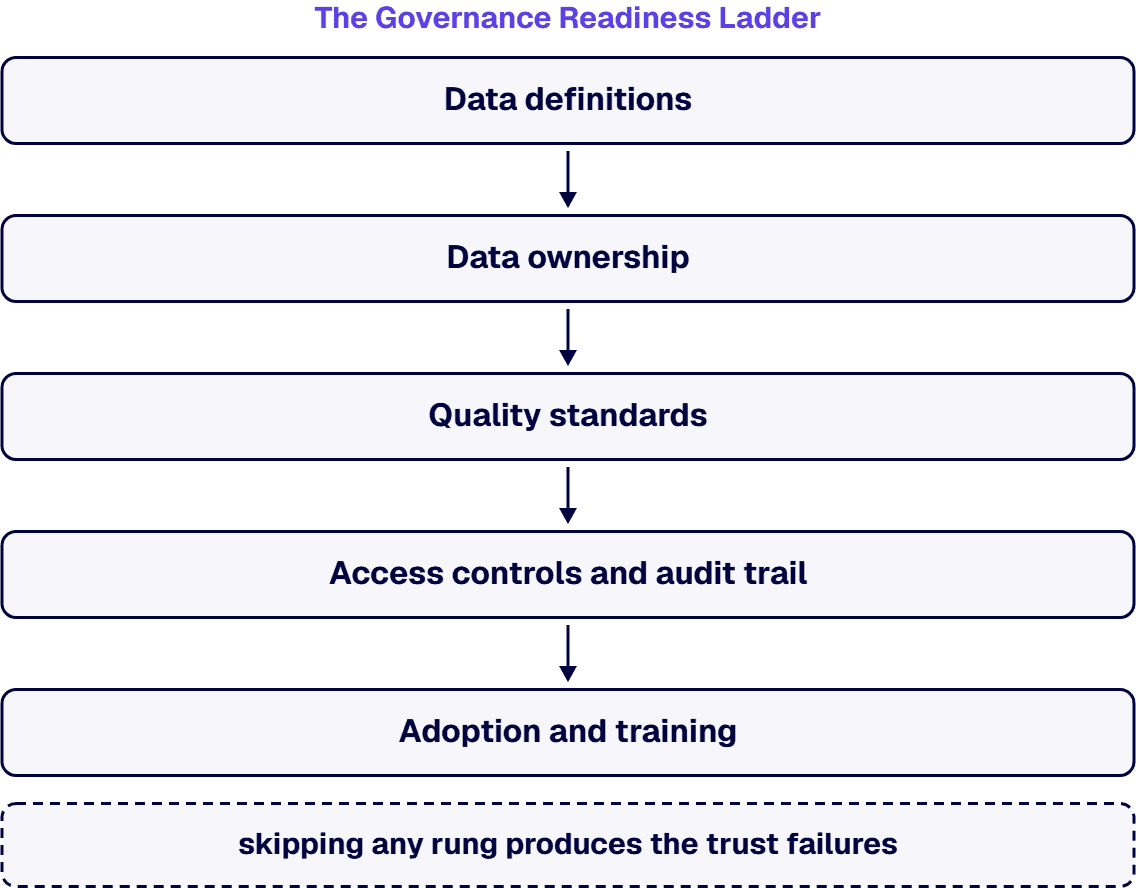
Rung 1: Data definitions. Canonical metric definitions documented and owned by named business stewards. Revenue, customer, order, product, and the dimensions that anchor them have agreed-upon definitions across the organization. Without Rung 1, every other rung is unstable.
Rung 2: Data ownership. Named owner per data domain with accountability for quality and access decisions. Ownership is a role assignment, not a project task. The owner decides who can access the domain, what quality thresholds apply, and how changes are communicated.
Rung 3: Quality standards. Measurable quality thresholds (completeness, freshness, accuracy) with monitoring that detects drift. Quality standards are documented in a data quality dictionary; drift produces alerts that the data steward acts on.
Rung 4: Access controls and audit trail. Row-level security definitions integrated into the semantic model, audit logging that captures every access decision, and the audit log itself protected as compliance evidence. SOC 2, HIPAA, and CMMC all live at this rung.
Rung 5: Adoption and training. Workforce capability to interpret governed reports without falling back to shadow spreadsheets. Training is not optional; without it, the shadow systems re-emerge and the governance investment compounds into wasted spend. The Governance Readiness Ladder is sequential. Most organizations who fail enterprise reporting attempt Rung 5 before Rungs 1 through 4, then wonder why adoption stalls. The architectural investment goes into the rungs the organization has not yet climbed.
Three governance failure modes recur across the audit findings we see at engagement intake. First, governance documented but not staffed: the policies exist on paper but no data steward owns enforcement, so the policies drift within months of publication. Second, governance integrated into the report layer but not the data layer: row-level security defined per report rather than at the semantic model means anyone with model edit access can bypass it. Third, governance designed for the current state but not the audit cycle: the controls satisfy SOC 2 Type I attestation but cannot produce a year of evidence for Type II audit because logging was sampled rather than retained. The architectural fix in each case is to integrate governance into the data layer so it cannot be bypassed and to make audit evidence a build-time output rather than an audit-time scramble.
Talk to us before the next audit cycle. The governance fixes are smaller before the finding than after, and the conversation is a scoping discussion, not a commitment.
Our enterprise reporting consulting engagement is structured in three phases with named exit criteria per phase. The phase boundaries are deliberate: each phase produces decision artifacts that the next phase depends on, and the organization can pause at any phase boundary without leaving the reporting environment in a worse state than it started. The engagement runs sequentially, not in parallel, because architecture sequencing is the discipline we are applying.
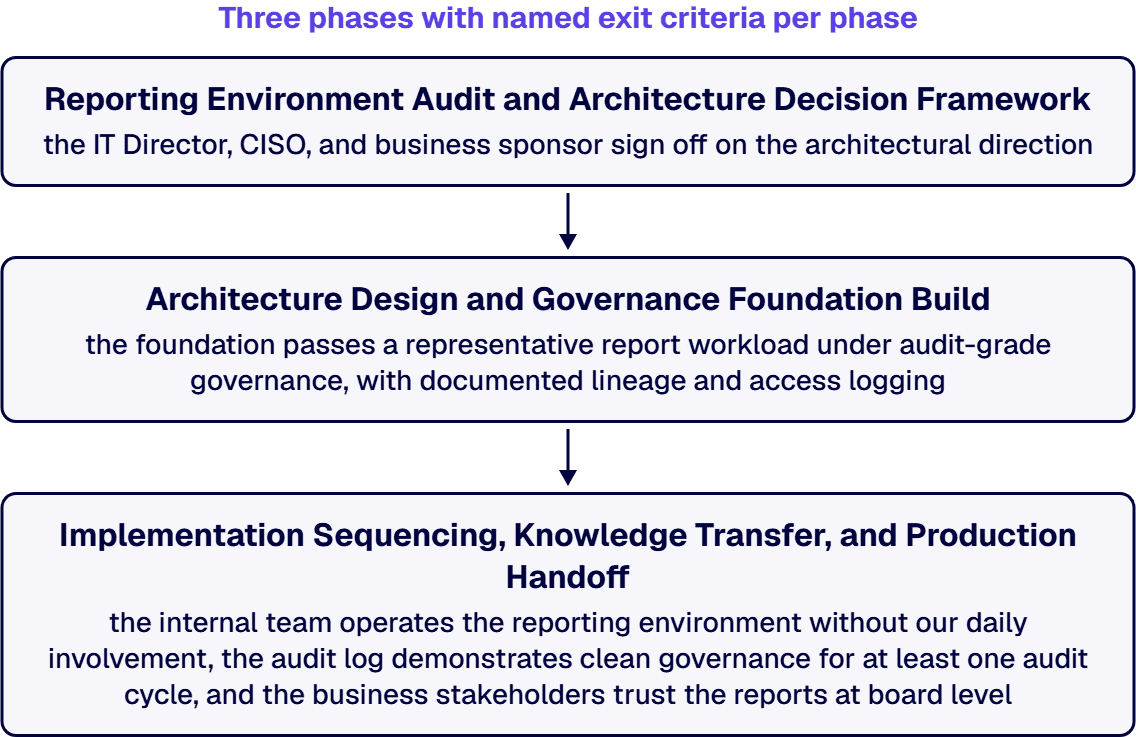
Phase 1 produces an architecture decision framework. We audit the current reporting environment (Power BI tenants, SSRS instances, Excel workflows, operational system reports), map the current data flows and metric definitions, identify the governance gaps against the applicable compliance frameworks, and document where the architecture is failing the business. The deliverable is a decision framework that names which architecture (A, B, or C from H2-1) fits the organization, which governance rungs of the Governance Readiness Ladder need investment, and what the staged rebuild looks like. Exit criteria: the IT Director, CISO, and business sponsor sign off on the architectural direction. Phase 1 is approximately four to six weeks for a 5,000-20,000 employee organization with mixed reporting platforms.
Phase 2 builds the architectural foundation: the data warehouse or lakehouse model, the central semantic model with conformed dimensions, the row-level security and audit logging integration, the data lineage capture mechanism, and the data steward role definitions for the governance rungs the organization has staffed. We do not migrate reports in Phase 2; we build the foundation that reports will move onto in Phase 3. Exit criteria: the foundation passes a representative report workload (typically five to ten reports spanning Finance, Operations, and one business unit) under audit-grade governance, with documented lineage and access logging. Phase 2 is approximately twelve to twenty weeks depending on the complexity of source systems and governance depth required.
Phase 3 sequences the report migration onto the new foundation. We do not migrate all reports at once; we sequence by business priority and by report-author capability, so the most critical reports move first and the report authors learn the new semantic model discipline as they go. Knowledge transfer to the internal team is built into every sprint: the internal architects and data engineers shadow the engagement, then lead increasingly larger pieces, then run the production environment with us as escalation support. Exit criteria: the internal team operates the reporting environment without our daily involvement, the audit log demonstrates clean governance for at least one audit cycle, and the business stakeholders trust the reports at board level. Phase 3 runs as long as report migration takes; typical engagements complete in twenty to forty weeks across all three phases combined.
The pattern recognition from across our engagements names three predictable failures from generalist consulting firms on enterprise reporting work. First, the firm staffs junior consultants who can build dashboards but cannot make architecture decisions; the client ends up with technically competent Power BI reports built on a fundamentally wrong architecture. Second, the firm sells implementation hours without selling the governance foundation, so the reports ship on time and break trust within twelve months. Third, the firm builds a closed system that the client cannot operate without ongoing consulting retainer, structurally biasing the engagement toward dependency rather than capability transfer. The Engineer-Advisor model we operate inverts those defaults: senior architects on every engagement, governance foundation as the first deliverable, knowledge transfer built into every sprint. This is what Enterprise Delivery Assurance means in practice for enterprise reporting work.
The output of a completed enterprise reporting system design engagement is not a set of reports. It is a reporting environment the organization can operate, extend, and govern independently. Five artifacts characterize the completed system, and four validation criteria distinguish a system that meets the bar from one that looks finished but is not.
First, the architecture decision document: the named architecture (A, B, or C), the rationale, and the decision log for downstream architects who inherit the environment. Second, the central semantic model with conformed dimensions: the single source of truth for shared metric definitions, version-controlled and documented. Third, the governance playbook: the data steward role definitions, the change-control process for dimensions and metrics, and the quality-monitoring runbook. Fourth, the compliance evidence package: row-level security definitions, audit log retention configuration, data lineage capture documentation, mapped to the applicable compliance frameworks (SOC 2 trust services criteria, HIPAA Security Rule citations, CMMC 2.0 Level 2 / NIST 800-171 Rev 2 control mappings). Fifth, the knowledge transfer record: training materials, environment runbooks, escalation contacts, and the named internal owners for each artifact above.
Performance: representative reports load within the defined service-level expectation at production user concurrency. The benchmark is what the business actually needs, not what the technology can theoretically do. Compliance: an external audit (or a defensible internal audit) confirms the governance evidence package satisfies the applicable framework. The audit happens; passing it is the validation. Adoption: business users use the governed reports for the decisions they previously made with shadow spreadsheets. Adoption is measured by activity logs, not by training attendance. Maintainability: the internal team adds a new conformed dimension or modifies a metric definition without needing us. The capability transfer is the validation.
Before declaring the enterprise reporting environment in production, the IT Director and CISO should jointly confirm the following. The architecture decision document names the selected architecture and the rationale for the selection. The central semantic model is version-controlled with named owners. Row-level security definitions live in the semantic model and audit log captures every access decision. Data lineage is captured automatically and exposed to compliance reviewers without ad hoc effort. The Governance Readiness Ladder rungs the engagement targeted are staffed and operational, not just documented. Performance benchmarks have been run at projected production load. The internal team has demonstrated end-to-end operation of the environment, including incident response, in at least one production cycle. For organizations whose Microsoft 365 governance and compliance evidence overlap with this reporting environment, Microsoft 365 Compliance Consulting: CMMC, HIPAA, SOC 2, and NIST for Regulated Enterprises covers the parallel evidence framework that the reporting environment inherits from. If any item on this checklist is partial, the environment is not yet in production; it is in late-stage build.
Enterprise reporting system design consulting engagements at i3solutions typically range from approximately $180,000 to $750,000 for the full three-phase engagement, with the range driven by five factors. First, the number of source systems in scope: an organization with three operational sources costs less than one with twelve. Second, the governance depth required by the applicable compliance frameworks: SOC 2 alone is less intensive than CMMC 2.0 Level 2 combined with HIPAA. Third, the reporting volume: 50 reports across one business unit costs less than 400 reports across nine business units. Fourth, the readiness of the internal team to absorb knowledge transfer: a team that already has data engineering capacity needs less hand-holding than a team building those capabilities for the first time. Fifth, the current-state condition: a clean modernization is cheaper than a rescue of a partially-failed prior implementation. Most engagements land at $300,000 to $450,000. We scope each engagement individually after Phase 1 audit so the cost reflects the actual work rather than a standard package.
A typical enterprise reporting architecture engagement runs twenty to forty weeks across the three phases combined. Phase 1 audit and decision framework: four to six weeks. Phase 2 foundation build (warehouse model, central semantic model, governance integration, lineage capture): twelve to twenty weeks. Phase 3 report migration, knowledge transfer, and production handoff: another twelve to twenty weeks depending on report volume and internal team capacity. Engagements move faster when the organization has a data engineering team in place; engagements move slower when the foundation has to be built from scratch or when compliance evidence has to be reconstructed from prior environments. We do not promise compressed timelines on enterprise reporting work; architecture sequencing failures are usually caused by compressed timelines on prior engagements.
A Power BI implementation engagement builds reports against an existing architecture. An enterprise reporting system design engagement establishes the architecture before reports are built. The distinction matters because most enterprise reporting failures are architecture failures rather than implementation failures: the reports are technically correct but built on a fundamentally wrong foundation. Implementation engagements presuppose that the data warehouse, semantic layer, governance framework, and compliance evidence package already exist. Design engagements produce those foundations. An organization that needs reports faster than it needs architecture is signing up for a rebuild within eighteen months. An organization that invests in architecture first ships reports more slowly but does not pay the rebuild cost.
Four evaluation criteria distinguish enterprise reporting consulting partners from generalist Power BI vendors. First, named architects on the engagement, not just project managers and junior implementers. The architecture decisions are where the engagement is won or lost. Second, governance foundation as a first deliverable rather than a Phase 3 afterthought. Vendors who skip the governance foundation are selling implementation hours, not enterprise reporting capability. Third, compliance framework fluency at the control level. A partner who can map their deliverables to SOC 2 trust services criteria, HIPAA Security Rule citations, or NIST 800-171 Rev 2 controls is operating at the audit-evidence layer. A partner who cannot is building reports that will fail audit. Fourth, knowledge transfer as a structural commitment, not an end-of-engagement gesture. The right partner leaves the internal team more capable. The wrong partner leaves the internal team more dependent.
Engage outside consulting for enterprise reporting architecture when the internal team has not previously designed an enterprise reporting environment at the scale and compliance depth the organization now requires. The architecture decisions compound for five to ten years and are expensive to reverse; learning by doing on the first enterprise implementation costs more than borrowing pattern recognition from a firm that has done it across the industries. Design internally when the internal team has a senior data architect who has previously built and operated a comparable environment, when the governance framework and compliance evidence requirements are familiar, and when the team has capacity to invest in architecture work alongside operational responsibilities. The hybrid model we run frequently embeds our architects alongside the internal team for the design phase, then transitions to internal-led implementation with our involvement as escalation support. That model fits organizations with strong internal capability who want the architecture validation without the dependency.
i3solutions is a Microsoft-focused technology consulting firm and Microsoft Partner, with 30 years of delivery across 1,500+ Microsoft platform implementations spanning aerospace, defense, financial services, and healthcare. Our Enterprise Delivery Assurance approach has delivered on-time, in-scope, and in-production for clients across aerospace, defense, financial services, and healthcare. We deliver enterprise reporting system design consulting through U.S.-based senior architects who bring borrowed expertise from comparable engagements across aerospace, defense, financial services, and healthcare.

US-Based | Est. 1997
© i3solutions. All rights reserved.
US-Based | Est. 1997
© i3solutions. All rights reserved.


