
By Matt Lawson, Senior Consultant, i3solutions
Matt Lawson has spent more than 14 years at i3solutions guiding complex enterprise technology work from scope and system design through development, acceptance, and long-term support. His expertise spans technical oversight, solution architecture, SharePoint and Microsoft 365 delivery, Power Platform implementation, business intelligence, enterprise search, and the practical application of AI to solve real business and operational challenges.
Custom Power BI dashboard development delivers governed analytics implementations built on row-level security, audit-defensible data lineage, and semantic models that pass compliance review. i3solutions builds Power BI implementations for regulated enterprises that scale from initial deployment through multi-year program operation without losing executive trust.
Custom and self-service Power BI are complementary: custom development builds the governed datasets, semantic models, row-level security, and audit trail that make self-service capability safe to use in a regulated environment, so the custom foundation comes first.
Custom Power BI dashboard development at regulated enterprises breaks at the same inflection point on most projects, and it is almost never the visualization layer that fails. Three to six months after a dashboard set goes live, two business units start producing contradictory numbers for the same metric. The CIO loses confidence in the reports. The audit team asks who validated row-level security and which controls produced the access logs. Internal teams that built the dashboards cannot answer because the foundation underneath was never governed in the first place.
i3solutions designs, builds, and governs Power BI implementations that hold up under that second-quarter scrutiny. An aerospace and defense manufacturer, a financial services firm, and a national healthcare system engaged i3solutions for Microsoft platform work where the audit-evidence chain matters as much as the visual output. We are a Microsoft Partner with 30 years of regulated-enterprise delivery experience and 1,500+ completed Microsoft platform implementations. Our Power BI engagements treat dashboards as the visible surface of a governed data architecture, not the deliverable in isolation.
This article explains how we structure custom Power BI dashboard development for regulated enterprises, the assessment we run before any visualization work begins, the engineering disciplines that determine whether the implementation passes audit, and how to evaluate a consulting partner when generic Power BI vendors are competing for the same work. The Engineer-Advisor approach we apply has produced on-time, in-scope, in-production implementations across aerospace and defense, financial services, and healthcare clients, with borrowed-expertise framing that pulls senior architects into the rooms where the architecture decisions actually get made.
Custom Power BI dashboard development fails in regulated enterprises for one repeatable reason. Teams ship dashboards that look right in a demo, then watch them degrade within a quarter or two as the data model underneath buckles under real refresh and governance load.
First, contradictory metric definitions across business units. Finance defines active customer one way, operations defines it another way, and both teams build dashboards that report different numbers for the same executive question. Without a governed semantic model that locks the metric definition centrally, every dashboard surface becomes a separate source of truth and the organization stops trusting any of them.
Second, row-level security treated as a deployment-time afterthought. The dashboard ships, the access controls are configured against an inherited Azure AD group structure that was set up for general file access, and the auditor returns three months later with questions about which users could see which sensitive data and when. NIST 800-171 control AC-2 Account Management and AC-3 Access Enforcement expect documented, testable boundaries. Power BI’s row-level security capability supports this directly when designed in from the start, but retrofitting it across a deployed dashboard set is materially harder than designing it into the semantic model.
Third, no data lineage and no audit trail. The dashboard shows a number. The auditor asks where that number came from, which transformations produced it, who approved the transformation logic, and when. Without data lineage instrumentation and audit logging configured at the data source and Power BI service layer, the answer is unknowable. HIPAA Security Rule audit control requirements and SOC 2 trust services criteria both expect demonstrable lineage; both fail the assessment when lineage cannot be reconstructed.
Generic Power BI consulting engagements optimize for visual output velocity. The client asks for a dashboard, the consultant delivers a dashboard, the engagement closes, and the governance work that should have run in parallel never happened. For regulated enterprises this pattern is dangerous because the governance gap shows up at audit time, not at delivery time. By the time the gap is visible, the consultant is gone and the internal team owns the remediation.
Self-service Power BI capability is a genuine asset when it is built on a governed foundation. When the foundation is missing, self-service becomes proliferation. Department analysts build local dashboards against ad-hoc data extracts, duplicate metric calculations, and bypass the central semantic model. The auditor encounters dozens of dashboards with overlapping scope, conflicting numbers, and no documented lineage. CMMC 2.0 Level 2 expects evidence chains for sensitive data handling. The self-service surface without governance produces the opposite of an evidence chain.
Before i3solutions builds any custom Power BI dashboard set for a regulated enterprise, we run a five-rung assessment we call the Governance Readiness Ladder. Each rung has named exit criteria. We do not start dashboard development until the rungs below it are either confirmed in place or scoped into the engagement as preparatory work. Skipping rungs is the most common reason Power BI implementations look right in demo and fail in production.
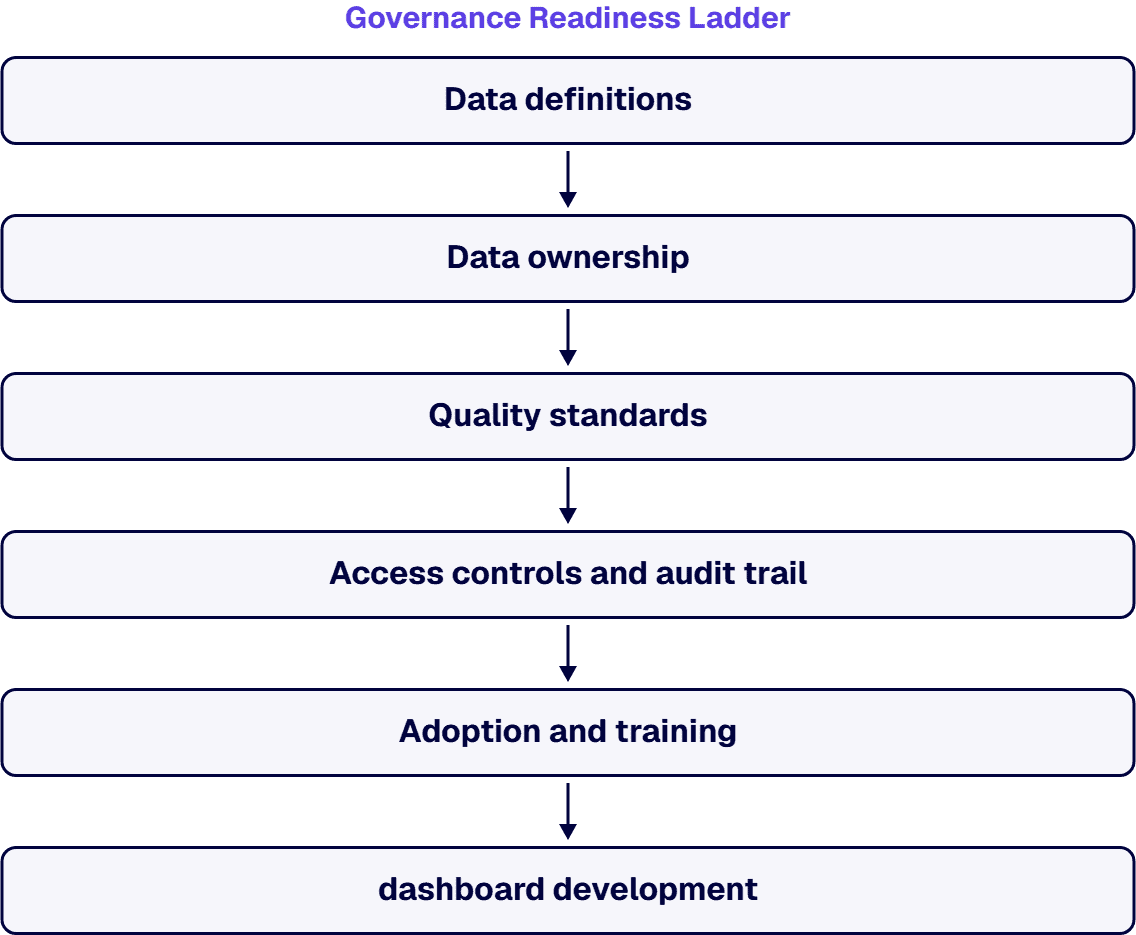
Every metric the dashboards will surface has a single, documented definition that the business has agreed on. Active customer means one thing across the organization. Revenue is calculated one way. Compliance status follows one rubric. Exit criteria: metric definition register reviewed and signed by business owners; conflicts resolved before any semantic model work begins. Without this rung, every downstream rung absorbs ambiguity that surfaces as inconsistency in the dashboards.
Every data source feeding the dashboards has a named owner who is accountable for the data’s accuracy, completeness, and timeliness. The owner has authority to approve changes to source structures and a documented review cadence. Exit criteria: data source register with named owners; owner-approval workflow defined for source changes. Regulated enterprises that bypass this rung end up with dashboards that drift when source systems change without coordination.
Data quality thresholds are defined per source and per metric: acceptable freshness, completeness, validation rules. Power BI dataset refresh schedules align with these thresholds. Exit criteria: documented quality thresholds; refresh schedule aligned; exception-handling workflow for quality failures. The dashboards report on data that meets the agreed standards, with explicit treatment of data that does not.
Row-level security is designed into the semantic model and tested against the regulated-enterprise access model. Audit logging captures who accessed what and when at the Power BI service layer. NIST 800-171 control AU-2 Event Logging expects this depth; we build it in from the semantic model up. Exit criteria: RLS roles defined and tested; audit logging configured at Power BI service tenant level; access reviews scheduled on a documented cadence per the compliance framework in scope.
The internal team that will operate the dashboards has the training and the runbooks to do so. Self-service Power BI capability is enabled on the governed foundation, with named conventions for new dashboard creation. Exit criteria: training delivered; runbooks documented; self-service governance pattern documented. The engagement closes with the client team capable of operating the implementation, not dependent on i3solutions for ongoing dashboard work.
i3solutions designs, builds, and governs Power BI implementations for regulated enterprises, with the semantic model, security, and evidence chain built in from the start.
Custom Power BI dashboard development at a regulated enterprise involves four engineering disciplines that determine whether the implementation will hold up over time. None of these disciplines are visible to the executive looking at the dashboard. All of them are visible to the auditor reviewing how the implementation was built.
Row-level security in Power BI works by mapping authenticated users to data filters at the semantic model layer. Designed correctly per Microsoft Learn row-level security guidance, an aerospace and defense contractor can build a single dashboard set that serves program managers across multiple cleared programs without anyone seeing another program’s data. Designed as an afterthought, the same dashboard set requires duplicated workspaces, parallel datasets, and ongoing manual synchronization. The first approach passes CMMC 2.0 Level 2 access enforcement review. The second approach absorbs months of remediation when the auditor arrives.
Every number a Power BI dashboard surfaces should be traceable back to its source through the transformations that produced it. Microsoft Purview, when configured at scan time, produces this lineage automatically across the data estate. Power BI’s dataflow lineage view extends it through the Power BI layer. SOC 2 trust services criteria CC7.2 expects this evidence; we build the instrumentation in from the start so the evidence exists before the auditor asks for it.
The semantic model is the canonical place where business logic lives in a custom Power BI dashboard development implementation. Metric calculations defined here are reused across every dashboard that consumes the model. A financial services firm engaged i3solutions to rebuild a fragmented reporting environment where the same metric was calculated three different ways across departmental dashboards. The rebuild consolidated metric definitions into a governed semantic model and the cross-departmental contradictions resolved without anyone renegotiating which definition was correct.
Regulated enterprises operate under specific compliance frameworks. Custom Power BI dashboard development for these environments needs alignment to the relevant frameworks from day one, not retrofit at audit time. SOC 2 trust services criteria expect documented access enforcement, change management, and monitoring. HIPAA Security Rule expects administrative, physical, and technical safeguards including audit controls 164.312(b). NIST 800-171 Rev 2 expects controls AC-2 Account Management, AC-3 Access Enforcement, AU-2 Event Logging, and SC-8 Transmission Confidentiality. CMMC 2.0 Level 2 expects all 110 NIST 800-171 controls plus the documentation depth that satisfies a C3PAO assessment. ITAR-adjacent CUI handling layers additional segmentation requirements. Our engagement structure maps each control family to specific Power BI implementation evidence so the compliance posture is testable, not assumed.
Buyers evaluating custom Power BI dashboard development engagements frequently miss a scope distinction that determines whether the engagement structure fits the actual need. A Power BI project ships a defined dashboard set against agreed requirements. A Power BI program operates a governed analytics capability across the enterprise on an ongoing basis. The two require different engagement structures and different governance disciplines.
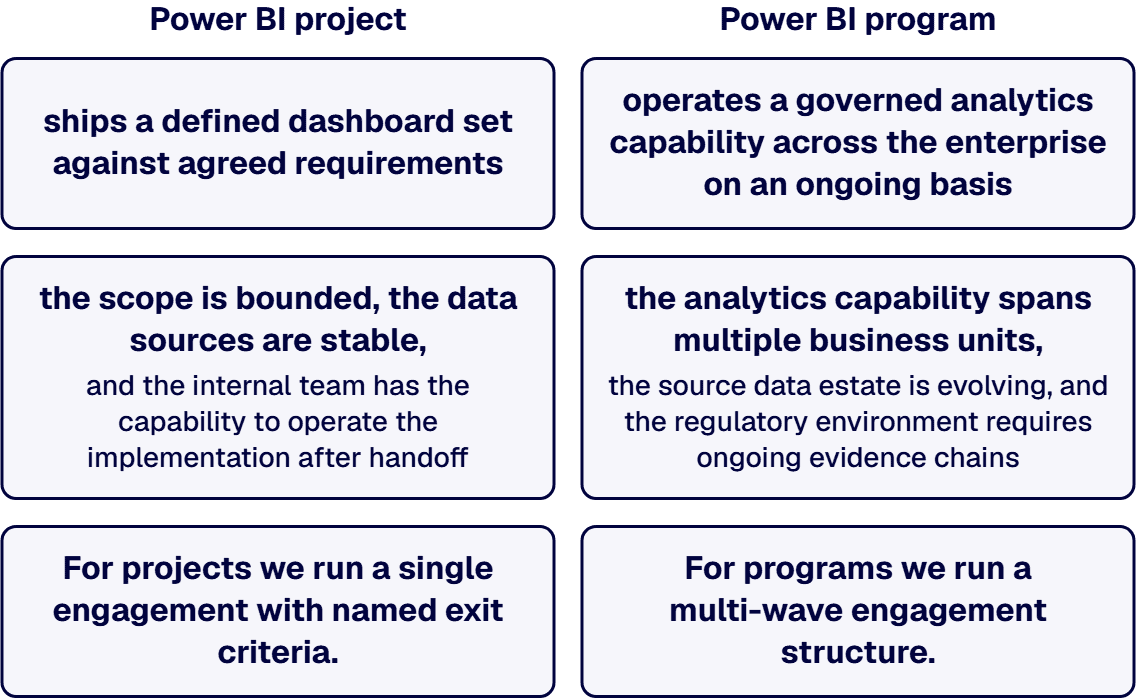
A project structure fits when the scope is bounded, the data sources are stable, and the internal team has the capability to operate the implementation after handoff. A single departmental dashboard set with a clear data source register and named business owners is project-shaped. We deliver projects in a fixed scope, fixed exit criteria, with knowledge transfer that leaves the internal team capable of operating the implementation.
A program structure fits when the analytics capability spans multiple business units, the source data estate is evolving, and the regulatory environment requires ongoing evidence chains. A national healthcare system engaged i3solutions for analytics work where HIPAA compliance, multi-department coordination, and ongoing source system evolution all argued for a program structure. The engagement looked like coordinated waves of dashboard development against a governed semantic model that evolved alongside the source estate, with formal change management and audit-evidence delivery throughout.
For projects we run a single engagement with named exit criteria. For programs we run a multi-wave engagement structure. Both project and program engagements use our named three-phase methodology with explicit exit criteria per phase.
Phase 1 covers assessment and architecture decision framework: the Governance Readiness Ladder runs against the existing environment, gaps are documented, and the implementation scope is set with named owners and named deliverables. Phase 1 exits when the semantic model design is approved, the row-level security pattern is documented, and the data lineage instrumentation scope is agreed with the compliance owner.
Phase 2 covers foundation build: governed semantic model construction, RLS implementation and testing, audit logging configuration, and the first dashboard set built against the governed foundation. Phase 2 exits when the dashboard set passes the regulated-enterprise access model test, the audit-evidence chain is in place for that scope, and the internal team has reviewed the implementation against the compliance framework.
Phase 3 covers production deployment and operations transition: production cutover, knowledge transfer to the internal team, self-service governance pattern enablement, and operations runbook delivery. Phase 3 exits when the internal team has demonstrated the capability to operate the implementation, the audit-evidence chain has been validated end-to-end, and the engagement is ready for closure. For program engagements, Phases 2 and 3 repeat across coordinated waves for additional business areas while maintaining the governed foundation established in Phase 1.
Discuss your scope, your regulatory environment, and the engagement structure that fits your enterprise. A scoping conversation, not a commitment.
Generalist Power BI consulting vendors compete for custom Power BI dashboard development engagements at regulated enterprises and most of them are not equipped to deliver against the audit-defensible standard the environment requires. The evaluation criteria below separate vendors who can deliver a demo from vendors who can deliver an implementation that passes a SOC 2, HIPAA, NIST 800-171, or CMMC assessment.
The first failure pattern is junior consultants on architecture decisions. The semantic model design, the row-level security pattern, and the data lineage instrumentation are architecture decisions, not visualization decisions. A vendor whose engagement model puts junior consultants in these rooms produces an implementation that stalls at audit time. The second failure pattern is implementation hours without governance foundation. The vendor bills hours against dashboard development without ever scoping the data architecture, the access controls, or the audit-evidence chain. The third failure pattern is closed-system dependency design where the vendor’s specific tooling, templates, and configurations become a lock-in that prevents the internal team from operating the implementation independently.
Require named senior consultants on architecture decisions, with documented prior delivery in your compliance framework. Require evidence-chain artifacts from prior engagements: lineage documentation, RLS test results, audit logging samples, change management records. Require knowledge-transfer commitments with named exit criteria, not vague handoff language. Require references from regulated enterprises of similar scale who can speak to the vendor’s delivery against compliance requirements.
Our engagement model puts senior architects in the rooms where architecture decisions are made and provides borrowed expertise from senior architects to the internal team throughout the engagement. The deliverables include the governance documentation, the lineage instrumentation, and the audit-evidence chain that the regulated enterprise compliance posture depends on. We are a Microsoft Partner with 1,500+ completed Microsoft platform implementations across aerospace and defense, financial services, and healthcare. Our Enterprise Delivery Assurance discipline produces on-time, in-scope, in-production engagements where the evidence chain stays intact from kickoff through operations handoff.
Scope clarity matters at engagement start because it determines what the evidence chain covers and what it does not. A custom Power BI dashboard development engagement with i3solutions produces the following deliverables, each with named exit criteria and audit-evidence artifacts where the compliance framework expects them.
First, a Governance Readiness Ladder assessment artifact documenting the client’s starting position on each of the five rungs, the gaps that need closing before implementation begins, and the work scoped to close them. Second, a governed semantic model with documented metric definitions, business-owner sign-off, and version control. Third, the dashboard set itself built against the semantic model, with row-level security configured and tested against the regulated-enterprise access model. Fourth, the data lineage instrumentation through Microsoft Purview where the data estate supports it, with Power BI dataflow lineage documented through the analytics layer. Fifth, the audit-evidence chain comprising RLS test results, access logging configuration, change management records, and control-family-to-implementation evidence mapping per the compliance framework in scope. Sixth, the knowledge transfer artifacts: runbooks, training materials, and self-service governance documentation that leave the internal team capable of operating the implementation.
What this engagement explicitly does not produce: data source remediation outside the scope of the implementation, business process reengineering, or general business intelligence strategy consulting separate from the Power BI implementation. Where data source quality work is required to support the implementation, we scope it in as preparatory work with named exit criteria. Where business process changes are required to operationalize the dashboards, we identify them and route them to the appropriate owner. The engagement boundary is the Power BI implementation and its governed foundation.
Custom Power BI dashboard development requirements differ materially across regulated enterprise sectors. The compliance framework that governs the implementation, the data sensitivity classifications that drive row-level security design, and the audit-evidence expectations from the relevant assessors vary by sector. The implementation patterns below describe how i3solutions structures engagements across the three regulated sectors we serve most frequently.
Financial services enterprises engaging i3solutions for custom Power BI dashboard development operate under SOC 2 trust services criteria, FINRA recordkeeping requirements, GLBA safeguards, and increasingly state-level data privacy regulations including CCPA and the New York Department of Financial Services 23 NYCRR 500 cybersecurity rules. A financial services firm engaged i3solutions for a wealth management reporting environment where client-segment data isolation, advisor-team access boundaries, and regulator-facing audit trails all needed to coexist in a single governed analytics surface. The implementation pattern for financial services centers on three engineering decisions: row-level security designed at the client-segment grain so advisors see only their books while compliance officers retain full visibility; audit logging configured at sub-second granularity to satisfy FINRA reconstruction requirements; and data lineage instrumentation that maps every reported number back to source-system-of-record so that any regulator question about calculation methodology has a documented answer. The deliverable layer includes the standard six-artifact set plus a financial-services-specific compliance-evidence packet that maps SOC 2 CC7.2 evidence, FINRA reconstruction logs, and GLBA safeguards implementation to specific Power BI implementation artifacts.
Defense contractors engaging i3solutions for custom Power BI dashboard development operate under DFARS 7012, NIST 800-171 Rev 2 across all 110 controls, CMMC 2.0 Level 2 documentation depth requirements, and ITAR-adjacent CUI segmentation requirements where applicable. An aerospace and defense manufacturer engaged i3solutions for Microsoft platform work across cleared-program and uncleared-program contexts where the same internal team needed analytics surfaces that respected program-level data segmentation. The implementation pattern for defense contractors centers on three engineering decisions: row-level security designed at the program grain with explicit testing against cleared-program access matrices; audit logging configured to satisfy NIST 800-171 controls AU-2 Event Logging and AU-3 Content of Audit Records depth; and data residency enforcement through Microsoft 365 GCC or GCC High tenant boundaries when the implementation scope includes CUI handling. The deliverable layer includes the standard six-artifact set plus a defense-specific compliance-evidence packet that maps the full 110 NIST 800-171 Rev 2 control set to Power BI implementation evidence at the depth a C3PAO assessment requires.
Healthcare enterprises engaging i3solutions for custom Power BI dashboard development operate under HIPAA Security Rule administrative, physical, and technical safeguards including audit controls 164.312(b), HITECH Act breach notification requirements, and increasingly state-level data protection rules. A national healthcare system engaged i3solutions for analytics work where PHI handling, multi-department coordination across clinical and operational reporting, and ongoing source system evolution all argued for a program-structure engagement. The implementation pattern for healthcare centers on three engineering decisions: row-level security designed at the care-team grain so clinicians see only their patient panels while quality and compliance teams retain full visibility; audit logging configured to satisfy HIPAA audit controls 164.312(b); and Business Associate Agreement coverage verified across the full data estate that feeds the Power BI implementation. The deliverable layer includes the standard six-artifact set plus a healthcare-specific compliance-evidence packet that maps HIPAA administrative safeguards, technical safeguards, and audit controls to specific Power BI implementation artifacts at the depth an OCR investigation expects.
i3solutions delivers regulated-enterprise Power BI on time, in scope, and in production through senior US-based architects and Enterprise Delivery Assurance.
Custom Power BI dashboard development engagements at regulated enterprises typically range from $80,000 to $150,000 for a bounded project covering a single business area with a stable data source register, and from $300,000 to $750,000 for a multi-wave program covering enterprise-scale analytics capability with full governance, compliance evidence chains, and adoption work across multiple business units. The cost drivers are the data architecture work below the dashboards, the compliance framework depth required, the row-level security complexity, and the data lineage instrumentation scope. We scope engagements by running the Governance Readiness Ladder assessment first so the cost estimate reflects the actual work the environment requires rather than a dashboards-only estimate that ignores the foundation. The most common cost surprise on Power BI engagements is data source remediation that should have been scoped at engagement start. Our scoping conversation covers that work explicitly so the budget reflects the implementation that passes audit, not the implementation that demos well.
A bounded project for a single business area typically runs 12 to 16 weeks from kickoff to operations handoff, with the Governance Readiness Ladder assessment running in the first two weeks, semantic model and access controls in weeks three through six, dashboard development in weeks seven through twelve, and adoption work through week sixteen. A multi-wave program for enterprise-scale capability typically runs 9 to 18 months across named waves with defined exit criteria per wave. The compliance framework in scope extends the timeline where evidence-chain instrumentation requires coordination with external auditors or C3PAO assessors.
Self-service Power BI is the capability for business users to build their own reports and dashboards against approved datasets. Custom Power BI development is the engineering work that builds the governed datasets, the semantic models, the row-level security, the audit trail, and the access controls that make self-service capability safe to use in a regulated environment. The two are complementary. Self-service without the custom development foundation produces the ungoverned-proliferation failure pattern. Custom development without self-service capability concentrates all dashboard work on the internal data team and creates a delivery bottleneck. A well-designed implementation builds the custom foundation first, then enables governed self-service capability on top of it.
Yes, when designed in from the start. Power BI’s row-level security, audit logging, and data lineage capabilities support CMMC 2.0 Level 2 access enforcement and event logging requirements, HIPAA Security Rule administrative and technical safeguards including audit controls 164.312(b), SOC 2 trust services criteria across access enforcement and monitoring, and NIST 800-171 Rev 2 controls AC-2, AC-3, AU-2, and SC-8. The implementation discipline determines whether the capability translates to passing assessment evidence. i3solutions builds the evidence chain in from the start so the compliance posture is testable rather than assumed.
Existing Power BI environments stay in operation through the rebuild engagement. Our approach runs the Governance Readiness Ladder assessment against the existing environment, identifies the governance and architecture gaps, and scopes the rebuild work to close them without taking the existing reporting offline. Production cutover happens at a defined milestone where the rebuilt implementation has been tested against the regulated-enterprise access model, the audit-evidence chain is in place, and the internal team has been trained on the new implementation. The legacy dashboards are typically retired in phases rather than all at once, with named retirement criteria per dashboard.
i3solutions is a Microsoft-focused technology consulting firm serving regulated enterprises across aerospace and defense, financial services, and healthcare. We are a Microsoft Partner with 30 years of regulated-enterprise delivery experience and 1,500+ completed Microsoft platform implementations. Our Engineer-Advisor model places senior architects on the architecture decisions that determine whether an implementation passes audit, with Enterprise Delivery Assurance discipline that produces on-time, in-scope, in-production engagements where the evidence chain stays intact from kickoff through operations handoff.

US-Based | Est. 1997
© i3solutions. All rights reserved.
US-Based | Est. 1997
© i3solutions. All rights reserved.


