
By Scot Johnson, Founder / CEO, i3solutions
Scot Johnson co-founded i3solutions 30 years ago with a focus on expert-led delivery, strategic advisory, and complex Microsoft-centered solutions for organizations where technology decisions carry operational, financial, and mission risk. His insights focus on the leadership, governance, integration, automation, data, and delivery decisions that determine whether technology investments become reliable business systems.
Power Platform DLP policy administration designs a seven-component connector-classification taxonomy, operates it through quarterly attestation cycles, and produces the audit-evidence artifacts that map DLP policy state to CMMC, NIST 800-171, HIPAA, and FedRAMP control families. The artifacts are what auditors recognize; the taxonomy is what makes them defensible.
Power Platform DLP policy administration breaks at the audit moment because most regulated-enterprise teams approach vendor evaluation as a configuration-tooling comparison when the actual decision is a compliance-evidence operating model. For IT Directors and CISOs at regulated enterprises operating under CMMC, NIST 800-171, HIPAA, or FedRAMP, DLP policy administration is the compliance-evidence layer that translates Microsoft’s connector-classification controls into audit-ready artifacts. As a Microsoft Partner with 1,500+ Microsoft platform implementations across aerospace and defense, financial services, and healthcare, i3solutions has designed and operated Power Platform DLP policy programs that survive auditor review. This guide walks through the seven-component DLP policy taxonomy, the four-framework regulatory cross-map auditors actually use, the audit-evidence artifacts that translate DLP policy state into the documentation an assessor recognizes, and the partner-engagement boundary that distinguishes when an in-house team can carry the work and when borrowed expertise from senior architects accelerates the program.
Power Platform DLP policy works by classifying every connector available to Power Apps and Power Automate into one of three categories. It then blocks flows and apps from combining connectors across non-compatible categories, which is the control that maps to CMMC, NIST 800-171, HIPAA, and FedRAMP safeguards.
Most regulated-enterprise IT teams discover the gap when their Power Platform footprint crosses the threshold between tactical experiment and production-scope platform. A makers community of fifty across two environments is manageable with default policies. A makers community of four hundred across six environments with three tenant boundaries and a dozen subsidiaries on different compliance scopes breaks every assumption in the default configuration.
Microsoft’s DLP framework (Power Platform data loss prevention documentation) classifies every connector into one of three groups. Business is for connectors appropriate for organizational data movement: SharePoint Online, Microsoft Dataverse, Microsoft 365 Outlook, Teams, Excel Online, OneDrive for Business, and other Microsoft 365 first-party connectors typically sit here. Non-Business is for connectors that handle organizational data but cross a trust boundary: Salesforce, ServiceNow, SAP, third-party SaaS. Blocked is for connectors that may not run at all: consumer connectors, unsanctioned cloud storage, and any connector the compliance program determined no business case justifies.
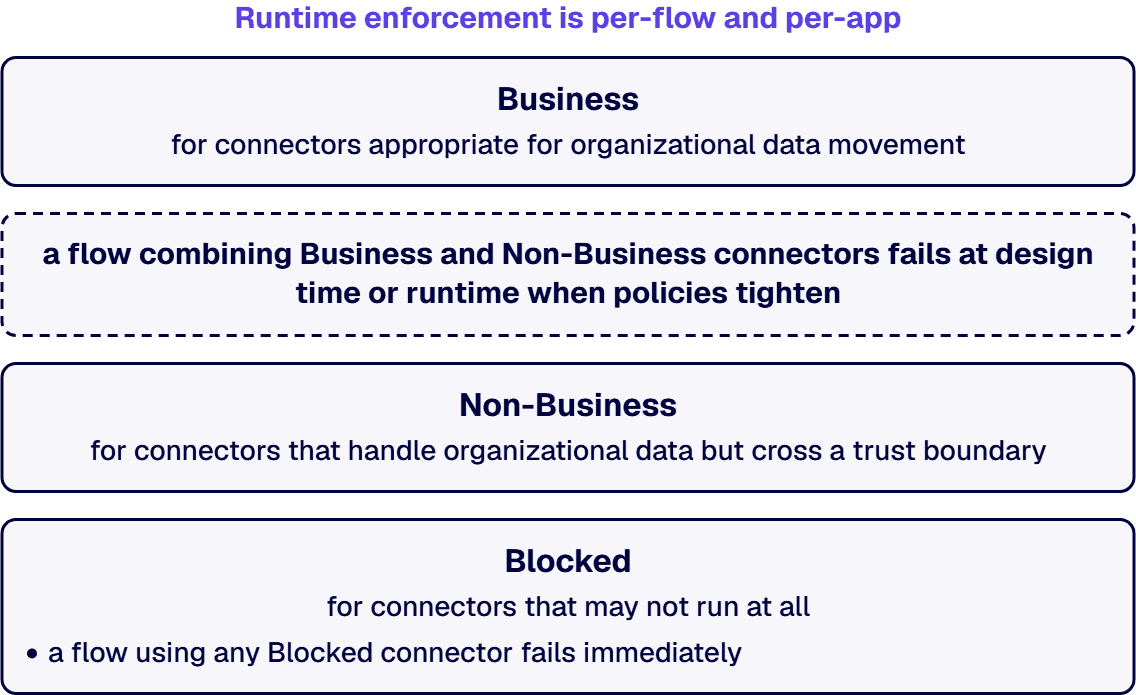
Runtime enforcement is per-flow and per-app: a flow combining Business and Non-Business connectors fails at design time or runtime when policies tighten; a flow using any Blocked connector fails immediately. Classification operates at the connector boundary, which is the unit of enforcement DLP policy administration has to design against. This matters because regulated-enterprise DLP programs come from compliance frameworks that classify data, not connectors. Translating a CMMC AC.L2-3.1.3 control statement about controlling the flow of CUI into a connector-classification policy requires explicit mapping no Microsoft documentation provides. That mapping is the work the DLP policy administration program produces.
Multi-environment deployments break four common assumptions. First, environment proliferation outpaces tenant-level policy design: production, test, sandbox, departmental, citizen-developer-pilot, and partner-integration environments accumulate, and without explicit taxonomy design the policy layering becomes inconsistent within months. Second, exception handling has no governance pattern by default; makers needing non-default connector combinations submit exception requests that get approved ad-hoc and surface as audit findings six months later. Third, custom connectors fall outside the default policy scope unless explicitly classified, and discovery typically happens at audit time. Fourth, cross-tenant scenarios (B2B collaboration, parent-subsidiary tenant relationships, defense-industrial-base supply chain integration) introduce a connector-classification dimension the default policy framework was not designed for. These four failure modes together produce the operational reality that most regulated-enterprise Power Platform DLP policy administration programs are technically configured but not compliance-defensible.
Three administrative surfaces matter. The Power Platform admin center UI is the default for tenant-wide baselines and one-off exception handling; its limits surface at scale with slow bulk operations and limited audit-evidence export. The Power Platform admin PowerShell module is the scriptable surface for bulk operations, automated audit-evidence export, and policy attribute access; regulated-enterprise programs at scale lean on PowerShell for quarterly attestation cycles and version-controlled policy-as-code patterns. Tenant-level connector administration settings govern which connectors are available for DLP classification and how cross-tenant scenarios are handled at the trust-boundary level.
DLP policy state expressed in Microsoft’s connector-classification framework does not directly answer auditor questions. Auditors ask for evidence of control implementation for AC.L2-3.1.3 (CMMC), 3.1.3 (NIST 800-171), 164.312(a)(1) (HIPAA), or AC-4 (FedRAMP Moderate). The program translates DLP state into evidence answers, mapped explicitly enough that a qualified assessor can verify.
CMMC Level 2 includes 110 practices drawn from NIST SP 800-171. Three practices are directly addressable by Power Platform DLP policy administration evidence: AC.L2-3.1.3 (Control the flow of CUI in accordance with approved authorizations), SC.L2-3.13.6 (Deny network communications traffic by default and allow by exception), and MP.L2-3.8.7 (Control the use of removable media). For AC.L2-3.1.3, the assessor wants the policy document defining authorized CUI movements, the technical control implementation, and evidence the control is operating. Power Platform DLP provides the technical control when connector classifications align with the CUI authorization policy. The audit-evidence artifact is the connector classification inventory tied to the CUI authorization policy by reference, plus the quarterly DLP-violation log. For SC.L2-3.13.6, the evidence is the explicit Blocked classification list (default-deny) plus documented exception governance for any connector that moved from Blocked to Non-Business or Business.
The assessor pattern (per the CMMC Program at DoD CIO) is to request the evidence artifacts, then probe with follow-up questions about exception handling and quarterly review discipline.
NIST SP 800-171 r2 controls 3.1.3 (Information Flow Enforcement) and 3.13.6 (Network Communications) are the controls CMMC Level 2 imports as AC.L2-3.1.3 and SC.L2-3.13.6. Defense-industrial-base prime contractors operate under NIST 800-171 r2 directly (DFARS 252.204-7012) and CMMC Level 2 as a layered assessment regime; evidence artifacts satisfy both.
HIPAA Security Rule technical safeguards are differently structured. The relevant safeguard is 164.312(a)(1) Access Control with four implementation specifications (Unique User Identification, Emergency Access Procedure, Automatic Logoff, Encryption and Decryption). Power Platform DLP evidence is adjacent; the closest direct evidence is 164.312(a)(1) interpreted as the technical-safeguard control point for information-flow restriction. Healthcare programs treat DLP administration as one of several technical safeguards supporting the 164.312(a)(1) control narrative.
FedRAMP Moderate baseline includes AC-4 Information Flow Enforcement with control enhancements AC-4(4), AC-4(8), and AC-4(21). Power Platform DLP evidence supports AC-4 directly and AC-4(4) (flow control of encrypted information) when paired with connector-level encryption posture evidence. FedRAMP authorization packages present DLP administration evidence as part of the AC-4 control implementation narrative with cross-references to SC-7 Boundary Protection and SC-8 Transmission Confidentiality. The pattern across all four frameworks is consistent: classification inventory plus exception-governance log plus quarterly DLP-violation reconciliation are the core artifacts.
Six artifacts cover the audit-evidence requirements across CMMC, NIST 800-171, HIPAA, and FedRAMP scope. The connector classification inventory enumerates every connector available in the tenant, its classification, environment scope, policy-document reference, and last review date; assessors ask for it first. The exception-governance log records every exception approval since the prior quarterly review (requester, connector or combination, business case, approving authority, date, expiration). The DLP violation log records every DLP policy violation in run history with disposition. The custom connector classification register lists every custom connector with classification rationale. The cross-tenant policy register documents every B2B, subsidiary, or partner-integration scenario where connector-mediated data flow crosses tenant boundaries. The quarterly attestation memo summarizes the prior quarter’s DLP state, names the IT Director or CISO signing the attestation, and signals open items requiring follow-up; the memo is the artifact that survives longest in audit trails.
Designing the seven-component taxonomy and the six audit-evidence artifacts is the work most regulated Power Platform programs need help with at least once.
A DLP policy taxonomy that holds up at enterprise scale has seven components. Each component names a distinct administrative decision the program has to make. The taxonomy is the operating-model abstraction i3solutions has refined through Power Platform DLP engagements across aerospace and defense, financial services, and healthcare programs, anchored in the broader Power Platform Governance discipline the program sits within. The taxonomy design methodology has four phases (assess, design, validate, operate) sequential at engagement start and parallel cadences once steady-state.
Component 1: Tenant-level baseline policies. The default DLP policy at tenant scope when no environment policy overrides it. The baseline is conservative: Blocked includes consumer cloud storage and consumer social connectors; Business is limited to first-party Microsoft 365 connectors plus explicitly classified internal connectors; Non-Business covers everything in between.
Component 2: Environment-level overrides. Per-environment refinements that tighten or loosen the baseline based on compliance scope, maker community, and data sensitivity. Production handling CUI receives the tightest overrides; sandbox environments may receive looser overrides with explicit policy documenting the scope.
Component 3: Connector classification governance. The process for adding, reclassifying, or removing a connector. New Microsoft-released connectors enter Non-Business by default until reviewed; third-party SaaS connectors enter Blocked until business case justifies promotion.
Component 4: Custom connector handling. The policy for connectors built in-house, by partners, or by vendors for the tenant. Custom connectors are explicitly classified at creation time, registered in the custom connector classification register, and reviewed on a more frequent cadence than first-party connectors.
Component 5: Exempt scenarios. Documented business scenarios where standard policy enforcement is relaxed: emergency-response flows combining compliance-bounded data sources, senior-executive-approved temporary cross-classification flows for due-diligence or M&A, partner-integration flows with documented cross-tenant trust boundaries.
Component 6: Exception request workflow. The process for makers to request a temporary or permanent exception. The workflow names requesting authority, approving authority, expiration mechanism, documentation requirement, and audit-evidence implications.
Component 7: Cross-tenant B2B and external sharing. The policy stance for B2B collaboration, parent-subsidiary tenant relationships, defense-industrial-base supply chain integration, and any scenario where connector-mediated flows cross tenant boundaries. Cross-tenant policy is documented at the trust-boundary level with cross-references to the partner’s compliance attestation.
Configuration of the tenant-level baseline (Component 1) happens in the Power Platform admin center under Policies > Data policies > New policy at tenant scope. For regulated-enterprise tenants, the initial baseline configuration typically takes a senior administrator four to six hours including connector inventory review against compliance scope. Configuration changes are version-controlled by exporting via PowerShell (Get-DlpPolicy) and committing to the Power Platform application lifecycle management discipline. Environment-level overrides (Component 2) are configured per environment with environment scope. For programs operating across many environments, the override design pattern is typically three to five override templates (CUI-scope production, non-CUI-scope production, sandbox, partner-integration) applied consistently across environments fitting each profile.
The three taxonomy components most prone to compliance posture degradation are Component 4 (custom connectors), Component 5 (exempt scenarios), and Component 7 (cross-tenant B2B). Custom connectors fail when created without explicit classification: a custom connector created by a maker with admin-tier permissions enters the tenant unclassified and operates in a default-allow posture until classified. The fix is process plus tooling: every custom connector creation triggers a classification review within five business days; unreviewed custom connectors revert to Blocked automatically; the classification register reconciles weekly against the actual inventory. Exempt scenarios fail when documentation is stale; the fix is review cadence with annual renewal-or-retirement. Cross-tenant B2B fails when the partner’s compliance attestation lapses; the fix is partner-attestation linkage with renewal triggers ninety days before expiration. For defense-industrial-base supply chain scenarios, the partner attestation is typically the partner’s CMMC Level 2 score or Joint Surveillance Voluntary Assessment status.
A defense contractor in the DoD supply chain operating with 1,800 makers across seven environments discovered during its first internal DLP audit that roughly 23% of their Power Automate flows used a non-compliant data path combining GCC High SharePoint with commercial Outlook for compliance reporting. The taxonomy redesign separated GCC High and commercial connector pools at the policy level using the seven-component pattern, eliminated the non-compliant flow pattern within the operating cycle following the audit finding, and produced audit-evidence artifacts CMMC Level 2 assessors recognized.
Designing the seven-component taxonomy and producing the six audit-evidence artifacts is the work most regulated-enterprise Power Platform programs need help with at least once. Hire i3solutions Power Platform consultants to design a compliance-defensible DLP policy administration program for your regulated-enterprise Power Platform footprint.
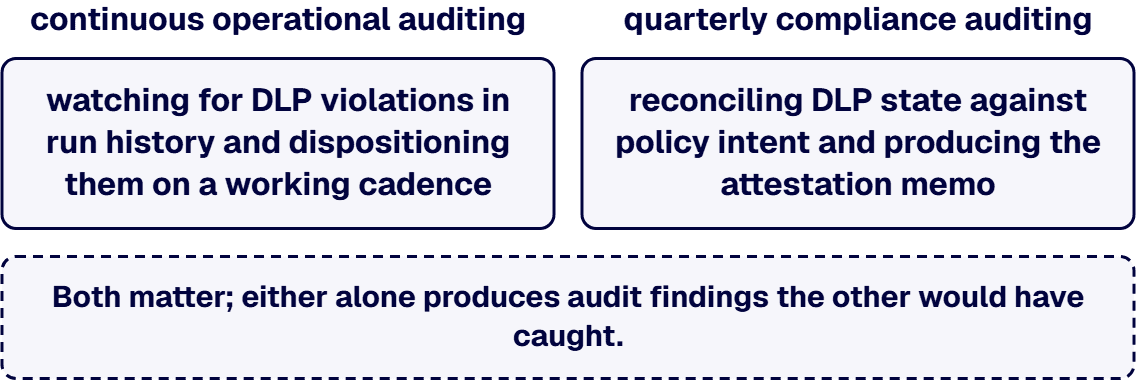
The audit-evidence artifacts are the deliverables; auditing DLP policy effectiveness is the process that produces them. The audit work breaks into two patterns: continuous operational auditing (watching for DLP violations in run history and dispositioning them on a working cadence) and quarterly compliance auditing (reconciling DLP state against policy intent and producing the attestation memo). Both matter; either alone produces audit findings the other would have caught.
DLP violations surface in run history with distinguishable signatures. The maker-error pattern: a maker builds a flow combining connectors in a way the policy disallows; the flow fails at design time, and the maker either reworks or submits an exception request. The fix is maker education and the Component 6 exception request workflow. The policy-drift pattern: a flow that previously ran successfully now fails at runtime because the DLP policy tightened after the flow deployed. The fix is either flow remediation or exception request approval; frequency is the leading indicator of how disruptive a policy change has been. The data-context pattern: a flow that runs successfully in most cases fails intermittently when specific data triggers a connector classification mismatch. The fix is typically taxonomy-level. Audit-defensible programs report a distribution stable around mostly maker-error with low policy-drift and low data-context.
A regional financial services firm preparing for SOC 2 Type II renewal needed audit-evidence artifacts proving DLP policy enforcement across 240 production flows running in a three-environment Power Platform deployment. The connector-classification attestation log produced quarterly via PowerShell automation, mapping each production flow to its connector pairings and DLP policy state at the attestation date, became the auditor’s primary evidence trail for the SOC 2 trust services criteria CC6.1 access control objective, replacing roughly three weeks of manual flow-by-flow documentation that had consumed the IT team in the prior cycle.
Quarterly compliance auditing runs three patterns in sequence. Sampling verifies policy state matches policy intent: select ten percent of environments (or all if the tenant operates under twenty), pull DLP policy state via PowerShell, compare against policy-document intent, document divergences with disposition. For each sampled environment, pull a sample of flows and verify connector usage matches the environment’s policy stance. Attestation produces the quarterly memo summarizing sampling findings, naming the IT Director or CISO signing, and naming current quarter’s open items. The memo is brief (one to three pages); supporting artifacts carry the operational detail. Exception review reconciles the exception-governance log against current operating reality and either renews or retires each exempt scenario. All three patterns matter; skipping any of them produces audit findings the others would have caught.
Talk through your environment and compliance obligations with our team for engagement-specific scope and pricing.
Most regulated enterprises handle some portion of Power Platform DLP policy administration in-house and benefit from borrowed expertise from senior architects for at least the taxonomy design and initial audit-evidence artifact build. The decision is rarely binary. Three signals identify the boundary where the cost-benefit shifts from in-house build-out to partner engagement.
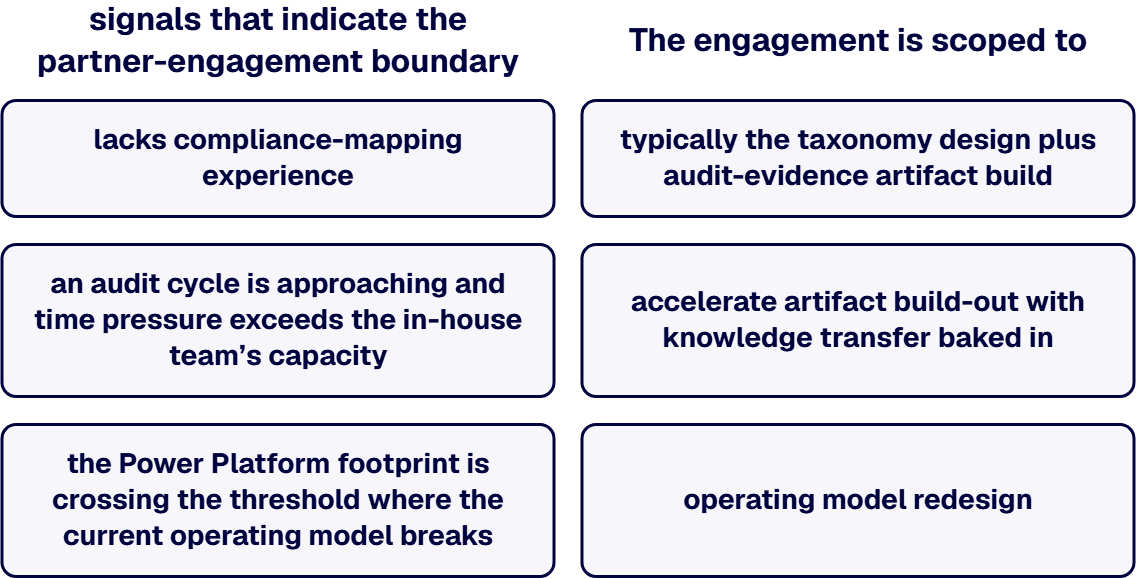
Signal one: the existing in-house team has senior Power Platform admin capability but lacks compliance-mapping experience. The team can configure DLP policies in the admin center fluently but has never produced audit-evidence artifacts in the form an assessor expects. This is the most common signal among regulated-enterprise teams whose Power Platform programs grew organically. The partner engagement is typically scoped to the taxonomy design plus audit-evidence artifact build, with the in-house team operating the program after handoff.
Signal two: an audit cycle is approaching and time pressure exceeds the in-house team’s capacity to design the taxonomy correctly from scratch. CMMC Level 2 audit prep, FedRAMP authorization package readiness, HIPAA Security Risk Assessment renewal, or DFARS annual self-attestation cycles generate this signal. The engagement is scoped to accelerate artifact build-out with knowledge transfer baked in so the in-house team operates the program after the audit.
Signal three: the Power Platform footprint is crossing the threshold where the current operating model breaks (multi-tenant scenarios, multi-environment proliferation, custom connector inventory beyond ad-hoc review capacity). The engagement is scoped to operating model redesign with the in-house team inheriting the redesigned model. Programs without these signals typically operate Power Platform DLP policy administration well in-house.
If your team is weighing whether the current Power Platform DLP state will survive the next audit, contact us for engagement-specific pricing and scope guidance.
Setup cost depends on existing state, compliance scope, and engagement structure. A taxonomy design and initial audit-evidence artifact build for a tenant with a moderate-complexity footprint (two to four hundred makers, six to twelve environments, a dozen custom connectors, single compliance framework) typically runs an engineering and architecture engagement at standard professional services rates; i3solutions provides specific pricing during the Power Platform advisory discussion based on the tenant’s actual state and the engagement scope. Operating cost after setup is primarily the quarterly cadence, which most in-house teams absorb within their existing Power Platform administrator capacity once taxonomy and artifact templates are established. Audit-cycle-driven accelerations typically carry higher scope than baseline taxonomy work. Programs with audit-evidence artifacts in place handle audit cycles substantially faster than programs scrambling at audit time, which is where the cost-benefit case favors investing in the taxonomy and artifact build up-front.
DLP policy changes that tighten classifications carry runtime disruption risk for flows depending on the connector combinations the change disallows. The audit-defensible approach has four parts. First, announce the change in advance with a maker communication naming the specific connectors moving; standard cadence is two weeks for non-urgent changes, seventy-two hours for urgent compliance-driven changes. Second, stage through a non-production environment first to identify affected flows; the change set includes flow remediation guidance. Third, apply in production with a maker-facing watch period of one to two weeks where the DLP violation log surfaces affected flows the staging pass did not catch. Fourth, the change becomes part of the next quarterly attestation memo with affected-flow disposition recorded.
DLP policy administration is not named explicitly in any of the four frameworks, but DLP evidence is what auditors expect for the information-flow-enforcement controls each framework includes. CMMC Level 2 practice AC.L2-3.1.3 and NIST 800-171 r2 control 3.1.3 are the most directly addressed; HIPAA Security Rule 164.312(a)(1) is adjacent; FedRAMP Moderate AC-4 is addressed by Power Platform DLP evidence paired with adjacent boundary-protection evidence. For regulated-enterprise programs operating under any of these frameworks with a footprint of meaningful size, audit-defensible DLP policy administration is required in practice.
The decision is rarely binary. Most regulated enterprises handle some portion of Power Platform DLP policy administration in-house and benefit from borrowed expertise from senior architects for at least the taxonomy design and initial audit-evidence artifact build. Three signals shift the cost-benefit toward outside engagement: (1) the in-house team lacks compliance-mapping experience and has never produced audit-evidence artifacts an assessor expects; (2) an audit cycle is approaching and time pressure exceeds in-house capacity to design the taxonomy from scratch; (3) the Power Platform footprint is crossing the multi-tenant or multi-environment proliferation threshold where the current operating model breaks. Without these signals, the in-house team is the right answer.
A taxonomy design and initial audit-evidence artifact build for a moderate-complexity tenant typically runs six to ten weeks from kickoff to operator handoff. The work sequences across the four-phase methodology (assess, design, validate, operate) with the artifact build concentrated in the design and validate phases. Audit-acceleration scoping compresses this to four to six weeks when the audit deadline drives. Operating-model-redesign scoping for tenants crossing the multi-tenant or multi-environment proliferation threshold extends to ten to fourteen weeks. The Power Platform advisory discussion at engagement entry surfaces which scope fits the tenant’s situation.
Start from a default-deny tenant baseline where every connector lands in a defined classification, then open access through business-justified exemptions that each carry a named owner, a documented use case, and a review date. That inversion is what satisfies an auditor: the evidence artifact shows why each connector sits where it does, not merely that a policy exists. The exemptions are what keep makers productive, because access is granted deliberately rather than through a blanket block that pushes work into shadow IT. Operate the exemption register on a quarterly attestation cycle so the policy state stays defensible between audits. i3solutions runs a governed Power Platform for a federal defense agency supporting roughly 10,000 personnel across about 180 locations, which works because it is governed, not despite it.
i3solutions is a Microsoft Partner with 1,500+ Microsoft platform implementations across aerospace and defense, financial services, and healthcare. i3solutions has run Power Platform DLP policy administration engagements for clients in all three sectors, including an aerospace and defense contractor, a financial services firm, and a national healthcare organization. The pattern recognition from 1,500+ Microsoft platform implementations produces taxonomy designs that hold up under CMMC, NIST 800-171, HIPAA, and FedRAMP audit review. Engagements ship on-time, in-scope, and in-production, with the Enterprise Delivery Assurance methodology ensuring every commitment lands at the agreed quality bar. Our senior architects bring borrowed expertise from senior architects to your in-house team.
Power Platform DLP policy administration that survives auditor review is the difference between a program operating under audit risk and a program operating under audit confidence. Hire i3solutions Power Platform consultants to design and operate your compliance-defensible Power Platform DLP policy administration program: https://i3solutions.com/hire-power-platform-developers/.

US-Based | Est. 1997
© i3solutions. All rights reserved.
US-Based | Est. 1997
© i3solutions. All rights reserved.


