
Microsoft 365 CMMC compliance consulting addresses per-product variant selection (Commercial, GCC, GCC High, DoD), NIST SP 800-171 control mapping per Microsoft 365 tool, and audit-evidence-artifact production for C3PAO assessment. Contractors storing CUI in Microsoft 365 for CMMC Level 2 need a cloud at the FedRAMP Moderate baseline or its equivalent, and Microsoft’s CMMC page (last updated March 9, 2026) says GCC can “Achieve compliance with FedRAMP High, Defense Federal Acquisition Regulations Supplement (DFARS), and DISA Cloud Computing Security Requirement Guide (CC SRG) Impact Level 2”; they implement controls, Microsoft provides the platform. Microsoft Defender runs in the environment that holds the CUI, GCC or GCC High, and the contractor, not the product, earns the certification.
Microsoft 365 CMMC compliance breaks at the product-by-product evaluation moment because most teams evaluate it platform-wide when the audit demands product-specific evidence of control implementation. Defense contractors need a variant-selection decision (Commercial, GCC, GCC High, DoD) for each product in their CUI workflow, an SSP attribution mapping each NIST SP 800-171 control family to a specific Microsoft tenant configuration, and an audit-evidence trail showing the configuration is operational. The question is not ‘is Microsoft 365 CMMC compliant’ but ‘which variant satisfies which control for which product in our CUI workflow, and what artifact will the C3PAO assessor expect at certification.’
Microsoft offers four variant tiers of the Microsoft 365 product family, each with its own compliance attribution and licensing. The variant-selection decision is per-product because the contractor’s CUI workflow does not touch every product the same way. Exchange Online and SharePoint Online for email and document storage need GCC or GCC High once they hold CUI; Power BI may be out of CUI scope entirely and can run on Commercial without triggering certification scope.
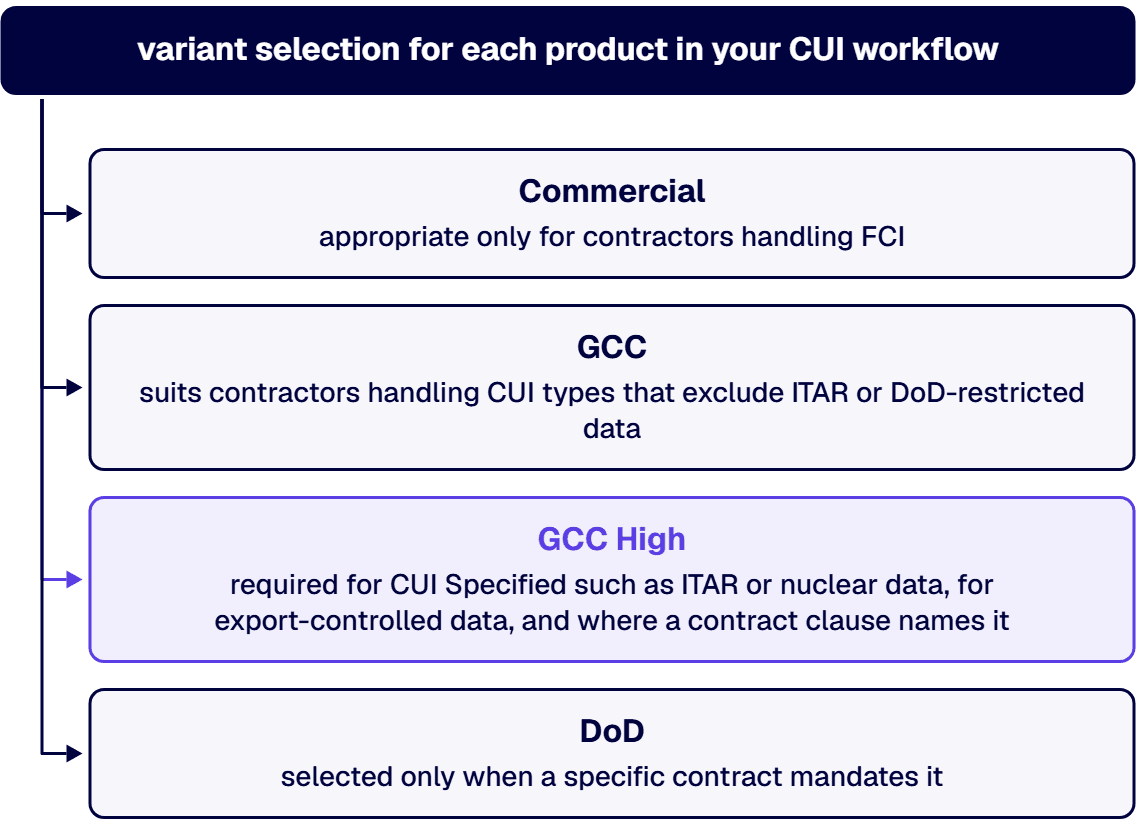
The variant-by-variant compliance attribution drawn from Microsoft Learn at learn.microsoft.com/en-us/compliance/us-government/gov-cmmc.
Exchange Online, SharePoint Online, OneDrive for Business, Teams, Intune, and Defender (Office 365, Endpoint, Identity) follow the environment they run in rather than carrying a CMMC level of their own: Microsoft’s CMMC page (last updated March 9, 2026) names CMMC Level 1 for Microsoft 365 for Enterprise and CMMC Level 2 and Level 3 “when configured appropriately” for GCC High, and names no CMMC level for GCC. Microsoft states that Intune for GCC is the same instance as Microsoft Intune in the commercial space. Microsoft Purview (Information Protection, DLP, Insider Risk, eDiscovery, Audit) is supported in GCC and GCC High. Microsoft Sentinel runs in GCC and GCC High with parallel security analytics. Microsoft Entra ID supports all four variants with Conditional Access, Privileged Identity Management, and Identity Protection.
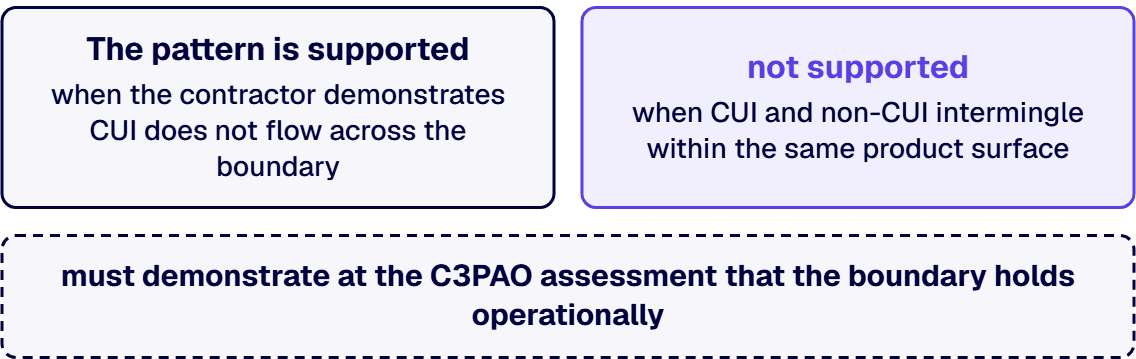
Partial-variant adoption runs some products on Commercial and others on GCC High, segmenting the CUI handling surface from non-CUI at the tenant boundary. The pattern is supported when the contractor demonstrates CUI does not flow across the boundary; not supported when CUI and non-CUI intermingle within the same product surface. A contractor with a small CUI footprint may put email and document storage on GCC High and run the rest on Commercial, but must demonstrate at the C3PAO assessment that the boundary holds operationally. This requires DLP policies enforcing the boundary, training records, and audit logs showing zero boundary violations across the assessment window.
The product-by-product compliance attribution that follows names the Microsoft 365 variant that can hold each product’s typical CUI handling surface, the primary control families the product addresses at L2, and the audit-evidence artifact a C3PAO assessor will expect at certification. Per Decision Q sourcing discipline, every attribution claim references Microsoft Learn’s compliance documentation; the citation pattern links the Microsoft Cloud for CMMC marketing page at microsoft.com/en-us/federal/cmmc and the Microsoft and Cybersecurity Maturity Model Certification documentation at learn.microsoft.com/en-us/compliance/us-government/gov-cmmc.
Exchange Online, SharePoint Online, OneDrive for Business, and Microsoft Teams are the four foundational Office 365 productivity services. For CMMC Level 2 with CUI handling, all four run in GCC or GCC High, both Office 365 U.S. Government, which Microsoft names adequate for DFARS; GCC High is required for CUI Specified such as ITAR or nuclear data, for export-controlled data, and where a contract clause names it. Primary control families at L2: Access Control (AC.L2-3.1.1 through 3.1.22 covering account management, separation of duties, least privilege, remote access), Audit and Accountability (AU.L2-3.3.1 through 3.3.9), System and Communications Protection (SC.L2-3.13.5, SC.L2-3.13.8 cryptographic protection of CUI in transit), and Identification and Authentication. C3PAO evidence: Conditional Access policy export, mailbox audit configuration export from Exchange Online, retention label policy export from SharePoint and OneDrive, Teams policy export with external access and federation configuration.
Microsoft Intune for unified endpoint management controls device compliance, configuration, and application management for devices touching CUI. For CMMC L2 with managed-device CUI handling, Intune follows the tenant that holds the CUI: Microsoft states that Intune for GCC is the same instance as Microsoft Intune in the commercial space, and GCC High is required for CUI Specified such as ITAR or nuclear data, for export-controlled data, and where a contract clause names it. Primary control families: Configuration Management (CM.L2-3.4.1 through 3.4.9 baseline configuration, change control, least functionality), Access Control (AC.L2-3.1.18 mobile device connection, AC.L2-3.1.19 CUI on mobile devices), and System and Information Integrity. C3PAO evidence: device compliance policy export, device configuration profile export, application protection policy export, compliance report showing device-by-device state across the assessment window.
Microsoft Defender is the integrated threat protection family: Defender for Office 365 (email), Defender for Endpoint, Defender for Identity, Defender for Cloud Apps (SaaS). For CMMC L2 with CUI handling, the Defender products run in the environment that holds the CUI, GCC or GCC High; GCC High is required for CUI Specified such as ITAR or nuclear data, for export-controlled data, and where a contract clause names it. Primary control families: System and Information Integrity (SI.L2-3.14.1 through 3.14.7 flaw remediation, malicious code protection, system monitoring), Incident Response (IR.L2-3.6.1 through 3.6.3), and Audit and Accountability. C3PAO evidence: Defender for Office 365 anti-phishing policy export, Defender for Endpoint security baseline configuration, Defender alert sample with classification and remediation timeline.
Microsoft Purview is the integrated data governance and compliance family: Information Protection (sensitivity labels), Data Loss Prevention, Insider Risk Management, eDiscovery, and Audit (Audit Premium one-year retention). For CMMC L2 with CUI handling, Purview runs in the environment that holds the CUI, GCC or GCC High; GCC High is required for CUI Specified such as ITAR or nuclear data, for export-controlled data, and where a contract clause names it. Primary control families: Media Protection (CUI labeling and handling boundaries), System and Communications Protection (SC.L2-3.13.10 cryptographic key establishment, SC.L2-3.13.11 FIPS-validated cryptography), Audit and Accountability for Audit Premium retention, and Awareness and Training. C3PAO evidence: Information Protection sensitivity label policy XML, DLP policy export, Insider Risk Management policy configuration, Audit retention policy showing one-year retention, eDiscovery case audit trail sample.
Microsoft Sentinel is the cloud-native SIEM aggregating security telemetry across Microsoft 365. Microsoft Entra ID is the identity and access management platform underlying all Microsoft 365 products. For CMMC L2 with CUI handling, Sentinel runs in Azure Government when it is paired with M365 GCC High, which is required for CUI Specified such as ITAR or nuclear data, for export-controlled data, and where a contract clause names it; Entra ID is required at the equivalent variant tier. Primary control families for Sentinel: Audit and Accountability for event aggregation, Incident Response for SOAR-style automated response, System and Information Integrity. Primary for Entra ID: Access Control for Conditional Access enforcement, Identification and Authentication for MFA, certificate-based authentication, and PIM. C3PAO evidence: Sentinel analytics rule definitions, Sentinel automated response playbook configurations, Entra ID Conditional Access policy export, PIM role assignment audit log.
Microsoft 365 Compliance Manager is Microsoft’s workflow product for tracking compliance posture, including built-in assessment templates for CMMC Level 1 and Level 2. Compliance Manager is useful as an internal-tracking tool but does not produce the final SSP the C3PAO reviews; the SSP remains a contractor-produced document drawing on Compliance Manager evidence but extending beyond it. C3PAO evidence: assessment template completion report showing customer-managed control implementation status with attached evidence pointers, score-card report, improvement-action audit trail.
Talk through your control-family-to-product mapping, SSP composition, and the variant decisions that drive your CMMC Level 2 posture.
The control-family-to-product mapping that follows uses NIST Special Publication 800-171 Revision 2’s 110 controls across 14 control families. CMMC Level 2 incorporates these 110 controls and no additional CMMC-specific practices. The mapping shows canonical Microsoft 365 product configurations addressing each control family along with a sample SSP entry pattern. For the authoritative source, refer to NIST Special Publication 800-171 Revision 2 at csrc.nist.gov.NIST Special Publication 800-171 Revision 2
The AC family contains 22 controls covering account management (AC.L2-3.1.1, AC.L2-3.1.5), separation of duties (AC.L2-3.1.4), least privilege (AC.L2-3.1.5), remote access (AC.L2-3.1.12 through 3.1.14), mobile device connection (AC.L2-3.1.18), and use of external systems (AC.L2-3.1.20). Canonical Microsoft 365 implementation: Microsoft Entra ID for identity and Conditional Access for policy enforcement; Privileged Identity Management for just-in-time access; Microsoft Defender for Cloud Apps for sanctioned-SaaS controls; Microsoft Intune for mobile device connection; Exchange Online and SharePoint Online for service-specific access discipline.
The AU family contains 9 controls covering audit record content (AU.L2-3.3.1), audit log retention (AU.L2-3.3.7, AU.L2-3.3.8), audit review and analysis (AU.L2-3.3.5), and protection of audit information. Canonical implementation: Microsoft Purview Audit Premium (one-year retention plus high-value audit events); Microsoft Sentinel for centralized log aggregation and correlation; Microsoft Defender for alert generation; Microsoft Entra ID Identity Protection audit logs.
The IA family contains 11 controls covering user identification (IA.L2-3.5.1), device identification (IA.L2-3.5.2), MFA for privileged and remote access (IA.L2-3.5.3), and authenticator strength (IA.L2-3.5.6 through 3.5.10). Canonical implementation: Microsoft Entra ID with MFA enforced via Conditional Access; FIDO2 security keys or certificate-based authentication for highest assurance; Windows Hello for Business at the device level; Entra ID password policy configured to NIST 800-63B.
The IR family contains 3 controls covering incident handling (IR.L2-3.6.1), incident reporting (IR.L2-3.6.2), and incident response testing (IR.L2-3.6.3). Canonical implementation: Microsoft Sentinel with automated response playbooks; Microsoft Defender for Endpoint with attack disruption; Defender for Office 365 with anti-phishing and anti-malware automated remediation; Microsoft Purview Insider Risk Management for insider-threat incidents; contractor’s documented Incident Response Plan supplementing platform automation.
The SC family contains 16 controls covering boundary protection (SC.L2-3.13.1, 3.13.5, 3.13.6), cryptographic protection (SC.L2-3.13.8, 3.13.10, 3.13.11), denial-of-service protection, and separation of system and user functionality. Canonical implementation: the GCC High platform’s built-in encryption for data at rest and in transit, run on FIPS-validated cryptographic modules (FIPS 140-3 for new systems; FIPS 140-2 modules remain usable in existing systems now that NIST moved their certificates to the Historical List on September 22, 2026); Microsoft Defender for Cloud Apps for shadow-IT and sanctioned-SaaS boundary; Microsoft Purview Information Protection sensitivity labels and DLP for CUI boundary enforcement; contractor’s network-tier boundary protection.
The SI family contains 7 controls covering flaw remediation (SI.L2-3.14.1), malicious code protection (SI.L2-3.14.2 through 3.14.5), system monitoring, and security alert monitoring. Canonical implementation: Microsoft Defender for Endpoint for malicious code protection on managed endpoints; Defender for Office 365 for email-borne malicious code; Microsoft Intune for managed-endpoint update compliance; Microsoft Sentinel for system monitoring and alert aggregation; Microsoft Threat Intelligence integration.
The CM family contains 9 controls covering baseline configuration (CM.L2-3.4.1), change control (CM.L2-3.4.3), least functionality (CM.L2-3.4.6), and security configuration of nonessential programs. Canonical implementation: Microsoft Intune with security baselines deployed to managed devices; Microsoft Entra ID with security defaults disabled and Conditional Access as the access-policy authority; Defender for Endpoint with attack surface reduction rules; contractor’s change-management process supplementing platform-enforced baselines.
The PS family contains 2 controls covering personnel screening (PS.L2-3.9.1) and personnel termination and transfer (PS.L2-3.9.2). Canonical implementation: GCC High’s background-screened US citizen support personnel for the platform tier; contractor’s HR and HR-aware access-provisioning processes for the contractor-employee tier; Microsoft Entra ID Access Reviews and PIM for transfer and termination access changes; contractor’s documented Personnel Security policy.
The Audit-Evidence Artifact Catalog that follows names the specific artifacts a Cybersecurity Maturity Model Certification Third-Party Assessor Organization will expect at a CMMC Level 2 assessment for a contractor running Microsoft 365 in the CUI workflow. The catalog organizes by control family. The artifacts are the operational evidence that SSP entries are accurate; without artifacts, the SSP is aspirational rather than audit-defensible.
The System Security Plan is the contractor-produced document describing how the contractor implements each of the 110 NIST SP 800-171 controls. The SSP is the foundational artifact at the C3PAO assessment; the assessor reads the SSP first and asks for evidence supporting the SSP claims. The SSP must name the system boundary, implementation responsibility per control (Microsoft-managed, contractor-managed, or shared), implementation status, and evidence pointer per implemented control. The SSP is a living document; updates are tracked with version history.
A Plan of Action and Milestones is required when not all controls are initially met. CMMC Level 2 allows POA&Ms only when the assessment score is at least 88 of 110 points and only for requirements worth 1 point (one exception: CUI encryption that is not FIPS-validated, worth 3), per the CMMC final rule Section 170.21, but POA&Ms must be closed out within 180 days of the Conditional CMMC Status Date for the contractor to reach final certification. Some controls (the ‘must be implemented’ tier) do not allow POA&Ms. The POA&M names the specific control gap, remediation plan, responsible party, milestone dates, and closure evidence.
The Supplier Performance Risk System is the DoD’s contractor scoring system tracking NIST SP 800-171 compliance posture. Defense contractors with DFARS 252.204-7012 clauses must maintain a current SPRS score. A perfect SPRS score (110 of 110 controls implemented) is required for final CMMC Level 2 certification. The contractor self-assesses the score and submits to SPRS; the C3PAO verifies the submitted score against the SSP and observed evidence. SPRS submissions are public to DoD contracting officers; a contractor with a low SPRS score will see fewer DoD contract awards even before the CMMC certification deadline.
A non-exhaustive catalog of artifact types per control family from the Microsoft 365 product surface:
Identity, access, and audit families (AC, AU, IA, IR): Conditional Access policy export (JSON; on-demand), PIM role assignment audit log (CSV; monthly), Entra ID Access Reviews completion report (CSV; quarterly), MFA registration report (CSV; quarterly), FIDO2 security key deployment evidence (PDF; on deployment and quarterly), Identity Protection registration policy (JSON; on-demand), Purview Audit retention policy configuration (JSON; verified quarterly), Sentinel analytics rule export (JSON; on rule deployment), Sentinel automated response playbook configuration (JSON; on changes), Defender alert sample with classification and remediation timeline (PDF; quarterly), Incident Response Plan document (PDF; annual plus on material change), tabletop exercise summary (PDF; annual).
Configuration, security, and personnel families (SC, SI, CM, PS): GCC High FIPS-validated cryptographic module inventory, current FIPS 140-3 certificates for new systems and any FIPS 140-2 certificates from NIST’s Historical List for existing systems (URL; verified at SSP creation), Office 365 Message Encryption configuration (screenshot; on-demand), DLP policy export covering CUI boundary enforcement (JSON; on-demand), Purview Information Protection sensitivity label policy XML (XML; on-demand and on update), Defender for Endpoint security baseline configuration (JSON; quarterly drift audit), Defender for Office 365 anti-phishing policy (JSON; on-demand), Defender Antivirus signature update report (CSV; monthly), Intune security baseline deployment evidence (PDF; quarterly drift audit), Intune device compliance policy export (JSON; on-demand), change-management ticket log sample (CSV; quarterly), background screening attestation per personnel record (PDF; on onboarding and transfer or termination), HR-to-Entra-ID reconciliation report (CSV; quarterly).
Three patterns recur in C3PAO assessment findings for contractors running Microsoft 365 in the CUI workflow. First, the SSP names the Microsoft product correctly but does not specify the variant; the assessor cannot verify control implementation without knowing whether the contractor runs Commercial, GCC, GCC High, or DoD. Second, the SSP names the control implementation but does not point at a specific configuration (for example, ‘Conditional Access enforces MFA for privileged access’ without identifying the specific policy name). Third, artifact evidence is current at SSP creation but stale at the assessment; the assessor samples artifacts from across the assessment window (typically 12 months) and expects consistent operational evidence rather than a single point-in-time snapshot.
Talk through your SSP composition, variant attribution per product, and the artifact-production cadence your team needs to land at certification.
The Microsoft 365 platform addresses the majority of CUI handling for typical defense contractors, but most CUI workflows include non-Microsoft tools carrying independent compliance posture. The Cross-Product Compliance Evaluation Checklist that follows names the most common non-Microsoft tools in the CUI workflow, the compliance posture of each, and the evaluation criteria the contractor should apply before bringing the tool into CUI scope.
DocuSign offers a ‘DocuSign for Government’ cloud variant with FedRAMP authorization differing from Commercial DocuSign. The Government variant supports CUI handling for some scenarios; the contractor must confirm with the contracting officer that the contract clause permits DocuSign for Government rather than mandating a Microsoft-only or DoD-internal signing flow. Microsoft does not offer a direct DocuSign equivalent in GCC High. Contractors with high signature volume typically retain DocuSign for Government and document third-party-tool acceptance in the SSP under SC.L2-3.13.6 (boundary protection of CUI sent to external systems).
Adobe Acrobat Sign offers a Government variant parallel to DocuSign for Government with similar FedRAMP authorization. Contractor evaluation criteria parallel DocuSign: contract clause compatibility, third-party-tool acceptance documentation in the SSP, integration with Microsoft Entra ID for SSO and Conditional Access, and audit-evidence-artifact production cadence for signature events. Some contractors run Acrobat Sign for PDF-format signatures and reserve DocuSign for workflow-driven signing.
Box for Government offers a FedRAMP-authorized cloud storage variant that some contractors use in parallel to OneDrive for Business and SharePoint Online. The variant is operationally compatible with Microsoft 365 GCC High through Microsoft 365’s external-system access controls. Contractor evaluation criteria: contract clause compatibility, third-party-tool acceptance documentation, Defender for Cloud Apps sanctioned-SaaS classification, and DLP policy enforcement on CUI transferred to Box. Several defense contractors run Box for Government for specific workflow types (engineering CAD file collaboration, legal hold workflows) while retaining OneDrive and SharePoint Online for the bulk of CUI document storage.
Google Workspace for Government (with the Assured Workloads variant) provides US-data-residency and US-citizen support personnel parallel to Microsoft 365 GCC High, but the two are not architecturally interchangeable for CMMC Level 2 CUI handling. Google’s FedRAMP authorization scope, DISA Impact Level support, and ITAR compatibility differ from Microsoft’s. Contractors evaluating ‘could we switch from M365 GCC High to Google Workspace for Government’ usually find switch costs outweigh licensing-tier savings.
The Cross-Product Compliance Evaluation Checklist for any non-Microsoft tool entering CUI scope: confirm contract clause compatibility; confirm FedRAMP authorization level (Moderate or High, with FedRAMP Equivalency acceptable per the December 2023 memo for some scenarios); confirm DISA Impact Level support if applicable; confirm ITAR scope compatibility if export-controlled data is in scope; confirm Microsoft Entra ID SSO integration is available and supports Conditional Access enforcement; confirm Defender for Cloud Apps sanctioned-SaaS classification is achievable; confirm audit-evidence-artifact production cadence is documented; confirm DLP policy enforcement on CUI transferred to the tool; confirm the vendor publishes a shared-responsibility model the contractor can map to the SSP.
The pre-decision CISO evaluating a Microsoft 365 CMMC compliance consulting partner needs diagnostic dimensions that surface partner depth before contract signing. Three diagnostic dimensions reliably distinguish partners that produce a passing CMMC Level 2 assessment from partners that produce a deployment with later remediation. The dimensions are presented as failure-mode patterns to apply against partner candidates.
Ask the partner to name specific prior CMMC Level 2 implementations they have led to certification, including engagement type, C3PAO assessor, artifact categories produced (SSP, POA&M, SPRS submission, evidence library), and timeline from engagement start to certification submission. Partners that stall provide framework-level claims (‘we have helped over fifty contractors with CMMC’) without engagement-specific anchoring, or reference generic Microsoft 365 deployments rather than scoped CMMC L2 work. Microsoft 365 deployment expertise is necessary but not sufficient; the audit-evidence-artifact production discipline is the differentiator.
Ask the partner to explain how they would approach variant selection (Commercial, GCC, GCC High, DoD) for each Microsoft 365 product in your CUI workflow. The expected response shows variant-specific reasoning at the product level: which products require GCC High, which could run on GCC, which are out of CUI scope and can run on Commercial. Partners that stall recommend GCC High globally without per-product reasoning. The variant selection drives licensing economics, migration scope, and operational complexity; a partner that recommends GCC High globally for a contractor with a small CUI footprint is over-recommending.
Ask the partner to walk through the audit-evidence-artifact production cadence they would establish for your environment, including specific artifact types per control family, production source (Microsoft 365 portal, Intune portal, Compliance Manager, Sentinel, scripted automation), evidence library storage location, and review cadence for evidence drift. Partners that stall provide a high-level ‘we will produce evidence quarterly’ answer without artifact-type specificity. The artifact production discipline is what the C3PAO evaluates at certification.
Defense and aerospace contractors usually run Microsoft modernization and CMMC certification as two separate programs, then absorb months of dual-program cost drag when the migration timeline and the C3PAO assessment window collide. i3solutions runs them as one. We are a Microsoft Partner with 30 years of enterprise technology delivery experience and an all-senior, US-based delivery team that has landed Microsoft 365 GCC High migrations and CMMC Level 2 posture work across the defense industrial base, including Microsoft platform delivery for an aerospace prime contractor. Our engineers map each NIST SP 800-171 control family to a specific tenant configuration and produce the per-control-family audit-evidence artifacts a C3PAO assessor expects, so modernization and certification advance on the same engagement.
i3solutions is a Microsoft Partner with 30 years of enterprise technology delivery experience, 1,500+ Microsoft platform
implementations and an all-senior, US-based delivery team. Our Enterprise Delivery Assurance model and Engineer-Advisor archetype anchor every engagement on proven patterns and the pattern recognition from prior CMMC Level 2 work across the defense industrial base. For the defense-contractor CISO presenting the partner recommendation to an executive sponsor or contracting officer, our engagement model functions as borrowed expertise: senior Microsoft consulting and compliance discipline available without expanding internal headcount, with the audit-defensible artifact production that survives C3PAO assessor review. We help defense contractors and federally-adjacent enterprises land Microsoft 365 CMMC compliance posture on-time, in-scope, and in-production.
Our Microsoft 365 CMMC compliance engagements run through four phases with named deliverables and exit criteria per phase. Phases are sequenced to surface decisions early and commit production work only after variant-selection and SSP-composition decisions are stable.
Phase 1 (assessment, 4-6 weeks). Deliverables: CUI scope-boundary map; variant-selection recommendation per product with named reasoning; current-state SSP draft naming implementation status per control; POA&M draft naming current gaps and proposed remediation; SPRS posture snapshot. Exit criteria: contractor’s CISO and contracting officer accept the scope-boundary map, variant recommendation, and SSP draft.
Phase 2 (design, 4-8 weeks). Deliverables: target-state Microsoft 365 tenant configuration design per product (Conditional Access set, Intune compliance and configuration policy set, Defender configuration baseline, Purview Information Protection and DLP set, Sentinel analytics rule set, Compliance Manager assessment template); migration plan if a Commercial-to-GCC-High migration is in scope; artifact-production-cadence design naming evidence library structure and per-control-family artifact catalog; Requirements Traceability Matrix mapping each NIST SP 800-171 control to a target-state configuration. Exit criteria: CISO accepts the target-state design and artifact-production cadence.
Phase 3 (implementation, 8-16 weeks depending on migration scope). Deliverables: target-state tenant configuration deployed to non-production with RTM validation; production deployment via the contractor’s change-management process; SSP final version with implementation evidence pointers; POA&M final version with remediation milestone tracking; SPRS submission with target score; initial artifact library populated. Exit criteria: SSP submitted, POA&M tracking active, SPRS score updated, contractor’s internal C3PAO-readiness review passes.
Phase 4 (ongoing operations, contracted as internal-team handoff with documented runbook and quarterly attestation support, or with i3solutions specialists embedded alongside your team). Deliverables: quarterly drift audit per control family; SSP version updates as configuration changes; POA&M milestone tracking and closure evidence; artifact library refresh cadence; pre-C3PAO-assessment readiness review; C3PAO-assessment support during the assessment window. Exit criteria: rolling, with the C3PAO assessment as the major external milestone.
i3solutions has delivered Microsoft platform implementations and compliance-discipline programs for defense, aerospace, financial-services, and healthcare enterprises in 30 years. Three named reference clients in regulated environments at the scale and discipline the Microsoft 365 CMMC compliance posture demands:
i3solutions delivered Microsoft platform implementations for an aerospace and defense engine manufacturer. The work landed on-time, in-scope, and in-production at the operational scale aerospace primes require and the discipline defense-industrial-base contracts demand.
i3solutions delivered Microsoft platform work for a wealth and investment management firm under financial-services regulatory scope. The engagement demonstrates that the audit-defensible artifact-production discipline at the heart of Microsoft 365 CMMC compliance consulting transfers cleanly to parallel-framework compliance programs (SOX, SEC) because the underlying engineering discipline is the same.
i3solutions delivered Microsoft platform work for a healthcare delivery network under HIPAA Security Rule technical-safeguard scope. The engagement applied the same Engineer-Advisor archetype and the same audit-evidence-artifact production discipline that defense-contractor CMMC L2 work requires, demonstrating cross-framework portability of the implementation methodology.
Anonymous patterns from i3solutions’ defense-industrial-base and federally-adjacent engagement portfolio illustrate the typical engagement shape across the variant-selection decision and the artifact-production discipline.
A large aerospace prime contractor handling ITAR-restricted technical data engaged i3solutions to land Microsoft 365 GCC High across email, document storage, and engineering collaboration. The engagement applied phased migration, retained the contractor’s Commercial M365 tenant for non-CUI workloads during the transition, and produced a CMMC Level 2 SSP and POA&M with evidence library populated across all fourteen NIST SP 800-171 control families. The engagement closed at certification submission within the contract milestone window.
A mid-size defense subcontractor in the DIB supply chain with DFARS 252.204-7012 flow-down requirements engaged i3solutions for variant-selection assessment and migration scope decision. The assessment recommended partial-variant adoption with email and document storage on GCC High and the remainder of the productivity suite on Commercial; the contractor’s licensing economics improved materially relative to a full GCC High migration. The artifact library and SSP supported a passing self-assessment with the C3PAO assessment scheduled for the certification window.
A federally-adjacent enterprise with a federal contract clause requiring NIST SP 800-171 compliance but not CMMC certification engaged i3solutions to land the NIST SP 800-171 controls across the Microsoft 365 product surface with an SSP that would also serve as the foundation for future CMMC Level 2 certification if contract scope expanded. The work applied the audit-evidence-artifact production discipline and per-control-family evidence catalog so the SSP would survive an external audit and would scale to CMMC L2 certification with limited incremental work.
Microsoft Defender supports CMMC Level 2 control families in the environment that holds the CUI, GCC or GCC High, and the certification belongs to the contractor rather than to Defender itself. Defender for Office 365, Defender for Endpoint, Defender for Identity, and Defender for Cloud Apps address the System and Information Integrity, Incident Response, and Audit and Accountability control families, and a C3PAO assessor expects anti-phishing policy exports, Defender for Endpoint security baseline configurations, and alert samples with classification and remediation timelines. Defender running in Microsoft 365 Commercial cannot satisfy CMMC Level 2 control evidence for CUI-handling workflows. A CMMC Level 2 implementation for a defense contractor with a defined CUI boundary typically ranges from $45,000 to $75,000, covering the Compliance Manager baseline assessment, Conditional Access redesign, DLP policy build and testing, Purview Audit Premium configuration, and post-implementation documentation.
i3solutions supports defense contractors through variant selection, control mapping, and audit-evidence production, with US-based senior engineers. On time, in scope, in production.
Microsoft 365 CMMC compliance consulting investment depends on existing Microsoft 365 state, CUI workflow scope, variant-selection decision, and engagement structure. A four-phase implementation (assessment, design, implementation, ongoing operations) for a mid-size defense subcontractor with moderate-complexity Microsoft 365 footprint (1,500-5,000 employees, single CUI workflow, Commercial-to-GCC-High migration in scope) typically runs an engineering and architecture engagement at standard professional services rates. i3solutions provides specific pricing during the CMMC Microsoft 365 Compliance Posture Assessment based on contractor state and engagement scope. Operating cost after implementation is primarily the quarterly artifact-production cadence at Phase 4, which most in-house teams absorb within existing Microsoft 365 administrator capacity. Programs with audit-evidence artifacts in place handle certification cycles substantially faster than programs scrambling at certification time.
Office 365 compliance with CMMC depends on which Microsoft 365 variant the contractor runs. Microsoft’s CMMC page (last updated March 9, 2026) says Microsoft 365 for Enterprise (Commercial) “Supports organizations in meeting CMMC Level 1 requirements and FedRAMP High for some services.” Microsoft names only Office 365 U.S. Government and Office 365 U.S. Government Defense, not Commercial, as having a FedRAMP moderate authorization and being adequate for DFARS 252.204-7012, which requires a cloud service provider that stores, processes or transmits covered defense information to meet security requirements equivalent to the FedRAMP Moderate baseline. Commercial is appropriate only for contractors handling FCI at CMMC Level 1. Microsoft 365 GCC and GCC High are both Office 365 U.S. Government, which Microsoft names adequate for DFARS; GCC High adds FedRAMP High, DFARS, DISA Impact Level 4, and ITAR. The right variant depends on contract clause, CUI types in scope, and operational constraints.
Microsoft Intune enforces CMMC Level 2 managed-device security controls; CMMC assesses the contractor, not the product. Intune addresses primary control families including Configuration Management (CM.L2-3.4.1 baseline configuration; CM.L2-3.4.3 change control; CM.L2-3.4.6 least functionality), Access Control (AC.L2-3.1.18 mobile device connection; AC.L2-3.1.19 control of CUI on mobile devices), and System and Information Integrity for device-level threat protection. The CMMC Level 2 assessor expects Intune device compliance policy exports, device configuration profile exports, application protection policy exports, and Intune compliance reports showing device-by-device state across the assessment window. Microsoft states that Intune for GCC is the same instance as Microsoft Intune in the commercial space, and that GCC High and DoD run Intune in a physically separate government datacenter.
Microsoft Defender is a family of products including Defender for Office 365 for email threat protection, Defender for Endpoint for endpoint threat protection, Defender for Identity for identity threat protection, and Defender for Cloud Apps for SaaS threat protection. The Defender products support the System and Information Integrity, Incident Response, and Audit and Accountability control families of CMMC Level 2 in the environment that holds the CUI, GCC or GCC High. The CMMC Level 2 assessor expects Defender for Office 365 anti-phishing policy exports, Defender for Endpoint security baseline configurations, Defender alert samples with classification and remediation timeline, and Defender for Cloud Apps policy exports with sanctioned-SaaS application lists. Defender deployed in Microsoft 365 Commercial cannot satisfy CMMC L2 control evidence requirements for CUI-handling workflows.
Microsoft 365 GCC High is the US Sovereign Cloud variant built on Azure Government infrastructure, physically and virtually segmented from Commercial per Microsoft Learn. The variant differs from Commercial across data residency (GCC High US-only versus Commercial which may host data outside the United States), personnel security (GCC High managed by background-screened US citizens versus Commercial with no US-citizenship requirement), compliance authorizations (Microsoft’s CMMC page, last updated March 9, 2026, says GCC High “Supports organizations in meeting CMMC Level 2 and Level 3 requirements (when configured appropriately),” along with FedRAMP High, DFARS 252.204-7012, DISA Impact Level 4, and ITAR, and says Microsoft 365 for Enterprise “Supports organizations in meeting CMMC Level 1 requirements and FedRAMP High for some services”), and licensing economics (GCC High carries a licensing premium over Commercial M365, and Microsoft does not publish a public per-user price delta). Microsoft states that the need for CMMC certification is not a deciding factor for choosing your cloud environment; Commercial is appropriate only for contractors handling FCI at CMMC Level 1.
i3solutions delivers it, with the modernization and the CMMC posture run as one engagement rather than two competing timelines. We have run Microsoft platform and compliance programs for defense and aerospace organizations for 30 years, including an aerospace prime contractor, with an all-senior US-based team. For CMMC-scoped work we select the right Microsoft 365 variant per product (Commercial, GCC, GCC High, DoD), map every applicable NIST SP 800-171 control to a tenant configuration, and produce the SSP, POA&M, and per-control-family evidence library that survives C3PAO assessment.
For the device-management answer on its own terms, read Is Microsoft Intune CMMC compliant?, which maps Intune to the CMMC Level 2 requirements it actually enforces and lists what stops working in GCC High.
And for the SKU trap underneath all of it, read Is Office 365 CMMC compliant?: Office 365 is not Microsoft 365, so an Office 365 tenant has no Intune, no Entra ID P1 Conditional Access, and no Defender for Endpoint, in any environment.
For framework-level Microsoft 365 compliance methodology spanning CMMC plus HIPAA plus SOC 2 plus NIST, read Microsoft 365 Compliance for Regulated Enterprises, which addresses the multi-framework approach for regulated enterprises in aerospace, defense, financial services, and healthcare.
For the defense-contractor Microsoft 365 GCC High migration path covering pre-migration assessment through post-migration governance, read Microsoft 365 GCC High Migration Services, which addresses the migration scope decision and the migration-readiness assessment discipline.
For Power Platform DLP policy administration for regulated enterprises (compliance-cluster sibling piece), read Power Platform DLP Policy Administration for Regulated Enterprises, which addresses the data-loss-prevention configuration discipline at the Power Platform tool surface.
For Microsoft Entra ID Governance for regulated enterprises with product scope, licensing, and audit-defensible implementation (compliance-cluster sibling piece), read Microsoft Entra ID Governance for Regulated Enterprises: Product Scope, Licensing, and Audit-Defensible Implementation, which addresses the identity-governance product surface at the Microsoft Systems Integration pillar.
For the authoritative external reference on Microsoft’s CMMC compliance attribution across the Microsoft 365 and Azure product surface, read Microsoft and the Cybersecurity Maturity Model Certification (CMMC) on Microsoft Learn.

US-Based | Est. 1997
© i3solutions. All rights reserved.
US-Based | Est. 1997
© i3solutions. All rights reserved.


