
Rapid Prototype vs Production Build: When Enterprise Teams Should Use Each

By Michael Branson | August 26, 2026

Quick answer. The rapid prototype vs production build decision turns on one question: which uncertainty is worth buying evidence about before the budget commits. Prototype when the answer would change what gets built; build for production when the requirement is settled and the risk sits in delivery.

The people who arrive at this question have already been told both answers by people they trust. An application development manager has a sponsor asking to see something working by the next steering group. An enterprise architect has a platform choice nobody can settle from a slide. An IT director has a vendor quote for a full build and a finance partner asking why the number is what it is. A process owner has a workflow that four people run from memory and one spreadsheet.

Each of them is being asked to spend money on one of two things: evidence, or a working system. This page settles which. It sets out what a prototype can buy and what it cannot, four tests that decide the case, the order those tests take when they disagree, what each path costs when it goes wrong, and the contract that keeps a prototype from quietly becoming the product.

What This Page Decides, and What It Hands Off

One question gets settled here: prototype first, or build for production directly. Everything downstream of that verdict belongs to a page that owns it, and trying to settle all of it in one meeting is how a two-week decision becomes a two-quarter procurement.

What happens after a prototype succeeds is the first hand-off. The readiness domains a working prototype still has to close, the order to close them in, and the harden-or-rebuild call on the code that exists sit at Prototype to Production: Enterprise Application Delivery. This page decides whether to start a prototype. That page runs the transition afterwards, and none of its method is repeated here.

The definition itself is the second hand-off. What a prototype is, the forms it takes, and where it sits in a delivery method are answered at What is a Prototype in Software Development?. This page assumes the definition and argues about the spend.

Third is the offering. What a paid prototyping engagement includes, what levels of evidence it can produce, and how it is governed sit on the Rapid Prototyping Services for Enterprise PoC, Prototype, and MVP Validation page. This page is written to be useful to a reader who ends up buying nothing.

One further hand-off fires only after the verdict is build for production. The work of recovering what an existing system actually does before scoping its replacement is a discipline of its own, and it is treated in Enterprise Application Discovery Before a Rebuild, which is drafted and not yet live, so it is named here rather than linked.

What remains is the decision: what a prototype buys, four tests, a rule for what happens when they disagree, and the contract that has to exist before either path starts.

What a Prototype Buys, and What It Cannot Buy

A prototype buys one thing: an answer to a question that was going to be answered anyway, bought earlier and cheaper than the build would have answered it. That is the whole economic case, and it collapses the moment nobody can name the question.

Microsoft’s own modernization guidance puts the same instrument at the front of the work. Its guide on how to Launch an application modernization proof of concept says that to support any new application modernization strategy “we recommend building a proof of concept (PoC)”, and names what the PoC is for: it “helps you identify potential technical or operational issues early”, and it “provides tangible evidence of the benefits of modernization” for the people who have to approve the spend. Carry the bound with the recommendation. That guidance sits inside an application modernization strategy, so it argues for a PoC where a legacy estate is being changed, and it does not say that every new build wants one. The same page also bounds what a PoC should take on, telling the reader to “Deprioritize or completely reconsider any scenario that requires significant effort.”

Four kinds of question are worth a prototype, and naming which one is live is the enterprise architect’s first move. Workflow uncertainty: nobody can describe the process the same way twice, and the people who run it disagree about what happens at the exceptions. Platform-fit uncertainty: two credible implementation routes are on the table and the argument between them is being run on opinion. Technical-feasibility uncertainty: an integration, a data volume, or a performance target has never been attempted against these particular systems. Sponsor uncertainty: the business owner cannot picture the outcome well enough to fund it, and every requirements document has come back with the same vague sign-off.

What a prototype cannot buy is more interesting, because this is where the money goes missing. It cannot buy a schedule, since a demo that works for one operator on one dataset says nothing about the elapsed time to make it work for four hundred. An architecture is out of reach where the prototype was made quick with shortcuts: those shortcuts are the ones a reviewer would refuse. A support position is an organizational question, and a working screen has never settled who answers when the thing breaks at month end. And it cannot buy a decision. Evidence sits in a document until a named person reads it and rules.

That last gap is the demo trap, and it has a recognisable shape. The prototype works, the room is pleased, and the meeting ends with enthusiasm and no ruling. Two months later the same artifact is running a real process for a real team, with no test coverage, no error handling and no owner, and the build it was supposed to inform was never scoped. The trap is not the prototype. It is the missing decision the prototype was bought to trigger.

Prove it first is a sound instinct when there is something specific to prove. It is an expensive habit when the instinct is really about comfort, and the four kinds of question above are how a reader tells one from the other.

The Four Tests That Settle the Decision

Four tests decide this, and each one produces a document an IT director can put in front of a finance partner. A test answered from memory is a preference wearing a framework; a test answered with its artifact is a position that survives the next meeting.

Test Prototype first when Build for production directly when The artifact that settles it, and where it comes from
The uncertainty test A named open question changes the scope of what gets built, not merely how it looks The open questions change sequence and effort, and none of them changes the scope An uncertainty register, one row per open question with the decision it blocks, exported from the backlog tool the project already runs, such as an Azure DevOps query or a Jira filter
The decider test A named person will read the result and rule go or no-go on a set date Approval is already given and the money is committed, so no ruling is waiting on evidence A decision record naming the person who signs and the date they sign, taken from the steering group’s own minutes or its calendar entry
The cost-of-being-wrong test Building the wrong thing costs materially more than buying the answer first The wrong answer is cheap to correct in the build, because the disputed part is small or late A cost comparison putting the prototype’s quoted cost beside the rework exposure a wrong answer carries, read from the rework line the delivery estimate names, or where that estimate carries no rework line, from the change-request log of the last comparable delivery
The constraint test A representative test can be run without production data and inside the compliance position the organization already holds A dated external commitment or a data rule makes a throwaway artifact unusable as evidence A constraint list: each dated external commitment from the contract register, and the classification of each source system from the organization’s data classification record

When the tests disagree, the order is fixed and it is not negotiated. The constraint test outranks the other three: where the data cannot leave its production controls, or a dated external commitment removes the room to run an experiment, the decision is settled whatever the uncertainty looks like. The decider test comes second, because an open question with nobody waiting to act on the answer buys evidence that will be filed and never read. The uncertainty test comes third. The cost-of-being-wrong test breaks the tie between the two remaining candidates and never overrides the first two on its own.

Read the framework in the direction that costs less to be wrong about. Three tests pointing at a prototype and one dated commitment pointing away is a build, because the commitment has a date somebody else set. One test pointing at a build and one genuine feasibility unknown is a narrow spike against that one unknown, not a full prototype programme. Where that test is the constraint test or the decider test, there is no spike either, because both outrank the uncertainty test.

If two of these tests are firing in opposite directions on work you own, the useful next step is a reading of your own constraints and estimates instead of another opinion. That conversation can end with a prototype scoped to one question, and it can end with i3solutions saying the answer is already in your own estimate and no prototype is warranted. Both endings are usable, which is why the conversation is worth having before the budget round rather than after it. Talk to a senior architect

What Each Path Costs

This page carries no prices. What makes two options comparable while the numbers are still estimates is the shape of the spend and the shape of the loss.

The prototype path carries three costs this comparison weighs, and the first estimate names one of them. There is the build cost of the artifact, which is the number on the quote. There is the attention cost, which is the time of the four or five people who know how the process really works, and those are the same people the production build will need later. And there is the decision cost, the meeting where the evidence is read and a ruling is taken, which is small in money and expensive in calendar, because it needs a quorum that can say no.

A production build front-loads a different set. Discovery has to be paid for whether or not a prototype preceded it. Architecture, environments, test coverage, release control and a support position are all in scope from the start, and their cost does not fall because the requirement turned out to be simple. Microsoft’s Azure design guidance states the principle that governs the scoping argument here: “Every design decision must be justified by a business requirement.” Read on the page that carries it, Build for business needs, that is a principle for designing Azure applications rather than a rule about prototypes, and the same guidance asks a team to “Document service level agreements (SLAs) and service level objectives (SLOs), including availability and performance metrics.” A prototype is not asked for an SLO. A production build designed under that guidance is, and that documentation requirement is where the cost gap between them opens.

The asymmetry that decides the case is not the size of the two numbers. It is what each path does with a wrong answer. A wrong prototype costs its own budget and, where its success measure was agreed before the run, returns a fact. A wrong production build costs its budget, the rework, and the operational exposure of a system that a team has started to depend on. Microsoft’s Well Architected guidance on deployment states the second half of that plainly: “There are no low-risk deployments to production.” The Architecture strategies for safe deployment practices guide sets that under recommendation OE:11 and applies it to changes to a running workload, so it is a statement about deployment practice, not about experiments. It is quoted here for one reason: the thing that makes a prototype cheap is that it is exempt from that discipline, and the exemption ends the moment anyone treats its output as a release.

Budget for twice is the phrase finance partners use when they have been through this before, and it deserves a straight answer instead of a reassurance. It is correct as a planning assumption when the prototype is a throwaway by design, because the artifact is written to be discarded and the production build starts from the evidence rather than from the code. It is wrong as a description of waste, because the second spend buys a different thing from the first. Where a team wants a single spend, the honest form of that wish is a narrower prototype answering one question, not a wider prototype that quietly becomes the build.

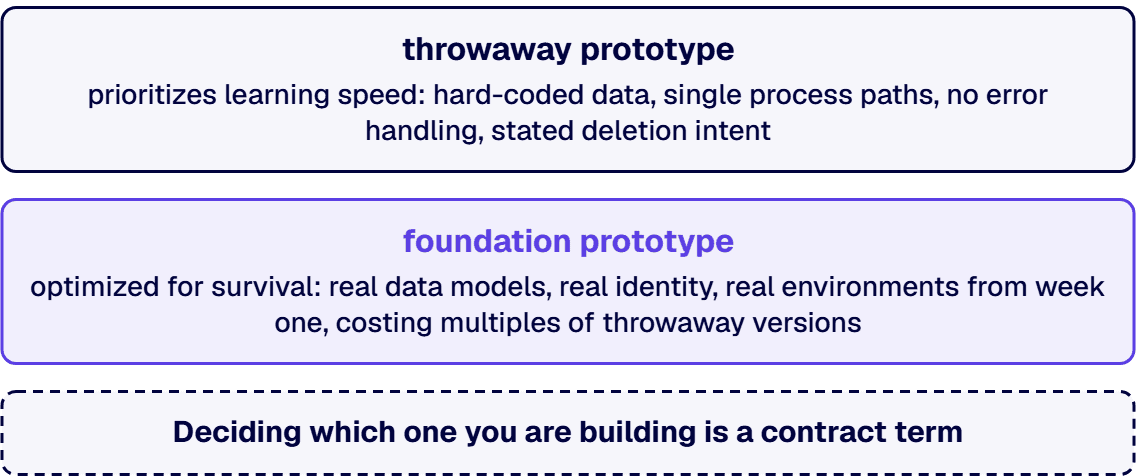
Throwaway or foundation is the choice that sets the price, and it is a choice, not a discovery made afterwards. A throwaway prototype is optimised for speed of learning: hard-coded data, one path through the process, no error handling, and a stated intention to delete it. A foundation prototype is optimised to survive, which means a real data model, real identity, and a real environment from the first week, and it costs a multiple of the throwaway version. Both are legitimate. Choosing neither, and letting the artifact drift into being the second while it was budgeted as the first, is the expensive outcome this page exists to prevent.

When Prototyping Wastes Time

Prototyping wastes time in four recognisable situations, and each one has an early tell that an application development manager can check before the money is committed.

The requirement is settled and the argument is about effort. Where the process is documented, the users are known, the data source is agreed and the disagreement is over how long the work takes, a prototype answers a question nobody was asking. Look for a backlog whose open items are all estimates and none of them a question. The cheaper instrument is a costed estimate with its assumptions written down, which the delivery team can produce from the same backlog.

The uncertainty is organizational. Two departments disagree about who owns the process, or the sponsor and the operations lead want different outcomes. A working screen does not resolve that; it gives each side a new artifact to argue about, and the disagreement resurfaces during user acceptance testing with a delivery contract already signed. The signal is a requirements workshop whose minutes carry an open item on process ownership instead of an open item on what the process does.

The evidence cannot be produced under the constraints that apply. Where the question is about behaviour under production data volumes or under a compliance position the test environment does not hold, the prototype answers a question about a synthetic case. A performance result taken on a sample the analyst assembled by hand is a fact about that sample. The tell is a success measure in the prototype’s scope document that cannot be stated without naming production data.

Nobody is waiting for the answer. No decision date, no named signer, no budget round the result feeds. What gives it away is the absence of a calendar entry. This is the demo trap’s origin, and it is visible before the work starts if anyone asks who reads the result and when.

There is a fifth situation that looks like waste and is not. A prototype that returns a negative answer, that the platform does not fit or the integration cannot meet the target, has done exactly what it was bought to do. A programme that treats a negative result as a failed prototype will stop commissioning them, and the next uncertainty gets carried straight into a build.

The Contract Between a Prototype and the Build That Follows

A prototype and the build that may follow it are two pieces of work with a handover between them, and the handover is agreed before the prototype starts. Written afterwards, it is a negotiation with an artifact already in production use and a team already attached to it.

Four terms make up the contract, and each one is a sentence the sponsor and the delivery lead both sign.

The question, in one sentence, with its measure. Not “test the concept” but the specific claim the prototype will support or refute, and what result counts as support. An analyst can write it as a hypothesis with a threshold: the approval step completes without leaving the application, or the nightly extract lands inside the window the finance team already works to.

The disposal term. Throwaway, reusable in part, or intended foundation, decided up front, because the answer changes the prototype’s cost and its technical standard. A reusable-in-part term names which part: the data model, the process map, the integration contract, the interface design. Naming the reusable pieces is what keeps the rest deletable.

The audience and the boundary. Who may use the artifact, on what data, and for how many process cycles. The boundary is the term that fails silently, because nothing enforces it once the prototype is on a shared environment and the first real user finds it useful.

The decision, its owner and its date. The steering group entry exists before the prototype is commissioned, with the person who rules named on it. Microsoft’s modernization guidance touches the same ground when it says a PoC “should validate your modernization approach” and recommends starting with a pilot program. That guidance reaches validation and stakeholder buy-in; the adopt-or-drop ruling on the evidence is this page’s own term.

Keeping a prototype from becoming the product is the disposal term doing its work, and one mechanism carries it: while the artifact is still evidence, the prototype and the production system are not the same deployment. Separate environment, separate identity configuration, and a named end date after which the artifact stops running. When a business unit asks for an extension, the extension is a decision with a cost attached and the cost is stated, which is a different conversation from the one where the prototype simply keeps running because nobody switched it off.

Where the disposal term is broken deliberately, because the prototype proved the approach and the sponsor now wants the artifact kept, that is a legitimate outcome and it becomes a different piece of work with its own gates. Everything that work involves, in what order, sits on the prototype-to-production page linked above; it is not restated here, and the decision this page owns is already made by then.

If the artifact you have is already past its boundary, with real users and no disposal term, the conversation to have is about what it now costs to make it defensible against what it costs to rebuild the capability with the evidence it produced. That reading takes your own environment record and your own estimate as its input. Talk to a senior architect

Common Failure Modes

Four patterns are where the money goes on this decision, and each has a tell that appears before the spend.

The prototype is scoped to impress rather than to inform. The demonstration covers the parts that show well and skips the exceptions, the volumes and the integration. Watch for a scope document written as a feature list with no open question named in it. What comes back is a positive result about the easy path and no information about the risk.

Success criteria are written after the result. The prototype runs, the team likes what they see, and the criteria are reconstructed to match. The tell is a hypothesis in the scope document with no threshold in it. Nothing can refute a claim written this way, so the prototype cannot return a no.

The throwaway is quietly promoted. No disposal term was agreed, the artifact is useful, and a department starts running work through it. The signal is a prototype still in use after its stated end date, visible in the environment list an administrator can export. By the time this is noticed the decision has been made by drift and the options are worse than they were.

Production discovery is skipped because the prototype felt like discovery. A prototype answers a bounded question; it does not recover the business rules the old system encodes, the integrations nobody documented, or the reporting a finance team depends on. The giveaway is a build estimate whose requirements section cites the prototype and no other source. The discipline that closes this gap is application discovery, which is its own work and its own page.

How i3solutions Runs the Prototype or Build Decision

What comes back from this conversation is a record, not a proposal, and its shape is worth knowing before anyone asks for one.

Four documents arrive, and each is built from records the reader’s own team can produce. An uncertainty register listing every open question with the decision it blocks and the person who holds it, exported from the project’s own backlog tool. A constraint list pairing each dated external commitment in the contract register with the data classification each system in scope carries in the organization’s classification record. A cost comparison setting the prototype’s price against the rework exposure the estimate already carries. And a recommendation written as a verdict with the four tests answered against that evidence, in the order the tests take when they disagree. The decision record that settles the decider test is not in this set, because the ruling and the record of it stay with the steering group that signs.

Three endings are available, and each is a real result. The verdict can read prototype, scoped to one named question with a disposal term and a decision date. It can read build for production, in which case what the reader holds is a written reason not to spend on evidence, which is the harder document to produce and the more useful one in a budget meeting. Or it can read that neither is the next step, which is where the uncertainty test lands when the open question changes neither the scope nor the effort but ownership of the process: an organizational disagreement no artifact resolves.

i3solutions has been a Microsoft partner since 1997. What that buys a sponsor at this particular decision is borrowed expertise: pattern recognition from applications that reached the same fork before theirs did, applied to their constraints before a direction is committed. The case-study record on this estate does not contain a prototype-first engagement written up as such, and that is stated here rather than dressed up, because a page arguing for evidence should not make an unevidenced claim about itself.

When i3solutions Is Not the Right Next Call

Three situations belong somewhere else, and naming them saves a scoping call on both sides.

The decision is already taken and what is needed is delivery capacity. If the path is settled, the requirement is documented and the constraint is people, that is a staffing conversation and deserves to be scoped and priced as one.

What blocks the work is organizational. Where two business units disagree about who owns the process an application would encode, no prototype and no build resolves it, and starting the technical work first buries the disagreement inside a project that later fails for reasons nobody records.

The work is not a Microsoft estate. This decision framework transfers to other technology stacks and the delivery bench behind it does not. Where the target platform is one i3solutions does not build on, a firm working in that stack will serve the reader better on everything after the verdict.

What is left is the case this page was written for: a real uncertainty, a sponsor asking for something to look at, and a budget round with a date on it. Bring the open questions, the constraints, and the estimate you already hold. The four tests get worked against those records, and the output is a written verdict with the artifact behind it attached. It can say prototype one question. It can say build, and here is why the evidence is not worth buying. It can say the blocker is not technical, and we would rather say that in the first conversation than in the third month. Talk to a senior architect

Frequently Asked Questions

Should we prototype first or build for production?

Prototype first when a named open question would change what gets built, and build for production when the open questions change only sequence and effort. Four tests settle it. The uncertainty test asks whether an open question changes scope. The decider test asks whether a named person will read the result and rule on a date. The cost-of-being-wrong test compares the prototype’s cost against the rework exposure in the delivery estimate. The constraint test asks whether a representative test can run without production data and inside the compliance position the organization already holds. When the tests disagree, the constraint test outranks the rest, the decider test comes second, the uncertainty test third, and the cost-of-being-wrong test breaks the remaining tie.

What should a rapid prototype prove before funding a build?

One claim, stated as a hypothesis with a threshold that could fail. Workflow: the process runs end to end for the roles that will use it, including the exception paths the team argues about. Platform fit: the chosen implementation route meets the requirement without a workaround a reviewer would refuse. Technical feasibility: the integration, the data volume or the performance target is met against the actual systems in scope, not against a sample assembled for the demonstration. Sponsor confidence: the business owner can describe the outcome well enough to fund it. A prototype that proves the easy path and leaves the integrations, the volumes and the exception paths untested has proved the wrong claim, and the build estimate that cites it will move.

When does prototyping waste time?

In four situations. When the requirement is already documented and the disagreement is about effort, in which case a costed estimate with written assumptions is the cheaper instrument. When the uncertainty is organizational, because a working screen gives two departments a new artifact to argue over and settles nothing. When the evidence cannot be produced under the constraints that apply, so the result describes a synthetic case instead of the real one. And when nobody is waiting for the answer, with no decision date and no named signer, which is where a prototype turns into an artifact that runs real work by drift. A negative result is not waste: refuting a platform choice before a build avoids the rework the build would have carried.

How do we keep a prototype from becoming the product?

Agree the disposal term before the prototype starts, and make it a term the sponsor signs: throwaway, reusable in part with the reusable pieces named, or intended foundation with the higher technical standard and the higher cost that implies. Then give it a boundary a mechanism enforces instead of a memo: a separate environment from the production system, its own identity configuration, a stated limit on who may use it and on what data, and a named end date after which it stops running. Where a business unit asks to keep it, treat that as a decision with a cost attached and state the cost, because the alternative is a system that acquired users without ever acquiring an owner, a test position or a support model.

What does a rapid prototype cost compared with a production build?

The two paths carry different cost shapes, not different sizes of one cost. A prototype pays for the artifact, for the attention of the few people who know how the process actually works, and for the meeting where a decision is taken on the result. A production build pays for discovery, for architecture and environments, for test coverage and release control, and for a support position, and those do not shrink when the requirement turns out to be simple. The number that decides the case is neither total: it is the price of a wrong answer on each path. A wrong prototype spends its own budget and hands back a fact, provided its success criteria were written before the result. A wrong build spends its budget, pays again for rework, and carries the exposure of a system people have started to depend on.

Related Reading

About the Author

Michael Branson co-founded i3solutions and brings executive, operational, and technical perspective to organizations running complex, secure, and mission-critical Microsoft estates. He works with enterprise teams on the spending decisions that come before a build: what is worth proving first, and what is already settled enough to build.