
The cost difference between hourly and monthly retainer pricing for Agile staff augmentation is not a rate spread, it is a difference in what you are buying: hourly pricing bills consumption after the fact and leaves the total open until the work stops, while a monthly retainer reserves named senior capacity at a fixed monthly figure you can budget before anything starts. i3solutions publishes monthly engagement bands rather than an hourly rate and prices hourly work per scope, so the honest comparison is between a band you can plan a quarter around and an estimate that only settles on the invoice. Retained advisory for Microsoft-focused environments runs $5K-$15K per month. The full ladder, from retained advisory up to a dedicated embedded team, is below.
The clearest published definition of hourly work is the federal one, because the federal government buys more of it than anyone. A time and materials contract, in the words of the Federal Acquisition Regulation, “provides for acquiring supplies or services on the basis of” “Direct labor hours at specified fixed hourly rates that include wages, overhead, general and administrative expenses, and profit” (FAR 16.601(b), acquisition.gov). The same section then states the consequence without softening it: a time and materials contract “provides no positive profit incentive to the contractor for cost control or labor efficiency,” and therefore “appropriate Government surveillance of contractor performance is required to give reasonable assurance that efficient methods and effective cost controls are being used” (FAR 16.601(c)(1)).
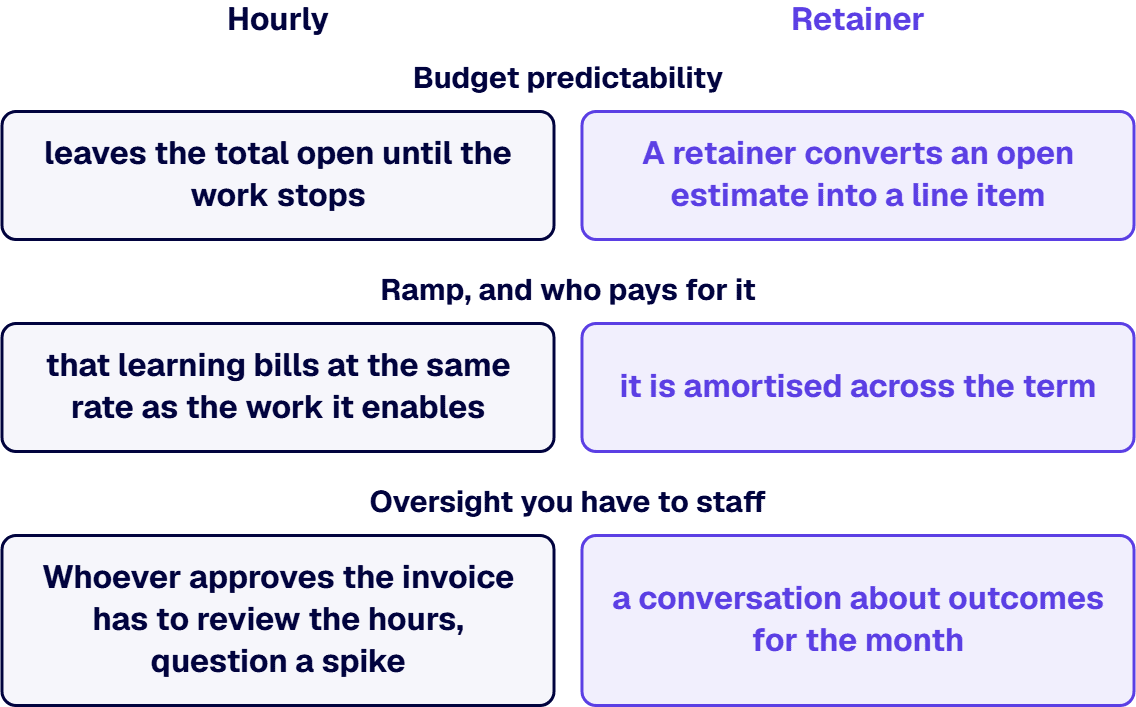
Read that as a pricing fact rather than a procurement footnote. Hourly billing moves the efficiency risk to the buyer, and the oversight that keeps it honest is work somebody on your side has to do. On a federal contract that somebody is a contracting officer. On your commercial engagement it is your program manager, and their time is not on the invoice.
The regulation is equally direct about the opposite pole. A firm fixed price contract “provides for a price that is not subject to any adjustment on the basis of the contractor’s cost experience in performing the contract” and “places upon the contractor maximum risk and full responsibility for all costs and resulting profit or loss” (FAR 16.202-1, acquisition.gov). A monthly retainer sits between the two. The monthly number is fixed, the work inside the month is allowed to move, so the vendor carries the efficiency risk within each month and you keep only one decision: how many months to buy.
There is no published i3solutions hourly rate, and this page will not manufacture one. i3solutions publishes monthly engagement bands and prices hourly work per scope. That is a deliberate position, not an omission: an hourly number with no named seniority mix, no named allocation and no named duration behind it is not a price, it is a placeholder that gets revised once the work is understood. The published bands are these.
Those are four different products, not four points on one curve. Each band names its own allocation or commitment, and nothing beyond what a band’s own sentence says should be read into it. Which one applies follows from three things you already know: how many senior people the work needs at the same time, what share of a senior architect’s week it needs, and how many months it runs.
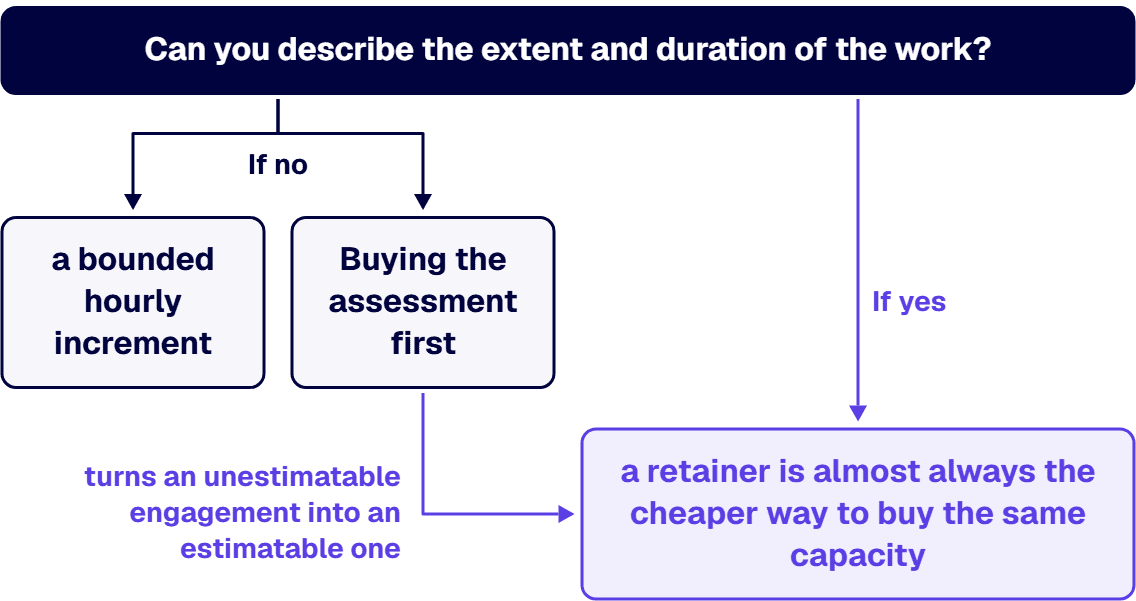
A retainer converts an open estimate into a line item. You know the monthly figure before the first sprint and you can defend it in a budget review without a caveat about how many hours the integration might take. Hourly work cannot give you that, by construction: the regulation quoted above allows time and materials only where it is “not possible at the time of placing the contract to estimate accurately the extent or duration of the work” (FAR 16.601(c)). If the extent genuinely cannot be estimated, hourly is the honest instrument. If it can be, paying hourly means buying uncertainty you do not have.
Reserved capacity is what makes a senior architect available on a Tuesday afternoon rather than in three weeks. The embedded advisory band prices that reservation explicitly, at 20 to 40 percent senior architect allocation. Hourly arrangements tend to buy whoever is unallocated this week, which is a different product even when the labor category on the invoice reads the same.
The three to nine month minimum commitment on the dedicated team band is not a sales device. A senior contributor’s first weeks go into learning your estate, your tenant, your release process and your approvers. Under an hourly arrangement that learning bills at the same rate as the work it enables, and it bills again the next time the roster changes. Under a monthly commitment it is amortised across the term, which is the actual mechanism behind most of the cost gap people notice at the end of a quarter.
Whoever approves the invoice has to review the hours, question a spike, and decide whether an eight hour task should have taken four. Under a retainer that scrutiny turns into a conversation about outcomes for the month, which is a conversation your delivery lead was going to have anyway.
When the argument between hourly and retainer stalls, it is usually because nobody yet knows how much work there is. That is a scoping problem wearing a pricing costume, and it has its own instrument. A Microsoft discovery assessment is a fixed-scope, fixed-fee engagement, typically $10K-$25K depending on scope, not an open-ended hourly meter, and the roadmap it produces is yours to execute with or without the firm that wrote it.
Buying the assessment first turns an unestimatable engagement into an estimatable one, which is the condition under which a retainer becomes the cheaper of the two models. Our fuller treatment of how these instruments compare sits in Microsoft consulting billing models.
Answer these three and the choice is made.
If the answers point at reserved capacity, the shape of it is set out in IT staff augmentation services, and the difference between a dedicated team and traditional staffing is compared directly in dedicated Microsoft teams versus traditional IT staffing. If you need a named specialist rather than a team, hire on demand Microsoft experts covers that route. For the total cost of ownership comparison against a full-time hire, which is a different question from this one and deserves its own arithmetic, see our guide to IT staff augmentation for Microsoft enterprises.
i3solutions delivers under a partner-led engagement model with named accountability and governance that holds up under a client audit, as distinct from contractor-only staff augmentation. That is a statement about how the engagement is run, not a record of any audit outcome, and it is the part of a retainer that never appears on an hourly rate card: an hourly arrangement buys labor by the hour, and accountability for the result stays with you.
Not comparably, because the two are not selling the same thing. Hourly can be the lower total outlay on genuinely short, bounded work, and the Federal Acquisition Regulation restricts time and materials to exactly that case: where it is “not possible at the time of placing the contract to estimate accurately the extent or duration of the work” (FAR 16.601(c)). Once the extent is estimatable and the work runs for months, a retainer usually wins on total cost, because ramp is amortised and the oversight burden drops.
i3solutions does not publish an hourly rate. It publishes monthly engagement bands and prices hourly work per scope. Retained advisory for Microsoft-focused environments runs $5K-$15K per month, and the ladder continues through embedded advisory, a named specialist, and a dedicated team, each with its own published band.
Dedicated team engagements range $35,000 to $95,000 per month per team depending on team composition (senior architect, senior engineer, delivery lead mix) with three to nine month minimum commitments. That is the only commitment length i3solutions publishes. Anything shorter is scoped in the conversation rather than on a price list.
Yes, and the cleaner sequence is to scope the work before you buy any of it. A Microsoft discovery assessment is a fixed-scope, fixed-fee engagement, typically $10K-$25K depending on scope, not an open-ended hourly meter, and the roadmap it produces is yours to execute with or without the firm that wrote it. Assessment first, then a retainer sized to the roadmap, avoids paying hourly for the discovery you were going to need anyway.
Reserved capacity, continuity of the same people, and a named owner for the outcome. i3solutions delivers under a partner-led engagement model with named accountability and governance that holds up under a client audit, as distinct from contractor-only staff augmentation. Hourly billing buys labor by the hour and leaves accountability for the result on your side of the table.

US-Based | Est. 1997
© i3solutions. All rights reserved.
US-Based | Est. 1997
© i3solutions. All rights reserved.


