
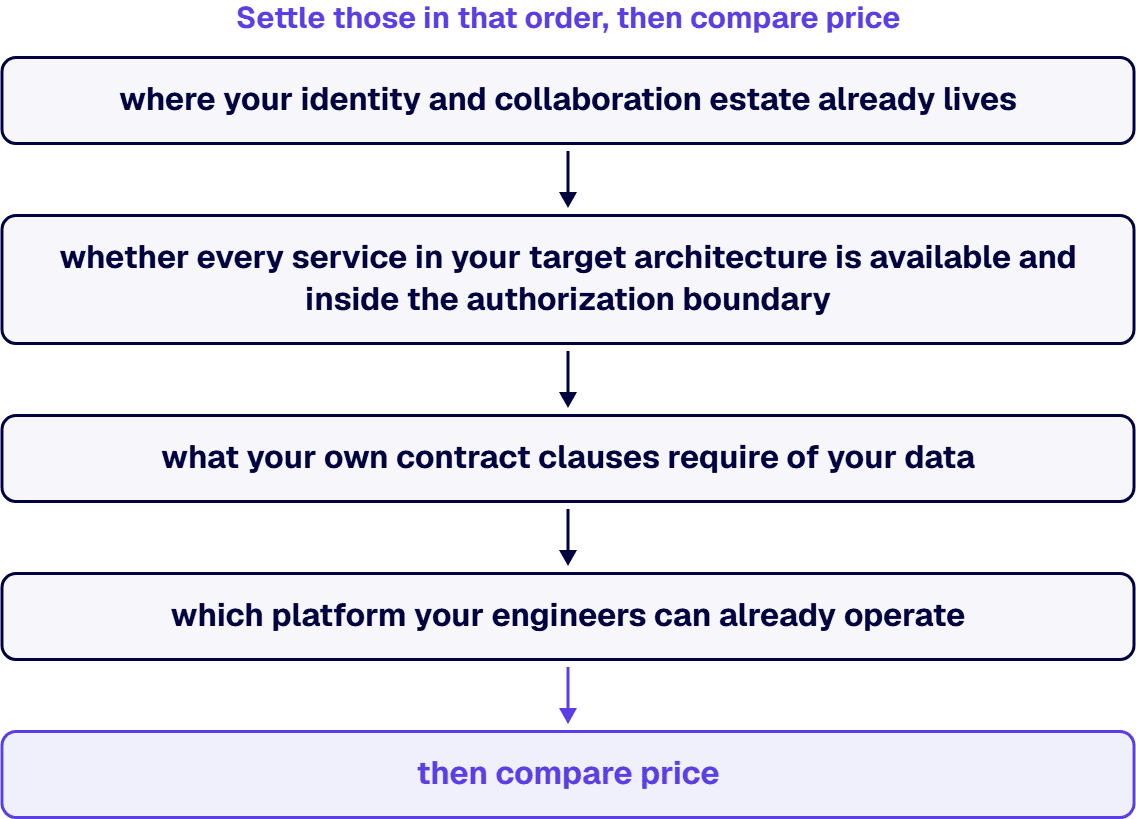
Neither platform wins on compliance ceiling, so the honest answer is conditional. Microsoft’s Azure Government documentation records a FedRAMP High Provisional Authorization to Operate issued by the FedRAMP Joint Authorization Board and DoD Impact Level 2, 4 and 5 Provisional Authorizations issued by DISA. AWS’s own DoD compliance page records AWS GovCloud (US) approved at Impact Levels 4 and 5 under a DISA provisional authorization. Both providers restrict operator access to screened US persons. At the levels most defense and civilian contractors actually work at, the two are peers, and a comparison that ends in a winner is usually selling something. What decides it is narrower: where your identity and collaboration estate already lives, whether every service in your target architecture is available and inside the authorization boundary of the specific government region you would deploy into, what your own contract clauses require of your data, and which platform your engineers can already operate at 2 a.m. Settle those four in that order, then compare price.
Say this plainly before anything else: i3solutions is a Microsoft firm. We hold no AWS delivery credential and we are not going to pretend otherwise on our own website. What we do have is the thing buyers actually need at this stage, which is a clear read on which criteria decide a government cloud platform choice and which ones only look like they do. If that read sends you to AWS GovCloud, that is a correct outcome and an AWS specialist is the right partner for it.
The authorization boundary and its vocabulary. The two vendors currently describe their FedRAMP status in different program language, and that trips buyers up more than any technical difference. Microsoft’s Azure Government compliance page states that Azure Government maintains a “FedRAMP High Provisional Authorization to Operate (P-ATO) issued by the FedRAMP Joint Authorization Board (JAB)” for the regions US Gov Arizona, US Gov Texas and US Gov Virginia. AWS’s FedRAMP page now states that “AWS GovCloud (US) is FedRAMP Certified Class D (formerly High baseline)” and that “AWS US East-West (Northern Virginia, Ohio, Oregon, Northern California) is FedRAMP Certified Class C (formerly Moderate baseline)”, adding that “The JAB Provisional Authority to Operate (P-ATO) previously issued to AWS is a legacy designation”. Read those side by side and the difference is program terminology, not security posture. Both government offerings sit at what was, and in Microsoft’s wording still is, the High baseline.
DoD impact levels. Microsoft’s page lists DoD IL2, IL4 and IL5 Provisional Authorizations issued by DISA for the three US Gov regions, and separately notes that “Some Azure services deployed in Azure Government regions (US Gov Arizona, US Gov Texas, and US Gov Virginia) require extra configuration to meet DoD IL5 compute and storage isolation requirements.” AWS’s DoD compliance page states that “AWS has been assessed and approved as a cloud service provider for the US East and US West Regions at Impact Level 2, AWS GovCloud (US) at Impact Levels 4 and 5, and the AWS Secret Region at Impact Level 6”, and that “At Impact Level 6, The AWS Secret Region holds a DoD provisional authorization for workloads up to and including Secret level.” Two things follow. At IL4 and IL5 the platforms are peers. Above IL5 both vendors move you into air-gapped clouds, and Microsoft’s comparison page is explicit that its published tables “do not include feature or bundle availability in the Azure Government Secret or Azure Government Top Secret clouds” and directs you to your account team. So on public documentation alone, AWS publishes an IL6 statement and Microsoft defers the equivalent conversation. That is a documentation difference, and treating it as a capability verdict would be reading too much into it.
Data residency and personnel screening. Microsoft states that “Azure Government uses physically isolated datacenters and networks located in the US only” and provides “an extra layer of protection to customers through contractual commitments regarding storage of customer data in the US and limiting potential access to systems processing customer data to screened US persons”, with customers “subject to validation of eligibility”. AWS describes GovCloud as “Two physically and logically isolated U.S. sovereign regions, AWS GovCloud (US-East and US-West), operated by U.S. citizens on U.S. soil”, and states that “Root Account holders must pass a screening process validating U.S. persons status and must be a (green card holder or citizen as defined by the U.S. Department of State).” Both are US persons regimes. The mechanics differ: Microsoft gates on tenant eligibility validation, AWS gates at the account root. If your export control counsel cares about who can touch the account, read both of those sentences with them rather than summarizing either.
Service parity in the region you would actually deploy into. This is where real projects break. Microsoft’s own comparison of Azure Government and global Azure warns that “Certain services and features that are in specific regions of global Azure might not be available in Azure Government” and that “Feature configurations in Azure Government might differ from those in global Azure”, pointing readers at the Products available by region listing “for the latest, up-to-date information on service availability”. The same caution applies on the AWS side. Neither vendor’s government cloud is a mirror of its commercial cloud, and the gaps move. Build the list of services your architecture depends on and check each one against the current listing before you commit.
Most of this work does not need outside help. Reading two vendor pages is not consulting. A partner earns the engagement in three places: turning contract clauses into a defensible data classification, verifying service availability and authorization boundary per service in the exact region you would deploy into, and pricing the cost of a split identity perimeter honestly before someone commits to one.
On the Microsoft side of that boundary, here is what i3solutions is attested to do. i3solutions advises clients on federal compliance posture as its own assessment rather than as a restatement of Microsoft’s documentation, including whether SharePoint Online meets NIST 800-53, whether Azure Government is required under the DoD Cloud Computing SRG, and whether a CMMC gap assessment is needed to bid. i3solutions plans and runs governed Azure and Microsoft 365 migrations with senior, U.S.-based engineers. i3 installs and helps configure applications inside IL4 and IL6 government cloud environments and other government networks. i3solutions is a Microsoft Partner with 30 years of delivery experience. i3solutions has completed more than 600 Microsoft platform implementations.
On the collaboration side: We manage GCC High migrations end-to-end: from eligibility validation and licensing coordination with your AOS-G supplier through identity architecture, data migration, security baseline configuration, and post-migration governance. i3solutions plans and runs these migrations for regulated defense organizations, structuring each phase around the compliance evidence assessors expect. Two boundaries inside that sentence are load bearing: i3solutions does not hold AOS-G status, and tenant provisioning itself is performed by a certified AOS-G supplier alongside whom i3solutions works.
What is not claimed, and should not be inferred. i3solutions does not hold a FedRAMP authorization at any impact level. i3solutions does not hold a DoD authorization of its own. i3solutions has not authorized, accredited or issued an authority to operate for any system. i3solutions has not performed a full tenant migration into IL4 or IL6. And i3solutions has no attested AWS delivery record, which is why every AWS statement on this page is a quotation from AWS’s own published documentation rather than a claim about our experience. Authorizations belong to the cloud service provider and to your own system boundary. Any consulting firm advertising one of its own is describing something that does not work the way the phrase implies, and that is worth checking on every firm you talk to, including this one.
If the decision lands on Microsoft, the next questions are practical rather than comparative: whether GCC High or GCC Moderate fits your obligations is covered in the GCC High versus GCC Moderate comparison, the sequencing and eligibility work is set out in the GCC High migration checklist, the workload move itself is described on the Azure Government migration page, the sensitive data boundary is covered on the GCC High and sensitive data protection page, and which multifactor authentication controls your baseline actually requires is set out on the MFA and NIST 800-53 identity page. If it lands on AWS, take this page’s criteria to an AWS specialist and make them answer the same four questions.
Neither, at the levels most government contractors operate at. Microsoft’s Azure Government compliance page records a FedRAMP High Provisional Authorization to Operate issued by the FedRAMP Joint Authorization Board and DoD Impact Level 2, 4 and 5 Provisional Authorizations issued by DISA. AWS’s FedRAMP page describes AWS GovCloud (US) as FedRAMP Certified Class D, formerly the High baseline, and its DoD compliance page records GovCloud approved at Impact Levels 4 and 5. Both restrict operator access to screened US persons. The compliance ceiling therefore rarely discriminates, and treating the comparison as a compliance contest is the most common way this decision goes wrong.
From each vendor’s own documentation: Azure Government maintains DoD Impact Level 2, Impact Level 4 and Impact Level 5 Provisional Authorizations issued by DISA for US Gov Arizona, US Gov Texas and US Gov Virginia, with Microsoft noting that some services in those regions require extra configuration to meet IL5 compute and storage isolation requirements. AWS states it is approved for US East and US West at Impact Level 2, AWS GovCloud (US) at Impact Levels 4 and 5, and the AWS Secret Region at Impact Level 6, holding a DoD provisional authorization for workloads up to and including Secret level. Above IL5 both vendors move you to air-gapped clouds, and Microsoft’s published comparison tables exclude its Secret and Top Secret clouds and direct you to your account team.
Four things, in this order. Where your identity and collaboration estate already lives, because running Microsoft 365 in a government cloud and the application estate somewhere else means operating two identity perimeters permanently. Whether every service your architecture needs is available and inside the authorization boundary of the specific government region you would deploy into, verified against each vendor’s current region listing rather than assumed from commercial parity. What your own contract clauses require of your data, which is a determination about your obligations rather than a property of a cloud. And which platform your engineering team can already operate under pressure, which is a legitimate input regularly treated as an embarrassing one.
No. i3solutions does not hold a FedRAMP authorization at any impact level, does not hold a DoD authorization of its own, has not authorized, accredited or issued an authority to operate for any system, and has not performed a full tenant migration into IL4 or IL6. What is attested is that i3 installs and helps configure applications inside IL4 and IL6 government cloud environments and other government networks. Authorizations belong to the cloud service provider and to your own system boundary. i3solutions is a Microsoft firm with no attested AWS delivery record, which is why every AWS fact on this page is quoted from AWS’s published documentation.
That is a contractual determination rather than a technical preference, and it should be made before the platform decision rather than justified after it. Microsoft’s own comparison states that global Azure and Azure Government are both assessed and authorized at the FedRAMP High impact level, and that what Azure Government adds is contractual commitments on storing customer data in the US and limiting access to screened US persons. So the government cloud question is really a question about your data classification and your export control exposure. If the classification says commercial is sufficient, a government cloud adds cost and service constraints for no benefit. If it does not, discovering that after you have built is the expensive path.
For Microsoft 365 government tenants, i3solutions publishes this directional band. Directional bands for organizations with 50 to 500 users: implementation costs typically range from $50,000 to $200,000, covering tenant provisioning, identity migration, data transfer, security configuration, and compliance validation. Treat that as a plausibility check against a defined scope rather than a quote. The variables that move it are user count, how many repositories are in scope, how much of the identity estate has to be rebuilt rather than migrated, and how many compliance frameworks the evidence has to satisfy. No equivalent band is published here for AWS GovCloud, because i3solutions has no attested AWS delivery record to base one on.

US-Based | Est. 1997
© i3solutions. All rights reserved.
US-Based | Est. 1997
© i3solutions. All rights reserved.


