
By Michael Branson
Yes, you still need Microsoft Purview without Copilot, because Purview is where Microsoft runs data loss prevention, sensitivity labels, audit, retention and eDiscovery, and a regulated enterprise owes the controls behind them to its regulators and auditors either way. The real question is which of them your obligations require first.
If you heard Purview sold as Copilot readiness and Copilot is not on your roadmap, you now have to defend the license and the build effort to a CFO or an audit committee without that reason. The defense rests on the obligations your organization carries today, matched one by one to the Purview capability that serves them.
If you take Copilot out of the picture, Microsoft’s own description of Purview does not change. Microsoft Learn describes it this way: “Microsoft Purview is a comprehensive set of solutions that helps your organization govern, protect, and manage data in the era of AI, wherever your data lives.” Where the same page turns to AI, it lists the places its protections apply as “Copilot experiences and agents,” “Enterprise AI apps that you build,” and “Other AI apps you use.” Copilot is one surface in that list, not the reason the product exists. Source, Microsoft Learn (read date 2026-09-22): Learn about Microsoft Purview.
If Copilot does not arrive, the five capabilities below still answer to obligations your organization carries.
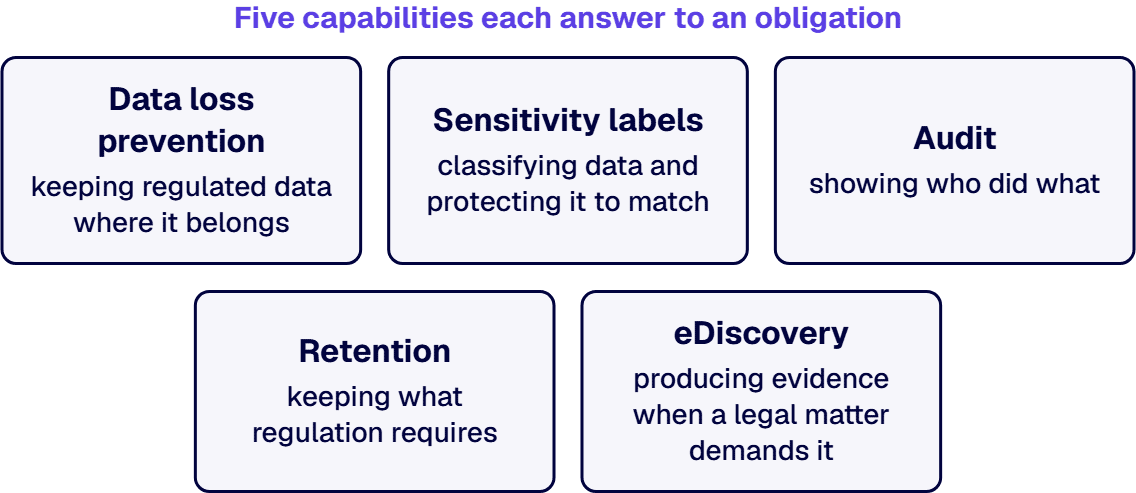
Data loss prevention. The obligation is keeping regulated data where it belongs. Microsoft Learn states that “In Microsoft Purview, you implement data loss prevention by defining and applying DLP policies,” and names the kinds of sensitive information organizations control, among them financial data, credit card numbers, health records and Social Security numbers. Source, Microsoft Learn (read date 2026-09-22): Learn about data loss prevention.
Sensitivity labels. The obligation is classifying data and protecting it to match. Microsoft Learn states that “Sensitivity labels from Microsoft Purview Information Protection let you classify and protect your organization’s data, while making sure that user productivity and their ability to collaborate isn’t hindered,” and that labels provide protection settings that include “encryption and content markings.” Source, Microsoft Learn (read date 2026-09-22): Learn about sensitivity labels.
Audit. The obligation is showing who did what when an investigator or an auditor asks. Microsoft Learn states that “Microsoft Purview auditing solutions provide an integrated solution to help organizations effectively respond to security events, forensic investigations, internal investigations, and compliance obligations.” How long records are kept depends on the audit tier, and Microsoft Learn states that “In Audit (Standard), the system retains records for 180 days”, so check the window your obligations name against that page before relying on it. Source, Microsoft Learn (read date 2026-09-22): Learn about auditing solutions in Microsoft Purview.
Retention. The obligation is keeping what regulation requires and disposing of what it does not. Microsoft Learn gives retention policies and labels the purpose to “Comply proactively with industry regulations and internal policies that require you to retain content for a minimum period of time,” and describes two actions: retain, which prevents permanent deletion and keeps content available for eDiscovery, and delete, which permanently removes content from the organization. Source, Microsoft Learn (read date 2026-09-22): Learn about retention policies and retention labels.
eDiscovery. The obligation is producing evidence when a legal matter or an investigation demands it. Microsoft Learn defines eDiscovery as “the process of identifying and delivering electronically stored information (ESI) that you can use as evidence in investigations and legal cases,” and states: “Use eDiscovery cases to identify, hold, and export content found in mailboxes and sites.” Source, Microsoft Learn (read date 2026-09-22): Learn about eDiscovery.
If Purview reached you as a Copilot prerequisite, the pitch was about stakes, not purpose: Copilot works over whatever a user can already reach, so it raises the stakes on the same controls a regulated enterprise already needed. For the Copilot side of that argument, read You Bought Copilot. Your Data Isn’t Ready for It. The Copilot Data Governance Fix.
If you are a defense contractor working toward CMMC, the first question is not about Purview but whether your Microsoft subscription and cloud can hold the data in scope, and that question is answered in Is Office 365 CMMC Compliant? The SKU Decides Before the Environment Does.
Once that is settled, Purview plays two parts. The first is assessment: Microsoft Learn describes Microsoft Purview Compliance Manager as “a solution that helps you automatically assess and manage compliance across your multicloud environment,” with “Pre-built assessments for common industry and regional standards and regulations,” and its regulations list on Microsoft Learn includes “CMMC v2 Level 1” and “CMMC v2 Level 2” in its premium regulations, which “may be purchased by your organization.” Microsoft Learn also states that “Available assessments depend on your licensing agreement.” Sources, Microsoft Learn (read date 2026-09-22): Microsoft Purview Compliance Manager; Compliance Manager regulations list. If insider risk is one of those obligations in GCC High, see who must sign off on Purview Insider Risk Management in GCC High.
The second part is evidence. The data loss prevention, audit and retention capabilities above produce records an assessor can ask to see. An assessment in Compliance Manager is a tool for tracking your own controls; it does not certify an organization, and neither Purview nor i3solutions makes an organization CMMC compliant.
What the work costs is a scoping question, and i3solutions prices it against its own band. A CMMC Level 2 implementation for a defense contractor with a defined CUI boundary typically ranges from $45,000 to $75,000, covering the Compliance Manager baseline assessment, Conditional Access redesign, DLP policy build and testing, Purview Audit Premium configuration, and post-implementation documentation.
Once you have to defend the license capability by capability, three tests do the sorting, and each names the document that answers it.
Obligation test. Which of your regulations, contracts and internal policies name a retention period, an audit trail or a data-handling control? Read your compliance obligations register for the answer; a named requirement tells you whether retention, audit or data loss prevention is owed.
Location test. Where does your regulated or controlled data sit today, by site, mailbox and team? Read your data inventory for the answer; it tells you where sensitivity labels and data loss prevention policies have to reach.
Legal-hold test. If counsel asked you today to hold and export the mailboxes and sites tied to one matter, what would you run? Read your last litigation hold request for the answer; if it was met by a manual search, eDiscovery is the gap. If Copilot is in use, a hold also suspends permanent deletion of Microsoft 365 Copilot Prompts and Responses, and eDiscovery searches them.
When the tests point different ways, the obligation test outranks the other two: a capability that a regulation or contract names is funded first, and the location test and the legal-hold test then set the order of the rest. Where the answer is that you need a capability, the next step is how to get ready for it, set out in Microsoft Purview Deployment Guide: A Readiness Playbook for Regulated Enterprises.
If the license has to be defended to a CFO or an audit committee, the defense is stronger when each capability is tied to a named obligation. i3solutions maps governance to named control families, enforces it in the platform through Entra ID, Purview, and Azure Policy, and evidences it continuously rather than reconstructing it at audit. Delivery is senior and US-based. The wider governance practice is set out on Embedding Governance into How the Enterprise Operates and Scales.
Yes: if you are not deploying Copilot, you still need Purview, because Microsoft Learn describes it as a set of solutions that helps an organization govern, protect and manage data wherever it lives, and its data loss prevention, sensitivity labeling, auditing, retention and eDiscovery tools answer to obligations that exist without Copilot. Copilot is one of the AI surfaces Purview protects, not the reason it exists. Decide which capabilities to fund first with three tests: the obligation test, the location test and the legal-hold test.
If you are working toward CMMC, settle the subscription and cloud question before the Purview decision. After that, Purview plays two parts: Microsoft Learn lists “CMMC v2 Level 1” and “CMMC v2 Level 2” among the regulations Microsoft Purview Compliance Manager carries assessments for, as premium templates that Microsoft says “may be purchased by your organization”, and Purview audit, retention and data loss prevention supply evidence for your controls. A Compliance Manager assessment is a tracking tool: Purview does not certify an organization or make it CMMC compliant.
If you are choosing where to start, begin with whatever a regulation or contract you hold spells out by name, which is the obligation test. Then use the location test, which maps where regulated data sits, and the legal-hold test, which asks what you would run to hold and export one matter’s content, to order the remaining capabilities.

US-Based | Est. 1997
© i3solutions. All rights reserved.
US-Based | Est. 1997
© i3solutions. All rights reserved.


