
There is no platform that is best for hybrid enterprises as a class, and any shortlist handed to you before someone has looked at your estate is a vendor preference wearing a recommendation’s clothes. Fit is decided by five constraints, and once you have measured them the shortlist usually writes itself down to two candidates. Where your authoritative source of identity already lives and what it must stay authoritative for. What your on-premises application estate actually needs, specifically how many applications cannot speak a modern authentication protocol. Which compliance regime has to be evidenced, and whether that regime constrains where identity data sits. How much identity governance you need beyond sign-in, meaning access reviews, joiner-mover-leaver automation, and entitlement certification. And what your team can operate on a Tuesday, which is the constraint most evaluations skip and most programs fail on. In practice a Microsoft-heavy estate with governance requirements and a modernizable application set lands on Microsoft Entra ID, an estate with a large non-Microsoft application portfolio and an established independent identity provider often keeps that provider at the front and integrates rather than migrates, and a genuinely mixed estate frequently runs both deliberately for a period rather than pretending the migration is shorter than it is. The rest of this page is how to measure the five so the answer is yours rather than ours.
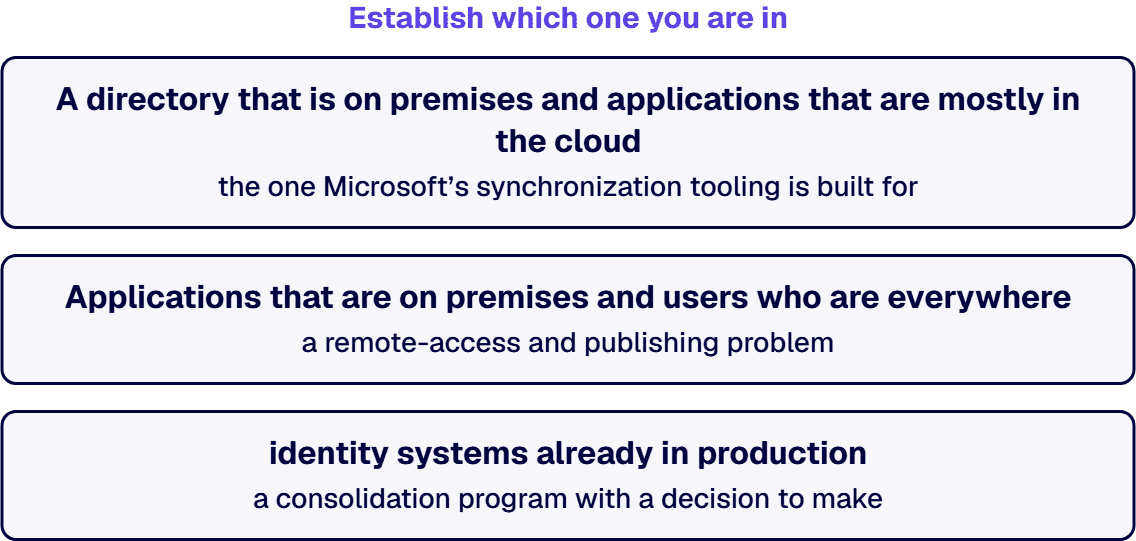
Hybrid names three different situations with three different answers. Establish which one you are in before you read any comparison, including this one.
Microsoft’s definition of the general case is the useful anchor: identity solutions that “create a common user identity for authentication and authorization to all resources, regardless of location. We call this hybrid identity.” The same page is specific about the mechanism, which is the part evaluations under-weight: “Hybrid identity is accomplished through provisioning and synchronization.” Most of the engineering in a hybrid identity program is provisioning and synchronization plumbing, not choosing a login screen.
The three situations are these. A directory that is on premises and applications that are mostly in the cloud, which is the common enterprise case and the one Microsoft’s synchronization tooling is built for. Applications that are on premises and users who are everywhere, which is a remote-access and publishing problem before it is an identity-platform problem. And two identity systems already in production, usually after an acquisition, which is a consolidation program with a decision to make rather than a platform selection. Naming which one you are in changes the shortlist more than any feature comparison will.
Ask what your authoritative directory is, what writes to it, and what would have to change for something else to become authoritative. In most enterprises the answer involves an on-premises Active Directory that a great deal of infrastructure still depends on, and that dependency is usually the real constraint rather than any preference about cloud platforms.
This matters because the synchronization layer is where hybrid programs actually break. Microsoft documents Microsoft Entra Connect for this job, and whichever platform you choose you will be running an equivalent. So evaluate the synchronization component with the same seriousness you evaluate sign-in: what is the source of truth per attribute, what happens when the two disagree, how long is the reconciliation window, and who is paged when it stalls. An evaluation that never asks those four questions has not evaluated the hard part.
Count them. Not the total application estate, the subset that cannot speak a modern authentication protocol, because that number decides more of the outcome than any other single input. Applications on Kerberos or header-based authentication, and applications nobody is allowed to change because a vendor owns them or a validation package covers them, all fall in this bucket.
Microsoft documents two relevant capabilities for publishing on-premises applications to remote users, Microsoft Entra application proxy and Microsoft Entra Private Access, and other identity platforms publish their own gateway approaches. The evaluation question is not whether a vendor has such a capability, since the serious ones do. It is whether yours works for your specific legacy applications, which is answered by testing three of the worst ones during evaluation rather than by reading a datasheet. Insist on that test. It is the cheapest de-risking available and vendors rarely volunteer it.
Identity is where most audit findings land, so the regime should be an input to platform selection rather than something bolted on afterwards. Write down which framework governs you, which controls in it are identity controls, and what artifact each control needs. Then ask each candidate platform to show you where that artifact comes from and how it is exported.
Two specifics are worth settling early because they can eliminate a candidate outright rather than merely score it down. Whether the regime constrains where identity data may reside, since that is a boundary question rather than a feature question. And whether your evidence has to be produced on a schedule for an assessor, because a platform that can show current state but cannot produce a defensible historical record turns every audit into a manual exercise. On our own side of that: i3solutions runs migrations against named control families across CMMC, HIPAA, SOC 2, and NIST 800-171, producing artifacts auditors can review.
Single sign-on and multifactor authentication are table stakes and every serious platform has them, so they should not decide anything. What decides the outcome for a large enterprise is the layer above: access reviews, joiner-mover-leaver automation, entitlement management, and separation-of-duties enforcement. Microsoft groups these under identity governance, and independent identity governance suites exist as a category for organizations whose requirements exceed what a general platform provides.
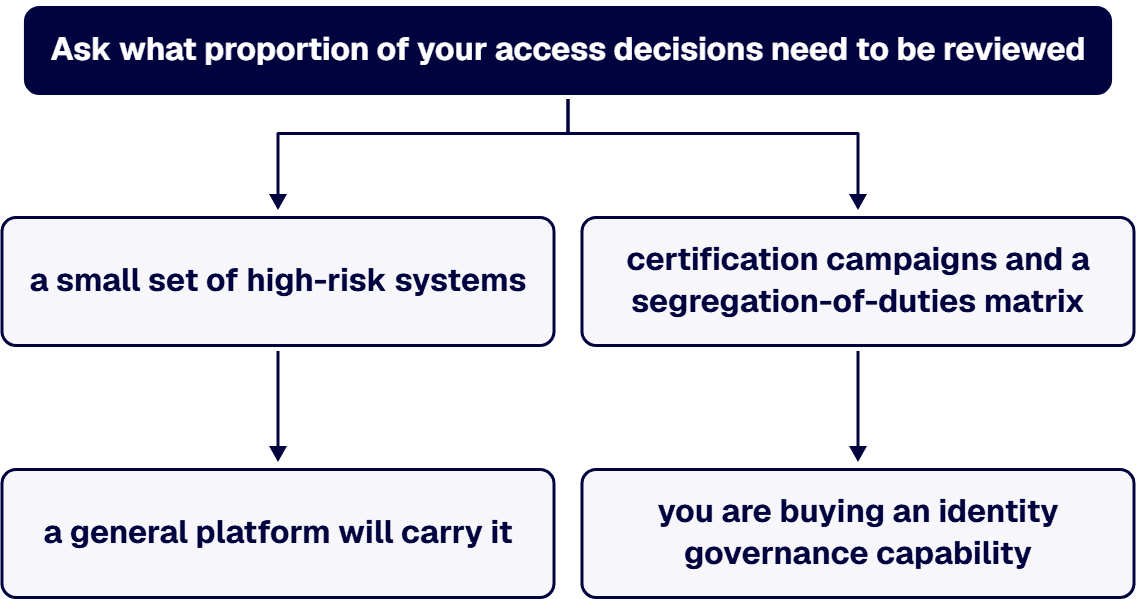
Scope this rather than compare features. Ask what proportion of your access decisions need to be reviewed, by whom, and how often. If the answer is a small set of high-risk systems reviewed quarterly, a general platform will carry it. If the answer is thousands of entitlements across dozens of systems with certification campaigns and a segregation-of-duties matrix, you are buying an identity governance capability and should evaluate that market rather than assuming your sign-in platform will grow into it. Getting this one wrong is expensive in both directions, and both directions are common.
This constraint decides more programs than the other four and appears in the fewest evaluation matrices. Ask how many people will operate this platform, what else those people own, and what happens when the person who configured it leaves.
The failure it prevents is specific and it is the most common one in this category: a platform selected on capability breadth, configured by a specialist, and then operated by a team that inherits a configuration it does not understand and is afraid to change. Policies calcify, exceptions accumulate as permanent grants, and two years later the access model is neither what was designed nor what anyone can explain. A platform your team can operate confidently at eighty percent of the capability beats one they can only operate at forty percent of a larger capability, and it is not close.
With the five measured, three patterns recur. None is a recommendation for your estate, because that requires the measurements.
The two-platform comparison most often asked about in this category is set out in Okta versus Microsoft Entra ID, including the case where both stay. If the decision is already made and the question is execution, Okta to Entra ID migration covers the consolidation path.
Our senior architects run this decision as a delivery exercise rather than a sales one, and the first fact is the one that matters most to you. i3solutions runs comparative platform-selection evaluations for clients, recommending among IAM platforms for hybrid estates and among workflow automation platforms against SOC 2 and HIPAA, rather than only implementing the Microsoft option. That is the disclosure that should decide whether you take a recommendation from anyone, including us: ask what the firm would have to conclude for it to recommend the platform it does not sell.
Both of the platforms most often shortlisted are ones we deliver. i3solutions delivers its full service portfolio into the healthcare vertical exactly as it does into defense manufacturing and finance, including identity work with Okta and Entra ID, AI work, Power Platform, and Dynamics 365 integration. i3solutions regularly delivers Okta to Microsoft Entra ID migrations for enterprises.
Provisioning is where these programs are won or lost, and the scale is the part worth checking. i3solutions unified identity and automated provisioning across systems for 125,000 users by treating the interfaces as owned, governed contracts. Adoption is the other number that decides whether a rollout finishes rather than stalls at pilot. Implementing Okta SSO with MFA achieved 95% enrollment across 4,000 users within 60 days, closing critical authentication gaps and reducing breach risk exposure valued at over $1M annually.
i3solutions is a Microsoft Solutions Partner. i3solutions has completed 1,500+ Microsoft implementations. The wider practice sits in enterprise identity and access management, and the government contracting variant of the buying decision is covered in hiring an IAM implementation firm for a government contracting environment.
If you want a second opinion on a shortlist you have already drawn up, the useful conversation is about the five constraints rather than about the platforms. Bring your directory topology, a count of the applications that cannot use modern authentication, and the framework you have to evidence, and an hour is usually enough to tell whether your shortlist is right or whether you are one measurement away from a different answer. We will say so either way, including when the answer is the platform you already own.
None of them, as a class. Fit is decided by five measurable constraints and the shortlist falls out of them: where identity is authoritative today and what depends on that, how many of your applications cannot speak a modern authentication protocol, which compliance regime has to be evidenced and whether it constrains where identity data sits, how much governance you need beyond sign-in in the form of access reviews and joiner-mover-leaver automation and entitlement certification, and what your team can operate day to day. A Microsoft-heavy estate with modernizable applications usually lands on Microsoft Entra ID. An estate with a large non-Microsoft application portfolio and an established independent identity provider often integrates rather than migrates. Any shortlist produced before those five are measured is a vendor preference rather than a recommendation.
No, and forcing it prematurely is a common and expensive mistake. Running two platforms deliberately is a legitimate architecture provided three things are written down: which platform is authoritative for which user population, which is authoritative for which applications, and when the arrangement will be reviewed. What is not legitimate is an undeclared dual-run that nobody owns, because that produces two sources of truth with no reconciliation and an access model no one can explain. The cost of re-integrating every application is the item most often underestimated in consolidation business cases, and it is usually larger than the licence saving that motivated the consolidation.
Count them first, because that number drives more of the outcome than any other input. Applications on Kerberos or header-based authentication, and applications nobody may change because a vendor owns them or a validation package covers them, all belong in this bucket. Microsoft documents Microsoft Entra application proxy and Microsoft Entra Private Access for publishing on-premises applications to remote users, and other platforms have their own gateway approaches. Every serious vendor has something here, so the evaluation question is not whether the capability exists but whether it works for your specific legacy applications. Test three of the worst during the evaluation rather than after signature. It is the cheapest de-risking available and vendors rarely offer it unprompted.
It can be, and the scoping question decides it. Single sign-on and multifactor authentication are table stakes and should not differentiate anything. What matters at enterprise scale is the layer above: access reviews, joiner-mover-leaver automation, entitlement management, and separation-of-duties enforcement. If a small set of high-risk systems needs quarterly review, a general platform will carry it. If you need certification campaigns across thousands of entitlements and dozens of systems with a segregation-of-duties matrix, you are buying an identity governance capability and should evaluate that market on its own rather than assume your sign-in platform will grow into it. Both errors, over-buying and under-buying, are common and both are expensive.
Less than the evaluation implies. Microsoft is direct that “Hybrid identity is accomplished through provisioning and synchronization,” and that is where the engineering time goes. So evaluate the synchronization layer as seriously as the sign-in experience: what is the source of truth for each attribute, what happens when the two directories disagree, how long is the reconciliation window, and who gets paged when synchronization stalls. An evaluation matrix full of authentication features and silent on those four questions has scored the easy half of the problem.
Ask what it would have to find for it to recommend the platform it does not sell, and listen for whether the answer is specific. Then ask for the evaluation artifact rather than the conclusion: the criteria, the weightings, and the evidence gathered against each. A recommendation you cannot audit is an opinion. For the record on our own position, i3solutions runs comparative platform-selection evaluations for clients, recommending among IAM platforms for hybrid estates and among workflow automation platforms against SOC 2 and HIPAA, rather than only implementing the Microsoft option, and you should hold that claim to exactly the standard described above.
Shortlists for a hybrid estate commonly include Microsoft Entra ID, Okta and Ping Identity for sign-in and the directory layer, with SailPoint added when the requirement is identity governance rather than sign-in. Each maker takes its own position on on-premises directories, so here is each one in its own words. For Microsoft Entra ID, the bridge to Active Directory is Microsoft Entra Connect or Microsoft Entra Cloud Sync. Of Cloud Sync, Microsoft states: “Microsoft Entra Cloud Sync is a hybrid identity synchronization service that provides modern, cloud-managed synchronization of users, groups, and contacts between Active Directory and Microsoft Entra ID.” (Microsoft Learn) Okta describes its Universal Directory this way: “Modernize your identity approach and allow your admins to focus on adopting the technology your enterprise needs, all while reducing your dependency on on-premises infrastructure like AD and LDAP.” (Okta) Ping Identity states of its directory: “Our out-of-the-box integrations make it easy to connect to your existing data store like Active Directory.” (Ping Identity) For governance, SailPoint states: “The SailPoint Active Directory connector offers complete management of your Active Directory infrastructure, which can be distributed across multiple domains/multiple forests.” (SailPoint) These are the makers’ own descriptions, not a ranking, and none of them settles fit on its own. The useful test is the same for every candidate: ask each vendor to show its synchronization or connector working against your own directory topology, including any second forest, and to state in writing which directory stays authoritative for which users and attributes.

US-Based | Est. 1997
© i3solutions. All rights reserved.
US-Based | Est. 1997
© i3solutions. All rights reserved.


