
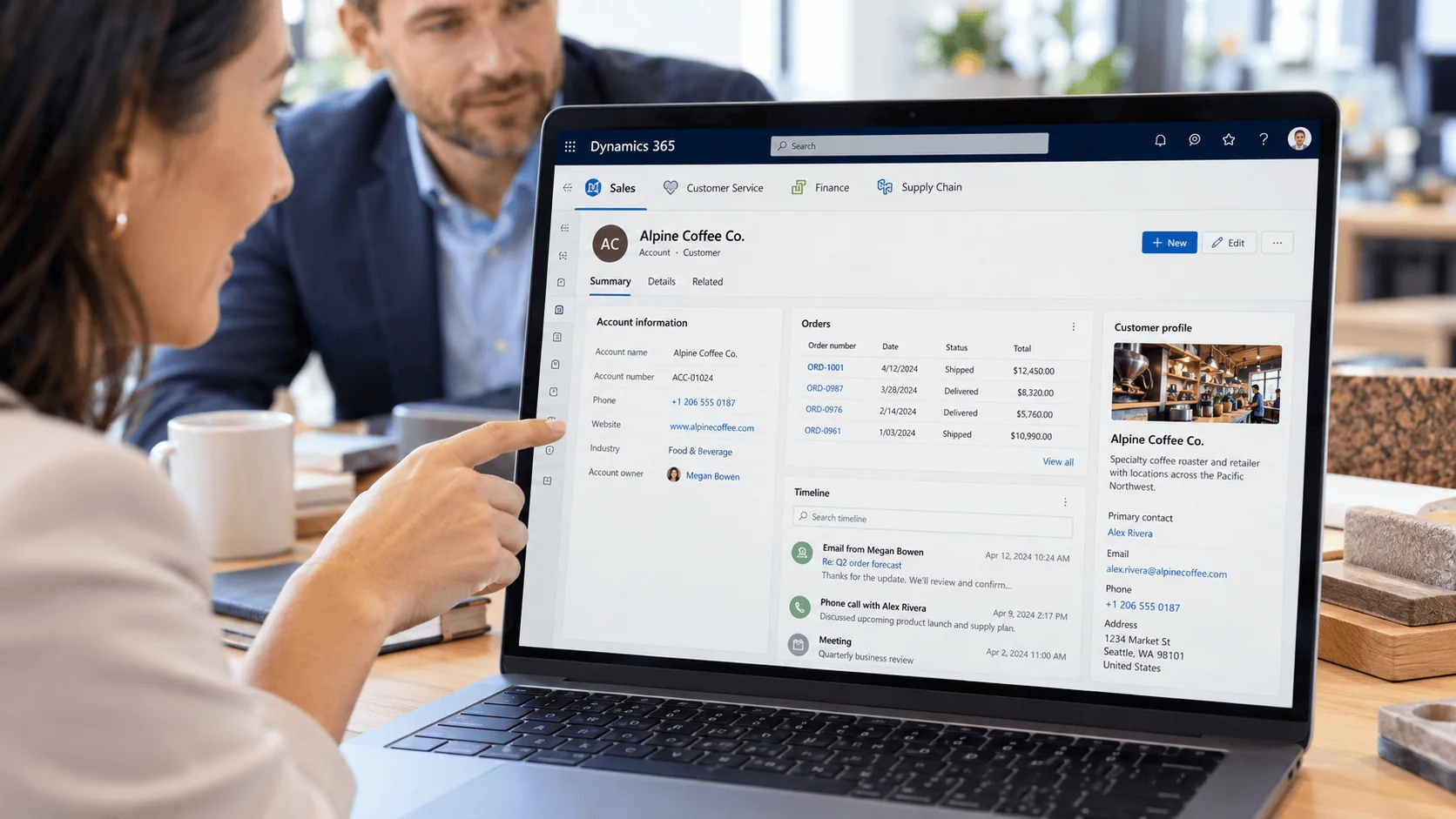
What if your business software didn’t just manage operations, but helped drive growth, improve customer experiences, and improve every moving part of your enterprise? That’s the promise of Microsoft Dynamics 365. Far more than a traditional business platform, it’s a powerful suite of cloud-based applications that merges the worlds of customer relationship management (CRM) and enterprise resource planning (ERP). If your company is navigating digital transformation, understanding Microsoft Dynamics 365 is the first step toward building a smarter, more connected business.
At its core, Dynamics 365 CRM and ERP solutions work together smoothly to manage your sales, customer service, operations, human resources, and finance all under one unified umbrella. Built on Microsoft Azure and tightly integrated with the broader Microsoft ecosystem (think: Teams, Power BI, and Microsoft 365), Dynamics 365 offers modular tools that can be customized to align with your business goals while maintaining enterprise-grade performance and security.
As a Microsoft-focused application development and integration firm, i3solutions specializes in helping organizations understand what is Microsoft Dynamics 365 and harness its full potential. Whether you’re looking to configure new workflows, extend app capabilities, or connect external systems, i3solutions is here to ensure that your Dynamics environment is strategically aligned to maximize long-term business value.
Before making the move to Microsoft Dynamics 365, many enterprises encounter a familiar set of roadblocks that hinder efficiency, collaboration, and growth. These challenges often reveal the need for a more unified and adaptable solution. It is one that Dynamics 365 can offer, especially when supported by expert Dynamics 365 customization and integration services.
Microsoft Dynamics 365 is a unified platform that brings together the best of customer relationship management (CRM) and enterprise resource planning (ERP) into a single, cloud-based solution. It can help your business manage everything from sales and customer service to finance, supply chain, and human resources, using connected data and intelligent insights.
What sets Dynamics 365 apart is its modular architecture. Organizations can start with just the applications they need, such as Sales, Customer Service, or Finance, and then expand as their needs change over time. Whether deploying apps independently or as an integrated suite, many businesses benefit from scalable CRM and ERP applications tailored for enterprise use, ensuring flexibility without sacrificing cohesion.
Built on Microsoft Azure and tightly integrated with Microsoft 365, Power Platform, and a wide range of third-party systems, Dynamics 365 enables seamless data flow and collaboration across departments and geographies. This makes it an ideal solution for growing organizations that require enterprise-grade performance, global scalability, and the ability to quickly adapt to change.
Dynamics 365 offers a range of core modules designed to support specific business functions, all while working together on a single, integrated platform. Each module is purpose-built to enhance operational efficiency, improve customer experiences, and make smarter decision-making across your organization.
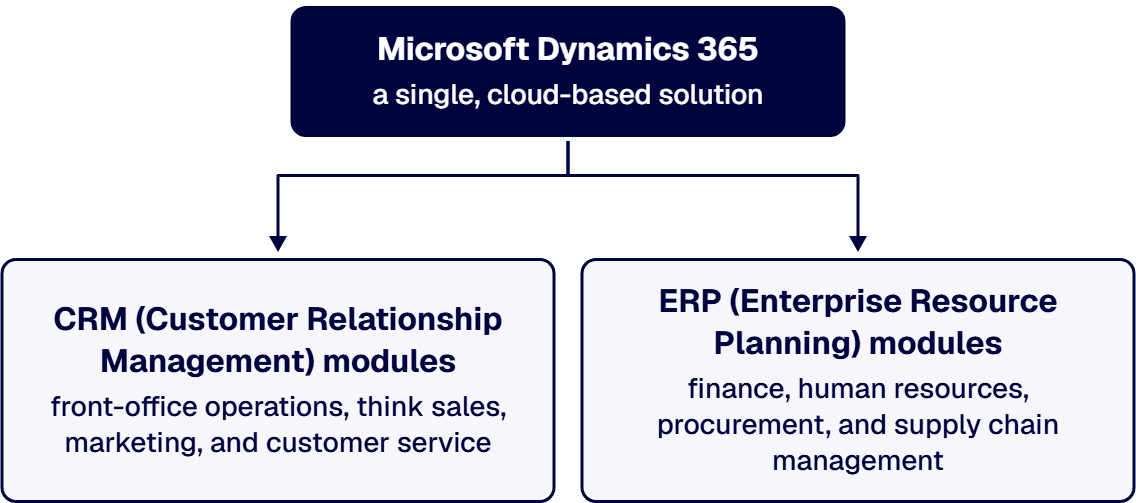
When exploring Microsoft Dynamics 365, one of the most important distinctions to understand is the difference between CRM and ERP functionalities. CRM (Customer Relationship Management) modules focus on front-office operations, think sales, marketing, and customer service. These tools are designed to improve how your business attracts, engages, and retains customers by managing leads, automating campaigns, and resolving service issues efficiently.
On the other hand, ERP (Enterprise Resource Planning) modules handle the back-office side of the business. This includes core operational areas such as finance, human resources, procurement, and supply chain management. ERP tools help you simplify internal workflows, track budgets and inventory, and ensure regulatory compliance. It can do this all while maintaining data consistency across your departments.
What makes Dynamics 365 unique is its flexibility: you can start with just the modules your business currently needs, whether that’s Microsoft Dynamics for sales and operations, and scale up as your organization grows. This modular approach lets you implement solutions based on priority, avoiding the disruption and cost of a full system overhaul.
Moreover, Dynamics 365 offers native integrations with Microsoft 365, Azure, and Power Platform, making it easier to connect data across CRM and ERP systems. These built-in connections help eliminate data silos, reduce manual entry, and ensure teams are always working with accurate, real-time information.
Customization debt, integration failures, and partial implementations don't resolve themselves over time. They calcify into the operating baseline. i3solutions delivers senior-level Dynamics 365 stabilization and modernization services for enterprise environments where the platform isn't delivering what was promised and the cost of continued underperformance is no longer acceptable.
Assess i3solutions Dynamics 365 ServicesOne of the biggest advantages of Dynamics 365 is its deep integration with familiar Microsoft 365 tools like Outlook, Teams, and Excel. Sales teams can manage leads directly from their inbox, collaborate on customer records in Teams, and analyze CRM data in Excel without ever leaving the apps they use daily. This tight integration enhances productivity and reduces the need to switch between disconnected platforms.
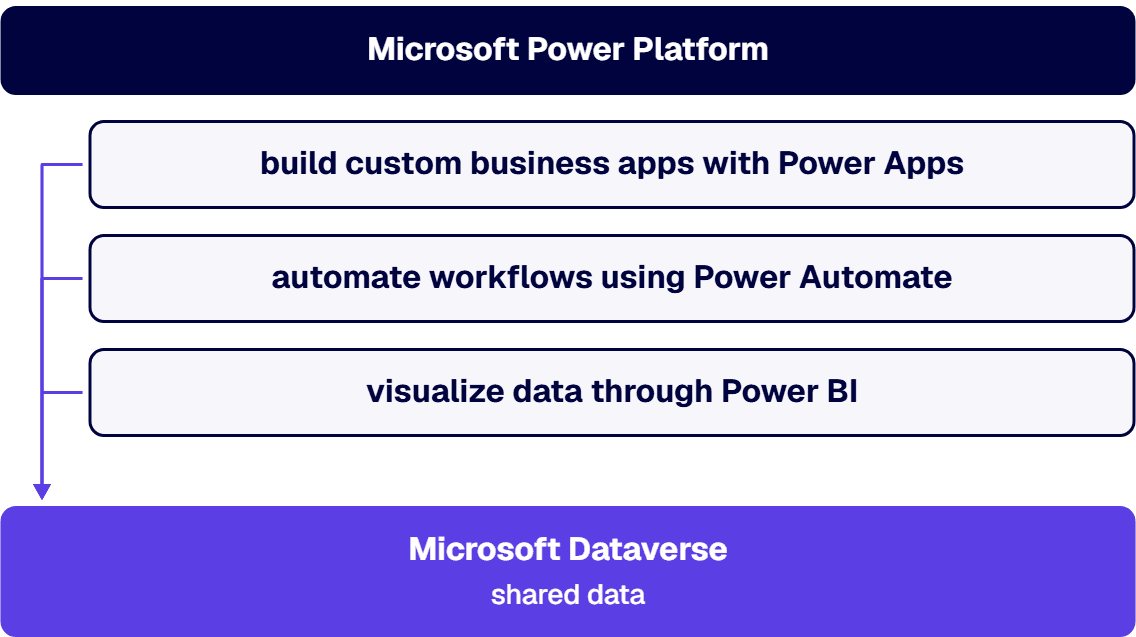
Dynamics 365 is also closely connected to the Microsoft Power Platform, allowing organizations to build custom business apps with Power Apps, automate workflows using Power Automate, and visualize data through Power BI. This empowers users to create tailored solutions without writing complex code, bridging the gap between IT and business teams. With shared data through Microsoft Dataverse, information flows freely across apps, making it possible for you to be more consistent and make smarter business decisions.
Built on Microsoft Azure, Dynamics 365 benefits from enterprise-grade scalability, security, and global compliance. Among the key benefits of using Microsoft Dynamics is the ability for developers to tap into APIs and custom connectors to create cross-platform workflows that integrate Dynamics 365 with third-party systems or legacy applications. This flexibility makes it easy to adapt and extend your solutions as your business needs change, without sacrificing performance or data integrity.
Dynamics 365 is versatile by design, supporting a wide range of real-world business needs across industries. Here are some of the most common scenarios where the Microsoft business applications platform proves its value.
Enterprises value Dynamics 365 for its modular deployment model, allowing them to implement only the tools they need today while retaining the flexibility to scale as the business changes with the times. Whether starting with sales, finance, or operations, your organization can expand seamlessly without disrupting existing workflows. This makes it ideal for both growing companies and large enterprises with complex needs.
The familiar Microsoft interface significantly improves user adoption, minimizing training time and accelerating productivity. Teams can quickly adapt to Dynamics 365 thanks to its tight integration with everyday tools like Outlook, Excel, and Teams. Beyond ease of use, the platform offers rich extensibility, supporting various workflows tailored to your many business processes and industry-specific customizations through low-code tools and APIs.
Security and global readiness are also major reasons enterprises choose Dynamics 365. It offers secure, cloud-based business process automation with advanced access controls, compliance features, and multi-geo support. This guarantees your organization can operate safely and efficiently, whether it’s centralized or spread across multiple regions.
Most Dynamics 365 environments that need stabilization were built by teams that understood the platform but not the enterprise context around it. Fixing that requires specialists who've worked through the same failure patterns in regulated, high-stakes environments. i3solutions' Dynamics 365 specialists bring that pattern recognition along with senior-level, 100% US-based delivery.
Hire i3solutions Dynamics 365 SpecialistsAs a Microsoft systems integrator, i3solutions begins every Dynamics 365 project with a deep understanding of your organization’s goals and operational landscape. Through detailed requirements gathering, platform selection guidance, and architecture planning, we ensure the solution aligns with your current needs while preparing for long-term scalability. If you want to replace your legacy systems or start fresh, our team helps lay the foundation for a successful transformation.
Our Microsoft Dynamics 365 specialists are experts in configuring and extending Dynamics 365 using tools like the Microsoft Power Platform, .NET, and Azure to create custom workflows, integrations, and user experiences. We also connect Dynamics 365 to Microsoft 365, legacy platforms, and third-party applications to ensure seamless data flow and eliminate operational silos. For clients in highly regulated industries, such as those requiring GCC, HIPAA, or CMMC compliance, we design secure solutions that meet strict governance requirements.
Beyond the initial rollout, i3solutions also provides ongoing support to help organizations evolve their enterprise business applications over time. From new feature deployments to team augmentation and proactive maintenance, we ensure your Dynamics 365 environment continues to deliver value as your business grows and adapts.
i3solutions is a trusted Microsoft system integrator with a strong track record of delivering successful Dynamics 365 and Power Platform solutions. Our team brings deep expertise across both CRM and ERP deployments, serving clients in commercial enterprises and the public sector alike. From complex sales workflows to government-grade compliance, we know how to tailor the platform to fit the mission, not the other way around.
Unlike firms that rely on rigid templates, i3solutions is known for customizing Dynamics 365 around real-world business processes. We specialize in making the technology work for your teams, whether that means reimagining workflows, enabling Power Platform integration with Dynamics 365, or building custom connectors to bridge legacy systems. This ensures a solution that feels intuitive, responsive, and purpose-built.
Add the criteria below, and put the same questions to every vendor on the shortlist so the answers can be compared side by side. This page sets no percentage weighting. How much each criterion counts follows the program’s risk: a program that moves years of regulated records weighs data migration more heavily than a light departmental rollout does.
With a U.S.-based team and deep expertise in Microsoft’s enterprise architecture, i3solutions delivers end-to-end services, from advisory and implementation to long-term support. Talk to a Dynamics 365 Expert and discover how our team stays engaged beyond go-live to help you continuously refine, scale, and optimize your Dynamics 365 environment as your organization evolves.

Matt Lawson has spent more than 14 years at i3solutions guiding complex enterprise technology work from scope and system design through development, acceptance, and long-term support. His expertise spans technical oversight, solution architecture, SharePoint and Microsoft 365 delivery, Power Platform implementation, business intelligence, enterprise search, and the practical application of AI to solve real business and operational challenges.
View LinkedIn Profile


When a Dynamics 365 implementation loses momentum, the causes are rarely just technical. They're scoping failures, integration gaps, vendor misalignment, or governance decisions that were never made. i3solutions' senior Dynamics 365 advisors work with IT leaders who need to stabilize what's in production before the next budget cycle forces the conversation.
Talk to a Dynamics 365 Advisor
US-Based | Est. 1997
© i3solutions. All rights reserved.
US-Based | Est. 1997
© i3solutions. All rights reserved.


