Building a Workflow Automation Business Case in Regulated Enterprises

A defensible workflow-automation business case in a regulated enterprise rests on four numbers, not on enthusiasm: the current cost of the manual process, the cost to automate it, the payback period, and the risk the manual process is carrying right now. The committee you are presenting to has watched automation pitches over-promise and under-deliver, so the case that survives is the one that is conservative on savings, explicit on payback, and honest about which processes are not worth automating yet. i3solutions builds these cases from delivery data, including regulated engagements where a single automation reached full ROI within months while removing an audit exposure at the same time.
If you have been asked to justify automating a process to a committee, you already know the room is skeptical. These are people who have approved technology spend that did not land, and their job is to protect the organization from doing it again. So the business case that wins is not the most ambitious one. It is the one that is hardest to argue with: conservative, specific, and honest about its own limits.
A defensible case is built on four numbers. The first is the real current cost of the manual process, and most cases understate it because they count only labor hours. Count the rest: the loaded cost of those hours, the rework when a manual step is done wrong, and the time spent every audit cycle reconstructing what happened. The second is the cost to automate, which has to include not just the build but the licensing and the ongoing maintenance, because a case that hides year-two cost will not survive contact with a CFO. The third is the payback period, stated plainly, because a committee trusts a fourteen-month payback it can verify far more than a vague promise of efficiency. The fourth is the number most cases leave out and committees most want to see.
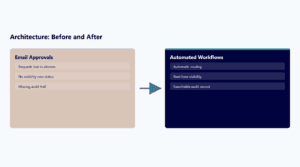
That fourth number is the risk the manual process is carrying. In a regulated enterprise a manual process is not merely slow; it is inconsistent, and inconsistency is what produces audit findings. Every hand-keyed step is a place where the control can fail and where you cannot prove afterward that it did not. Automating the process is therefore partly a governance control: it makes the step uniform, logged, and evidenced. That reframing matters, because it moves the spend from the efficiency column, where it competes with every other nice-to-have, into the risk-reduction column, where boards fund things. It is also where the proof is strongest. On a nuclear power operator, i3solutions replaced a manual reporting process with an automated dashboard that saved over $293,000 a year and returned its full cost within three months, while removing the manual reconciliation that had been the audit exposure. For a defense technology contractor, an automated process reached full ROI inside the first fiscal year and took $1.15 million a year out of the operation. Those numbers are i3solutions delivery results, and they are the kind of conservative, dated figure a committee can stand behind.
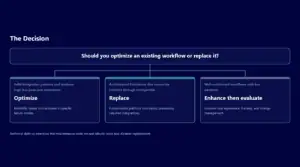
Now the part that makes the whole case credible: name the processes you are not automating. A case that proposes to automate everything signals that no one did the analysis. A low-volume process, a process about to be replaced by a platform migration, or one with no clear owner will not pay back, and a committee that has seen failures will spot an inflated number immediately. Listing the two or three processes you deliberately left manual, and why, is what tells the room that the ones you did choose were chosen on evidence.
So the case that survives is structured, not enthusiastic. Lead with the risk the manual process carries and the payback period, keep the savings conservative enough that no one can dispute them, and name what you are leaving alone. That is the version your committee approves, because it reads like analysis rather than a pitch, which in a regulated enterprise is the only kind of case that gets funded.
Key Takeaways
- A defensible automation case rests on four numbers: current manual cost, cost to automate, payback period, and the risk the manual process carries.
- Count the full current cost, including rework and audit-preparation time, not just labor hours.
- Include year-two licensing and maintenance in the cost to automate, or the case fails in front of a CFO.
- In a regulated enterprise, frame automation as a governance control: it makes the step consistent and evidenced, moving the spend into the risk-reduction column where boards fund it.
- Name the processes you are deliberately not automating; it is what makes the ones you chose credible. (Proof: a regulated automation returned full ROI in three months and removed an audit exposure.)
Frequently Asked Questions
What goes into a workflow automation business case?
Four numbers: the current cost of the manual process (including rework and audit-prep time), the cost to automate (build, licensing, and maintenance), the payback period, and the compliance or operational risk the manual process is carrying.
How do I justify automation to a risk-averse committee?
Lead with risk reduction and a verifiable payback period, keep savings conservative, and name the processes you are deliberately not automating. A committee trusts a specific, self-limiting case far more than an ambitious one.
Why include compliance risk in an efficiency case?
In a regulated enterprise a manual process is inconsistent, and inconsistency produces audit findings. Automating it makes the step uniform and evidenced, which reframes the spend from efficiency to risk reduction, the column boards fund.
How fast can workflow automation pay back?
Volume and the manual cost being removed decide it. In i3solutions engagements, regulated automations have reached full ROI within months; lower-volume processes take longer and sometimes should not be automated at all.
When is automation not worth it?
For low-volume processes, processes about to be replaced by a platform migration, or processes with no clear owner. Automating these rarely pays back, and proposing to automate everything undermines the credibility of the whole case.
If you are assembling the case to take to your committee, the hardest part is usually the four numbers, especially the real current cost and the risk the manual process is carrying. Bring the process and we will help you build those figures from comparable engagements, conservatively, so the version you present is one your committee can verify rather than one they have to take on faith.
About the Author
Michael Branson, Founder and COO, i3solutions. LinkedIn