
Power Automate is a subscription: $15.00 per user per month for Power Automate Premium or $150.00 per bot per month for Power Automate Process, both paid yearly, with the US Government plans sold as monthly subscriptions through Volume Licensing or a Cloud Solution Provider at contract pricing Microsoft does not list publicly. Azure Logic Apps has no user license at all. It bills per operation on the Consumption plan, at $0.000025 per built-in action, $0.000125 per standard connector action and $0.001 per enterprise connector action in East US, or as reserved compute on the Standard plan, at $0.1997 per vCPU hour plus $0.0143 per GB hour. For a government contractor the controlling number is neither list price: it is that Azure Government meters the Logic Apps consumption model roughly 24 to 25 percent above commercial while pricing the same service’s dedicated compute within half a percent of it. Both of those comparisons are derived from the per-region Microsoft rate cards in the Azure Retail Prices API, read on August 14, 2026, and the underlying rates are itemized below.
Power Automate prices entitlements: a Premium license entitles a named person to build and run automations, a Process license entitles one automation to run regardless of who owns or triggers it, and nothing on the invoice moves when a flow runs more often until it hits its daily action ceiling. Azure Logic Apps prices execution: no seat to buy, no maker to license, metered per operation on Consumption and reserved by the hour on Standard whether it runs or not. That difference in axis is what makes the government-contractor version of this question answerable at all. Your Power Automate government price comes out of a contract negotiation; your Logic Apps government price is a published per-region rate card you can model before procurement is involved.
Commercial list pricing on Microsoft’s Power Automate pricing page is four numbers. Power Automate Premium is $15.00 per user per month, paid yearly, and carries a daily limit of 40,000 actions per user, one attended bot, process mining with 50 MB of storage per license, 5,000 AI Builder credits per month and Dataverse capacity of 250 MB database plus 2 GB file. This 5,000-credit allowance applies through October 31, 2026: Microsoft’s AI Builder licensing overview states that a Power Automate license bought or renewed from November 1, 2026 no longer receives seeded AI Builder credits, while credits already seeded on a license before that date continue through the end of that license’s contract term. Power Automate Process is $150.00 per bot per month, paid yearly, and carries 250,000 actions per day, stackable up to 10 licenses on a single cloud flow, or assignable to a flow group that shares 250,000 daily actions across up to 25 flows. Power Automate Hosted Process is $215.00 per bot per month and adds a Microsoft hosted machine. The Process Mining add-on is $5,000.00 per tenant per month and is available only with the Premium plan. The dividing line between those two standalone plans is that Premium follows the person and Process follows the flow, so an automation with several owners, or with none, belongs on Process capacity rather than on a maker’s seat; our Power Automate Premium vs Process comparison works the edge cases through.
In the US Government clouds the catalog narrows. Microsoft offers exactly two standalone plans, the Power Automate Process plan for Government and the Power Automate Premium plan for Government, each a monthly subscription that can be licensed to an unlimited number of users, plus the Power Automate capabilities seeded into Microsoft 365 US Government and Dynamics 365 US Government plans. Purchasing runs through Volume Licensing and the Cloud Solution Provider program, and the CSP channel is not currently available to GCC High customers. Microsoft publishes no US Government list price for these plans, so any government-cloud Power Automate figure in a budget model is a quoted price, not a documented one.
Licensing settles what the flows cost; who builds them is a separate choice, and Top Power Automate Consultants for Government Contracting sets out evaluation criteria for ranking a shortlist.
What Microsoft does document is the accreditation boundary each environment sits in. GCC is compliant with FedRAMP High and DoD DISA IL2 and supports CJIS data types. GCC High is designed against DISA SRG IL4, requires Microsoft Entra Government for identity rather than public Microsoft Entra ID, is operated so that DoD contractor customers can meet ITAR commitments and DFARS acquisition regulations, and holds a DISA Provisional Authority to Operate. The DoD environment is designed against IL5 and is available only to DoD entities. If your CUI boundary or your contract language forces one of those environments, the licensing conversation is downstream of a decision already made for you, and our comparison of GCC High and GCC Moderate covers how that boundary gets set. One caveat belongs in every government estimate: Microsoft states that it strives to maintain functional parity with the commercial service and that there are exceptions, tracked in its Business Applications US Government availability summary. A premium connector that carries your integration in commercial and is absent in GCC High is a re-architecture, and re-architecture costs more than any license.
Every Logic Apps rate quoted on this page comes from two Microsoft primary sources, the Azure Logic Apps pricing page and its machine readable equivalent, the Azure Retail Prices API, both read on August 14, 2026. Azure rates move and they differ by region, so re-read the price list for your own region before a number goes into a budget.
The Consumption plan meters operations. In East US, built-in actions run $0.000025 per execution above the initial free allowance, which Microsoft’s pricing page lists as the first 4,000 actions per Azure subscription, standard connector actions run $0.000125 per execution, enterprise connector actions run $0.001 per execution, and data retention on run history runs $0.12 per GB per month. Integration accounts, which you need for EDI and B2B artifacts, are separate resources at $300.00 per month for Basic and $1,000.00 per month for Standard and Premium.
The Standard plan reserves capacity instead. A Workflow Standard hosting plan comes in three tiers, WS1 at 1 vCPU and 3.5 GB of memory, WS2 at 2 and 7, and WS3 at 4 and 14, billed at $0.1997 per vCPU hour and $0.0143 per GB hour in East US. Using Microsoft’s own monthly formula of 730 hours times the vCPU and memory rates, that is about $182 per month for WS1, $365 for WS2 and $729 for WS3 at current East US rates. In exchange, Standard includes an unlimited number of free built-in operations, which is the single largest economic difference between the two hosting models. Managed connector calls are still billed, at the same standard and enterprise rates as Consumption, and Azure Storage for a Standard logic app is billed separately on your own storage account.
One metering detail reshapes most estimates: Consumption bills per execution and Standard bills per call. An operation that pages through a large result set in ten calls is one billable execution under Consumption and ten billable calls under Standard.
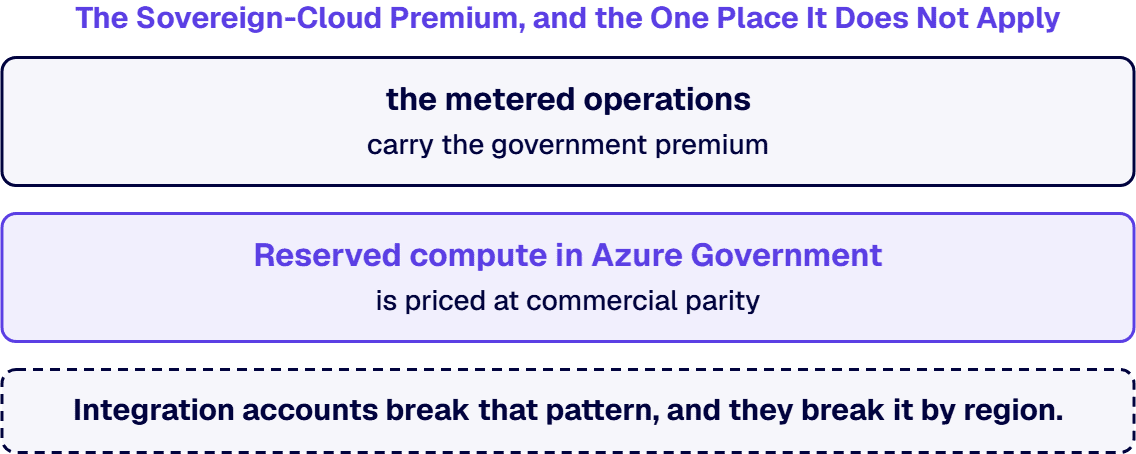
Microsoft publishes Logic Apps rates for each Azure Government region in the same Azure Retail Prices API that carries the commercial rates, and the metered rates are consistent enough to plan against even though the fixed resources are not. In US Gov Virginia, built-in actions are $0.000031 against $0.000025 in East US, standard connector actions are $0.000156 against $0.000125, enterprise connector actions are $0.00125 against $0.001, and data retention is $0.15 per GB per month against $0.12. That is a premium of roughly 24 to 25 percent on everything the Consumption model meters, and it is identical in US Gov Arizona and US Gov Texas. Integration accounts break that pattern, and they break it by region. In US Gov Virginia, Basic runs $381.30 and Standard $1,274.10 per month, about 27 percent above commercial, and Premium runs $3,125.00 against $1,000.00 in East US, more than three times the commercial rate. In US Gov Arizona the same three tiers are $375.00, $1,250.00 and $1,250.00. In US Gov Texas they are $300.00, $1,000.00 and $1,000.00, which is commercial parity. A Premium integration account therefore costs more than three times as much in Virginia as in Texas for the same artifact model, and nothing in the product tells you so.
The exception is the part most buyers assume will be worst. Standard plan compute in US Gov Virginia is $0.1987 per vCPU hour and $0.0142 per GB hour, both marginally below the East US rates, and US Gov Arizona and US Gov Texas carry the identical compute rates. Reserved compute in Azure Government is priced at commercial parity; only the metered operations carry the government premium. The consumption data retention meter is a second region split: $0.15 per GB per month in US Gov Virginia against $0.30 in US Gov Arizona and US Gov Texas. The DoD regions are a different matter again. Microsoft’s public Azure retail price list publishes Logic Apps meters for all three US Gov regions and none at all for US DoD East or US DoD Central, so IL5 rates in those regions come through the contracting channel rather than off a web page. If the estate is moving into that boundary, the Azure Government migration sequencing matters more to the cost model than the rate card does.
Because Standard includes unlimited free built-in operations and Consumption meters them, the crossover between the two Logic Apps models is a built-in operation count, not a workflow count. At current East US rates, a WS1 plan at about $182 per month is worth roughly 7.3 million billable built-in executions. At US Gov Virginia rates, the same WS1 plan at about $181 per month is worth roughly 5.8 million. The government premium moves the crossover down by about 20 percent, which means a government contractor should reach for the Standard plan at a lower volume than a commercial peer running the identical design.
Three qualifications keep that number honest. Managed connector calls are billed at the same rates under both models, so they do not move the crossover at all; only built-in operations do. Standard adds Azure Storage charges that Consumption absorbs, so the real crossover sits somewhat above the pure compute comparison. And the operation counts that feed the estimate are usually understated, because Consumption meters skipped and failed triggers, meters each retry as a separate execution, and multiplies loop contents by collection size. A ten-item list processed by one action inside a loop is eleven executions, not one.
A Process license needs the flow in a solution. Power Automate Process capacity can only be assigned to a cloud flow that lives in a solution. Estates with years of personal, non-solution flows have a migration chore before the capacity model helps them, and that chore belongs in the plan rather than in the discovery call after purchase.
Unattended automation still needs a licensed human. The Process license carries the unattended bot, but the machine it runs on must be registered by a Power Automate Premium user, and the user whose connection triggers a desktop flow needs Premium as well. An unattended RPA budget with no Premium seats in it is a provisioning dead end.
Pay-as-you-go is not the escape hatch it looks like. Microsoft’s published pay-as-you-go meters bill $0.60 per run for premium cloud flows and attended desktop flows and $3.00 per run for unattended, against an Azure subscription. The Power Automate meters are in preview with a per-day cap on billed runs, unattended RPA add-on units are ignored once an environment is linked, and the guidance on that same Microsoft Learn meters page is that high-run flows belong on a fixed per-flow plan. It is a fit for seasonal and broadly shared automations, not for a production integration running thousands of times a day.
Cross-cloud connectivity is a design cost that looks like a licensing problem. Power Automate US Government runs in Azure Government, and reaching a service you left in the public cloud, a SQL instance for example, requires specific firewall openings to the Azure Government IP space for US Gov Virginia, US Gov Texas and the DoD regions. Nothing about that appears on a license line, and it is a common reason a government-cloud automation estimate doubles after the first architecture review.
Bring in a partner when the licensing question is really an architecture question wearing a budget disguise: a mixed estate where some automations belong on seats, some on capacity and some on Azure meters, inside an accredited boundary that limits which connectors exist. Two versions of getting it wrong are concrete enough to price, one on the over-licensed side and one on the unbudgeted-consumption side. An unattended RPA budget built with no Power Automate Premium seats in it does not fail at purchase, it fails at machine registration, because the machine must be registered by a Premium user and nothing on the invoice says so. A Premium integration account provisioned in US Gov Virginia costs $3,125.00 per month for an artifact model that runs in US Gov Texas for $1,000.00, and the product gives no signal that the region choice just tripled the line item.
i3solutions is a Microsoft Partner with 30 years of enterprise technology delivery experience. i3solutions has completed 1,500+ Microsoft implementations. i3solutions runs a governed Power Platform for a federal defense agency supporting roughly 10,000 personnel across about 180 locations, which works because it is governed, not despite it. i3solutions delivery includes ALM practices with Power Platform pipelines or Azure DevOps integration, environment separation strategies, and change control processes, which is what keeps a two-platform automation estate auditable rather than merely working. The same governance discipline underpins i3solutions Power Platform development services.
On the Logic Apps side of the same estate, Microsoft integration architecture applies that discipline to API Management, Service Bus and event-driven connections between systems.
Enterprise workflow automation consulting engagements typically range from $75,000 to $350,000 for Phase 1 assessment and pilot delivery, depending on process complexity, integration surface area, and compliance framework requirements. The licensing model falls out of that assessment as an artifact: an inventory of automations classified by owner type, measured operation volume, connector tier and accredited environment, priced against Microsoft’s published rates for your actual region, in a form that survives a budget review. If the estate needs an owner for that decision rather than a one-time model, that is the work our Power Automate licensing consultants take on. If it needs building, start with our Power Automate development services team.
If you are assembling the internal case before committing budget, the two things a reviewer will press on are the measured operation volumes behind the model and the region the rates were read from. Bring both to the first conversation and the licensing question stops being an argument about platforms and becomes an inventory you can price.
No dedicated Azure administrator on staff is required. Logic Apps management maps to two Azure built-in roles you can delegate: Logic App Operator, which can read, enable, and disable a workflow but cannot edit it, and Logic App Contributor, which can manage the workflow but cannot change who has access. That split lets an outside team operate the estate while your organization keeps role assignment and the accredited boundary. Microsoft recommends managed identities with Microsoft Entra ID and Azure Key Vault for connection secrets, so credentials never sit with an individual administrator. i3solutions plans and runs governed Azure and Microsoft 365 migrations with senior, U.S.-based engineers. The practical model is a partner-operated deployment under your governance, not a full-time hire.
Microsoft does not publish a US Government list price for the Power Automate Premium plan for Government or the Power Automate Process plan for Government, so there is no documented commercial-to-government delta to quote. Both are monthly subscriptions sold through Volume Licensing or a Cloud Solution Provider, and the CSP channel is not currently available to GCC High customers. Any government-cloud per-user figure should come from your own quote, not from a comparison page.
No, and the split is specific. In US Gov Virginia, the Consumption meters run roughly 24 to 25 percent above East US: $0.000031 per built-in action, $0.000156 per standard connector action, $0.00125 per enterprise connector action. Standard plan compute is the exception, at $0.1987 per vCPU hour and $0.0142 per GB hour, marginally below commercial. Integration accounts are worse than the general pattern and they vary by region: the Premium tier is $3,125.00 per month in US Gov Virginia against $1,000.00 in East US, $1,250.00 in US Gov Arizona and $1,000.00 in US Gov Texas.
Power Automate is cheaper for people-shaped work and Logic Apps is cheaper for volume-shaped work, so the answer turns on how each automation is classified rather than on which platform is nominally cheaper. A hundred business users automating their own approvals is cheaper on Power Automate Premium seats than on any metered model. A single integration running millions of operations a month is cheaper on a Logic Apps Standard plan, and the government premium on consumption metering moves that crossover down by about 20 percent compared with a commercial estate. Most government contractors need both, and the money is in classifying the workloads correctly rather than picking a platform. The classification is the inventory described above: every automation tagged by owner type, measured operation volume, connector tier and accredited environment.
For anything touching desktop automation, yes. Logic Apps has no attended or unattended RPA model, so automating a legacy application without an API keeps Power Automate in the estate, which means at least one Premium user to register machines and Process capacity for each unattended bot. Microsoft 365 US Government plans also seed Power Automate capabilities, so the practical question is how many premium entitlements you need, not whether you need any.
Power Automate US Government GCC High is designed against DISA SRG IL4 and holds a DISA Provisional Authority to Operate, and the DoD environment is designed against IL5 and is restricted to DoD entities. Azure Logic Apps runs in Azure Government, where Microsoft lists it in scope for the FedRAMP High provisional authorization and for the DoD IL2, IL4 and IL5 workload isolation authorizations; IL5 in the US Gov regions requires extra configuration to meet the compute and storage isolation requirements. Confirm connector-level availability against Microsoft’s Business Applications US Government availability summary before committing a design, because service availability and feature parity are separate questions.
Yes, through the government version of the plan. Microsoft lists the Power Automate Process plan for Government among the Power Automate US Government plans, and eligible customers can deploy Power Automate US Government to the GCC High environment, which requires Microsoft Entra Government for identity. The Cloud Solution Provider program is not currently available to GCC High customers. Microsoft also notes exceptions to feature parity with the commercial service, tracked in its Business Applications US Government availability summary, so confirm any specific capability there before relying on it.
Sometimes, and not for production integration. Microsoft’s published meter rates are $0.60 per run for premium cloud and attended desktop flows and $3.00 per run for unattended flows against a linked Azure subscription, the Power Automate meters are still in preview with a cap on billed runs per flow per day, and any unattended RPA add-on units in that environment are ignored once it is linked. The recommendation on that same meter-rates page is to move high-run flows onto a fixed per-flow plan. Pay-as-you-go earns its place on seasonal and widely shared automations where seats would sit idle.

US-Based | Est. 1997
© i3solutions. All rights reserved.
US-Based | Est. 1997
© i3solutions. All rights reserved.


