
By Scot Johnson, Founder / CEO, i3solutions
Scot Johnson co-founded i3solutions 30 years ago with a focus on expert-led delivery, strategic advisory, and complex Microsoft-centered solutions for organizations where technology decisions carry operational, financial, and mission risk. His insights focus on the leadership, governance, integration, automation, data, and delivery decisions that determine whether technology investments become reliable business systems.
Power Platform automation consulting designs the Center of Excellence operating model, environment and DLP architecture, and lifecycle controls that hold up under CMMC, HIPAA, and SOC 2 audits. i3solutions delivers it through three models: Managed Delivery, Hire Senior Power Platform Specialists, or Risk and Roadmap Assessment.
Power Platform automation consulting matters when departmental Power Platform success stops scaling. The tools work at the departmental scale; they do not scale to the enterprise without an explicit operating model, governance layer, and Center of Excellence designed to hold up under audit. The decision in front of you is not whether Power Platform is the right automation layer; that decision was made the first time a department succeeded. The decision is whether to build the enterprise program internally, hire a Power Platform consulting partner to design it, or let app sprawl, security gaps, and unmaintained flows accumulate until a compliance incident forces the conversation.
i3solutions is a Microsoft Partner with 1,500+ Microsoft platform implementations across aerospace, defense, financial services, and healthcare, including programs for an aerospace and defense manufacturer, a financial-services firm, and a national healthcare system. Our Enterprise Delivery Assurance model brings pattern recognition from those implementations to every engagement.
Power Platform automation consulting earns its place when a program stalls at the departmental ceiling, where scattered wins stop scaling. Three unmade decisions cause the stall: centralized versus federated operating model, environment strategy for compliance separation, and connector and DLP governance at the platform level.
You have hit the departmental ceiling when Power Platform usage has spread beyond two or three pilot teams; when citizen developers in different business units have built apps touching the same data sources but no one can enumerate which apps touch what; when flows are in production but you cannot tell which are mission-critical versus experimental versus abandoned; when an audit cycle is approaching and you cannot characterize Power Platform controls with a defensible answer.
Application sprawl. Citizen-developer apps accumulate faster than IT can inventory. Orphan apps appear when the original maker leaves. Duplicate apps appear when two teams solve the same problem independently. The tenant accumulates debt no one is positioned to retire.
Governance gap. Without tenant-wide DLP policies, makers can connect business data to consumer connectors, including connectors that route data outside your compliance scope. Without environment segregation, regulated and non-regulated data sit in the same environment. Without connector management, a new connector can bypass monitoring controls without administrative awareness.
Unmaintained flows. A flow that runs reliably for six months is a flow nobody thinks about. When it fails silently, the upstream dependency that fed it breaks operational continuity. When the maker leaves, the troubleshooting trail is invisible to IT because IT was never part of the build.
For commercial mid-market organizations, the inflection point is a productivity ceiling fixed by housekeeping. For regulated enterprises in defense, financial services, and healthcare, the inflection point is an audit-defensibility floor that gets fixed before the audit, because the after is a finding that compounds across your other Microsoft compliance posture. CMMC, HIPAA, NIST 800-171, and SOC 2 control families that govern your other Microsoft workloads also govern Power Platform usage, even when no one has explicitly mapped them.
i3solutions designs enterprise automation programs that move past departmental wins into a governed, audit-ready operating model.
Programs do not stall because the technology fails. Power Platform works as advertised; that is precisely why the departmental wins accumulate. Programs stall because the operating-model decisions were never made, and the longer the sprawl runs without those decisions, the harder it becomes to make them retroactively.
The first decision a Power Platform enterprise program requires is whether to run a centralized, federated, or hybrid model. Centralized: a single platform team owns environments, connectors, and DLP policies. Federated: business units run their own platform footprints within a shared governance framework. Hybrid: a central team owns infrastructure and cross-cutting controls while named business-unit platform owners run intake within their domains. There is no universally correct choice; there is a correct choice for your organization based on architecture maturity, autonomy norms, and compliance scope. Programs that defer the decision end up with central infrastructure that does not centralize control and federated autonomy that does not federate capability, with no clear accountability when controls fail.
Power Platform’s environment construct is the boundary control mechanism for citizen-developer activity. When environments are created ad-hoc by makers without a tenant-level strategy, the resulting topology cannot be reasoned about for compliance purposes. A regulated enterprise needs environment strategy that segregates production from test from development, regulated from non-regulated data, and citizen-developer activity from IT-owned solutions, with defensible per-environment access controls.
Connectors are the data-exchange boundary of Power Platform. Without DLP policies at the tenant level, a maker can combine business and non-business connectors in the same flow without warning. Microsoft documents this as the central data governance mechanism for Power Platform; without explicit DLP policies, the default permits combinations regulated enterprises cannot defend. For organizations under CMMC, HIPAA, or SOC 2, the absence of DLP policy is a finding waiting to be written.
The cost of departmental sprawl in a regulated enterprise is paid in three currencies: audit findings, operational liability, and stakeholder trust. Each compounds the other.
CMMC 2.0 Level 2 incorporates NIST 800-171 Rev. 2, which carries 110 controls across 14 control families. Several map directly to Power Platform usage. AC-2 (Account Management) and AC-6 (Least Privilege) require enforcement of identity and access controls on the maker and consumer populations of every environment touching Controlled Unclassified Information. AU-2 (Event Logging) requires audit trails for activities that touch CUI, including activities executed by citizen-developer flows. SC-7 (Boundary Protection) and SC-8 (Transmission Confidentiality and Integrity) require protection of data flowing across system boundaries, which is exactly what a Power Automate flow does when it moves data between services. HIPAA Security Rule 164.308(a)(4) requires information access management procedures that map to Power Platform environment access controls. SOC 2 Trust Services Criteria for Security and Confidentiality apply to citizen-developer activity touching in-scope data. These mappings are not optional; they apply whether or not your Power Platform program has been formally scoped into your compliance posture.
A flow that runs reliably for six months is a flow whose failure mode is invisible. When an upstream system changes a field name, when a connector deprecates an action, when a permission boundary moves, the flow fails. If the flow handles a business process that operational continuity depends on, the failure ripples. The IT organization that did not know the flow existed cannot triage it, and the operational liability sits on IT regardless of who built the asset.
The IT director who manages this risk well does not encounter it as a board-level conversation. The IT director who does not encounters it as a forensic exercise: an incident has occurred, the data exposure has been characterized, and the board wants to understand how a platform supposed to be governed produced an unmanaged exposure surface. The honest answer is that the platform was governed at the tenant level for traditional Microsoft 365 workloads, but the citizen-development surface was never explicitly brought into the governance perimeter.
Talk through your governance posture and partner-evaluation criteria with our team before you define the engagement.
Microsoft has explicitly transitioned core CoE capabilities from the legacy CoE Starter Kit to native Power Platform admin center experiences (Inventory, Usage, Monitor, Actions), which means the platform now provides the instrumentation layer the Starter Kit used to provide. What the platform does not provide is the operating-model decision-making that the CoE codifies. Six structural decisions determine whether your CoE holds up under audit.
We work through this choice with questions about your enterprise architecture maturity, compliance footprint, and business-unit autonomy norms. The output is a named operating model with named owners. The decision determines who creates environments, who approves connector additions, who reviews DLP policy exceptions, and who signs off on a citizen-developer pattern moving from pilot to production.
A regulated enterprise typically needs a Default environment locked to administrative activity, per-business-unit production environments with explicit data classifications, a shared test environment for citizen-developer experimentation against synthetic data, a sandbox per maker, and segregated environments for any workload touching CUI, PHI, or other regulated data. The strategy coordinates with the broader Microsoft 365 and Azure tenancy: Microsoft Entra ID security groups gate environment access, Azure conditional access policies govern maker authentication, and Microsoft 365 sensitivity labels propagate into Dataverse table classifications.
A regulated enterprise needs a baseline tenant-wide DLP policy classifying connectors into Business, Non-business, and Blocked categories, plus per-environment overlay policies for environments handling regulated data. The architecture determines which connector combinations are permitted, what the exception process looks like, who can request exceptions, and how exceptions are documented for audit.
A maturing Power Platform program builds reusable components: Power Apps canvas components, Power Automate templates, custom connectors, model-driven app templates, Dataverse tables with curated schemas, Power BI dashboard templates. Without governance, makers reinvent components or use unapproved ones. The governance decision is who curates the library, how new patterns are accepted, how patterns are versioned, and how the library is published for maker discovery.
A citizen-developer app running in production is a production asset that needs source control, deployment automation, and a managed promotion path. Power Platform’s managed solutions construct is the deployment unit. The ALM pipeline decision determines how solutions are built in development environments, promoted through test environments with automated checks, and deployed to production with documented approval. Without an ALM pipeline, every maker is a deployment pipeline of one, the configuration that fails audit.
The sixth decision is what happens after an app or flow is in production. Monitoring determines when something fails. Lifecycle management determines when an asset is updated, deprecated, or retired. Decommissioning is the explicit process for removing an asset when no longer needed. Without these processes, every app that ships stays and every flow that runs continues to run; the accumulated state becomes the technical debt auditors find.
The audit-ready Power Platform governance program is the program where controls map to compliance control families with documented evidence. Five governance layers carry the load.
AC-2 (Account Management) and AC-6 (Least Privilege) under NIST 800-171 Rev. 2 require that connector access is constrained to the least privilege needed for the authorized task. The DLP classification of connectors into Business, Non-business, and Blocked is the implementation mechanism. For CMMC Level 2 environments, the DLP policy needs explicit documentation of which connectors are permitted in environments handling CUI, with the rationale and the approval trail.
SC-7 (Boundary Protection) requires explicit boundaries around regulated data. The boundary primitive in Power Platform is the environment. Environment design typically requires named environments per data class, with the class declared in environment metadata, managed-environment status enabled, security groups gating maker access, and documented data-flow restrictions in and out of each environment.
AC-3 (Access Enforcement) requires access to data and services be mediated by enforced policy. A regulated program manages connectors at two scopes: tenant-wide (which connectors exist in the catalog) and per-environment (which are enabled in each environment). The two-scope model lets a regulated enterprise restrict high-risk connectors tenant-wide while permitting targeted business-justified use in specific environments.
AU-2 (Event Logging) requires audit trails for activities that touch regulated data. Power Platform’s native audit logging captures maker activity, app and flow execution, and environment administration events. The audit-defensible program ingests these logs into the SIEM handling the rest of the regulated workload audit posture, with retention aligned to the compliance framework.
CM-7 (Least Functionality) requires that systems provide only essential capabilities. Orphan apps need a detection mechanism. Inactive apps need a deprecation review. Retired apps need a documented removal process with the artifact archived per records-retention requirements. Without lifecycle management, the production environment grows toward sprawl, which is the inverse of CM-7.
i3solutions runs Power Platform automation consulting engagements through three engagement models. The model choice depends on buyer state and scope clarity.
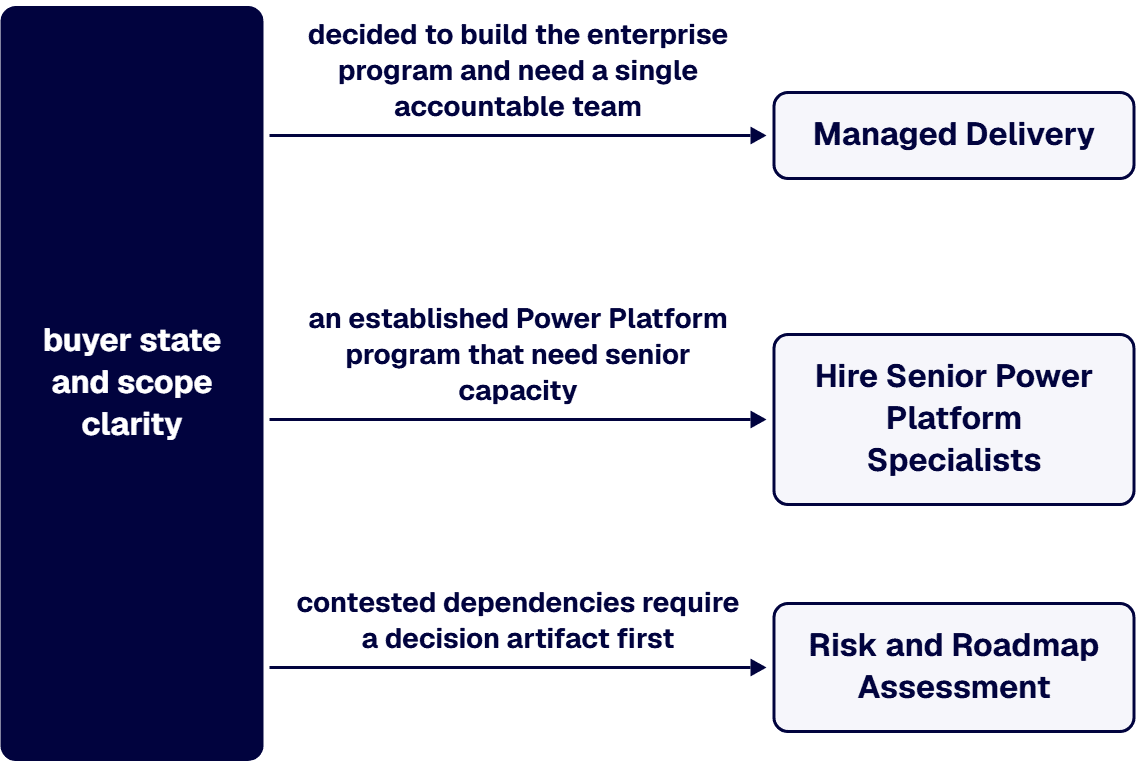
Managed Delivery is for organizations that have decided to build the enterprise program and need a single accountable team to take the work from scoping to production handoff. We own delivery execution end-to-end: program structure, environment design, DLP policy architecture, pattern library curation, ALM pipeline build, operational handoff. The client owns governance approval, internal communications, and final operating-model decisions. The cadence runs around named delivery gates requiring explicit acceptance before each phase begins.
The Hire Senior Power Platform Specialists model is for organizations with an established Power Platform program that need senior capacity embedded into their delivery model. The model provides US-based senior specialists who integrate with the client’s team, contribute to in-flight workstreams, and transfer specialist expertise to client permanent staff. The specialists we place have led Power Platform CoE design or build engagements at scale before.
The Risk and Roadmap Assessment is the appropriate starting point when program scope is contested, when dependencies on adjacent Microsoft programs are unclear, when stakeholder alignment is unsettled, or when the buyer needs a decision artifact to support internal funding before a larger engagement is committed. The output is a sequenced roadmap with named decisions, dependencies, risks, and owners.
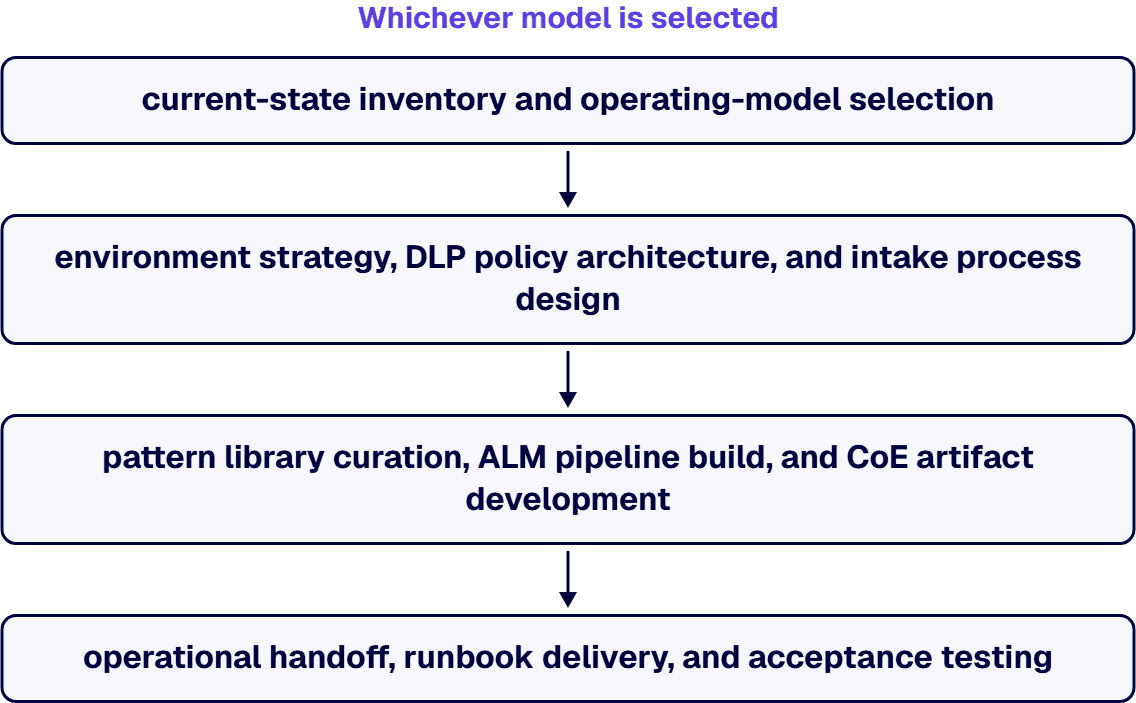
Whichever model is selected, the work runs through four phases. Phase 1 is current-state inventory and operating-model selection: Power Platform usage inventory, operating-model decision, named owners. Phase 2 is environment strategy, DLP policy architecture, and intake process design: environment topology, DLP policy baseline and overlays, intake mechanism for new makers. Phase 3 is pattern library curation, ALM pipeline build, and CoE artifact development: reusable component library, managed-solution deployment automation, monitoring instrumentation. Phase 4 is operational handoff, runbook delivery, and acceptance testing: documented operating procedures, role transition to client steady-state operations, formal acceptance milestones.
An aerospace organization with 12,000 employees had scaled departmental Power Automate flows in finance and HR to over 80 citizen-developer apps across four lines of business before the IT director recognized the CMMC audit-defensibility gap. The remediation engagement designed a centralized CoE with federated business-unit platform owners, established environment and DLP architecture for CUI data classes, and brought the citizen-developer surface into the CMMC compliance perimeter.
A regional financial services firm with 4,500 employees operating under SOC 2 Type II had seen Power Apps and Power BI usage spread organically across six business units. The engagement scoped through Risk and Roadmap Assessment first, then transitioned to Managed Delivery for the federated CoE build that brought the citizen-developer surface inside the SOC 2 control evidence trail without disrupting the productivity gains business units had captured.
Three diagnostics reduce a crowded Power Platform consulting market quickly. The work in front of an IT director at this stage is not selecting a vendor; it is selecting borrowed expertise the organization can lean on without owning the build internally. The right partner is career insurance for the IT director who is one audit cycle away from a board-level conversation about Power Platform exposure.
Ask the candidate for named CoE design engagements in regulated environments. CMMC, HIPAA, ITAR, or SOC 2 delivery references demonstrate the partner has worked through the compliance-mapping discipline before. A candidate that can name two or three such engagements at the discussion-of-detail level (operating model selected, environment topology, DLP policy architecture, audit posture achieved) has done the work. A candidate that talks generically about “regulated industry experience” without naming engagements has not.
Ask the candidate to explain the trade-off between centralized and federated CoE models in the context of a specific regulated enterprise scenario. A candidate with operating-model literacy walks through the decision in terms of governance scope, accountability mechanisms, and compliance posture. A candidate with tool-deployment literacy reaches for the CoE Starter Kit components or admin center features as the answer. Both literacies matter at the build stage; only operating-model literacy matters at the design stage, which is where Power Platform engagements are won or lost.
Ask who specifically will lead the engagement, where they are based, and how the handoff to your steady-state operations is structured. A regulated enterprise typically requires US-based delivery for compliance and citizenship reasons (the Onshore vs Offshore for Microsoft Power Platform decision is structural), senior staffing because the work is operating-model design rather than tool configuration, and rigorous handoff discipline because the steady-state owner needs the operating model documented and rehearsed before the consulting engagement ends. A candidate that names a senior US-based delivery lead by name, walks through the handoff plan in concrete terms, and commits to no offshore handoff has the discipline.
Power Platform automation consulting engagement pricing typically runs from low-six-figure to mid-six-figure depending on tenant scale, environment complexity, and compliance scope. A Risk and Roadmap Assessment that produces a decision artifact for an internal funding conversation runs in the low-six-figure range for mid-sized regulated enterprises with one or two business-unit Power Platform footprints; the output is named decisions, named dependencies, and named risks the IT director can take into the next funding conversation. A Managed Delivery engagement for end-to-end CoE design and build in a regulated environment with CMMC or HIPAA scope runs in the mid-six-figure range and spans a defined delivery window with named acceptance gates per phase. Hire Senior Power Platform Specialists engagements are scoped by specialist count, seniority mix, and engagement duration. We provide a defensible budget figure tied to your specific portfolio shape rather than a single quote that will not survive the first scoping conversation.
The design phase of a Power Platform CoE engagement typically runs through Phase 1 and Phase 2 of the four-phase engagement structure. The build phase (Phase 3) and operational handoff (Phase 4) follow. Total elapsed time depends on operating-model complexity, the number of business units involved, the compliance scope, and the rate at which the client organization can absorb the governance change. We name the named decisions and gates explicitly at the start of each engagement; we do not commit to a specific duration before Phase 1 scoping is complete, because durations committed before that point break at first contact with environmental reality. The Risk and Roadmap Assessment is the appropriate vehicle when a duration commitment is needed before engagement scope is finalized.
The CMMC 2.0 framework does not name “Center of Excellence” as a required control structure. The framework names the controls (NIST 800-171 Rev. 2 control families AC, AU, CM, IA, MP, SC, and others) that govern the systems handling CUI. The Center of Excellence is the operating model that implements those controls for Power Platform usage in your environment. You can pass a CMMC audit with a Power Platform footprint that lacks a CoE in name if every control family is implemented through some other mechanism. In practice, the cleanest implementation for organizations with non-trivial Power Platform usage is a documented CoE with explicit control-to-mechanism mappings. The audit-defensibility question is whether the controls are enforced and evidence-able, not whether you have used the specific phrase “Center of Excellence” in your documentation.
HIPAA Security Rule 164.308(a)(4) requires information access management procedures: policies and procedures for authorizing access to electronic protected health information. In Power Platform, those procedures live in the environment design (which environments contain PHI), the connector management policy (which connectors can touch PHI), the DLP policy architecture (which connector combinations are blocked for PHI environments), and the audit logging architecture (the evidence trail for access through Power Platform assets). A CoE design that addresses these areas explicitly produces the documentation HIPAA-covered organizations need to demonstrate compliance during audit cycles and Business Associate Agreement diligence. The CoE is the operating-model layer above the technical controls and is what makes the controls maintainable as the Power Platform footprint evolves.
Some organizations do build internally, and we describe the conditions where that path works. The conditions: a senior platform architect on staff with prior Power Platform CoE design experience in a comparable regulated environment, a dedicated platform team with capacity to absorb CoE design and build without displacing other priorities, an established compliance discipline that already maps controls to Microsoft platform services, and a leadership structure that can resolve cross-business-unit operating-model decisions internally. When those conditions are met, the internal-build path is defensible and the consulting engagement is unnecessary. When they are not met, the internal-build path produces the same departmental-sprawl outcome that motivated the program in the first place, with the additional cost of the internal effort. We are direct about the trade-off in the initial conversation because the partner-evaluation discipline cuts both directions.
i3solutions is a Microsoft Partner, delivering more than 1,500 Microsoft platform implementations to regulated enterprises in aerospace, defense, financial services, and healthcare. Our Enterprise Delivery Assurance model brings senior US-based specialists and pattern recognition from prior implementations to every engagement, helping IT leaders take complex Microsoft initiatives from departmental experiment to production at scale, on-time, in-scope, and in-production.
US-Based | Est. 1997
© i3solutions. All rights reserved.
US-Based | Est. 1997
© i3solutions. All rights reserved.


