
No neutral body ranks them, so rank the shortlist yourself against evidence. The consultants who rate highest for government contracting can show environment and DLP strategy for the cloud you actually run in, connector governance around controlled data, application lifecycle management with real pipelines, named delivery inside a government boundary, US-based administrators, and premium connector licensing math done before design.
There is no published, independent ranking of Power Automate consultants for the government contracting market. What circulates instead is a rotating set of vendor-written lists, directory placements bought by the seat, and marketplace profiles ordered by transaction volume rather than by delivery quality in a controlled environment. Any page that hands you ten names in ranked order, this one included, is giving you an opinion. The useful thing to publish is the rubric, so that you can rank a shortlist yourself and defend the result to a contracting officer.
Every candidate on your shortlist will fall into one of these categories, and the category predicts the failure mode more reliably than the logo does.
None of these categories is disqualifying by itself. The point is to know which risk you are buying, and to test for it in the evaluation rather than discovering it in month four.
Every criterion here is checkable from public sources or from a first scoping conversation. None of them requires taking a vendor’s word.
Score each shortlisted firm from zero to three on the nine criteria, then weight the four that carry the compliance risk at double. In practice a defensible weighting looks like this:
Applied honestly, this rubric usually eliminates two of five candidates on criterion four alone, which is the point of running it before the demos rather than after.
If you want to pressure-test the rubric against a practitioner before you shortlist, a senior i3solutions architect will walk your existing flow estate with you: what is running in production without a pipeline behind it, which connectors are reachable from environments holding controlled data, and where the premium licensing exposure sits. You leave the call with the reasoning whether or not you engage us, which is usually what a buyer needs to build the internal case.
Applying our own rubric to ourselves, with the gaps named rather than smoothed over.
Criterion four is where the honest answer needs a boundary. No single i3solutions case study combines Power Automate with a federal contractor. The engagement where Power Automate is the named technology was delivered for a state National Guard organization that serves both state and federal missions: ahead of a compliance inspection, i3solutions migrated an aging SharePoint estate and replaced 32 InfoPath forms with Power Apps and Power Automate. Thirty-four workflows essential for automating key processes were migrated seamlessly, along with over 336,000 custom list items. The upgraded SharePoint environment ensured the organization passed their inspection, meeting all compliance requirements and avoiding costly penalties or mission delays valued at over $250K. That is government delivery, and it is state and federal mission work, but it is not a federal contractor and we are not going to describe it as one. The account is in the InfoPath replacement case study.
Separately, and on the Power Platform rather than Power Automate specifically, i3solutions runs a governed Power Platform for a federal defense agency supporting roughly 10,000 personnel across about 180 locations, which works because it is governed, not despite it. And the federal contractor experience that does exist sits in a different technology: for a global engineering and government services contractor, i3solutions built an enterprise proposal management system shaped around the specifics of government procurement, which is documented in the proposal management case study. That programme is real GovCon delivery and it is not a Power Automate engagement, so it belongs in a different column of your scorecard than the one this page is about.
On the remaining criteria the record is more direct. i3solutions has completed more than 600 Microsoft platform implementations. i3solutions is a Microsoft Solutions Partner. i3solutions is an SBA certified small business providing technical and professional services to US Federal Agencies, the DoD and the private sector. i3solutions runs migrations against named control families across CMMC, HIPAA, SOC 2, and NIST 800-171, producing artifacts auditors can review. On lifecycle discipline the position is specific: i3solutions delivery includes ALM practices with Power Platform pipelines or Azure DevOps integration, environment separation strategies, and change control processes. i3solutions delivery pods use standardized environments, connection references, and solution packaging from day one. On the connector and boundary side, the detailed position is written up in our analysis of securing Power Automate in regulated enterprises, and the governance argument sits in shadow IT versus a governed Power Platform.
What i3solutions does not hold is a FedRAMP or DoD authorization of its own, and it does not accredit a system or issue an authority to operate; those determinations sit with the government. i3 installs and helps configure applications inside IL4 and IL6 government cloud environments and other government networks, which is the accurate description of the boundary work and is deliberately narrower than the claims you will see elsewhere on this shortlist.
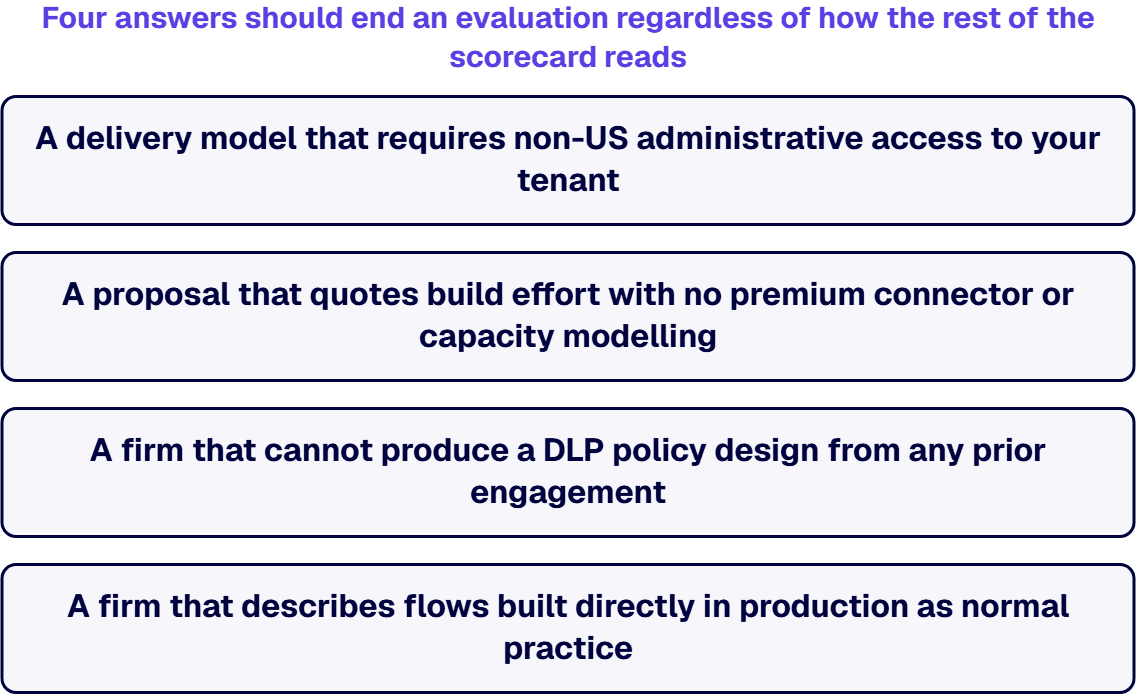
Four answers should end an evaluation regardless of how the rest of the scorecard reads. A delivery model that requires non-US administrative access to your tenant, because your own security review will stop it later at greater cost. A proposal that quotes build effort with no premium connector or capacity modelling, because the number is structurally incomplete rather than merely optimistic. A firm that cannot produce a DLP policy design from any prior engagement, because connector governance is the control that matters most in this category. And a firm that describes flows built directly in production as normal practice, because that is the finding that turns a routine assessment into a remediation programme.
One softer signal is worth weighting too. A candidate that has never recommended against automating something has not been in the room long enough. The most valuable output of a good scoping conversation is usually a shorter list of processes than you brought to it, which is the argument made at length in our guide to the Power Automate processes worth automating first.
Two bands are worth separating, because they answer different questions. A typical regulated-enterprise Power Automate security consulting engagement at i3 runs in the $60,000 to $180,000 range, depending on environment scope and framework complexity. That is governance and boundary work on an estate you already have. Migration of a legacy workflow estate is the other shape: Phase 3 (sequenced migration to Power Automate with governance handoff) ranges from $100,000 to $400,000 depending on the number of keep-and-migrate and rebuild workflows, and the sequencing method behind that band is set out in the guide to migrating SharePoint 2013 workflows to Power Automate. Licensing is a third and separate question, and the Power Automate premium cost analysis shows where the per-user and capacity figures come from rather than restating them here.
Which end of either band applies is decided by the inventory, not by a rate card, which is the practical reason a scoping conversation precedes a committed number. If your requirement is a longer-running delivery team rather than a bounded engagement, that is a dedicated Power Automate delivery team instead, and it is a different conversation with a different commercial shape. For broader platform scope, the Power Platform development services overview is the wider view. When you are ready to test fit, i3solutions routes a senior U.S.-based engineer to a client call usually within one to two weeks. You can also reach the team by phone at 703.652.8966.
No. There is no published, independent ranking for this category. What circulates is vendor-written lists, paid directory placements, and marketplace profiles ordered by transaction volume rather than by delivery quality in a controlled environment. The practical substitute is to score a shortlist yourself against a written rubric, weight the criteria that carry compliance risk at double, and require an artifact behind every claim so that a plausible answer without evidence scores zero rather than one.
Four things, and none of them is build skill. Environment strategy for the government cloud the tenant actually runs in, because connector availability and feature parity differ and change. Data loss prevention and connector governance around controlled data, with a real exception process. Control mapping to named families under CMMC, NIST SP 800-171, and DFARS with artifacts an assessor can review. And US-based administrative access, because the personnel constraints on a government cloud environment will decide the delivery model whether or not the vendor raises them.
One engagement names Power Automate as the technology: for a state National Guard organization serving both state and federal missions, i3solutions replaced 32 InfoPath forms with Power Apps and Power Automate ahead of a compliance inspection. Thirty-four workflows essential for automating key processes were migrated seamlessly, along with over 336,000 custom list items, and the environment passed inspection. No single i3solutions case study combines Power Automate with a federal contractor, and we would rather state that than blur a defense-sector logo into a Power Automate reference.
A typical regulated-enterprise Power Automate security consulting engagement at i3 runs in the $60,000 to $180,000 range, depending on environment scope and framework complexity. Migrating a legacy workflow estate is a different shape: Phase 3 (sequenced migration to Power Automate with governance handoff) ranges from $100,000 to $400,000 depending on the number of keep-and-migrate and rebuild workflows. Licensing is a separate question again. Which end of either band applies is decided by the inventory rather than by a rate card.
They change the arithmetic, which changes the ranking. Power Automate cost in an enterprise estate is decided by the connector and capacity choices made during architecture, not by the seat count, so a firm that quotes build effort without modelling premium connector consumption has quoted half the number. Ask each candidate to show the licensing model behind its estimate. The ones that can produce it during evaluation are the ones that produced it on their last programme.
Ask for a data loss prevention policy design from a prior engagement and the exception process behind it. Connector governance is the control that matters most in this category, and a firm that has genuinely delivered in a controlled environment can produce a redacted example in a day. A firm that offers a policy template instead, or that describes flows built directly in production as normal practice, has told you what its last engagement looked like.

US-Based | Est. 1997
© i3solutions. All rights reserved.
US-Based | Est. 1997
© i3solutions. All rights reserved.


