
By Matt Lawson, Senior Consultant, i3solutions. Matt has spent more than 14 years at i3solutions guiding complex enterprise technology work from scope and system design through development, acceptance, and long-term support, including Power Platform implementation across regulated and federal environments.
Power Automate Premium for 100 users costs $18,000 per year in license fees: $15.00 per user per month, paid yearly, at Microsoft’s published list price (microsoft.com Power Automate pricing, accessed August 2026). That number is the floor, and for most 100-user deployments it is also the wrong number, in both directions. It overstates the license cost when only a fraction of those 100 people build automations, because shared flows can carry their own capacity licenses instead. It understates the total cost when the deployment is real, because unattended automation, Dataverse storage, and the implementation work that makes flows production-grade all sit outside the per-user fee. This page prices each layer with Microsoft’s published figures, then shows the arithmetic for the license mixes that usually beat 100 flat Premium seats.
The flat model: 100 Premium seats, $18,000 per year. Every user can build and run unlimited cloud flows with standard, premium, and custom connectors, run attended desktop flows (RPA), and use process mining. Each seat also carries 5,000 AI Builder credits per month, 250 MB of Dataverse database capacity, 2 GB of file capacity, and a 40,000 action-per-day limit (Microsoft Learn, Types of Power Automate licenses, accessed August 2026). This 5,000-credit allowance applies through October 31, 2026: Microsoft’s AI Builder licensing overview states that a Power Automate license bought or renewed from November 1, 2026 no longer receives seeded AI Builder credits, while credits already seeded on a license before that date continue through the end of that license’s contract term. Buy this model when most of the 100 genuinely author automations or run attended RPA at their desks.
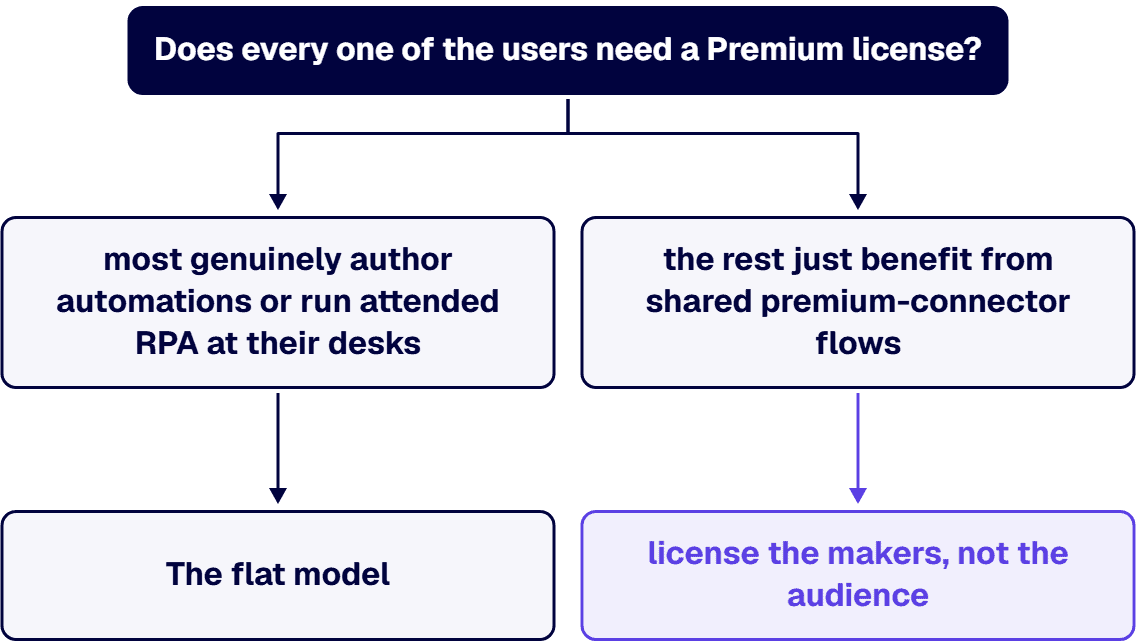
The mixed model: license the makers, not the audience. A Power Automate Process license at $150.00 per bot per month attaches to a cloud flow itself and grants premium-connector use to everyone who triggers it, with 250,000 actions per day. So if 20 of your 100 users actually build flows and the rest just benefit from six shared premium-connector flows, the arithmetic is 20 seats at $15.00 ($3,600 per year) plus six Process licenses at $150.00 ($10,800 per year): $14,400 per year, or 20 percent under the flat model, with far higher action headroom on the shared flows. The split between makers and consumers in your actual population, not the headcount, is what sets the price.
Unattended RPA is a separate line. A Premium seat includes attended desktop flows only. Running desktop flows unattended requires a Process license allocated to the machine ($1,800 per bot per year), or a Hosted Process license at $215.00 per bot per month ($2,580 per year) if Microsoft hosts the machine. A 100-user estimate that includes legacy-application automation and omits this line is understated.
Dataverse storage beyond the pooled entitlement. License-included Dataverse capacity accrues per seat, but flow-heavy estates with approvals, audit trails, and AI Builder outputs grow past it. Additional Dataverse database capacity is $40.00 per GB per month at list (microsoft.com Power Apps pricing, accessed August 2026). Storage is the quiet second bill in year two.
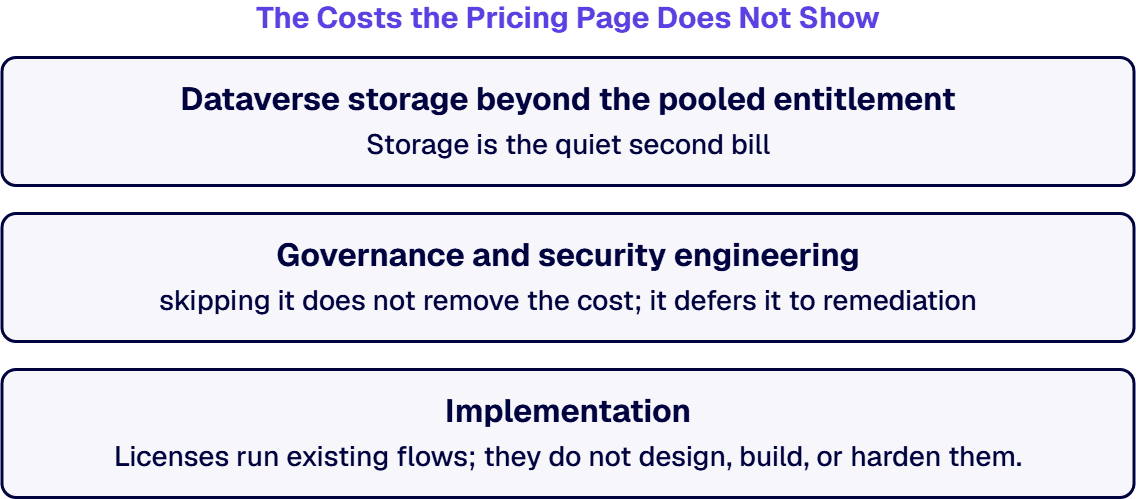
Governance and security engineering. One hundred licensed users means one hundred people who can move enterprise data between systems. Environment strategy, DLP policies, and connector governance are what keep that from becoming an audit finding. For scale, a typical regulated-enterprise Power Automate security consulting engagement at i3solutions runs in the $60,000 to $180,000 range, depending on environment scope and framework complexity. That work is not a Microsoft fee, but at 100 users in a regulated organization it belongs in the total cost of ownership, and skipping it does not remove the cost; it defers it to remediation.
Implementation. Licenses run existing flows; they do not design, build, or harden them. Build cost depends entirely on scope, which is why credible firms price it from a flow inventory rather than a seat count. The delivery model matters more than the day rate: i3solutions Power Automate developers follow a three-phase delivery model designed to minimize risk while building internal capability, so the 100-user organization ends up able to maintain its own automations rather than renting that ability indefinitely.
Put the layers together and the honest annual range for a 100-user Power Automate Premium deployment is $14,400 to $18,000 in Microsoft license fees depending on the maker-to-consumer split, plus per-bot capacity for any unattended RPA, plus Dataverse storage growth, plus one-time implementation and governance engineering scaled to your compliance posture. Organizations in GCC or GCC High should also note that US Government plans are purchased through government channels with their own pricing, and the Cloud Solution Provider channel is not available for GCC High, so commercial list prices are a modeling reference, not a quote. The same modeling discipline applies to adjacent Microsoft stacks; our breakdown of Dynamics 365 licensing cost and Microsoft 365 Copilot licensing follows the same method.
i3solutions is a Microsoft Partner with 30 years of delivery experience and runs a governed Power Platform for a federal defense agency supporting roughly 10,000 personnel across about 180 locations, which works because it is governed, not despite it. Licensing models and the governance engineering behind them are part of the same Power Platform practice.
$18,000 per year at Microsoft’s published price of $15.00 per user per month, paid yearly. Most 100-user organizations can license below that by giving Premium seats to the people who build automations and attaching Power Automate Process licenses ($150.00 per bot per month) to shared flows, which premium-enables those flows for every user who triggers them.
No. A flow in a solution with a Process license assigned can use premium and custom connectors regardless of who triggers it. Premium seats are for the people who author flows and for anyone running attended desktop automation. Counting the makers is the first step of any honest cost model.
Per Microsoft’s licensing documentation: attended RPA on a registered workstation, process mining access with 50 MB of process mining storage, 5,000 AI Builder credits per month, 250 MB of Dataverse database and 2 GB of file capacity, and a 40,000 action-per-day request limit per user. This 5,000-credit allowance applies through October 31, 2026: according to Microsoft Learn, a Power Automate license bought or renewed from November 1, 2026 no longer receives seeded AI Builder credits, while credits already seeded on a license before that date continue through the end of that license’s contract term.
$1,800 per year per unattended bot (a $150.00 per month Process license allocated to your machine), or $2,580 per year per hosted bot (a $215.00 per month Hosted Process license on a Microsoft-hosted machine). Parallel unattended runs need one license each, so the count follows your peak concurrency, not your total flow count.
Government cloud licensing is purchased through Volume Licensing or Cloud Solution Provider channels, and CSP is not available for GCC High. Pricing and connector availability differ from the commercial list, so model sovereign-cloud deployments with your licensing partner rather than the public pricing page. If you are still choosing an environment, start with GCC High versus GCC.
Two recur: Dataverse storage growth once approvals and audit histories accumulate ($40.00 per GB per month for database capacity beyond entitlements), and governance engineering. At 100 licensed users, DLP policy design and environment strategy stop being optional; in regulated organizations that engineering typically lands in the $60,000 to $180,000 range as a one-time engagement, which is small against the cost of the audit finding it prevents.

US-Based | Est. 1997
© i3solutions. All rights reserved.
US-Based | Est. 1997
© i3solutions. All rights reserved.


