
By Matt Lawson, Senior Consultant, i3solutions. Matt Lawson has spent more than 14 years at i3solutions guiding complex enterprise technology work from scope and system design through development, acceptance, and long-term support, with expertise spanning technical oversight, solution architecture, SharePoint and Microsoft 365 delivery, Power Platform implementation, business intelligence, enterprise search, and the practical application of AI to real business and operational challenges.
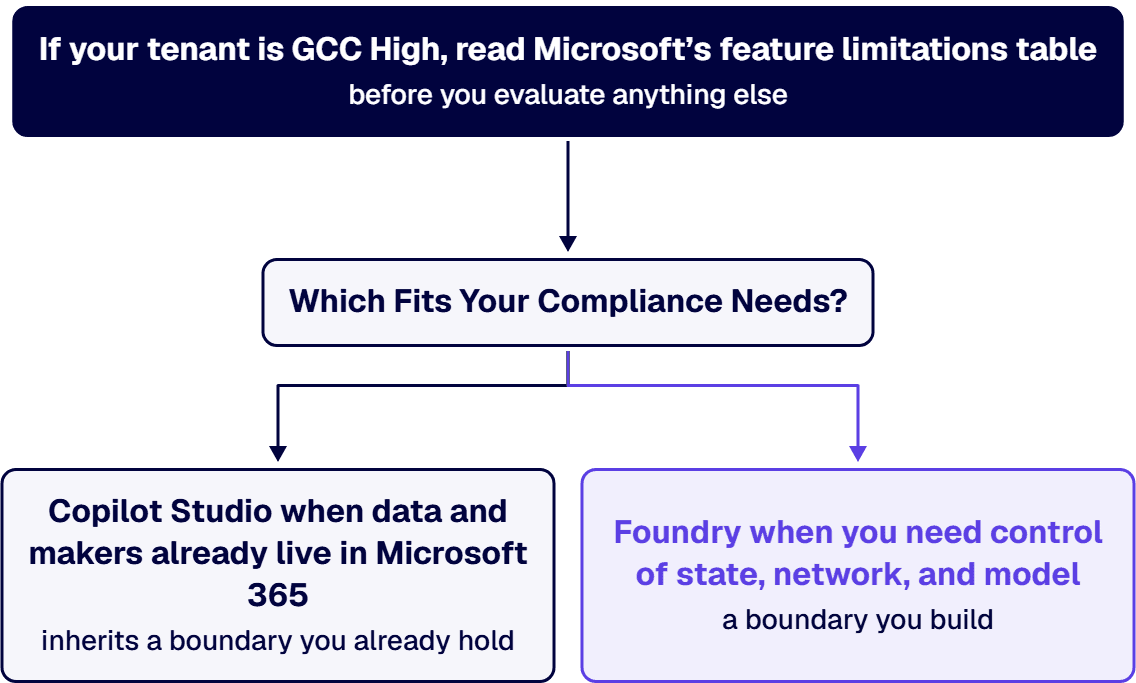
Neither is safer by default. Copilot Studio inherits a boundary you already hold: Microsoft documents GCC as FedRAMP High compliant and GCC High as aligning with DISA SRG IL4. Azure AI Foundry gives you a boundary you build, keeping agent state in your own Cosmos DB, Storage, and AI Search. Pick Copilot Studio when data and makers already live in Microsoft 365; pick Foundry when you need control of state, network, and model.
The rest of this page is the evidence behind that sentence, the four criteria that actually decide it, and the one Microsoft table that flips the answer for GCC High tenants before any of the four criteria get a vote.
When a regulated buyer says compliance posture, they are usually asking four separate questions that get compressed into one word. Separating them is most of the work.
Those four map cleanly onto the two platforms, and they do not all point the same way. That is why the honest answer is a split rather than a winner.
Microsoft publishes a dedicated US Government article for Copilot Studio, and it is specific. The US Government customers article states that “The Copilot Studio GCC environment complies with the Federal requirements for cloud services, including FedRAMP High,” and separately that “Copilot Studio is authorized as a service within the Azure Government FedRAMP ATO.”
For the higher boundary, the same US Government customers article records that “Starting February 2022, eligible customers can choose to deploy Copilot Studio US Government to the GCC High environment,” that “Microsoft designed the platform and its operational procedures to meet the requirements aligning with the DISA SRG IL4 (Defense Information Systems Agency Security Requirements Guide Impact Level 4) compliance framework,” and that “DISA has granted a Provisional Authority to Operate.” For defense contractors specifically, it states that “Microsoft operates the service in a manner that enables these customers to meet International Traffic in Arms Regulations (ITAR) commitment and Defense Federal Acquisition Regulation Supplement (DFARS) acquisition regulations.”
Three further commitments matter to an ISSO reading a system security plan. Customer content “is physically separated from customer content in non-US-Government plans.” The service “stores customer content at rest in datacenters physically located only in the United States.” And “Microsoft administrators can access Copilot Studio US Government customer content only if they’re US citizens,” backed by a screening table that includes OFAC, BIS, and DDTC list validation and, for DoD SRG L5 service capacities, DoD IT-2 adjudication.
Two boundary edges are stated just as plainly and get missed just as often. First, identity: “Microsoft Entra ID isn’t part of the Copilot Studio US Government accreditation boundary,” even though the service relies on your tenant for authentication and licensing. Second, connectors: third-party applications reached through Power Automate cloud flows and skills “aren’t covered by the Copilot Studio US Government compliance and data protection commitments.” An agent is only as accredited as its least accredited hop, and a connector is a hop.
One note on scope, because a gap is not the same as a prohibition. That article documents GCC and GCC High. It does not carry a DoD environment column for Copilot Studio. We are not going to read that silence as an answer either way: if you are targeting IL5, treat Copilot Studio availability as unresolved and get it in writing from your account team before it becomes a design assumption.
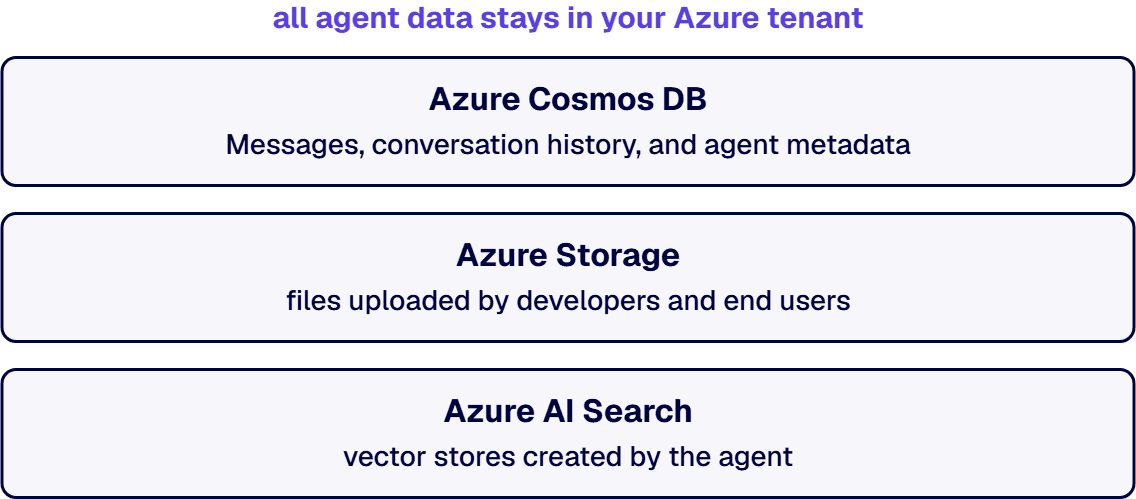
Foundry inverts the model. Instead of inheriting a service boundary, you assemble one. Microsoft’s standard agent setup documentation is explicit that “Standard setups require you to Bring Your Own (BYO) resources so that all agent data stays in your Azure tenant,” and names exactly where each class of data lands: Azure Storage for files uploaded by developers and end users, Azure AI Search for vector stores created by the agent, and Azure Cosmos DB for “Messages, conversation history, and agent metadata.” The same page states that “Agent states (conversations, responses) are stored in your own Azure resources” and that “You maintain complete control over data residency and access.”
On the underlying cloud, the Azure Government comparison states that “both cloud environments are assessed and authorized at the FedRAMP High impact level,” and that Azure Government adds “contractual commitments regarding storage of customer data in the United States and limiting potential access to systems processing customer data to screened US persons.” Microsoft’s Foundry models in Azure Government article records that “Models sold by Azure include all Azure OpenAI models offered in Azure Government,” with availability tables covering the USGov Arizona and USGov Virginia regions. If the question widens from Azure agents to Azure AI Foundry versus AWS Bedrock in a hybrid regulated estate, that comparison has its own answer.
Data residency for the model layer is defined by deployment type. The Azure Government deployment types article states that “Data stored at rest remains in the designated Azure region,” that USGov DataZone types are “Processed only within the Azure Government cloud USGov data zone,” and that Standard and Regional types are “Processed in the deployment region.” That is a control you set per deployment, which is exactly the kind of knob a boundary owner wants and exactly the kind of knob a low-code platform does not hand you.
The same page carries one line that belongs in every Foundry risk register and rarely makes it there: “Not all features of Abuse Monitoring are enabled for Azure OpenAI deployments in Azure Government. You are responsible for implementing reasonable technical and operational measures to detect and mitigate any use of the service in violation of the Product Terms.” Building your own boundary means owning the monitoring that came with the managed one.
Two honest limits on what we can tell you here. Model retirement schedules differ: Microsoft states that “In some cases, models are retired in Azure Government earlier or later than in the commercial cloud,” so a model your commercial pilot proved out is not guaranteed to have the same lifecycle in your government subscription. And the standard agent setup article does not itself state Azure Government availability for the Agent Service resource type. Confirm that against the products-by-region page for your specific Azure Government region rather than assuming parity, because a Foundry architecture that cannot be provisioned in your cloud is a rework item discovered late.
If your tenant is GCC High, read Microsoft’s feature limitations table in the US Government customers article before you evaluate anything else. As published, it marks the following as not available in GCC High: the Copilot Studio Microsoft Teams app experience, the Teams channel in the Copilot Studio web app, transfer to agents, the Teams and Microsoft 365 Copilot channel, Copilot agents that extend Microsoft 365, and the prompt action. Triggers and autonomous agents are marked unavailable in both GCC and GCC High. Azure AI Search as a knowledge source is marked unavailable in both. Generative orchestration is marked available in both.
Read the shape of that list rather than the individual rows. In GCC High, the Teams delivery surface is the thing that goes away, and Teams is where most enterprise agents are meant to be used. The same article says as much in prose: “client applications are limited to the web-user client and aren’t available in Microsoft Teams.” An agent nobody can reach from the app where they work is not a governance win, it is an adoption failure with a compliance justification attached.
There is a second, smaller constraint worth pricing in early. Microsoft’s quotas and limits article notes that the 5 MB connector payload ceiling “applies only to public cloud plans. Government Community Cloud (GCC) plans have a 450 KB limit.” If your agent’s job is to pass documents or large records through a connector, that is a design constraint, not a footnote.
These tables move. Both articles carry Microsoft revision dates, and the honest instruction is to open them yourself on the day you decide, rather than trusting a copy in a slide deck or a paragraph on a vendor page, including this one.
Governance surface. Copilot Studio agents live in Power Platform environments, which means they are governed by the machinery you already run there: tenant and environment data loss prevention policies, managed environment controls, and solution-based promotion. i3solutions governs client Power Platform tenants with the Center of Excellence Starter Kit, tenant-level and environment-level DLP policies, and managed environment controls. Microsoft guidance dated May 7, 2026 says the Center of Excellence Starter Kit is no longer actively maintained, that it remains available, and that its core capabilities are part of the Power Platform admin center. i3solutions runs client Power Platform work on a multi-tenant Center of Excellence model with separate Dev, Test, UAT, and Production environments promoted through managed solutions. Foundry agents are governed by Azure role-based access control, resource-level permissions, and whatever your landing zone already enforces. Neither is weaker. They answer to different owners, and the question to ask internally is which of those two owners actually has the standing to say no.
Data boundary. This is the sharpest split. Copilot Studio grounds naturally on Microsoft 365 content, and the accreditation, residency, and personnel commitments come with the service. Foundry puts conversation history in a Cosmos DB account you own, files in your storage account, and vectors in your search resource, which is the right answer when your obligation is to point at the resource and its access policy. If your requirement is expressed as “we must be able to name the resource, hold the key, and produce the access log,” Foundry answers it directly and Copilot Studio answers it by inheritance.
Team shape. Copilot Studio is built for makers, and that is a governance property as much as a productivity one: it lowers the bar to build and therefore raises the bar on your approval process. Foundry standard setup is a development exercise, with role assignments across five resources and a capability host that Microsoft’s own documentation warns cannot be updated after creation. If you do not have a team that owns Azure infrastructure, choosing Foundry for compliance reasons buys you a boundary nobody is qualified to operate.
Cost model. These bill on different clocks. Copilot Studio runs on Copilot Credits, which Microsoft describes as “the common currency across Copilot Studio capabilities,” available “through pay-as-you-go meters, prepurchase plans, and Copilot Credit prepaid pack subscriptions,” and which are enforced monthly: unused credits “don’t carry over to the next month,” and “If your usage exceeds your purchased capacity, technical enforcement applies and can result in service denial.” Foundry bills per token on Standard deployments or as reserved provisioned throughput units, through your Azure subscription. Copilot Studio’s model is a capacity commitment with a cliff. Foundry’s is a meter that keeps running. For an agent inside a mission workflow, the cliff is the risk worth designing around.
The framing that produces the best outcomes is not a choice at all. It is a boundary drawn between two tiers.
Put employee-facing agents that ground on Microsoft 365 content in Copilot Studio, inside a governed environment, where the accreditation and the residency commitments are inherited and the DLP policy you already wrote applies without a new control. Put agents that need model choice, custom retrieval, network isolation, or state you can point an auditor at in Foundry, inside your Azure Government landing zone, where you own the resources and the access policy. Then govern the seam between them, because the seam is where the failures live: connectors reaching out of the accredited boundary, an identity plane that Microsoft’s own article says is outside the Copilot Studio accreditation boundary, and permissions on the underlying content that were never right before an agent started reading them at machine speed.
That last one is not theoretical, and it is not an AI problem. The order-of-magnitude difference between AI readiness assessment quotes is data governance cleanup: when Dataverse and SharePoint access-control alignment has to precede a Copilot or OpenAI API integration, that remediation dominates the engagement. An agent does not create oversharing. It finds it, and then it quotes it to someone with a citation.
The work this question implies is a scoped platform and boundary decision, sized in weeks, that ends in a written architecture rather than a pilot. It produces a boundary map naming where conversation history, files, and vectors land for each agent class, a governance model naming which control plane enforces which rule, and a per-agent-class placement recommendation with its cost model attached. It is not a migration and it is not a managed service.
It also needs people who have worked inside the accredited boundaries rather than reading about them. i3solutions installs and helps configure applications inside IL4 and IL6 government cloud environments and other government networks. i3solutions runs a governed Power Platform for a federal defense agency supporting roughly 10,000 personnel across about 180 locations, which works because it is governed, not despite it. On the compliance side, i3solutions advises clients on federal compliance posture as its own assessment rather than as a restatement of Microsoft’s documentation, including whether SharePoint Online meets NIST 800-53, whether Azure Government is required under the DoD Cloud Computing SRG, and whether a CMMC gap assessment is needed to bid. That assessment is a named deliverable. The i3solutions Federal Compliance Assessment evaluates a client tenant against NIST SP 800-53 and CMMC using automated tenant configuration scripts and a 42-point security checklist. i3solutions engages its Federal Compliance Assessment when the scope spans a FedRAMP Moderate or FedRAMP High boundary, or when the client operates in a GCC High tenant.
Two practical notes on the delivery side. i3solutions delivery includes ALM practices with Power Platform pipelines or Azure DevOps integration, environment separation strategies, and change control processes, which is what keeps an agent promotable rather than hand-built in production. And i3solutions selects Dataverse over SharePoint as the primary relational store when a client needs scalable high-volume transactional data, and holds application secrets in Azure Key Vault, which is the same discipline a Foundry agent’s connection strings need.
On price, the closest published band we hold is for readiness rather than for this decision. An i3solutions Microsoft 365 Copilot readiness engagement typically runs $18,000 to $35,000. A platform-placement decision for agents is a narrower piece of work than that. AI readiness assessment cost variance at i3solutions is driven by custom semantic index building, multi-tenant vector database configuration on Azure AI Search, and prompt-engineering compliance reviews for regulated data. If a firm quotes you a platform decision without asking which cloud your tenant is in, they have not scoped it.
Neither, on the facts Microsoft publishes. Copilot Studio US Government inherits an accreditation: Microsoft documents the GCC environment as complying with FedRAMP High and states that Copilot Studio is authorized as a service within the Azure Government FedRAMP ATO. Foundry standard agent setup gives you a boundary you build and own, with conversation history, files, and vectors in your own Azure resources. The right question is whether your obligation is satisfied by inheriting a boundary or by owning one.
Microsoft’s US Government customers article for Copilot Studio documents both GCC and GCC High. It states that eligible customers have been able to deploy to GCC High since February 2022, that the platform was designed to align with the DISA SRG IL4 compliance framework, and that DISA has granted a Provisional Authority to Operate. That article does not carry a DoD environment column, so treat DoD availability as unresolved and confirm it with your Microsoft account team rather than inferring it from the GCC High row.
As published in Microsoft’s feature limitations table, GCC High does not have the Copilot Studio Microsoft Teams app experience, the Teams channel in the web app, transfer to agents, the Teams and Microsoft 365 Copilot channel, Copilot agents that extend Microsoft 365, or the prompt action. Triggers and autonomous agents, and Azure AI Search as a knowledge source, are marked unavailable in both GCC and GCC High. Generative orchestration is marked available in both. The practical consequence is that in GCC High the agent is reached through the web client rather than through Teams.
Under standard agent setup, in resources you own. Microsoft’s documentation names Azure Cosmos DB for messages, conversation history, and agent metadata, Azure Storage for uploaded files, and Azure AI Search for vector stores, and states that standard setups require you to bring your own resources so that all agent data stays in your Azure tenant. Data residency for the model layer is set by deployment type, with USGov DataZone deployments processed only within the Azure Government USGov data zone.
Copilot Studio bills in Copilot Credits, bought as pay-as-you-go meters, prepurchase plans, or prepaid pack subscriptions, and enforced monthly. Microsoft states that unused Copilot Credits do not carry over and that exceeding purchased capacity can result in service denial. Azure AI Foundry bills through your Azure subscription, either per token on Standard deployments or as reserved provisioned throughput units. The planning difference is that Copilot Studio has a monthly capacity cliff and Foundry has a meter, which matters most for agents sitting inside a mission-critical workflow.
Yes, and it is the common landing spot: employee-facing agents grounded on Microsoft 365 content in Copilot Studio inside a governed environment, and agents needing model choice, custom retrieval, or state you can point an auditor at in Foundry inside your Azure Government landing zone. What goes wrong is the seam. Connectors can reach services Microsoft explicitly says are not covered by the Copilot Studio US Government commitments, Microsoft Entra ID is stated to be outside the Copilot Studio US Government accreditation boundary, and underlying content permissions that were already wrong become visible the moment an agent starts reading at machine speed.

US-Based | Est. 1997
© i3solutions. All rights reserved.
US-Based | Est. 1997
© i3solutions. All rights reserved.


