
By Scot Johnson, Founder / CEO, i3solutions. Scot Johnson co-founded i3solutions 30 years ago with a focus on expert-led delivery, strategic advisory, and complex Microsoft-centered solutions for organizations where technology decisions carry operational, financial, and mission risk.
What a regulated enterprise pays a Dynamics 365 implementation partner is set less by a published hourly rate than by three structural choices: the engagement model (time and materials, fixed price, or staff augmentation), where the delivery team physically sits (onshore US personnel versus offshore), and the seniority mix assigned to your account. In regulated and defense work a fourth factor overrides the rest. Requirements such as US-based personnel, background-checked staff, and demonstrated CMMC or DFARS experience remove offshore labor arbitrage from the table, which compresses the rate structure toward senior onshore delivery and narrows which partners can bid at all.
This page is about who you pay and how to choose them, and how to tell two firms quoting the same rate apart before you sign. For the program budget itself, the modules, integrations, data condition, and customization that set the total, see our companion guide on Dynamics 365 implementation cost.
A partner’s price is a blended rate applied to an estimated effort, and both halves move independently. Two firms quoting the same rate can differ widely on total cost, because one staffs senior and delivers in fewer cycles while the other staffs junior and bills the rework. Four factors set the number:
Each model assigns scope risk to a different party, and that assignment, not the rate card, decides the economics. Time and materials keeps the rate transparent and puts scope risk on you, which is honest for discovery and for work whose shape is not yet fixed. Fixed price moves scope risk to the partner, who prices a contingency premium to carry it, so it is only defensible once discovery has fixed the scope it covers; a fixed price for an entire enterprise program before any discovery is a warning sign, meaning either a quietly narrowed scope or a premium you pay whether or not the risk materializes. Staff augmentation is the third structure: you rent senior capacity into your own team, own the architecture and management, and carry the lowest overhead, which fits when you already have delivery leadership and need qualified hands rather than a turnkey program.

Regulated requirements remove the cheapest inputs from the estimate. When ITAR or EAR data, controlled unclassified information, DFARS clause 252.204-7012, or a CMMC Level 2 obligation is in scope, the personnel who touch the environment usually must be US-based and background-checked. That eliminates offshore labor arbitrage and narrows the field to partners who staff senior onshore, setting a higher floor on the rate before any work begins. Compliance then adds defined overhead a commercial project never touches: control mappings, audit-trail discipline, and evidence production.
In i3solutions’ experience, regulated-enterprise delivery typically carries roughly 25 to 35 percent overhead versus commercial work for equivalent scope. That is a cost-risk explanation, not a surcharge for its own sake: the higher onshore rate buys the removal of a category of risk, a failed assessment, a data spill, an ineligible worker on a controlled system, that is not optional to avoid when you are in scope.
Choose on delivery evidence, not headline rate. The partner that fits a regulated enterprise can name the team that will actually work your account and say where they sit, can show delivery under the same compliance regime you carry, governs the customization boundary so the system survives Microsoft’s update waves, and can stabilize a program that goes sideways rather than only build greenfield. A low rate from a partner that fails those tests is the most expensive option on the table.
Six questions separate a fit from a risk, and they are worth asking every firm on a shortlist:
The red flags mirror those questions: a fixed price before any discovery, a blended rate that only works with undisclosed offshore junior staffing, no named team, a firm that sells licenses before it scopes the work, and an inability to speak to your compliance regime when you are plainly in scope. The last test, stabilization capability, matters most when a program is already in trouble: a partner senior enough to map the dependencies, re-sequence by risk, and return a build to a defensible track is doing a different job from greenfield delivery, and it is the one that protects the budget when an implementation is off the rails.
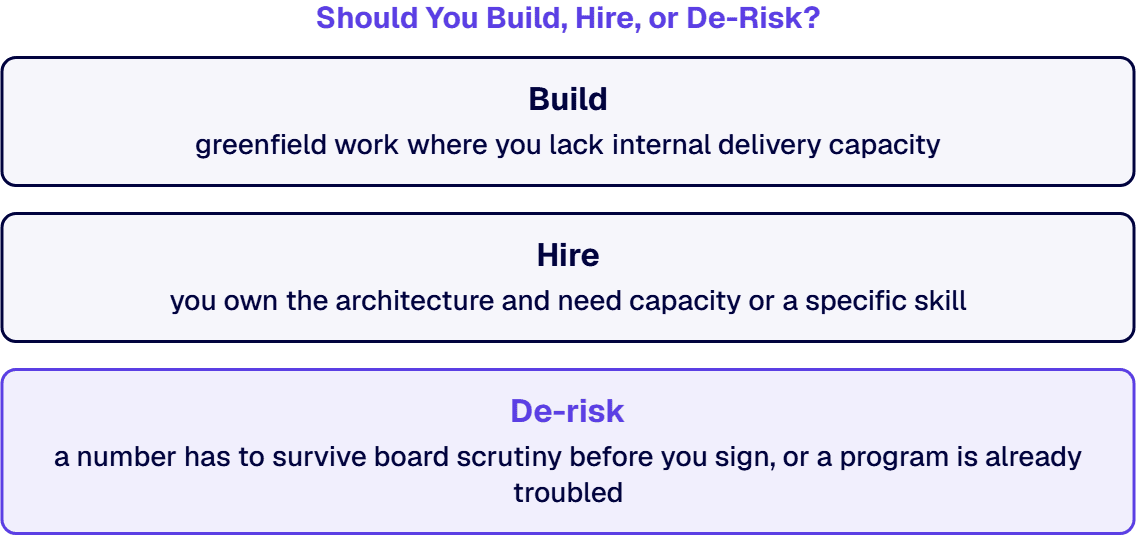
These are three different decisions, and treating them as one is how enterprises overpay. Build means engaging a partner to implement end to end, which fits greenfield work where you lack internal delivery capacity. Hire means bringing senior Dynamics 365 engineers into your own team under a scoped engagement, which fits when you own the architecture and need capacity or a specific skill rather than a turnkey program; you can hire Dynamics 365 developers to embed alongside an in-house team or another partner’s delivery. De-risk means putting a bounded engagement in front of a large commitment, a fixed-scope discovery, an advisory oversight role, or a program rescue, which fits when a number has to survive board scrutiny before you sign, or a program is already troubled. It is usually the cheapest insurance available, the difference between correcting a plan on paper and correcting a build in production.
i3solutions staffs US-based senior Dynamics 365 engineers and prices the removal of risk rather than the lowest hourly rate. All i3solutions Dynamics 365 developers and consultants are US-based, and the delivery teams include dedicated compliance specialists who understand CMMC, HIPAA, SOC 2, and financial services regulations within Microsoft environments. Senior specialists typically embed within two to four weeks, and the regulated-delivery overhead is stated openly rather than buried. The track record sits in regulated and mission environments: i3solutions runs a governed Power Platform for a federal defense agency supporting roughly 10,000 personnel across about 180 locations, and has delivered Dynamics 365 CRM integrations in a regulated healthcare environment. On cost, the bias is configuration over customization, with fixed-scope discovery in front of any commitment and stabilization capability held for programs that need rescuing rather than restarting. What i3solutions does not do is quote a rate before discovery has touched your systems.
Choose on delivery evidence rather than headline rate: the partner that fits can name the team that will work your account and where they physically sit, show delivery under your compliance regime such as CMMC, DFARS, HIPAA, or SOC 2, govern the customization boundary against Microsoft’s update cadence, and stabilize a troubled program rather than only build greenfield. Ask for the seniority mix assigned to your program specifically, and treat a fixed price quoted before any discovery as a warning sign.
For regulated and defense work it is usually not optional: when ITAR or EAR data, controlled unclassified information, DFARS 252.204-7012, or CMMC Level 2 is in scope, the people touching the environment generally must be US-based and background-checked, which removes offshore staffing as a legal option rather than a preference. Even without a mandate, senior onshore delivery often lowers total cost by reducing rework loops, so the higher rate frequently buys a lower final number.
Time and materials fits discovery and work whose scope is not yet fixed, because it keeps the rate transparent and lets scope adjust as you learn; fixed price fits a defined phase once discovery has pinned the scope it covers. A fixed price for an entire enterprise program before discovery should be read as either a quietly narrowed scope or a premium-priced contingency, not as certainty.
Ask where the delivery team sits and whether it is the account team or the pitch team, what seniority mix is assigned to your program specifically, for evidence of delivery under your compliance regime, and what happens when a phase fails. A partner that answers directly, and offers fixed-scope discovery before a fixed price, is showing you how it works.
A stabilization-capable partner can, and it is a distinct capability from greenfield delivery: the work is dependency mapping, risk-sequenced triage, and getting the program back onto a defensible track, which requires people senior enough to diagnose a build rather than only follow a plan. If a program is over budget or slipping, a bounded rescue or discovery engagement is usually cheaper than continuing on the current path or restarting procurement.

US-Based | Est. 1997
© i3solutions. All rights reserved.
US-Based | Est. 1997
© i3solutions. All rights reserved.


