
By Scot Johnson, Founder / CEO, i3solutions. Scot Johnson co-founded i3solutions 30 years ago with a focus on expert-led delivery, strategic advisory, and complex Microsoft-centered solutions for organizations where technology decisions carry operational, financial, and mission risk.
For a US enterprise deployment of 100 or more users, published partner estimates (Rand Group’s Dynamics 365 pricing guide and ERP Software Blog’s 2026 US implementation guide, both detailed below) put Dynamics 365 implementation costs between roughly $250,000 and $750,000, and complex Finance and Supply Chain Management programs at multinational scale can exceed $1 million. Licensing is a separate, recurring budget on top of that: Microsoft’s published prices run from $8 to $300 per user per month depending on the application. At enterprise scale the final number is driven less by user count than by four factors: how many modules you deploy, how many systems Dynamics must integrate with, the condition of the data you are migrating, and how tightly customization is governed.
That is the honest answer in three sentences. The rest of this page explains where those numbers come from, what the published ranges leave out, and what an IT leader preparing a board-level budget should scrutinize before signing anything.
Every Dynamics 365 program carries two distinct cost streams, and estimates go wrong when they are blended. Licensing is a recurring subscription paid to Microsoft. Implementation is a one-time (in practice, phased) professional services investment paid to a partner or staffed internally. A budget that quotes one without the other is incomplete, and at enterprise scale the two are usually the same order of magnitude over a three-year horizon.

These are Microsoft’s published US list prices as listed on Microsoft’s Dynamics 365 pricing pages, accessed July 2026. The first qualifying application is licensed at the base price; additional applications for the same user qualify for lower attach pricing.
Confirm current figures on Microsoft’s Dynamics 365 pricing pages before you build the business case; Microsoft adjusted list prices in both 2024 and 2025. Two licensing line items surprise enterprise buyers most often: Dataverse and operational database storage beyond the included capacity, which is billed per gigabyte per month, and sandbox environments for development, test, and staging, which mature enterprise ALM practice requires and starter budgets rarely include.
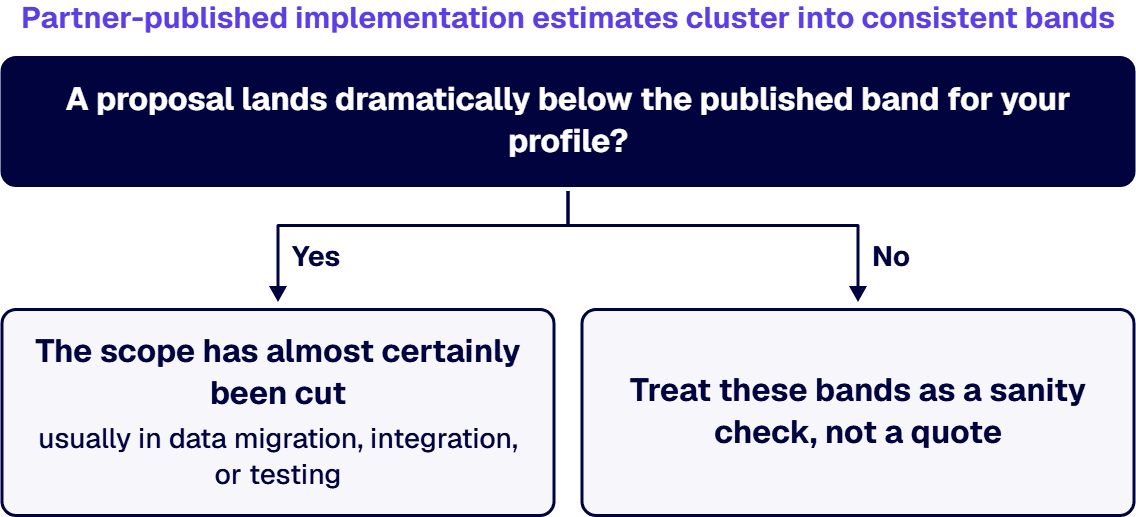
Partner-published implementation estimates cluster into consistent bands. Rand Group’s pricing guide puts typical Dynamics 365 implementations at $25,000 to over $250,000, with Finance and Operations programs ranging from $25,000 to over $1,000,000. ERP Software Blog’s 2026 US guide breaks the same picture out by company size: roughly $25,000 to $75,000 for small deployments, $75,000 to $250,000 for mid-sized companies, and $250,000 to $750,000 or more for enterprises above 100 users, with published timelines of 6 to 12 months for a Finance implementation.
Treat these bands as a sanity check, not a quote. They are useful for one thing above all: if a proposal lands dramatically below the published band for your profile, the scope has almost certainly been cut somewhere you will pay for later, usually in data migration, integration, or testing.
User count is the variable everyone asks about and the one that matters least. Beyond a few hundred users, licensing scales linearly and implementation cost barely moves with headcount. The real drivers are structural.
The failure patterns are consistent enough to list. Integration underscoping leads, in our experience across Microsoft platform programs: interfaces estimated as line items (“connect to SAP”) that are actually subprojects. Second is late-discovered data quality, which stalls user acceptance testing at the exact moment the program has the least schedule slack. Third is customization sprawl, where each department’s “one small change” accumulates into an upgrade burden that turns every Microsoft release wave into a testing event. Fourth is the two-budget blindspot itself: programs funded for build but not for hypercare, training, and the first year of managed evolution, which is when adoption is actually decided.
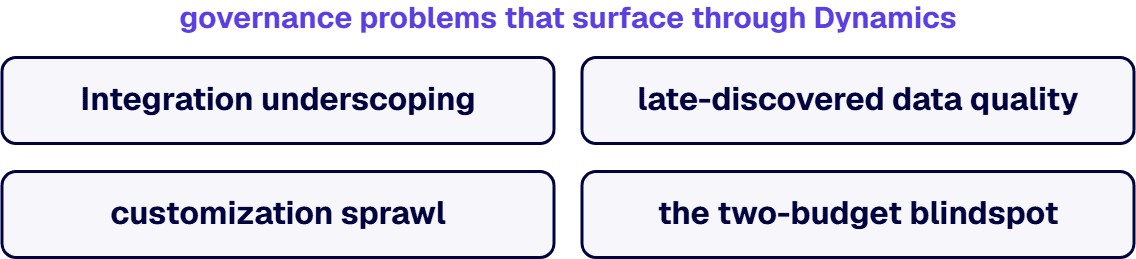
None of these are Dynamics problems. They are governance problems that surface through Dynamics, which is why the corrective is architectural discipline rather than a bigger contingency line.
i3solutions approaches Dynamics 365 as senior US-based Microsoft engineers rather than as a license reseller, and that changes how the estimate is built. We scope the integration and data layers first, because that is where enterprise variance lives, and we put a fixed-scope discovery phase in front of any implementation commitment so the number you take to the board is derived from your systems, not from a published band. Delivery is phased with explicit exit ramps: each phase produces a working, testable increment and a documented decision record, so the program can be defended at audit and redirected without sunk-cost drama.
On the cost side, our bias is configuration over customization, and where custom work is genuinely required, our Dynamics 365 development services team builds extensions against Microsoft’s ALM guidance so they survive platform updates without a standing maintenance tax. Organizations that need to blend our engineers with an in-house team or another partner’s program can hire Dynamics 365 developers from us directly, which is often the fastest way to rescue a program that is over budget without restarting procurement. We have applied this model in regulated environments including aerospace and defense manufacturing and financial services, where the estimate has to survive audit scrutiny, not just a steering committee.
What drives our pricing up or down is the same list that drives every honest estimate: module footprint, integration count, data condition, and the customization boundary. What we do not do is quote a number before discovery has touched your actual systems.
Enterprise budgets differ by module and compliance posture. These companion guides break down the numbers for each scenario:
Published US estimates put enterprise ERP-centered implementations at 6 to 12 months, and multinational, multi-entity Finance and Supply Chain programs commonly run longer. Phased deployment, one region or business unit first, is the norm at enterprise scale and is usually the right call.
It depends entirely on the application mix, which is why per-user math misleads. A population of 500 users is typically not 500 full licenses: a common enterprise pattern is a core of Finance or Supply Chain users at $210 per user per month, a sales and service population at $105, and a long tail of light users on $8 Team Members licenses. Model the actual role mix before multiplying anything.
Because they price different scopes. The low end of a published band assumes single-module, near-vanilla configuration with clean data and no integrations. The high end assumes multi-module, multi-entity deployment with a real integration landscape. Neither is wrong; they describe different projects. The variance disappears once scope is fixed, which is the purpose of a discovery phase.
Yes, in three defensible ways: hold the customization boundary and adapt processes to standard capability where the process is not a differentiator; phase the rollout so early increments fund confidence in later ones; and invest in data cleanup before migration rather than during testing. Cutting testing, training, or integration scope also lowers the quote, and reliably raises the total cost of the program.
For a defined phase, yes; for an entire enterprise program before discovery, treat a fixed price as a warning sign rather than a comfort. It means either the scope has been quietly narrowed or the contingency has been priced in at a premium. Fixed-scope discovery followed by phase-level commitments gives finance the predictability it needs without paying for a guess.
If a Dynamics 365 decision is on your calendar this quarter, the fastest path to a budget you can take upstairs is a short conversation about your module footprint, integration landscape, and data condition. That conversation produces two things: a straight answer on which published band your program actually belongs in, and the two or three scope questions your finance team will ask that you do not want to hear for the first time in the boardroom. There is no deck and no follow-up sequence, just a senior engineer looking at your situation. Schedule a 30-minute scoping call and bring the messiest integration diagram you have.

US-Based | Est. 1997
© i3solutions. All rights reserved.
US-Based | Est. 1997
© i3solutions. All rights reserved.


