
By Scot Johnson, Founder / CEO, i3solutions. Scot Johnson co-founded i3solutions 30 years ago with a focus on expert-led delivery, strategic advisory, and complex Microsoft-centered solutions for organizations where technology decisions carry operational, financial, and mission risk.
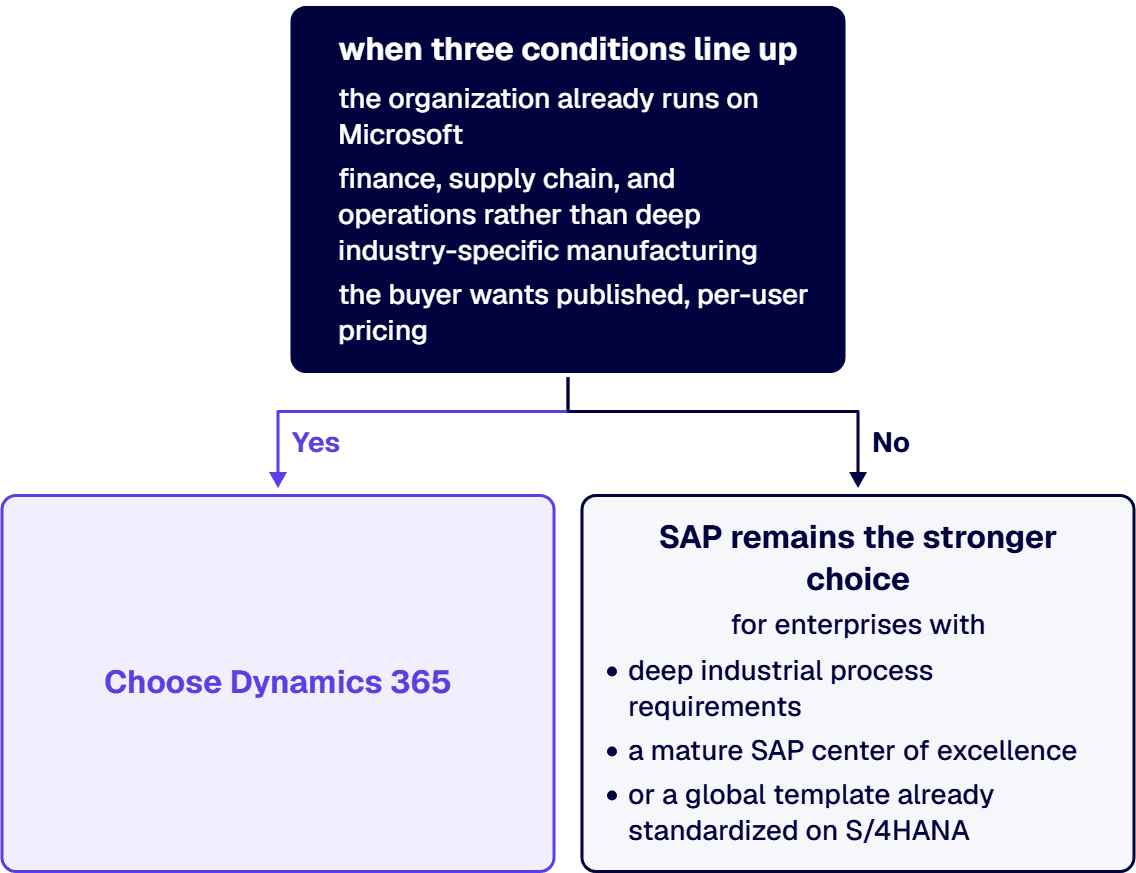
An enterprise should choose Dynamics 365 over SAP for ERP when three conditions line up: the organization already runs on Microsoft (Entra ID, Microsoft 365, Azure), the ERP scope is finance, supply chain, and operations rather than deep industry-specific manufacturing, and the buyer wants published, per-user pricing, which Dynamics 365 has at $210.00 per user per month for Finance and for Supply Chain Management on Microsoft’s US price list while SAP S/4HANA is quoted rather than listed. SAP remains the stronger choice for enterprises with deep industrial process requirements, a mature SAP center of excellence, or a global template already standardized on S/4HANA.
There is also a clock running on the decision. SAP will provide mainstream maintenance for SAP Business Suite 7 core applications until the end of 2027, with optional extended maintenance until the end of 2030 at a premium of two percentage points on the maintenance basis, per SAP’s published maintenance strategy. Every ECC estate is therefore choosing its next ERP now, whether it frames the decision that way or not. This page gives the conditions under which that next ERP should be Dynamics 365, the ones under which it should not, and the verified numbers on both sides as of July 2026.
Choose Dynamics 365 when the following describe your organization, because each one converts directly into cost or risk on an SAP route. Your identity, collaboration, and analytics standards are Microsoft: Entra ID conditional access, Teams, Excel, and Power BI apply to Dynamics 365 natively, while an SAP estate is a second identity perimeter and a separate analytics integration. Your ERP requirements are strong core financials, procurement, supply chain execution, and project accounting rather than industry-specific manufacturing depth. Your entity structure is tiered, because running Business Central at $80.00 to $110.00 per user in smaller subsidiaries alongside Finance at $210.00 in the parent is a supported pattern that SAP matches only with more machinery. And your delivery model favors phased, entity-by-entity rollouts over a multi-year global template program. Enterprises matching that profile get shorter paths to production and an operating model their existing Microsoft governance already covers. If an SAP or ERP renewal is driving cost, check first whether Power Pages can reduce ERP customization and licensing costs for external users.
The pricing transparency gap is itself a finding. Microsoft publishes US list prices per user per month, paid yearly, on its Dynamics 365 pricing pages: Finance at $210.00, Supply Chain Management at $210.00, their Premium tiers at $300.00 each, Project Operations at $135.00, and Business Central Essentials and Premium at $80.00 and $110.00 for the subsidiary tier, with light users at $8.00 on Business Central Team Members. Multi-app users pay a reduced attach price for a second qualifying application rather than a second full seat; the per-seat mechanics are broken down in our Dynamics 365 licensing cost guide.
SAP does not publish a comparable list price for S/4HANA Cloud: pricing is quote-based through SAP or a partner, and ECC customers electing extended maintenance after 2027 pay the published premium of two percentage points on their maintenance basis. None of that makes SAP more expensive by definition, but it changes who holds the information in the negotiation, and it means an SAP business case cannot be independently priced from public sources the way a Dynamics 365 case can. For a board that wants two comparable bids, that asymmetry is worth naming early.
SAP’s own calendar is the forcing function for most enterprises reading this page. Mainstream maintenance for Business Suite 7 core applications ends at the end of 2027, extended maintenance runs to the end of 2030 at the premium, and SAP has committed maintenance for S/4HANA through 2040, all per SAP’s published maintenance strategy. The practical consequence: staying put is not one of the options. An ECC enterprise is choosing between an S/4HANA conversion, which SAP has framed as the default path, and a re-platforming decision in which Dynamics 365 competes on equal footing because the migration project must be funded either way. That is precisely the moment to test the Microsoft-centric conditions above, since the S/4HANA conversion carries most of the cost and disruption of a new ERP without re-opening the platform question. Treat 2027 as a planning boundary, not an emergency: a deliberate migration decided in 2026 costs less than a rushed one quoted in 2029.
Four profiles argue for SAP, and pretending otherwise would make this page a brochure. Deep industrial and industry-specific functionality: for complex discrete and process manufacturing, advanced variant configuration, and industry solutions SAP has spent decades building, S/4HANA’s functional depth is the requirement, not a preference. An established SAP center of excellence: an enterprise with hundreds of person-years of SAP process knowledge and a governance machine built around it should price the loss of that asset honestly. A standardized global template: multinationals running one SAP template across dozens of countries get consolidation value that a re-platforming would have to rebuild. And an existing S/4HANA investment: with maintenance committed through 2040, an enterprise already live on S/4HANA has no forced exit and should evaluate Dynamics 365 only at the edges, for example in subsidiaries or satellite entities where a two-tier pattern fits.
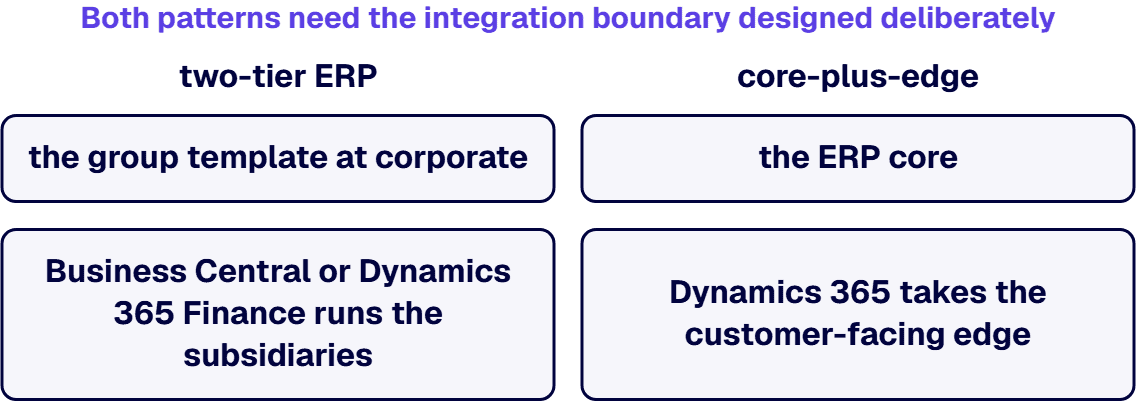
Yes, and for large enterprises the coexistence pattern is often the honest recommendation rather than a consolation prize. The common shape is two-tier ERP: S/4HANA remains the group template at corporate while Business Central or Dynamics 365 Finance runs the subsidiaries, acquisitions, and regional entities where SAP’s weight is not justified, with consolidation flowing up through defined integration. The second common shape keeps SAP as the ERP core while Dynamics 365 takes the customer-facing edge, CRM, field service, and project operations, where its Microsoft 365 integration earns its keep daily. If the CRM layer is itself a contested choice, our Dynamics 365 vs Salesforce comparison runs that decision on the same governance tests. Both patterns need the integration boundary designed deliberately, with owned interfaces and monitored data flows rather than point-to-point improvisation, and that boundary is where these programs succeed or fail.
Run the decision through the compliance boundary first, because it can settle the question before any feature comparison. Which platform keeps regulated data inside an environment your framework already certifies, with evidence produced by controls you already operate? For US defense-adjacent work, Microsoft’s Dynamics 365 US Government service description lists core Finance, Supply Chain Management, and Sales availability in GCC High, inside the same boundary as the rest of a GCC High tenant; what that environment adds to an implementation budget is priced in our defense contractor cost guide. Then test the operating model: which platform can your security and audit teams actually govern for a decade, and in how many separately administered perimeters? Our teams maintain dedicated compliance specialists who understand CMMC, HIPAA, SOC 2, and financial services regulations within Microsoft environments, providing audit trail documentation and access control frameworks that reduce audit preparation time by 60%. An ERP selection that ignores the audit workload buys the demo and inherits the findings.
i3solutions is a Microsoft Solutions Partner. All i3solutions Dynamics 365 developers and consultants are U.S. based. We do not resell either platform, and our recommendation is built from the integration surface, data condition, entity structure, and compliance obligations of your specific estate, the same drivers that price the program in our Dynamics 365 implementation cost guide. When the honest answer is an S/4HANA conversion or a coexistence pattern, that is the answer we give, because an ERP recommendation is only worth what it costs the recommender to say it. What we bring to the Dynamics 365 route is senior, phased, governance-first delivery: working increments by entity, a documented decision record, and an estate your own team can run when the program ends. That delivery model is described on our Dynamics 365 development services page. Enterprises that want that capacity inside an in-flight program can hire Dynamics 365 developers from us directly.
When the organization is already Microsoft-centric in identity, collaboration, and analytics, when the ERP scope is core financials, supply chain, and operations rather than deep industry-specific manufacturing, and when phased entity-by-entity delivery and published per-user pricing matter. Dynamics 365 Finance and Supply Chain Management list at $210.00 per user per month each on Microsoft’s US price list, while SAP S/4HANA pricing is quote-based, and the ECC maintenance deadline at the end of 2027 makes this decision current for every Business Suite 7 estate.
It is more transparently priced, which is not the same claim. Dynamics 365 publishes US list prices, $210.00 per user per month for Finance and for Supply Chain Management with Premium tiers at $300.00, so a budget can be modeled from public sources. SAP quotes S/4HANA Cloud rather than listing it, so a comparison is only as good as your negotiation. Total cost on either platform is dominated by implementation, integration, and the ongoing estate rather than by the subscription line.
Per SAP’s published maintenance strategy, mainstream maintenance for SAP Business Suite 7 core applications runs until the end of 2027, followed by optional extended maintenance until the end of 2030 at a premium of two percentage points on the existing maintenance basis. SAP has committed maintenance for S/4HANA through 2040. Enterprises on ECC are therefore selecting their next ERP platform now, and both the S/4HANA conversion and a Dynamics 365 re-platforming are funded migration projects rather than upgrades.
For deep discrete and process manufacturing and industry-specific functionality where S/4HANA’s decades of functional depth are the actual requirement, for enterprises with a mature SAP center of excellence whose process knowledge is a real asset, for multinationals consolidating on a single global SAP template, and for organizations already live on S/4HANA, which has maintenance committed through 2040 and no forced exit. In those profiles the Microsoft-centric integration argument does not outweigh the functional and organizational fit.
Yes, and it is common. The two proven patterns are two-tier ERP, with S/4HANA at corporate and Business Central or Dynamics 365 Finance in subsidiaries and acquisitions, and core-plus-edge, with SAP as the ERP core while Dynamics 365 covers CRM, field service, and project operations. Both depend on a deliberately designed integration boundary with owned interfaces and monitored flows, which is where the engineering investment belongs.

US-Based | Est. 1997
© i3solutions. All rights reserved.
US-Based | Est. 1997
© i3solutions. All rights reserved.


