
Verify readiness before capability. A firm qualified for Copilot in a government contracting environment can show you its permission and sensitivity label remediation method, name the cloud environment it has configured inside, produce control mappings an assessor can review, staff the work from the United States, and confirm Copilot feature availability for your tenant with Microsoft in writing.
Microsoft 365 Copilot does not create access. It surfaces what a user could already reach and had never found. In a commercial tenant that produces an awkward week. In a defense contractor’s tenant, where controlled unclassified information sits in SharePoint libraries that were opened to “everyone except external users” during a migration nobody documented, it produces a disclosure event. That difference is why firm selection for Copilot in government contracting is a readiness question first and a deployment question second, and why the vetting sequence below spends more time on your existing estate than on the product.
The single best predictor of a Copilot rollout going badly is that nobody inventoried the tenant first. Oversharing is not a hypothetical. i3solutions assessment engagements routinely find 20 to 40 percent more SharePoint sites during Phase 1 than the client internal inventory lists. Sites the IT organization did not know it had are, by definition, sites whose permissions nobody has reviewed, and every one of them is inside Copilot’s retrieval scope on day one.
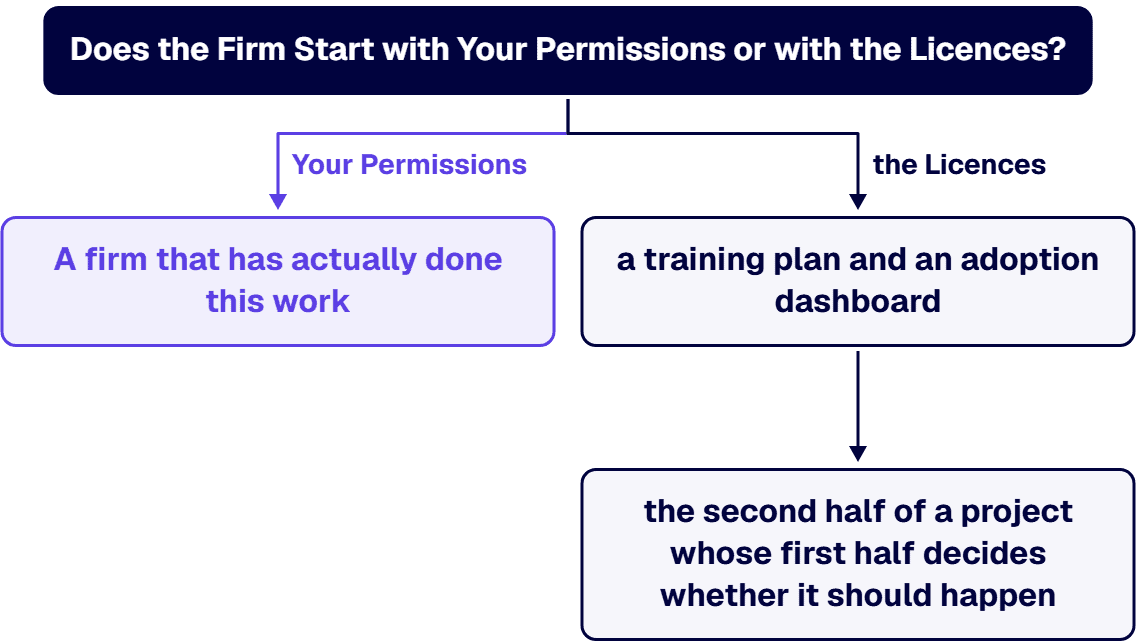
So the first question to ask a candidate firm is not how it would run enablement. It is what it would measure before a single licence is assigned, and what result would make it recommend delaying the rollout. A firm that has actually done this work has a specific answer: a site and permission inventory, an oversharing report, a sensitivity labeling scheme with a decision about default labels, a retention and disposition review, and a named remediation backlog with owners. A firm that answers with a training plan and an adoption dashboard is describing the second half of a project whose first half decides whether it should happen.
Every criterion here is checkable from public sources or from a first scoping conversation. None of them requires taking a vendor’s word.
Ask each shortlisted firm the same five questions and compare the specificity of the answers rather than the confidence:
Question five is the one that sorts the market. Ask it plainly and listen for whether the answer is a number and a reference, an analogy to a different product, or a change of subject.
If you want to test those questions against a practitioner before you shortlist, a senior i3solutions engineer will walk your tenant’s readiness posture with you: where your oversharing exposure actually sits, what a labeling scheme would have to enforce, and what sequence the work has to run in. You leave the call with the reasoning whether or not you engage us, which is usually what a buyer needs to build the internal case before committing to a platform-wide programme.
The Microsoft 365 record in government-facing environments is specific. i3solutions has been a Microsoft Partner with 30 years of enterprise technology delivery experience and has delivered 1,500+ Microsoft engagements across aerospace and defense, financial services, and health sciences. i3solutions is a Microsoft Solutions Partner. i3solutions is an SBA certified small business providing technical and professional services to US Federal Agencies, the DoD and the private sector. i3solutions runs migrations against named control families across CMMC, HIPAA, SOC 2, and NIST 800-171, producing artifacts auditors can review. i3 installs and helps configure applications inside IL4 and IL6 government cloud environments and other government networks. What i3solutions does not hold is a FedRAMP or DoD authorization of its own, and it does not accredit a system or issue an authority to operate; those determinations sit with the government. i3solutions has delivered a Microsoft 365 Copilot deployment, pilot or rollout for a client.
The published client references below sit alongside that record, and it is worth being precise about what they measure. For a nonprofit government consulting firm serving federal civilian agencies, the Department of Defense, and state and local governments, i3solutions consolidated a multi-farm SharePoint estate into Office 365 and integrated identity. Implementing Okta SSO with MFA achieved 95% enrollment across 4,000 users within 60 days, closing critical authentication gaps and reducing breach risk exposure valued at over $1M annually. That is an identity and migration outcome at Copilot-relevant scale, and the detail is in the Office 365 consolidation case study.
For a global aerospace and defense engine manufacturer, i3solutions built a proposal management system on the Microsoft stack, in an estate where, as the case study records, Office 365 allows the company to apply advanced security rules for SharePoint Online and GCC High. Automated validation workflows reduced rework by 30% and boosted compliance audit scores by 20%, minimizing late corrections and improving proposal accuracy. Those are proposal-operations figures rather than compliance determinations, and the full account is in the proposal management case study. For a national membership organization for education professionals, i3solutions assessed the estate first and then rebuilt the digital workplace on it; the published benefit reads: Automated business processes to boost productivity by more than 50%. That last organization is not a defense contractor and does not run in a government cloud, and we are naming it as what it is rather than letting it pad a GovCon page. It is in the digital workplace case study.
Wider platform experience is real in the same sector. i3solutions has delivered enterprise SharePoint and Power Platform programs for aerospace and defense manufacturers, major defense organizations, a financial-services firm, a national healthcare system, and military organizations. i3solutions runs a governed Power Platform for a federal defense agency supporting roughly 10,000 personnel across about 180 locations, which works because it is governed, not despite it.
Honest disqualification is cheaper than a bad engagement. We are not the right vehicle when the programme needs a prime contractor fronting a large multi-vendor structure, when the requirement is lowest-price-technically-acceptable staffing, when your platform direction is away from Microsoft, or when you want a fixed price quoted on a tenant nobody has inventoried, because a number produced that way is one we would not stand behind. We do not perform certification assessments and cannot guarantee certification outcomes; those determinations belong to accredited assessors reviewing your environment and evidence.
The fit is a defense or federal contractor that needs the readiness question answered properly before the licences are committed: the permission surface measured, the labeling scheme designed against a real CUI boundary, the controls implemented and evidenced inside a Microsoft estate, and the SharePoint and Power Platform work under it delivered by senior US-based engineers.
Two numbers are worth separating. An i3solutions Microsoft 365 Copilot readiness engagement typically runs $18,000 to $35,000. That is the bounded assessment that produces the inventory, the oversharing report, the labeling design, and the remediation backlog, and it is deliberately not a free assessment: a scoping exercise nobody pays for is a scoping exercise nobody staffs properly. Licensing is the separate half, and it has published sources rather than our opinion; the Microsoft 365 Copilot licensing analysis shows where each figure comes from, and the Copilot total cost of ownership breakdown covers what the licence line leaves out. Which end of the readiness band applies to you is decided by tenant size and the state of the estate, not by a rate card.
Shortlist two or three firms against the criteria above and ask each for the same four artifacts: a sample statement of work with the exclusions visible, the readiness deliverable that precedes their committed number, a redacted labeling or control-mapping artifact from a comparable engagement, and a written answer to question five. Then weight the answers by who was most specific about your existing estate, because the firm that measures your permissions before quoting your rollout is the one whose plan will survive contact with your tenant.
If your environment question is still open, the sequencing work is already written down. Start with the comparison of GCC and GCC High if you are not yet certain which environment your contracts require, read the analysis of whether CMMC requires GCC High before anyone tells you it does, and look at Office 365 and CMMC compliance if the assessment date rather than the AI programme is what is driving your calendar. When you are ready to test fit, i3solutions routes a senior U.S.-based engineer to a client call usually within one to two weeks, and you can reach the team by phone at 703.652.8966.
Five artifacts, all reviewable. A site and permission inventory covering the whole tenant rather than the sites IT knows about. An oversharing report naming the specific libraries and links that would be exposed. A sensitivity labeling scheme with an explicit decision on default labels and on what happens to existing content. A retention and disposition review. And a remediation backlog with named owners and a sequence. If the deliverable is a slide deck and a licence recommendation, it was not an assessment.
Do not assume so, and do not accept a vendor summary either way. Copilot feature availability and parity differ by cloud environment and change over time, so the only answer worth acting on is a written confirmation from Microsoft or your licensing channel for the specific environment your tenant runs in, dated, obtained before scoping. A firm that treats that step as a formality has not deployed into a government cloud recently enough to know that it is not one.
An i3solutions Microsoft 365 Copilot readiness engagement typically runs $18,000 to $35,000. That covers the bounded assessment work: the tenant inventory, the oversharing report, the labeling design, and the remediation backlog. Licensing is a separate question with published sources. Where you land inside the band is decided by tenant size and the state of the estate rather than by a rate card, which is the practical reason the assessment comes before any committed rollout number.
Copilot does not create access; it surfaces content a user could already reach and had never found. That makes the existing permission surface the actual control boundary. i3solutions assessment engagements routinely find 20 to 40 percent more SharePoint sites during Phase 1 than the client internal inventory lists, and sites nobody knew about are sites whose permissions nobody has reviewed. In an estate holding controlled unclassified information, that gap is the risk the programme has to close first.
Administrative access to a government cloud environment carries personnel constraints, so in practice the answer is yes for anyone touching the tenant. Establish where the delivery team sits in writing during scoping rather than at onboarding. i3solutions routes a senior U.S.-based engineer to a client call usually within one to two weeks.

US-Based | Est. 1997
© i3solutions. All rights reserved.
US-Based | Est. 1997
© i3solutions. All rights reserved.


