Security Aware Microsoft Modernization: How Regulated Enterprises Prevent Security Gaps During Platform Transitions

Quick Answer
Security aware Microsoft modernization configures identity, permission, data-residency, and connector-governance controls into a Microsoft platform transition from day one rather than retrofitting them after go-live. For regulated enterprises in defense, healthcare, and finance, it prevents the audit findings that surface 6 to 12 months after migration.
Key Takeaways
- Security-aware Microsoft modernization builds compliance controls into each migration phase instead of bolting them on afterward. Programs that defer security to a post-migration workstream surface audit findings six to twelve months after go-live, when remediation costs the most and the evidence trail is hardest to reconstruct.
- The three security gap patterns Microsoft modernization consistently produces are identity model transitions (AD to Entra ID), permission model changes (on-prem to cloud), and connector governance gaps in Power Platform.
- The i3solutions security-aware Microsoft modernization methodology covers five phases: threat modeling during assessment, security architecture alongside application architecture, compliance validation gates at each migration phase, identity and access transition control, and post-cutover audit-evidence retention.
- Compliance framework integration at named control-family depth across CMMC 2.0 Level 2, HIPAA Security Rule, NIST 800-171 Rev 2, SOC 2, and DFARS 252.204-7012 is the differentiation against generalist modernization vendors who name frameworks without mapping controls.
- Evaluate a security-aware Microsoft modernization consulting partner on five observable signals: named control-family fluency, identity and access architecture credentialing, audit-survived references, senior-only US-based roster transparency, and Enterprise Delivery Assurance.
Why Security-Aware Microsoft Modernization Breaks at Regulated-Enterprise Scale
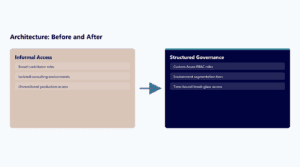
Security-aware Microsoft modernization breaks at regulated-enterprise scale because most modernization programs evaluate the migration as a routine platform-upgrade decision when the next compliance audit cycle actually demands an architecture and governance commitment. Programs that treat security as a post-migration workstream consistently produce audit findings 6 to 12 months after go-live, and by that point the migration is irreversible. This is the core tradeoff between governance-first and speed-first Microsoft modernization. The gap surfaces in vendor selection: generalist modernization consultants approach Microsoft 365, Azure, SharePoint, Power Platform, and Entra ID transitions as configuration work, not as identity, permission, data residency, and connector governance redesigns that must satisfy CMMC 2.0, HIPAA Security Rule, NIST 800-171 Rev 2, SOC 2, and DFARS 252.204-7012 simultaneously.
This piece names the three security-aware Microsoft modernization gap patterns that surface in audits, the five-phase methodology that designs security into migration architecture rather than retrofitting it, the compliance framework mappings at named control-family depth, and the five-signal partner evaluation that distinguishes security-aware modernization consultants from vendors who treat security as a downstream workstream.
i3solutions has delivered Microsoft modernization in regulated environments for an aerospace and defense manufacturer, a financial services firm, and a national healthcare system. Across 600+ Microsoft platform implementations since 1997, the failure mode that consistently surfaces in audit findings post-migration is the same: security architecture decisions deferred until after the platform is live.
Three Security-Aware Microsoft Modernization Gap Patterns That Surface in Audits
Microsoft modernization programs that defer security architecture until after go-live produce three recurring gap patterns. Each is observable in audit findings and traceable to a specific architectural decision made during the migration.
Identity model transition gaps (Active Directory to Entra ID)
Modernization moves identity from on-premises Active Directory to Entra ID, but the authorization model embedded in the legacy AD environment rarely transfers cleanly. Nested security groups, delegated permissions, and service-account patterns that worked in the on-prem environment produce overprivileged identities in Entra ID by default. The audit finding pattern: privileged Entra ID roles assigned to standard user accounts because the migration carried over group membership without re-evaluating the cloud authorization model. Conditional Access policies configured to satisfy CMMC 2.0 AC-2 and AC-6 fail at audit because the underlying identity model carries too many privileges for the controls to be effective.
Permission model drift (on-premises to cloud)
On-premises SharePoint and file-share permissions inherit through site collections, libraries, folders, and items in patterns the legacy environment has accumulated. Modernization to SharePoint Online and OneDrive changes the inheritance model: site permissions, Microsoft 365 group memberships, sharing links, and external guest access interact in ways the legacy permission model never encountered. The audit finding pattern: content classified as Controlled Unclassified Information under DFARS 252.204-7012 or as electronic Protected Health Information under HIPAA 164.312(a)(1) becomes accessible to internal users who lacked access in the legacy environment because the modernization inherited permissions but not the intent behind them. Information barriers, sensitivity labels, and Data Loss Prevention policies close this gap, but they must be designed during migration architecture, not bolted on after go-live.
Connector governance gaps in Power Platform
Power Platform comes online during Microsoft modernization as the citizen-developer automation layer, and its connector library opens hundreds of paths for data to leave the compliance perimeter. Without configured Data Loss Prevention, connectors that legitimately serve business workflows (Outlook, SharePoint, Teams) can share an environment with connectors that route data outside the tenant (Twitter, Gmail, personal Dropbox). The audit finding pattern: a Power Automate flow built by a citizen developer exports CUI or ePHI through an unclassified connector that IT never approved because the environment lacked Business and Non-Business connector classification at activation. NIST SP 800-171 Rev 2 control families 3.1 and 3.3 require explicit data-flow documentation; Power Platform connector governance is where that documentation either exists or doesn’t.
The i3solutions Security-Aware Microsoft Modernization Methodology
The i3solutions security-aware Microsoft modernization methodology spans five phases that design security controls into the migration architecture from the assessment stage forward. Each phase has named exit criteria and produces audit-defensible documentation.
Phase 1: Threat modeling during assessment
Before any migration decisions lock, the engagement maps the data classifications, identity boundaries, integration surfaces, and compliance framework requirements the modernized environment must satisfy. Threat modeling produces a documented attack surface comparison between legacy and target environments, with explicit treatment decisions per transition risk. Exit criteria: a board-defensible threat model naming where the migration introduces new exposure and how each exposure is treated, tolerated, or transferred.
Phase 2: Security architecture alongside application architecture
Application architecture and security architecture are designed in parallel, not sequentially. Identity model design, Conditional Access policy structure, Microsoft Purview information protection labels, Microsoft Defender controls, and Power Platform Data Loss Prevention environment design land in the same architecture document as the application portfolio map. Exit criteria: an integrated artifact connecting every workload to its security control footprint and compliance framework mapping.
Phase 3: Compliance validation gates at each migration phase
Migration proceeds in phases, and each phase clears a compliance validation gate before the next phase begins. The gate confirms controls designed in Phase 2 are implemented correctly in the deployed scope, documentation matches implementation, and audit-evidence collection is operational. Gates are governed by named control families (CMMC 2.0 Level 2 derived practices, HIPAA Security Rule 164.308 + 164.312, NIST 800-171 Rev 2, SOC 2 CC6 and CC7) and the gate report goes to the named compliance owner before phase release.
Phase 4: Identity and access transition control
Identity is the single highest-leverage transition in Microsoft modernization. Phase 4 executes the identity model migration with explicit control of privilege escalation, service-account rationalization, federation cutover, and break-glass procedure validation. The phase produces a documented identity transition record showing every account moved, every privilege changed, every Conditional Access policy applied at cutover, and every legacy account decommissioned. This is what auditors expect when they ask how the identity migration was governed.
Phase 5: Post-cutover audit-evidence retention
Modernization is not finished at go-live. Phase 5 establishes the post-cutover audit-evidence retention program that captures the migration’s compliance-relevant artifacts for the retention period required by the applicable frameworks. HIPAA Security Rule requires six-year retention; CMMC 2.0 Level 2 requires evidence covering the assessment cycle plus the prior 12 months; SOC 2 Type 2 requires evidence covering the audit period. Phase 5 configures Microsoft Purview audit log retention, exports immutable copies of migration governance documents, and stages the next audit cycle’s evidence package.
Compliance Framework Integration for Security-Aware Microsoft Modernization
Generalist modernization vendors name compliance frameworks. Security-aware Microsoft modernization consulting maps Microsoft platform configurations to specific control families inside each framework. The mapping is what an auditor expects to see, and it is what makes the migration audit-defensible. Five frameworks recur across i3solutions regulated-enterprise engagements: CMMC 2.0 Level 2 for defense and aerospace, HIPAA Security Rule for healthcare, NIST 800-171 Rev 2 for organizations handling CUI, SOC 2 Trust Services Criteria for financial services and SaaS providers, and DFARS 252.204-7012 for defense contractors handling controlled unclassified information.
NIST 800-171 Rev 2 control families anchor the most defensible mapping because CMMC 2.0 Level 2 derived practices align directly with the NIST catalog. The full specification is published in NIST Special Publication 800-171 Revision 2. Control family 3.1 (Access Control) maps to Entra ID Conditional Access design and SharePoint Online permission rationalization. Control family 3.3 (Audit and Accountability) maps to Microsoft Purview audit log configuration and retention. Control family 3.5 (Identification and Authentication) maps to Entra ID authentication method policy and privileged identity management.
Microsoft Entra ID Conditional Access operationalizes access control decisions in modernized environments. Microsoft’s Conditional Access overview describes the signal, control, and enforcement model. Effective design for regulated enterprises requires explicit policy structure: device compliance for CUI-accessible accounts, named-location enforcement for federal contracting, session controls for high-sensitivity access, and block policies for legacy authentication.
Healthcare organizations modernizing Microsoft platforms work against the HIPAA Security Rule as published by HHS at the HHS HIPAA Security Rule reference. The rule’s three safeguard categories (Administrative 164.308, Physical 164.310, Technical 164.312) all surface in modernization decisions. 164.308(a)(1) requires risk analysis the modernization threat model satisfies. 164.312(a)(1) Access Control maps to Entra ID and SharePoint Online configuration. 164.312(b) Audit Controls maps to Purview audit log retention, held for six years under the 164.316(b)(2) documentation-retention standard. 164.312(e) Transmission Security maps to encryption-in-transit across the modernized environment.
SOC 2 Common Criteria 6 (Logical and Physical Access Controls) and CC7 (System Operations) apply to organizations whose customers require SOC 2 attestation. CC6.1 access control responsibilities map to the same Entra ID and SharePoint Online configurations as NIST 800-171 Rev 2 family 3.1 and HIPAA 164.312(a)(1); the consolidated mapping reduces redundant configuration effort. CC7.2 system operations monitoring maps to Microsoft Defender for Cloud Apps and Microsoft Sentinel configured during migration architecture.
DFARS 252.204-7012 applies to defense contractors handling CUI and requires NIST 800-171 implementation plus 72-hour cyber incident reporting to the Department of Defense. The clause’s documentation requirements (System Security Plan plus Plan of Action and Milestones) align directly with the Phase 2 security architecture artifact and the Phase 4 identity transition record produced by the i3solutions methodology.
Sector-Specific Security-Aware Microsoft Modernization Patterns
Security-aware Microsoft modernization manifests differently by sector. The compliance framework set differs, the audit cadence differs, and the operational tempo of the regulated environment differs. Three sector patterns recur in i3solutions engagements.
Aerospace and defense (CMMC 2.0 Level 2, DFARS, NIST 800-171)
A regional aerospace and defense organization engaged i3solutions for a security-aware Microsoft 365 modernization scoped to CMMC 2.0 Level 2 readiness ahead of a contracting cycle that required CMMC certification. The environment carried Controlled Unclassified Information across SharePoint sites, Teams channels, and Power Automate flows that had evolved without consolidated governance. The engagement produced a threat model, an integrated security architecture mapping every CUI-touching workload to NIST 800-171 Rev 2 control families 3.1 (Access Control), 3.3 (Audit and Accountability), 3.5 (Identification and Authentication), and 3.6 (Incident Response), and a phased migration plan with compliance validation gates at each stage. Post-cutover audit-evidence retention configured Microsoft Purview to the DFARS-required documentation retention standard and produced the System Security Plan and Plan of Action and Milestones artifacts the assessor’s organization required.
Healthcare (HIPAA Security Rule)
A mid-sized healthcare network engaged i3solutions for a security-aware Microsoft 365 and Azure modernization ahead of a HIPAA risk assessment required by a payer contract. Electronic Protected Health Information was distributed across SharePoint sites, OneDrive accounts, and Power Apps applications supporting clinical operations. The engagement produced HIPAA Security Rule 164.308(a)(1) risk analysis documentation, configured Microsoft Purview information protection labels mapped to ePHI classification, established Purview audit log retention satisfying the six-year HIPAA standard under 164.316(b)(2), and deployed Conditional Access policies satisfying 164.312(a)(1). Phase 5 audit-evidence retention produced the documentation the payer contract referenced as a precondition of continued participation.
Three Engagement Models for Security-Aware Microsoft Modernization Consulting
Three engagement models cover the range of regulated-enterprise needs in security-aware Microsoft modernization. Each maps to a different buyer situation, scope discipline, and accountability model.
Fixed-scope security architecture engagement
Scope: produce the Phase 1 threat model and Phase 2 integrated security architecture for a defined modernization initiative, then hand off to the modernization delivery team for execution. Typical duration: 8 to 14 weeks. Internal buyer: VP of IT or CIO scoping a modernization initiative who recognizes architecture decisions need security-literate input before the implementation contract goes out. Accountability: i3solutions owns the architecture artifact; the modernization delivery team owns implementation. Engagement value: defensible architecture decisions, lower downstream rework, and the documentation an auditor expects.
Embedded security advisory engagement
Scope: senior security architecture and compliance specialists embedded into the active modernization program, attending architecture reviews, executing Phase 3 compliance validation gates at each phase, and producing the Phase 5 audit-evidence retention package. Typical duration: 4 to 12 months, scaled to the program timeline. Internal buyer: Director of IT or VP of Information Security where the modernization program is already underway and security architecture needs continuous oversight. Accountability: i3solutions shares architecture and compliance accountability with the internal program owner. Engagement value: continuous compliance posture maintenance and audit-defensible documentation produced in cadence with the program.
Audit-readiness sprint engagement
Scope: a defined-duration intensive engagement focused on closing identified compliance gaps in an already-modernized Microsoft environment ahead of a known audit cycle. Typical duration: 6 to 12 weeks. Internal buyer: CISO or Director of Compliance where modernization completed without security-aware architecture and an audit cycle is now facing an environment that cannot defend. Accountability: i3solutions owns gap closure for the named control families and produces the audit-evidence package; the internal team owns environment operations. Engagement value: focused remediation and a defensible audit posture before the cycle opens.
How to Evaluate a Security-Aware Microsoft Modernization Consulting Partner
Vendor selection for security-aware Microsoft modernization consulting comes down to five observable signals. Each is verifiable in advance and each distinguishes a security-literate Microsoft consulting partner from a generalist modernization vendor who treats security as a downstream workstream.
Signal 1: Named control-family fluency
Ask the partner to name the specific control families from NIST 800-171 Rev 2, HIPAA Security Rule, and SOC 2 Trust Services Criteria that apply to a modernization in your sector. A security-aware partner names them at the family-and-sub-control level (NIST 800-171 Rev 2 family 3.1 with specific sub-controls; HIPAA 164.312(a)(1) versus 164.312(b) versus 164.312(e); SOC 2 CC6.1 versus CC6.6 versus CC7.2). A generalist names the framework only. Named control-family fluency is the single highest-signal differentiator in a 30-minute conversation.
Signal 2: Identity and access architecture credentialing
Identity is the single highest-leverage transition in Microsoft modernization, and Entra ID architecture is its own discipline. A security-aware partner has named senior architects with verifiable Microsoft Entra ID and Conditional Access design experience, not generalist Microsoft 365 administrators who learned identity on prior engagements. Ask for the lead architect by name and verify their identity-specific delivery history before the engagement starts.
Signal 3: Audit-survived regulated-sector references
References from regulated-sector clients who completed audits after the modernization are the proof signal that closes vendor selection. A security-aware partner can name regulated-sector engagements where the modernized environment cleared an audit cycle without material findings in the scope covered. i3solutions delivers Microsoft platform modernization for organizations including an aerospace and defense manufacturer, a financial services firm, and a national healthcare system. i3solutions’ broader Microsoft Consulting Services portfolio anchors security-aware modernization in the same delivery discipline.
Signal 4: Senior-only US-based roster transparency
Senior-only US-based delivery is the structural signal that distinguishes the partner’s delivery model from body-shop staffing and offshore-supplemented engagement. Ask the partner to confirm the roster for your engagement is senior-only, US-based, and compliance-literate at the named-control-family depth required by your sector. The answer should be specific (named individuals, named credentials, named US locations), not generic claims. i3solutions delivers under Enterprise Delivery Assurance: senior-only roster, US-based, and on-time, in-scope, and in-production.
Signal 5: Documented post-cutover audit-evidence retention
The fifth signal is whether the partner’s methodology explicitly addresses post-cutover audit-evidence retention. Generalist modernization vendors treat audit-evidence as a downstream concern the internal compliance team handles. Security-aware partners produce the audit-evidence retention package as a Phase 5 deliverable. Ask the partner to describe the artifacts their Phase 5 produces: Microsoft Purview audit log configuration, exported immutable migration governance documents, and the evidence package staged for the next audit cycle. If the answer is vague, the partner is unlikely to deliver against the named-control-family audit standard.
About i3solutions
i3solutions has been a Microsoft partner since 1997. The firm has delivered 600+ Microsoft platform implementations across regulated enterprises in aerospace and defense, financial services, and healthcare. Engagements operate under Enterprise Delivery Assurance: senior-only US-based teams delivering on-time, in-scope, and in-production. Internal teams gain borrowed expertise from senior architects who have delivered modernization in identical compliance contexts, so they are not learning on client time.
Related Reading
Microsoft 365 Compliance Consulting. Configuration of Microsoft Purview, Conditional Access, DLP policies, and Audit Log against CMMC 2.0, HIPAA, SOC 2, and NIST 800-171 control requirements. Companion piece for organizations whose modernization scope includes tenant compliance configuration.
How to Prepare for a CMMC Audit. The structured, phased approach to CMMC 2.0 audit preparation for defense contractors. Recommended for aerospace and defense readers whose modernization timeline overlaps a CMMC certification cycle.
Custom Microsoft Application Development. Engagement-model framing for custom application development in regulated environments. Recommended when the modernization scope includes new application development against the same compliance frameworks.
Legacy SharePoint Modernization. SharePoint-specific modernization with the governance-first frame. Recommended for readers whose modernization centers on legacy SharePoint Server to SharePoint Online migration with compliance posture preservation.
Frequently Asked Questions About Security-Aware Microsoft Modernization Consulting
How much does security-aware Microsoft modernization consulting cost?
Security-aware Microsoft modernization consulting for regulated enterprises ranges from $85,000 to $245,000 for a Fixed-Scope Security Architecture engagement (8 to 14 weeks), $35,000 to $95,000 per month for an Embedded Security Advisory engagement (4 to 12 months scaled to the modernization program timeline), and $55,000 to $145,000 for an Audit-Readiness Sprint engagement (6 to 12 weeks). Cost scaling factors include the applicable compliance framework set (single-framework engagements run at the lower end; multi-framework CMMC plus HIPAA plus SOC 2 environments run at the higher end), the scope of the Microsoft platforms in transition (Microsoft 365 only vs Microsoft 365 plus Azure plus Power Platform), and the legacy environment complexity that drives Phase 1 threat model effort. Ranges reflect engagement experience patterns across regulated enterprise sectors rather than published price lists.
How long does a security-aware Microsoft modernization engagement take?
Fixed-Scope Security Architecture engagements run 8 to 14 weeks from kickoff to architecture artifact delivery. Phase 1 threat modeling consumes 2 to 4 weeks, Phase 2 integrated security architecture consumes 4 to 8 weeks, and the architecture handoff documentation and stakeholder review consume 2 to 4 weeks. Embedded Security Advisory engagements run 4 to 12 months scaled to the modernization program’s overall timeline; the embedded specialists attend program cadence meetings, execute Phase 3 compliance validation gates at each migration phase, and deliver the Phase 5 audit-evidence retention package at program close. Audit-Readiness Sprint engagements run 6 to 12 weeks: 2 to 3 weeks of current-state gap assessment, 4 to 8 weeks of targeted remediation, and 1 to 2 weeks of audit-evidence package finalization.
What does i3solutions deliver in a security-aware Microsoft modernization engagement?
Every engagement produces a Phase 1 threat model document mapping the legacy-to-modern attack surface comparison with explicit treatment decisions, a Phase 2 integrated security architecture artifact connecting every application workload to its security control footprint and compliance framework mapping, a Phase 3 compliance validation gate report at each migration phase confirming controls are implemented correctly with documentation matching implementation, a Phase 4 identity transition record documenting every account that moved with privilege changes and Conditional Access policies applied at cutover, and a Phase 5 post-cutover audit-evidence retention package configuring Microsoft Purview audit log retention and staging the evidence the next audit cycle will reference. All five artifacts are audit-defensible and aligned to the applicable framework set named at scope.
When should an enterprise choose Embedded Security Advisory versus Fixed-Scope Security Architecture?
Choose Fixed-Scope Security Architecture when the modernization initiative is at the scoping or vendor selection stage and the architecture decisions need security-literate input before the implementation contract goes out. The internal team or a third-party modernization delivery team will execute against the architecture artifact. Choose Embedded Security Advisory when the modernization program is already underway, the internal team owns delivery execution, and security architecture and compliance posture need continuous oversight through migration phases rather than a one-time deliverable. Embedded Security Advisory is also the right choice when the modernization is multi-phase across multiple Microsoft platforms (Microsoft 365 plus Azure plus Power Platform) and the compliance validation gates need named-control-family expertise at each phase transition. Choose Audit-Readiness Sprint only when the modernization completed without security-aware architecture and an audit cycle is already on the calendar.
What distinguishes a security-aware Microsoft modernization consulting partner from a generalist modernization consultant?
Three distinctions matter at vendor evaluation. First, named control-family fluency: the security-aware partner names specific control families and sub-controls from NIST 800-171 Rev 2, HIPAA Security Rule, and SOC 2 in conversation; the generalist names the framework only. Second, identity architecture credentialing: the security-aware partner has named senior architects with verifiable Microsoft Entra ID and Conditional Access design experience; the generalist deploys Microsoft 365 administrators who learn identity on prior engagements. Third, post-cutover audit-evidence retention as a methodology phase: the security-aware partner produces a Phase 5 audit-evidence retention package as a named deliverable; the generalist treats audit-evidence as a downstream concern. i3solutions has been a Microsoft partner since 1997 with 600+ Microsoft platform implementations in regulated environments, and Enterprise Delivery Assurance is the structural commitment to on-time, in-scope, and in-production delivery under senior-only US-based staffing.