
By Matt Lawson, Senior Consultant, i3solutions. Matt Lawson has spent more than 14 years at i3solutions guiding complex enterprise technology work from scope and system design through development, acceptance, and long-term support, with expertise spanning technical oversight, solution architecture, SharePoint and Microsoft 365 delivery, Power Platform implementation, business intelligence, enterprise search, and the practical application of AI to real business and operational challenges.
For a Microsoft-centric enterprise, Microsoft Fabric is usually the right center of gravity: one capacity, from $262.80 per month for an F2 on pay-as-you-go rates to roughly $8,410 per month for an F64, covers warehousing, pipelines, Spark, and Power BI, with OneLake storage at about $0.023 per GB per month. Choose Snowflake when cross-cloud neutrality, its data sharing ecosystem, or an established Snowflake estate is the binding condition; it prices per compute credit, about $2.00 on Standard, $3.00 on Enterprise, and $4.00 on Business Critical for on-demand use in its US baseline regions, plus $23.00 per TB per month for storage.
And the choice is less binary than the title suggests: Fabric can mirror a Snowflake database into OneLake with free replication compute and free mirrored storage up to the capacity size, so a Microsoft-centric enterprise with Snowflake already in place has a documented coexistence path rather than a forced migration. This page lays out both cost models, the conditions that decide the platform, and the mirroring mechanics, the same framework we apply in Microsoft Fabric development engagements for regulated organizations.
This table summarizes the cost models, best-fit conditions, and coexistence path detailed in the sections below. Every figure reflects the vendors’ published pricing referenced on this page.
Fabric sells a provisioned pool; Snowflake meters consumption. Understanding that difference matters more than any single number, because it determines who in your organization controls the bill.
Fabric is bought as an F-SKU capacity, a pool of Capacity Units shared by every Fabric workload, warehouse queries, Spark jobs, pipelines, and Power BI alike. On Microsoft’s published Fabric pricing for US regions, an F2 runs $262.80 per month pay-as-you-go and an F64 roughly $8,410, with a one-year reservation cutting compute about 41 percent, and OneLake storage billed at about $0.023 per GB per month, roughly the same $23 per TB that Snowflake charges. Two Fabric-specific mechanics shape the bill: capacities can be paused when idle, and at F64 and above, Power BI report viewers no longer need paid per-user licenses, which folds much of the BI licensing line into the platform fee. That viewer-license arithmetic is walked in full in our Power BI vs Tableau comparison.
Snowflake bills compute in credits consumed per second while a virtual warehouse runs, with the per-credit price set by edition: on Snowflake’s published pricing, on-demand list rates in its US baseline regions are about $2.00 per credit on Standard, $3.00 on Enterprise, the tier most regulated enterprises need for features like extended time travel, and $4.00 on Business Critical, which adds HIPAA and PCI-oriented protections. A warehouse’s size sets its burn rate, each size up doubles credits per hour, and storage is billed separately at $23.00 per TB per month on demand. Pre-purchased capacity earns discounts off those list rates. The model is elastic and precise, and it makes cost governance a daily discipline: a mis-sized warehouse or an always-on schedule quietly compounds, which is why mature Snowflake shops run FinOps reviews as a standing practice.
When the consumption layer is Power BI and the operational estate is Azure and Microsoft 365, Fabric collapses several vendor seams into one platform. Power BI reads Delta tables in OneLake directly through Direct Lake mode, so there is no per-query warehouse bill behind every dashboard refresh and no extract schedule to babysit. Security and governance run through the same Entra ID identities and Purview labels as the rest of the tenant, which regulated organizations can present to an auditor as one control plane instead of two. And the capacity model makes the analytics bill a predictable line item a CFO can reserve, rather than a consumption curve to forecast.
The honest trade is maturity for integration. Snowflake’s warehouse has more years in production at extreme concurrency, its workload isolation is more granular, and its cross-cloud replication has no Fabric equivalent. A Microsoft-centric enterprise whose scale is in reporting, governed data marts, and departmental analytics will rarely feel those edges; one running a thousand-warehouse data business might. If your platform question is really Fabric versus a code-first lakehouse rather than a warehouse, our Fabric vs Databricks vs Synapse comparison covers that fork.
Snowflake earns the decision under three conditions. First, genuine multi-cloud: it runs the same platform on AWS, Azure, and Google Cloud with cross-cloud replication, so an enterprise with a sovereignty constraint, a merger on the horizon, or a deliberate second-cloud policy keeps its data platform portable in a way Fabric, an Azure-anchored SaaS, cannot match. Second, data sharing as a business model: Snowflake’s secure shares and marketplace let you serve live data to customers and partners on any cloud without building an API layer, and organizations whose product is data often choose it for that alone. Third, an established estate that works: a tuned Snowflake deployment with years of pipelines, role hierarchies, and FinOps discipline is an asset, and replatforming it to save a marginal license delta is usually a bad trade. If the estate is working, the better question is integration, not migration.
Microsoft’s Fabric mirroring documentation lists Snowflake as a supported database mirroring source: Fabric continuously replicates Snowflake tables into OneLake in Delta format, near real time. The economics are deliberately favorable, the background replication compute is free and does not consume your capacity, and mirrored storage is free up to one terabyte per capacity unit, so an F64 carries 64 free terabytes of mirrored data. Once mirrored, the data behaves like any OneLake table: Power BI queries it through Direct Lake without extracts, Spark and SQL reach it without draining Snowflake credits, and Purview governs it alongside everything else.
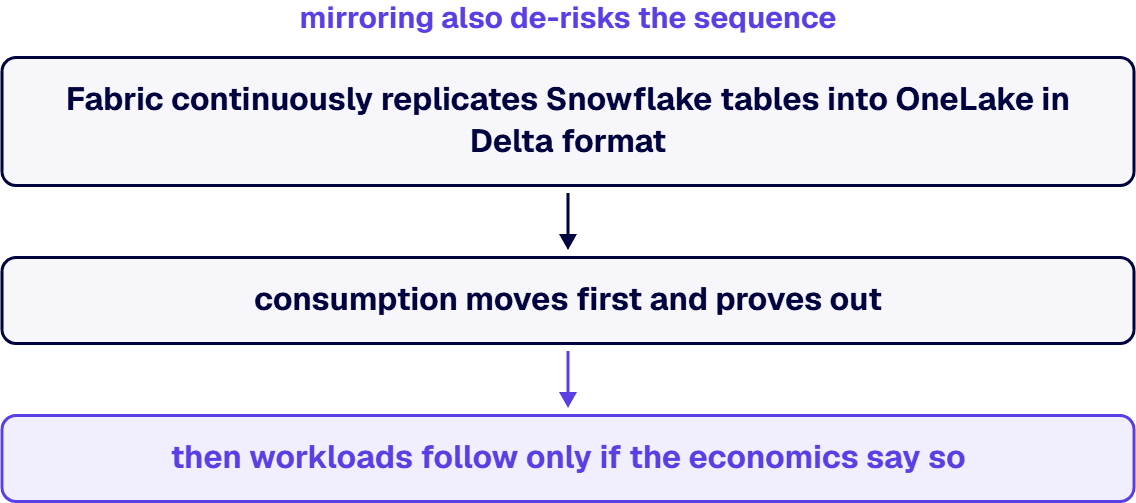
The pattern this enables is pragmatic: Snowflake keeps the workloads it is good at, and the Microsoft estate reads a continuously synchronized copy without per-query Snowflake compute or a hand-built pipeline. For enterprises weighing a migration, mirroring also de-risks the sequence, consumption moves first and proves out, then workloads follow only if the economics say so. Designing that boundary, what mirrors, what migrates, what stays, is integration architecture of the kind we compare across platforms in our data integration tooling analysis.
As a bounded evaluation with a written verdict, not an opinion. We inventory the estate and its workloads, model both platforms’ costs against your actual query patterns, storage, and viewer population, test the compliance requirements your regulators impose against each platform’s controls, and design the mirroring or migration boundary if the answer is both. i3solutions has completed 1,500+ Microsoft platform implementations. Data integration tool evaluation engagements at i3solutions typically range from $40,000 to $120,000 depending on the scope and complexity of the enterprise’s data estate. The deliverable is a platform decision your steering committee can defend, with the cost model attached. Organizations that already know the direction can hire Microsoft Fabric developers from us to build it, or start from the broader analytics roadmap through our analytics and insights solutions practice.
For a Microsoft-centric enterprise with a wide Power BI audience, usually yes, because the capacity fee absorbs costs Snowflake bills separately: an F64 at roughly $8,410 per month pay-as-you-go covers warehouse compute, pipelines, Spark, and unlimited report viewing, while a Snowflake estate pays per credit, about $2.00 to $4.00 each by edition, for every query including the ones behind dashboards. For narrow, bursty analytical workloads with few consumers, Snowflake’s per-second metering can come out ahead. The decision needs your workload profile, not a generic benchmark.
Yes. Snowflake is a supported database mirroring source in Fabric: tables replicate continuously into OneLake in Delta format, the background replication compute is free, and mirrored storage is free up to one terabyte per capacity unit, 64 free terabytes on an F64. Power BI then reads the mirrored data through Direct Lake mode without consuming Snowflake credits, which is the standard coexistence pattern for Microsoft-centric enterprises with an established Snowflake estate.
When multi-cloud portability is a binding requirement, when secure data sharing with customers and partners across clouds is part of the business model, or when a tuned Snowflake estate with years of accumulated pipelines and governance is already delivering, and the cost of replatforming would exceed any license savings. In those conditions Snowflake is the stronger answer, and the Microsoft question becomes how to integrate it, typically via mirroring, rather than how to replace it.
A credit is consumed by a running virtual warehouse: the smallest size burns one credit per hour, and each size up doubles the rate, billed per second while the warehouse runs. On-demand list pricing in Snowflake’s US baseline regions is about $2.00 per credit on Standard, $3.00 on Enterprise, and $4.00 on Business Critical, with storage at $23.00 per TB per month; pre-purchased capacity earns discounts. A warehouse left running on an idle schedule is the classic source of Snowflake bill surprise.
Fabric inherits the Microsoft 365 control plane: Entra ID identity and conditional access, Purview sensitivity labels and audit, and capacity-level tenancy controls, which lets a regulated organization present one governance story for collaboration and analytics alike. Snowflake’s Enterprise and Business Critical editions carry strong controls as well, including features aimed at HIPAA and PCI workloads. The governance question is rarely which platform can comply; it is which lets your team run one control plane instead of two.
As a data integration tool evaluation with a fixed scope: estate inventory, cost modeling on both vendors’ published prices against your real workloads, a compliance-control comparison for your regulatory regime, and a written integration or migration boundary. Engagements typically run $40,000 to $120,000 depending on estate complexity, and the outcome is a decision with evidence attached, including, where the evidence says so, the recommendation to keep Snowflake and mirror it.

US-Based | Est. 1997
© i3solutions. All rights reserved.
US-Based | Est. 1997
© i3solutions. All rights reserved.


