
There is no defensible public ranking of workflow automation firms in financial services, and any page that hands you one is ranking on marketing spend. The shortlist splits into four categories that solve different problems: automation platform vendors, robotic process automation vendors, the large advisory firms, and Microsoft systems integrators. Choose by asking which category owns your constraint, then test each firm on one thing: whether it has automated a money-movement or client-reporting process inside a regulated firm and can describe the control evidence it produced. i3solutions built a cash processing system for an independent investment management and strategic advisory firm, integrated to that firm’s portfolio and compliance systems.
This page does not publish a ranked list, and the reason is worth stating plainly. Rankings of automation firms in this sector are either vendor-authored, pay-to-list, or aggregated from review sites with no verification of what was actually delivered. We are not going to reprint one and we are not going to invent one. What we can do is describe the categories of firm you will actually encounter, the criteria that separate them for a financial services buyer, and exactly where i3solutions fits and where it does not. If you want the underlying method rather than the vendor question, the workflow automation services page covers the delivery model.
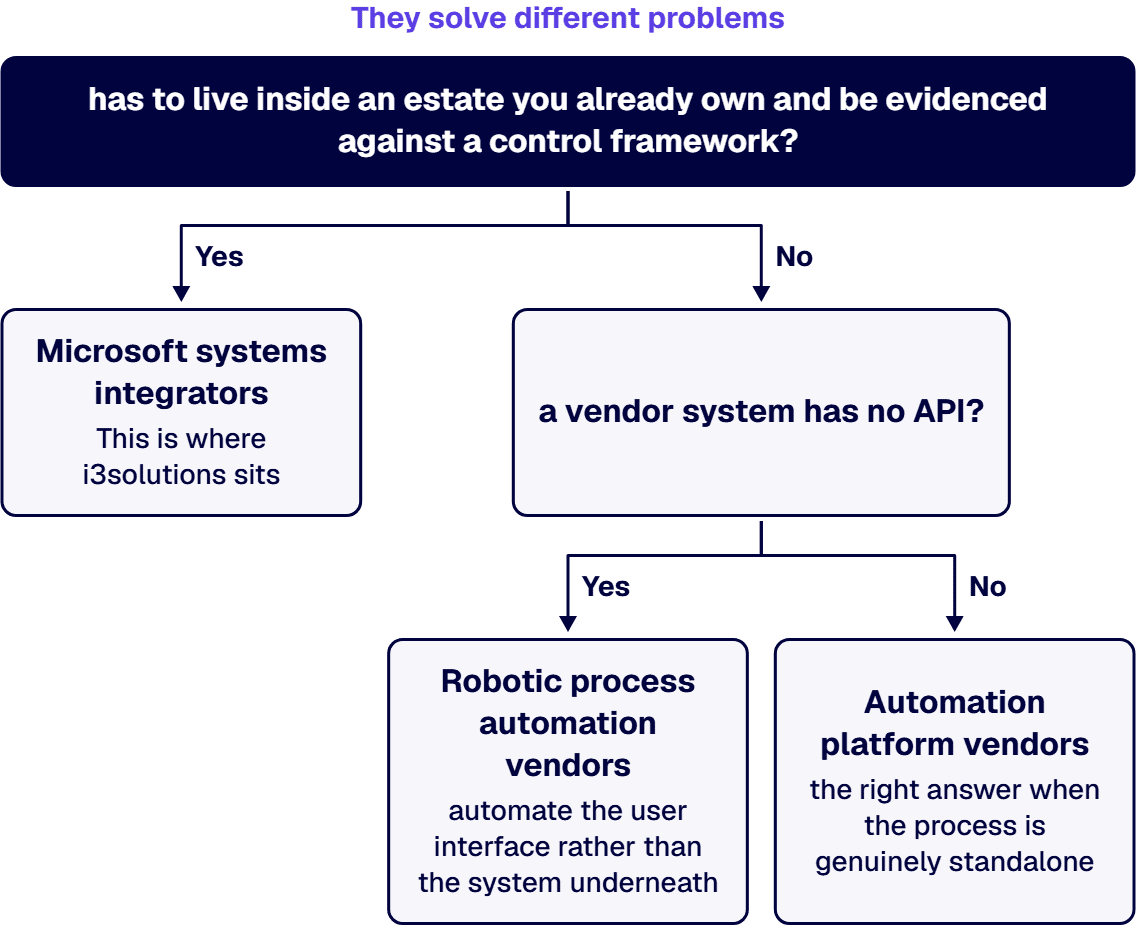
They are not competitors with each other. They solve different problems and they fail in different ways.
Automation platform vendors. These sell the tool and increasingly sell implementation alongside it. Fast to stand up, and the right answer when the process is genuinely standalone. The failure mode is the integration surface: a platform that does not natively reach your portfolio accounting system, your custody feed, or your compliance archive becomes a second system of record that someone reconciles by hand.
Robotic process automation vendors. These automate the user interface rather than the system underneath. Genuinely useful where a vendor system has no API and no prospect of one. The failure mode is brittleness and audit posture: a bot driving a screen leaves a thinner evidence trail than an API-level integration, and every upstream UI change is an outage.
The large advisory firms. They bring process design, change management, and a brand that survives a board conversation. The failure mode is the delivery gap between the partners who scoped it and the team who build it, and a cost structure that assumes a program rather than a process.
Microsoft systems integrators. The right category when the automation has to live inside an estate you already own and has to be evidenced against a control framework. This is where i3solutions sits, and we would rather say so than pretend to be category-neutral. The failure mode of this category is scope creep into platform work the buyer did not ask for.
Generic automation evaluation criteria miss what this sector is actually buying. These do not.
Automating the process that was easiest to reach. Sequencing by convenience is how a program produces eleven small automations and no measurable change in the operating model. Our guide to prioritizing automation processes works through the sequencing question.
Buying the tool before defining the process. The platform decision is downstream of the process decision, and taking it first constrains every process you subsequently automate to what that platform does well. Choosing automation tools covers the order of operations.
Treating the control evidence as a phase. If the process is in scope for an audit, the evidence model is a design constraint on the first workflow, not a document produced at the end. Retrofitting it costs more than building it in and it usually means rework.
No business case anyone will defend. A number produced to get the project funded, and abandoned once it is. The workflow automation business case page covers what a defensible one contains.
Our case studies describe clients by what they are rather than by name, and we have kept that convention here. The engagements below are genuinely in financial services. We have been careful not to pad the list with work from other sectors.
Cash processing for an investment manager. For an independent investment management and strategic advisory firm specializing in active public equity and fixed income strategies, i3solutions built a Cash Processing System on SharePoint with Nintex workflows that automated four distinct transaction types, each following its own process, and integrated it across the firm’s Galileo, APX, and RedOwl systems. The case study reports streamlined operations, enhanced risk management, and seamless integration across platforms. It reports no percentage or dollar figure, and we are not going to supply one. Read the cash processing system case study
Mortgage acquisition at scale. For a national network of wholesale banks, part of a national network of more than 7,700 financial institutions and 12 District Banks, i3solutions built the Loan Acquisition System, which automates contracting, purchasing, and tracking the delivery of mortgages from member banks, credit unions, and other financial institutions. A complex rules engine validates every uploaded loan against mortgage industry standards and returns instant feedback. The district banks are reaping significant benefits from a sophisticated system that expertly manages over $40 billion in mortgages. Read the mortgage acquisition case study
Mortgage origination productivity. For a premier regional mortgage originator group in the mid-Atlantic region, i3solutions delivered an automated client engagement solution built on Microsoft .NET, SharePoint, and SQL Server. The new solution enhanced customer service and boosted team productivity by 75%, as less time is spent on data entry and more time is devoted to helping clients find mortgages that meet their needs. Read the mortgage origination case study
Where we have measured the pattern across our financial services modernization work, the outcomes anchor to SOC 2 trust services criteria closure and decision-velocity improvement for client reporting, with time recovered in the range of 10 to 18 hours per week per analyst and error reduction of 75 to 90 percent. Those are ranges from our own engagements, not a market benchmark, and the assessment produces the number for your processes rather than borrowing one.
What we are not claiming on this page. We hold no ranking, award, or third-party placement in a financial services automation list, and we have not implied one. We have automation work for a national labor union (check request and accounting workflows) and for a defense organization (performance appraisal and salary review workflows), and neither is financial services, so neither appears above as if it were. We are not claiming a core banking system implementation, a payments processor engagement, a trading or order management system build, or a delivered SOC 2 audit or attestation. We are not claiming any client name, because the case studies are anonymised and we are not going to un-anonymise them to make a page read better.
We run this as a defined sequence rather than an open-ended program: process discovery and prioritization, target design with the control evidence model attached, pilot delivery on one process, parallel-run validation, and governance handoff. The pilot is deliberately a single process with a real exception queue, because a pilot that only exercises the happy path proves nothing about a regulated environment.
Enterprise workflow automation consulting engagements typically range from $75,000 to $350,000 for Phase 1 assessment and pilot delivery, depending on process complexity, integration surface area, and compliance framework requirements. Where the automation has to cross several Microsoft platforms rather than sit inside one, the system integration and data management practice carries that work, and the enterprise workflow automation page carries the phase model in full.
No defensible public ranking exists. The lists that circulate are vendor-authored, pay-to-list, or aggregated from review sites that never verify what was delivered, so reprinting one would mislead you. A more useful frame is category: automation platform vendors, robotic process automation vendors, the large advisory firms, and Microsoft systems integrators each solve a different problem and fail in a different way. Decide which category owns your constraint first, then compare firms inside it on delivered work in regulated money-movement or client-reporting processes.
Three engagements. For an independent investment management and strategic advisory firm, a Cash Processing System on SharePoint with Nintex workflows automating four distinct transaction types and integrated across the firm’s Galileo, APX, and RedOwl systems. For a national network of wholesale banks, the Loan Acquisition System, which automates contracting, purchasing, and tracking of mortgage delivery and manages over $40 billion in mortgages. For a premier regional mortgage originator group in the mid-Atlantic region, an automated client engagement solution that boosted team productivity by 75%. The case studies are anonymised and we do not publish the client names.
It depends on whether the underlying system has an API. Robotic process automation drives the user interface, which makes it the practical answer for vendor systems that expose nothing else, but it leaves a thinner audit trail and it breaks whenever the interface changes. Platform-native automation integrates at the data and service layer, which produces better evidence and survives upstream change, but it requires that the integration point exists. Most estates end up with both, and the decision belongs to each process rather than to the program.
Enterprise workflow automation consulting engagements at i3solutions typically range from $75,000 to $350,000 for Phase 1 assessment and pilot delivery, depending on process complexity, integration surface area, and compliance framework requirements. Financial services scope usually sits in the upper half of that band because the integration surface includes portfolio, custody, or compliance systems and because the control evidence model is a design constraint rather than a closing document.
One with a real exception queue, a named process owner, and a measurable current cost. Sequencing by whatever is easiest to reach is how a program produces a series of small automations and no change in the operating model. The exception queue matters most: in financial services the happy path is the easy path, and both the value and the risk sit in what happens when a transaction does not fit.
Senior U.S.-based delivery teams. i3solutions is a Microsoft Partner with 30 years of delivery experience and has completed more than 600 Microsoft platform implementations. Justin Bowen has spent more than 15 years at i3solutions and more than 25 years leading project, program, and product delivery across complex technology environments.

US-Based | Est. 1997
© i3solutions. All rights reserved.
US-Based | Est. 1997
© i3solutions. All rights reserved.


