

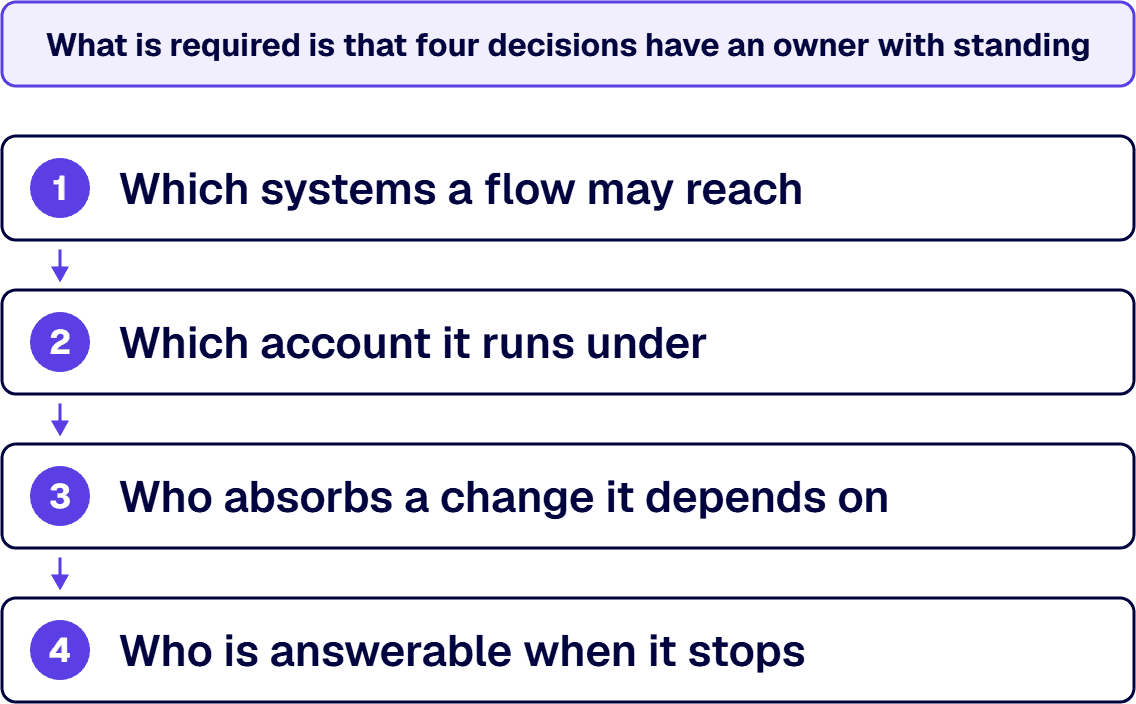
A dedicated IT team is not required to run Power Automate day to day. What is required is that four decisions have an owner with standing: authority to make the decision and access to act on it. Which systems a flow may reach, which account it runs under, who absorbs a change it depends on, and who is answerable when it stops. Most organizations already hold standing over the first two for reasons that predate automation.
The question arrives in a specific shape. Somebody has built flows that the business now depends on, the finance conversation has moved from what it costs to buy to what it costs to keep, and the person asking needs to know whether the answer is a line item for people.
The honest answer is that the platform does not set that line item. What sets it is whether anybody in the organization already holds standing over four decisions the platform will keep producing. Standing here means one thing: the authority to make a decision and have it hold, together with the access needed to act on it. A person with the access and no authority escalates every time. A person with the authority and no access files a request and waits. Neither of them is running anything.
A flow is useful in proportion to what it can touch, and what it may touch is a decision somebody has to be allowed to make. This one binds first because it is a gate: if a flow is not permitted to reach a system, no amount of staffing changes the outcome, and the conversation is about permission and not about people.
The person who builds a flow is very often not the person who can widen what it reaches. That gap is the first place a self-service tool stops being self-service, and it is worth establishing before anything else who in your organization can currently answer that question, and how long the answer takes to arrive.
Every flow runs as somebody or something. That choice is made once per flow, it is easy to make without noticing, and it decides whether the flow is a durable piece of the business or a dependency on one person’s continued employment. For staffing, the consequence is narrow: somebody has to be able to change the answer, and to change it before the person it currently depends on has gone. That is standing, not headcount.
This is the decision nobody costs, and it is the one that actually recurs. A flow is a set of assumptions about other systems: that a field exists, that a name is stable, that an approver is still the approver, that a folder is still where it was. Those systems change on schedules the flow does not control and the flow’s author does not see.
When the systems a flow depends on change, and they do, somebody has to adjust the flow or it fails. That owner has to be in the room when those systems change, which happens on somebody else’s schedule. In most organizations, that sitting-in is not part of anyone’s named role, and it is why the person who built the flows ends up running them indefinitely. This is the decision that converts an automation estate from something one person maintains to something that needs a named function.
A flow that stops is not always a flow that announces it has stopped. The staffing consequence is the only part of that this page decides: there has to be a named person for each flow the business depends on, and the naming has to happen while the flow is working. A list of flows with no owners is not an inventory; it is a set of future incidents with nobody attached.
Durable orchestration, reliable retries, and auditable state are built, not configured. i3solutions’ workflow specialists are senior-level, 100% US-based, and deliver automation that holds under production load.
The reason Power Automate and a product like Zapier feel different to run has less to do with the products than with where the four decisions get settled. Both arrangements have a cost and they are different costs.
Power Automate is a service inside your Microsoft tenant. The four decisions are therefore settled in the same place your organization already settles who may access what, which accounts exist, and what happens when somebody leaves. A separately-accounted automation product settles the equivalent decisions inside its own account, on its own terms, alongside whoever holds that account. That produces two different bills.
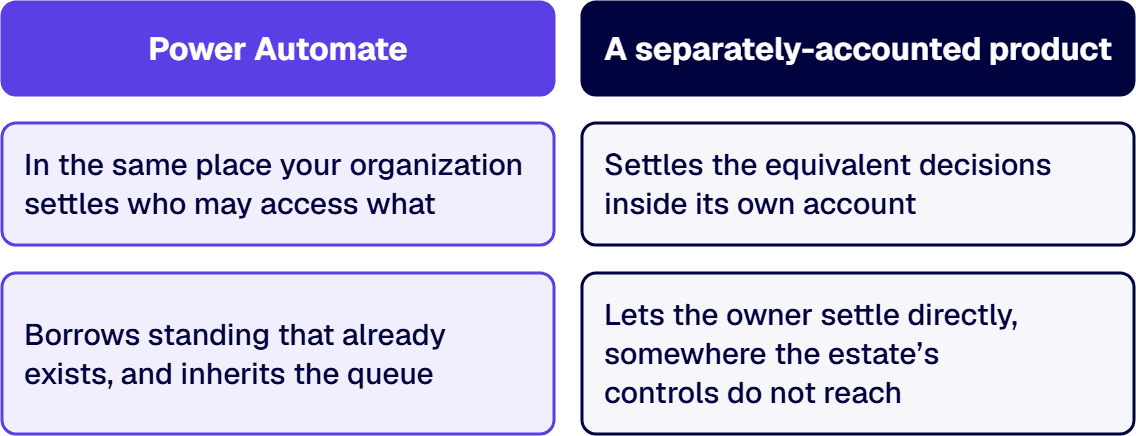
A tenant-resident service borrows standing that already exists, and inherits the queue that comes with it. Three of the four decisions are somebody’s job already for reasons that predate automation, so the marginal staffing cost is lower than the question implies. The cost is that a non-technical owner cannot settle those three alone, and the speed of the arrangement is the speed of the existing queue.
A separately-accounted product lets the owner settle the decisions directly, and settles them somewhere the estate’s controls do not reach. The cost is not felt at the moment of building. It is felt at the moment somebody asks who approved the connection to the finance system, or what happens to the account when the owner changes role.
The question “can a non-technical owner run it” has a precise answer for a tenant-resident service. They can own the flow, own the process it automates, and be the named person answerable for it. What they cannot settle alone is which systems a flow may reach and which account it runs under. Find out who in your organization holds those two today, and how long it takes to get an answer. That measurement, taken against your own estate, is the whole staffing question.
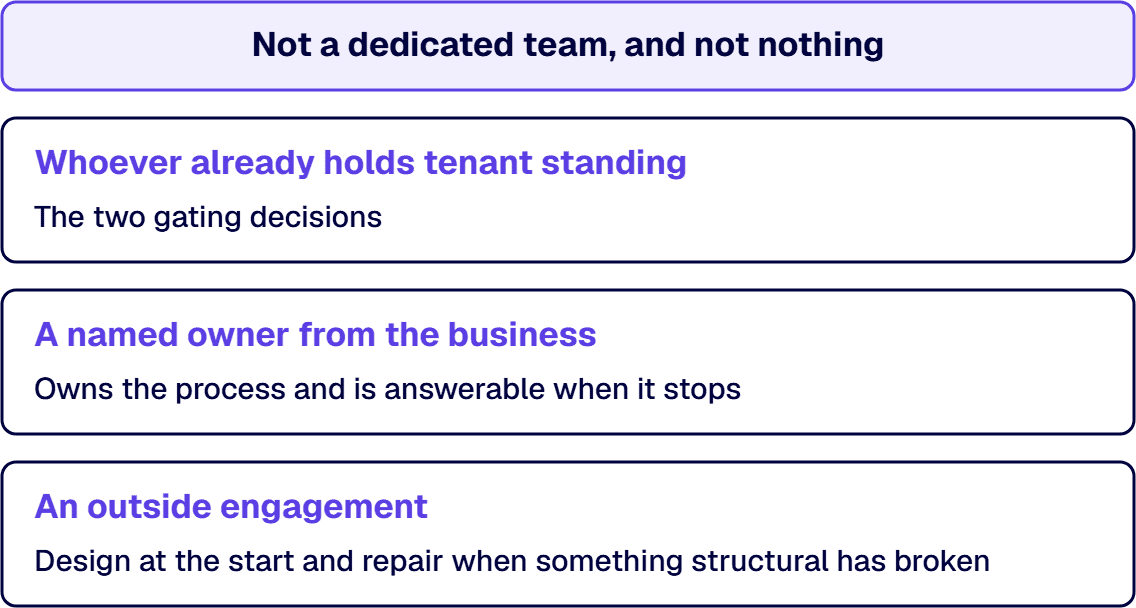
The common arrangement across organizations of very different sizes is not a dedicated team, and it is not nothing. The standing arrangement branches into three roles. The two gating decisions sit with whoever already holds tenant standing: the first thing to establish is how quickly that standing can currently be reached. The flows themselves get a named owner from the business, who owns the process and is answerable when it stops, and who does not need to be technical to hold that role. The work that genuinely needs depth (design at the start and repair when something structural has broken) is bought as an outside engagement, not carried as internal headcount.
The answer above holds for most organizations most of the time, and it stops holding under conditions you can check against your own estate. Any one of these is a signal that the standing arrangement has outgrown itself:
None of these is about the number of flows. They are about whether the four decisions still have owners who can act.
If the decision in front of you is which automation platform to use in the first place, this page is downstream of that. If the room is arguing about what the platform costs to buy, that is a different question with a different answer, and staffing is not the lever that settles it. If the flow you are thinking about automates one person’s own work and nothing else in the business depends on it, there is no standing to arrange. If what you actually need is the flows built in the first place, that is a delivery engagement, not a staffing conversation.
i3solutions has delivered on the Microsoft stack since 1997, with senior, 100 percent US-based teams. In the three-part standing arrangement, the outside engagement covers the depth: design at the start and repair when something structural has broken, so internal headcount is not carrying work that recurs only occasionally.

Michael Branson co-founded i3solutions 30 years ago and brings executive, operational, and technical perspective to organizations working in complex, secure, and mission-critical environments. His insights focus on business process consulting, automation, data analytics, collaboration, secure operating models, and the operational discipline required to turn technology investments into practical business systems with measurable value.
Connect on LinkedInNo. What is required is that four decisions have an owner with standing, meaning authority to make the decision and access to act on it: which systems a flow may reach, which account it runs under, who absorbs a change it depends on, and who is answerable when it stops. Most organizations already hold standing over the first two for reasons that predate automation, so the question is whether that standing can be reached in a workable time, not whether it exists.
Four decisions bind in order. Which systems a flow may reach (a gate): a flow that cannot reach a system is not a staffing problem. Which account it runs under: determines whether the flow outlasts its builder. Who absorbs a change it depends on: recurs repeatedly because the systems a flow assumes about will change on schedules the flow does not see. Who is answerable when it stops: must be settled while the flow is running, because an unarmed flow is a future incident.
Partly, and the boundary is precise. A non-technical owner can own a flow, own the process it automates, and be the named person answerable when it stops. What they cannot settle alone in a tenant-resident service are the two gating decisions: which systems a flow may reach and which account it runs under. In a separately-accounted product those two are settled inside that product's own account by whoever holds it. The difference is where the decision is made, not how difficult it is.
In the tenant, alongside your other access and account decisions. Because Power Automate runs inside your tenant, the two gating decisions sit where your organization already settles who may access what and what happens when somebody leaves. That places the marginal cost lower than many think, and the speed equal to your existing queue. Find out who holds those two decisions today and how long they take to answer: that measurement is the staffing question.
Three parts, none of which is a job title. The two gating decisions sit with whoever already holds tenant standing. Each flow the business depends on gets a named owner from the business who owns the process and is answerable when it stops, who does not need to be technical to hold that. The work that genuinely needs depth (design at the start and repair when something structural has broken) is bought as an outside engagement, not carried as internal headcount.
When any of four conditions is true, and none of them is about the number of flows. More than one team depends on the same flow. The systems the flows depend on are changing on a schedule set elsewhere, so absorbing the changes becomes embedded work. Nobody can produce a current list of the flows the business depends on and who is answerable for each. Or the person who built the flows is no longer the person who runs them, and no handover happened.
The happy path was never the risk. i3solutions' senior workflow advisors work with enterprise IT leaders whose processes have outgrown the tools they started on and need the next stage scoped.
Request a Workflow Scoping Discussion
US-Based | Est. 1997
© i3solutions. All rights reserved.
US-Based | Est. 1997
© i3solutions. All rights reserved.


