
By Michael Branson, Founder and COO, i3solutions
Yes, and the honest form of that answer is a composition rather than a slogan. CMMC and DFARS are one problem seen twice: DFARS 252.204-7012 imposes the control baseline and DFARS 252.204-7021 verifies it. ITAR is a genuinely separate axis about export-controlled technical data and who may see it. Section 3 sets out what i3solutions has delivered on each axis, and we do not claim a single published engagement named against all three clauses at once.
What follows is the reasoning first and the record second, because a trust question deserves the reasoning even from a firm you do not hire. Section one separates the three names into the two problems they actually are. Section two puts them where they land in an integration design, which is not where most compliance documents put them. Section three is the delivery record, stated regime by regime with the seams visible. Section four is what we do not claim, written out rather than left for you to discover.
The most useful thing an integrator can do on the first call is refuse to treat the three names as three parallel workstreams. They are not parallel and they do not cost the same.
DFARS and CMMC are one axis: a control baseline on covered information. DFARS 252.204-7012, Safeguarding Covered Defense Information and Cyber Incident Reporting (MAY 2024), is the clause that creates the obligation. Its paragraph (b)(2)(ii)(A) requires the contractor to implement NIST SP 800-171. Its paragraph (c) requires the contractor to “rapidly report” cyber incidents, which the clause defines as within 72 hours of discovery, to dibnet.dod.mil. And its paragraph (b)(2)(ii)(D) is the one integrators keep missing: where the contractor uses an external cloud service provider to store, process or transmit covered defense information, that provider must “meet security requirements equivalent to those established by the Government for the Federal Risk and Authorization Management Program (FedRAMP) Moderate baseline” and must comply with the clause’s incident reporting and forensic provisions.
CMMC is the verification layer on that same baseline rather than a second baseline. The program rule was published at 89 FR 83092 on October 15, 2024, effective December 16, 2024, and codified at 32 CFR part 170. The contract clause that puts it into your agreements is DFARS 252.204-7021, Contractor Compliance With the Cybersecurity Maturity Model Certification Level Requirements (NOV 2025), which requires a contractor to have and maintain a current CMMC status at the specified level for all information systems used in performance that process, store, or transmit FCI or CUI. The acquisition rule carrying it was published in the Federal Register on September 10, 2025, with Phase 1 beginning November 10, 2025. Phase 2, scheduled for November 10, 2026, was suspended on July 13, 2026.
One version detail changes integration design and is worth checking rather than assuming. NIST SP 800-171 Revision 3 was published in May 2024, but DoD issued Class Deviation 2024-O0013 on May 2, 2024 directing contractors under DFARS 252.204-7012 to comply with Revision 2, and that deviation stands until it is rescinded. Read the clause in your own contract and confirm the current deviation status before anyone designs an interface to a control number, because the two revisions do not number their controls the same way.
ITAR is the other axis, and it is about people and data rather than controls. The International Traffic in Arms Regulations sit at 22 CFR chapter I, subchapter M, parts 120 to 130 and are administered by the State Department’s Directorate of Defense Trade Controls. Nothing in ITAR tells you to implement a cybersecurity control baseline. It tells you that export-controlled technical data may not be released to a foreign person, in the United States or outside it, without authorization. That is an access question and a data-classification question, and a system can be fully CMMC Level 2 compliant while still being an ITAR violation waiting for an audit.
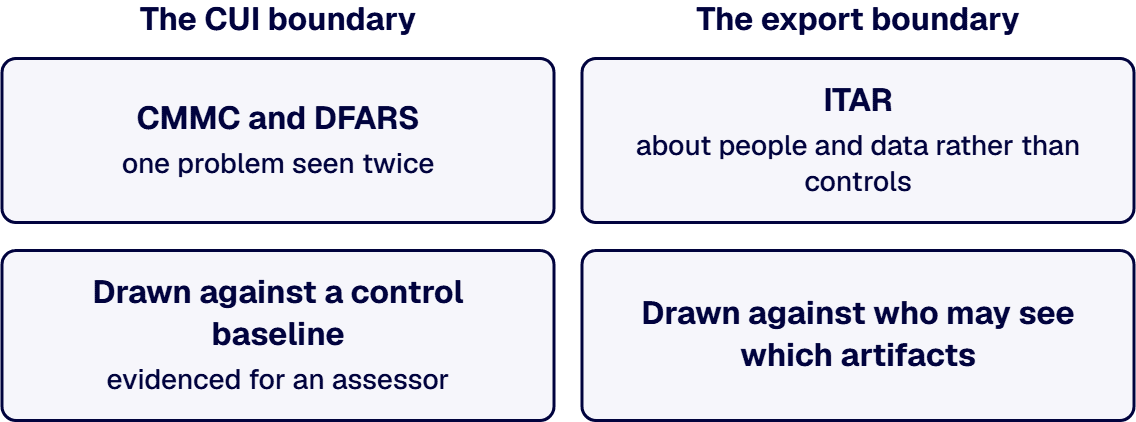
The practical shape of the work is two boundaries, not three programs. One is the CUI boundary, drawn against a control baseline and evidenced for an assessor. The other is the export boundary, drawn against who may see which artifacts.
Compliance documentation describes systems. Integration lives in the spaces between systems, and that is where the obligations get lost. Six places in a Microsoft integration estate carry regulated data that the system inventory usually does not list.
None of that is exotic. It is the ordinary content of an integration architecture, read with the two boundaries in hand instead of read afterwards. That is what “handling all three at once” means in practice, and it is why the answer to the buyer’s question should be an architecture conversation rather than a certification badge.
Here is the record with the seams left visible, because a composed answer that pretends to be a single engagement is the thing this page exists to avoid.
Start with the standing, because it is the part you can check without us. i3solutions is an SBA certified small business providing technical and professional services to US Federal Agencies, the DoD and the private sector. The Microsoft relationship is the long part of it: i3solutions has been a Microsoft partner since 1997 and has delivered 1,500+ implementations across aerospace and defense, financial services, and health sciences. On the integration side specifically, i3solutions is a Microsoft Systems Integrator with 30 years of experience implementing identity and access management solutions for enterprises in regulated industries.
The integration work is specific rather than general. i3solutions builds Dynamics 365 integrations using named Microsoft mechanisms including Dataverse, dual write, virtual tables, Azure Logic Apps, Azure Service Bus, and Power Automate connectors. There is a count behind that practice: i3solutions has completed more than 20 Dynamics 365 integration engagements. Beyond Dynamics, i3solutions designs Azure integration architecture and builds and operates Azure Logic Apps workflows for enterprise clients, including running them on an ongoing basis rather than only building them. At estate scale, which is where governance stops being a word and becomes an interface inventory, i3solutions has implemented governance frameworks for organizations managing 200+ integrations across Microsoft ecosystems. On the operations side, i3solutions implements monitoring and observability for Microsoft integration landscapes: Azure Monitor, Application Insights, intelligent alerting, and standardized runbooks that reduce mean time to resolution from hours to minutes. Change control is part of the same shape: i3solutions delivery includes ALM practices with Power Platform pipelines or Azure DevOps integration, environment separation strategies, and change control processes. One identity outcome is worth stating on its own, because it is the pattern the whole approach rests on. i3solutions unified identity and automated provisioning across systems for 125,000 users by treating the interfaces as owned, governed contracts.
i3solutions runs migrations against named control families across CMMC, HIPAA, SOC 2, and NIST 800-171, producing artifacts auditors can review. i3solutions teams maintain dedicated compliance specialists who understand CMMC, HIPAA, SOC 2, and financial services regulations within Microsoft environments, providing audit trail documentation and access control frameworks that reduce audit preparation time by 60%.
The assessment has a named shape rather than a promise. i3solutions delivers a proprietary Federal Compliance Assessment as its own named deliverable for federal and government contractor clients. The i3solutions Federal Compliance Assessment evaluates a client tenant against NIST SP 800-53 and CMMC using automated tenant configuration scripts and a 42-point security checklist. i3solutions engages its Federal Compliance Assessment when the scope spans a FedRAMP Moderate or FedRAMP High boundary, or when the client operates in a GCC High tenant. Expect the assessment to find work. The count that follows is our own, from running these assessments, and not an industry statistic. Organizations facing CMMC Level 2 certification consistently discover 15-25 configuration gaps during Microsoft environment assessment. If your environment question is still open, the analysis of whether CMMC actually requires GCC High is worth reading before anyone tells you it does.
On DFARS specifically, read this sentence carefully. What is attested is a staffing competence rather than a delivery history. Typical engagement ranges land at $28,000 to $48,000 per specialist per month for senior US-based Microsoft specialists with named platform depth (SharePoint, Power Platform, Microsoft 365 compliance, Azure security, Dataverse, .NET enterprise integration) and compliance literacy in CMMC 2.0 Level 2, HIPAA Security Rule, NIST 800-171 Rev 2, SOC 2, or DFARS 252.204-7012. That is a claim about what the named people know. The delivery evidence for the same axis is carried by the CMMC and NIST 800-171 record above, which is the baseline DFARS 252.204-7012 imposes. We are not going to dress that up as a separate DFARS practice.
The export question usually reaches us as one line in a security questionnaire: can your engineers see the drawings? Here is the record behind our answer. i3solutions has successfully delivered software development projects under CMMC, HIPAA, ITAR, and SOC 2 compliance frameworks with audit-ready documentation and governance practices built into our standard delivery methodology. The named artifacts behind that last phrase are not left abstract: they are the Federal Compliance Assessment and the three gate deliverables set out further down this section. In the identity layer, which is where the export boundary is actually enforced, i3solutions has deep experience implementing identity governance for enterprises in aerospace and defense manufacturing, financial services, and healthcare, including environments with CMMC and ITAR obligations. That second sentence is the closest thing in our record to the composite question you asked: a single environment carrying both a CMMC obligation and an ITAR obligation, with i3solutions doing the identity governance in it. The detail of how the export boundary interacts with Microsoft 365 is set out on our ITAR export control compliance in Microsoft 365 page.
i3solutions installs and helps configure applications inside IL4 and IL6 government cloud environments and other government networks. We manage GCC High migrations end-to-end: from eligibility validation and licensing coordination with your AOS-G supplier through identity architecture, data migration, security baseline configuration, and post-migration governance. i3Solutions plans and runs these migrations for regulated defense organizations, structuring each phase around the compliance evidence assessors expect. i3solutions has deployed Power BI inside a GCC High tenant and inside Azure Government for a federal customer.
The gate structure is deliberate rather than decorative. i3solutions produces three named artifacts across an Azure Government or AWS GovCloud engagement: an Architecture Fit Assessment at discovery, a Landing Zone Blueprint and Compliance Matrix at design, and a Migration Risk and Cutover Runbook at execution, each one a mandatory gate check before the engagement moves to the next phase. Before any of that, the environment question gets answered on evidence: i3solutions advises clients on federal compliance posture as its own assessment rather than as a restatement of Microsoft’s documentation, including whether SharePoint Online meets NIST 800-53, whether Azure Government is required under the DoD Cloud Computing SRG, and whether a CMMC gap assessment is needed to bid. The engagement below ran the opposite way to the default, and it is worth stating in full. The assessment recommended partial-variant adoption with email and document storage on GCC High and the remainder of the productivity suite on Commercial; the contractor’s licensing economics improved materially relative to a full GCC High migration.
i3solutions runs a governed Power Platform for a federal defense agency supporting roughly 10,000 personnel across about 180 locations, which works because it is governed, not despite it. More broadly, i3solutions has delivered enterprise SharePoint and Power Platform programs for aerospace and defense manufacturers, major defense organizations, a financial-services firm, a national healthcare system, and military organizations. i3solutions has delivered Dynamics 365 integration engagements for regulated enterprises across healthcare, defense and aerospace manufacturing, and financial services.
The published engagements below show the integration layer as the deliverable rather than as plumbing under something else. On a federal special-operations command program the data layer is the system. MySQL databases serve as the system’s core data management layer by supporting schema design, stored procedures, and efficient API integration for unifying 300TB of structured and unstructured data. Note what that says about the estate: a defense integration program is rarely all Microsoft, and an integrator who can only reason inside the Microsoft stack will hand the non-Microsoft half back to you. The account is in the federal special-operations command case study. The second is narrower, and unlike the special-operations account above it is our own reported figure rather than a published case study. When the case is honest the returns are defensible: for a defense technology contractor, i3 automation reached full ROI inside the first fiscal year and removed about $1.15 million a year from the operation.
One further piece of evidence is unusual enough to name, because it goes directly to whether a vendor can build inside your compliance boundary rather than beside it. i3solutions’ Virtual Proposal Center operates inside the customer’s own compliant Microsoft tenant. i3solutions’ Virtual Proposal Center (i3VPC) implements a requirements and compliance matrix tracked to Section L and Section M and color team (pink, red, gold) review gates for federal proposals. A firm that has shipped a product designed to live inside somebody else’s accredited tenant has met the constraint your integration will meet. The Virtual Proposal Center overview has the detail.
This section exists because the question in the title is a trust question, and a trust page that lists only its strengths has answered a different question.
The sequence below is methodology rather than a claim about a past engagement, and it is stated that way on purpose.
A first conversation on this is worth more than another capability deck. Thirty minutes with a senior i3solutions integration architect produces three things you can take into a committee: a first cut at where your two boundaries sit, which interfaces in your estate are carrying regulated content that nobody has classified, and the sequence the work has to run in.
Three bids are on the desk and they are not comparable, because two of them priced the integration and the third priced the integration plus the compliance evidence work wrapped around it. Separate those two numbers before you compare anything: the integration work itself, and the evidence work wrapped around it.
On the integration side, directional bands. A Stabilization Protocol engagement (Phase 1 dependency mapping plus Phase 2 risk-sequenced triage) typically costs between $85,000 and $175,000 for enterprises running four to six Microsoft platforms with 40 to 120 integration touchpoints. A focused reference architecture engagement (assessment plus reference architecture document plus governance framework, 8-to-12-week duration) typically scopes between $150,000 and $350,000 for mid-sized regulated enterprises. A full architecture and roadmap engagement (assessment plus reference architecture plus governance framework plus target-state design plus prioritized roadmap, 16-to-24-week duration) typically scopes between $400,000 and $850,000 depending on integration estate complexity and the number of compliance frameworks anchoring the audit profile.
On the control side, the CMMC half has its own band. A CMMC Level 2 implementation for a defense contractor with a defined CUI boundary typically ranges from $45,000 to $75,000, covering the Compliance Manager baseline assessment, Conditional Access redesign, DLP policy build and testing, Purview Audit Premium configuration, and post-implementation documentation. The CMMC compliance cost breakdown has the component detail.
The regime adds overhead in two measurable places: unit cost and assessment schedule. Both figures below are ours, observed across our own delivery and assessment work rather than drawn from market research. Regulated-industry SharePoint modernization carries roughly 25 to 35 percent cost overhead versus commercial work for equivalent scope, driven by control mappings, audit-trail discipline, and zero-downtime cutover patterns. The assessment stage stretches too. Defense contractors with CMMC requirements typically require 3 weeks due to additional compliance mapping.
One thing the constraint should not do is create a separate rate card, and it is worth saying because some firms price a government boundary as a premium product. Analytics engagements delivered inside a government cloud boundary are the same type of services work as commercial engagements; the difference is additional compliance steps, not a pricing premium. Where you land inside any of the bands above is decided by the state of the estate rather than by the clause list, which is the practical reason a scoped assessment comes before any committed implementation number.
Every one of these is answerable in a first conversation and none of them requires taking a vendor’s word, including ours.
If a scoped conversation would be more useful than another proposal, a senior i3solutions engineer will walk the boundary question with you and tell you plainly where our record composes and where it does not. You leave with the reasoning whether or not you engage us, which is usually what a buyer needs to build the internal case.
Yes, but the honest version is that they are two problems rather than three. DFARS 252.204-7012 imposes the NIST SP 800-171 control baseline and DFARS 252.204-7021 verifies it through CMMC, so those two clause numbers are one axis. ITAR is a separate axis about export-controlled technical data and foreign-person access. A system can meet the control baseline and still breach the export boundary. What to test in a vendor is whether they draw those as two distinct lines in your estate, because drawing them as one line is the most common design error in a regulated integration.
Not one that is published and named against all three clauses, and we would rather say so than blur it. The strongest attested record naming two regimes in the same environment is that i3solutions has deep experience implementing identity governance for enterprises in aerospace and defense manufacturing, financial services, and healthcare, including environments with CMMC and ITAR obligations. Alongside that, i3solutions has successfully delivered software development projects under CMMC, HIPAA, ITAR, and SOC 2 compliance frameworks with audit-ready documentation and governance practices built into our standard delivery methodology. The DFARS 252.204-7012 element is carried by the same NIST 800-171 and CMMC delivery record, because that clause is what imposes the baseline; the named artifact that carries that evidence is our Federal Compliance Assessment, set out in section 3. If your evaluation needs a single all-three reference, ask for it directly in scoping.
No, and the place this usually goes wrong is an encryption carve-out read as a blanket cloud permission. 22 CFR 120.54(a)(5), effective March 25, 2020, provides that sending, taking or storing technical data is not an export where the data is unclassified, secured using end-to-end encryption, secured using cryptographic modules compliant with FIPS 140-2 or its successors in accordance with current NIST guidance, and not intentionally sent to or stored in a country proscribed in 22 CFR 126.1. The verbs matter: sending, taking, storing. Integration middleware decrypts a payload in order to map a field, and at that point the carve-out is no longer describing what the platform is doing. The design question is where decryption happens and who can reach it, not whether cloud is allowed.
Paragraph (b)(2)(ii)(D) of the clause is the one that reaches your vendor’s stack. Where an external cloud service provider stores, processes or transmits covered defense information, it must meet security requirements equivalent to those established by the Government for the FedRAMP Moderate baseline, and comply with the clause’s cyber incident reporting and forensic provisions. That test applies to monitoring agents, migration utilities and third-party connectors in the integration path, not only to the systems on your architecture diagram. Ask for the equivalency evidence per component.
Check your own clause and the current class deviation rather than assuming. NIST published Revision 3 in May 2024, and DoD issued Class Deviation 2024-O0013 on May 2, 2024 directing contractors under DFARS 252.204-7012 to comply with Revision 2, a deviation that stands until rescinded. The two revisions do not number their controls the same way, so a control mapping built against the wrong revision produces an evidence package an assessor cannot follow. This is a five-minute check that saves a rework cycle.
In the places the system inventory does not list: dead-letter queues and retry stores holding copies of failed messages, diagnostic logs that captured request bodies, non-production environments refreshed from production, service principals with broad read across a CUI-bearing store, and the vendor’s own tooling in the integration path. Every one of those is either a copy of regulated data or a standing path to it, sitting outside the boundary the system inventory describes. i3solutions has implemented governance frameworks for organizations managing 200+ integrations across Microsoft ecosystems, and interface inventory is where that work starts.
Those are two different questions and only the first is answered here. i3solutions plans and runs governed Azure and Microsoft 365 migrations with senior, U.S.-based engineers. i3solutions provides dedicated US-based Microsoft teams for aerospace and defense programs. Both of those are facts about where the people work. US-persons status under the export regulations and personnel security clearances under a contract are separate determinations with their own evidence, and no vendor web page is the right place to establish them. Ask for them specifically and in writing, against what your own contract requires, during scoping rather than at onboarding.
The integration work and the compliance evidence work price separately, and comparing bids without splitting them is how quotes get misread. A focused reference architecture engagement (assessment plus reference architecture document plus governance framework, 8-to-12-week duration) typically scopes between $150,000 and $350,000 for mid-sized regulated enterprises. A CMMC Level 2 implementation for a defense contractor with a defined CUI boundary typically ranges from $45,000 to $75,000, covering the Compliance Manager baseline assessment, Conditional Access redesign, DLP policy build and testing, Purview Audit Premium configuration, and post-implementation documentation. Expect the regime to add overhead: regulated-industry SharePoint modernization carries roughly 25 to 35 percent cost overhead versus commercial work for equivalent scope, driven by control mappings, audit-trail discipline, and zero-downtime cutover patterns.

US-Based | Est. 1997
© i3solutions. All rights reserved.
US-Based | Est. 1997
© i3solutions. All rights reserved.


