
By Michael Branson, Founder and COO, i3solutions
Hire on environment fit before capability. A qualified firm names the cloud environment it has configured inside, treats CMMC, DFARS and ITAR as delivery constraints rather than marketing words, produces control artifacts an assessor can review, staffs the tenant with US-based people, and puts its contract vehicle and flowdown answers in writing before scoping.
What follows is the sequence we would use if we were sitting on your side of the table: the environment decision that decides who is even eligible, the criteria that are checkable from public sources or a first call, the five questions that sort the market, and then a plain account of where i3solutions fits and where it does not. The order matters. Most selections in this market go wrong because capability was assessed before environment, and by the time the environment question surfaces the tenant is already committed.
Microsoft 365 is not one product with a government checkbox. It is a set of separate cloud environments with different feature parity, different licensing paths, different eligibility rules and different assessor expectations. A firm with ten years of commercial M365 delivery and no government cloud work is not a slower version of the right firm. It is a firm that has never met the constraints your contract imposes.
So the first question in the selection is not what a firm can build. It is which environment your contracts actually require, and whether the firm can reason about that independently rather than repeating what a licensing reseller told you. The most expensive mistake we see is a defense contractor asking for GCC High by default, because someone in the supply chain said CMMC requires it. It does not by default, and the difference between a full GCC High migration and a scoped one is a material line in the budget for years.
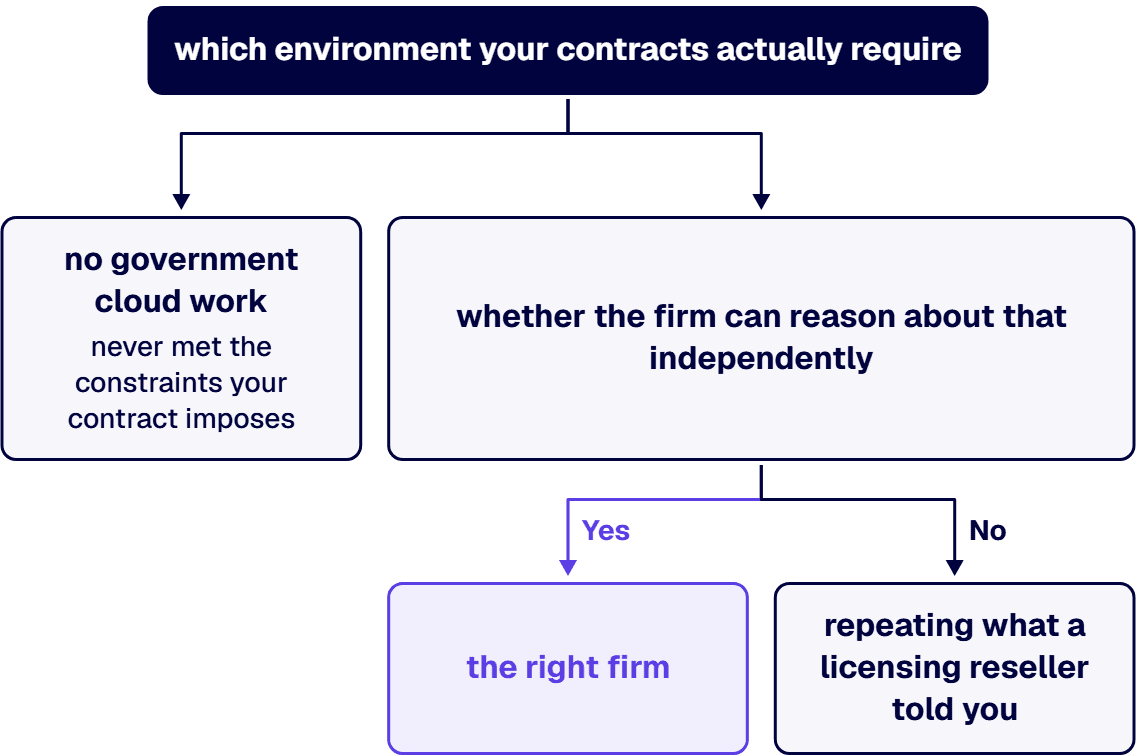
That reasoning is a service in its own right, and it is a fair thing to buy before you buy an implementation. i3solutions advises clients on federal compliance posture as its own assessment rather than as a restatement of Microsoft’s documentation, including whether SharePoint Online meets NIST 800-53, whether Azure Government is required under the DoD Cloud Computing SRG, and whether a CMMC gap assessment is needed to bid. It does not always point at GCC High. The assessment recommended partial-variant adoption with email and document storage on GCC High and the remainder of the productivity suite on Commercial; the contractor’s licensing economics improved materially relative to a full GCC High migration.
If your environment question is still open, read the analysis of whether CMMC actually requires GCC High before anyone tells you it does, and the GCC High cost breakdown if the licensing delta is what your finance team is asking about.
A firm that treats CMMC, DFARS, ITAR or NIST SP 800-171 as a specialty practice bolted onto a Microsoft team will hand you two deliverables that do not reconcile: a working environment and a compliance narrative written about it afterwards. The firms worth shortlisting treat the regime as a constraint on how the same work is done, which shows up in the build rather than in the appendix.
The practical test is the artifact. i3solutions runs migrations against named control families across CMMC, HIPAA, SOC 2, and NIST 800-171, producing artifacts auditors can review. Ask any candidate firm to describe the artifact set its last government engagement left behind, who consumed it, and what an assessor asked for that was not in it. The gap between the artifact list a firm claims and the one it can describe from memory is the most reliable signal in the whole evaluation.
Expect the constraint to cost something, and expect a credible firm to say so. Organizations facing CMMC Level 2 certification consistently discover 15-25 configuration gaps during Microsoft environment assessment. Regulated-industry SharePoint modernization carries roughly 25 to 35 percent cost overhead versus commercial work for equivalent scope, driven by control mappings, audit-trail discipline, and zero-downtime cutover patterns. A firm quoting government work at commercial rates has either absorbed that overhead into a margin it will later need back, or has not done the work.
Every criterion below is checkable from public sources or from a first scoping conversation. None requires taking a vendor’s word, including ours.
Ask each shortlisted firm the same five questions and compare the specificity of the answers rather than the confidence behind them.
Question two is the one that sorts the market. A firm that has done this work answers it with nouns. A firm that has not answers it with a methodology.
Onboarding is where this one bites: the contract says who may hold administrative access, and nobody checks until the tenant is already open. Ask where the delivery team sits, ask what personnel status the work requires under your own contract, and get both answers in writing during scoping. Firms differ substantially here and the difference does not appear on a capability matrix.
i3solutions plans and runs governed Azure and Microsoft 365 migrations with senior, U.S.-based engineers. Senior Microsoft specialists from i3solutions typically embed in the client’s team within two to four weeks of engagement start. i3solutions routes a senior U.S.-based engineer to a client call usually within one to two weeks. U.S.-based senior staffing reduces communication overhead by 25-30 hours per month on enterprise projects through direct stakeholder interaction and real-time issue resolution.
Vendor pages blur the next distinction, so hold it. US-based is a fact about where people work. US-persons status and personnel security clearances are separate determinations with their own evidence, and no vendor page is the right place to establish them. Ask for them specifically, in writing, against the requirement your contract imposes.
The record first, so you can weigh it rather than take it. i3solutions is an SBA certified small business providing technical and professional services to US Federal Agencies, the DoD and the private sector. i3solutions is a Microsoft Solutions Partner. i3solutions is a Microsoft Partner and has delivered 1,500+ implementations across aerospace and defense, financial services, and health sciences. i3solutions installs and helps configure applications inside IL4 and IL6 government cloud environments and other government networks. We manage GCC High migrations end-to-end: from eligibility validation and licensing coordination with your AOS-G supplier through identity architecture, data migration, security baseline configuration, and post-migration governance. i3solutions plans and runs these migrations for regulated defense organizations, structuring each phase around the compliance evidence assessors expect.
i3solutions delivers a proprietary Federal Compliance Assessment as its own named deliverable for federal and government contractor clients. The i3solutions Federal Compliance Assessment evaluates a client tenant against NIST SP 800-53 and CMMC using automated tenant configuration scripts and a 42-point security checklist. i3solutions engages its Federal Compliance Assessment when the scope spans a FedRAMP Moderate or FedRAMP High boundary, or when the client operates in a GCC High tenant. For government cloud infrastructure work, i3solutions produces three named artifacts across an Azure Government or AWS GovCloud engagement: an Architecture Fit Assessment at discovery, a Landing Zone Blueprint and Compliance Matrix at design, and a Migration Risk and Cutover Runbook at execution, each one a mandatory gate check before the engagement moves to the next phase.
Each published client outcome measures something narrower than the record above. The client was a government management consulting firm serving federal agencies. i3solutions’ migration approach to Microsoft 365 ensured a seamless transition from legacy systems with zero critical outages and 99.9% uptime during cutover. The move to Microsoft 365 and Okta SSO also reduced ongoing maintenance and licensing overhead by about 25%, delivering full ROI within the first year. That is a migration and identity outcome at the scale most contractors are working at, and the detail is in Streamlining Operations With a Unified Office 365 Environment.
Inside the defense estate the work is governance-led. i3solutions runs a governed Power Platform for a federal defense agency supporting roughly 10,000 personnel across about 180 locations, which works because it is governed, not despite it. The detail is in our Modernizing Internal Operations Processes With Digital Transformation case study. In a National Guard payroll engagement the finding was narrower and just as checkable. Error rates that once averaged around 1% per payroll cycle were nearly eliminated, closing prior audit findings and ensuring compliance with federal reporting standards. That account is in Transforming Mission Attendance Tracking With a Customized SharePoint Portal, our National Guard payroll modernization case study. More broadly, i3solutions has delivered enterprise SharePoint and Power Platform programs for aerospace and defense manufacturers, major defense organizations, a financial-services firm, a national healthcare system, and military organizations.
What i3solutions does not do is accredit a system or issue an authority to operate. Those determinations sit with the government and with accredited assessors reviewing your environment and your evidence. i3solutions does not perform certification assessments and cannot guarantee a certification outcome. Any firm that implies otherwise is describing something that is not theirs to give.
Honest disqualification is cheaper for both sides than a bad engagement. i3solutions is not the right vehicle when the programme needs a prime contractor fronting a large multi-vendor structure, when the requirement is lowest-price-technically-acceptable staffing measured on rate rather than outcome, when your platform direction is away from Microsoft, or when you want a fixed price quoted on a tenant nobody has inventoried, because a number produced that way is one we would not stand behind.
The fit is a federal agency or a government contractor that needs the environment question answered properly before the tenant is committed: the boundary decided on evidence rather than on rumour, the controls implemented and evidenced inside a Microsoft estate, and the SharePoint, Power Platform and identity work under it delivered by senior US-based engineers who have done it before.
Two numbers get confused in this market, so separate them before you compare bids. The compliance and advisory half has its own band: Microsoft 365 compliance consulting for regulated enterprises ranges from $35,000 to $120,000 or more depending on the framework, the number of in-scope systems, and the current tenant configuration. The migration half has another. Directional bands for organizations with 50 to 500 users: implementation costs typically range from $50,000 to $200,000, covering tenant provisioning, identity migration, data transfer, security configuration, and compliance validation.
Where you land inside either band is decided by the state of the estate rather than by a rate card, which is the practical reason a scoped assessment comes before any committed implementation number. When two quotes differ sharply, the difference is almost never the hourly rate. It is whether the compliance evidence work was priced in or left for your team to absorb after go-live. Ask each firm to show that line separately, and price it yourself into the quote that omitted it before you compare the totals.
Shortlist two or three firms against the criteria in section three and ask each for the same four things: a sample statement of work with the exclusions visible, the assessment deliverable that precedes their committed number, a redacted control-mapping or boundary artifact from a comparable government engagement, and a written answer to question two. Then weight the answers by who was most specific about your existing estate rather than about their own methodology.
Most shortlists carry at least one firm that has only half of what the phrase means. The first half is tenant experience: having configured Microsoft 365 inside a government cloud environment rather than adjacent to it, which is why the answer should name GCC, GCC High, Azure Government or an impact level. The second half is contracting fluency: understanding DFARS flowdown, CUI handling obligations, and how your own proposals are evaluated. Ask for both separately, because a firm with federal customers on a commercial tenant has neither in the sense your contract means.
Not by default, and the assumption is expensive. The requirement follows from what data your contracts actually put in the environment and what the flowdown obligates, not from a general rule about CMMC. i3solutions advises clients on federal compliance posture as its own assessment rather than as a restatement of Microsoft’s documentation, including whether SharePoint Online meets NIST 800-53, whether Azure Government is required under the DoD Cloud Computing SRG, and whether a CMMC gap assessment is needed to bid. The assessment recommended partial-variant adoption with email and document storage on GCC High and the remainder of the productivity suite on Commercial; the contractor’s licensing economics improved materially relative to a full GCC High migration.
The firm should leave behind a reviewable set rather than a narrative. i3solutions runs migrations against named control families across CMMC, HIPAA, SOC 2, and NIST 800-171, producing artifacts auditors can review. The i3solutions Federal Compliance Assessment evaluates a client tenant against NIST SP 800-53 and CMMC using automated tenant configuration scripts and a 42-point security checklist. When comparing firms, ask what the last engagement’s artifact set contained, who consumed it, and what an assessor asked for that was missing. A firm that answers from memory has produced one; a firm that answers with a methodology has not.
Administrative access to a government cloud environment carries personnel constraints, so in practice the answer is yes for anyone touching the tenant. i3solutions plans and runs governed Azure and Microsoft 365 migrations with senior, U.S.-based engineers. Establish this in writing during scoping rather than at onboarding, and treat US-persons status and personnel security clearances as separate determinations with their own evidence, requested specifically against what your contract requires.
Most quotes in this market blur two things that are priced apart. Microsoft 365 compliance consulting for regulated enterprises ranges from $35,000 to $120,000 or more depending on the framework, the number of in-scope systems, and the current tenant configuration. Directional bands for organizations with 50 to 500 users: implementation costs typically range from $50,000 to $200,000, covering tenant provisioning, identity migration, data transfer, security configuration, and compliance validation. Where you land is decided by the state of the estate, which is why a scoped assessment precedes any committed number.
Because the constraint changes how the work is done, not just what is written about it afterwards. Regulated-industry SharePoint modernization carries roughly 25 to 35 percent cost overhead versus commercial work for equivalent scope, driven by control mappings, audit-trail discipline, and zero-downtime cutover patterns. Organizations facing CMMC Level 2 certification consistently discover 15-25 configuration gaps during Microsoft environment assessment. That remediation is real work. A quote at commercial rates has either absorbed the overhead into a margin it will need back later, or has not scoped it.
No. i3solutions does not perform certification assessments and cannot guarantee certification outcomes, and it does not accredit a system or issue an authority to operate. Those determinations belong to the government and to accredited assessors reviewing your environment and your evidence. What a firm can do is build the environment and the evidence package so that the assessment is a review rather than a rebuild. Treat any vendor implying otherwise as a disqualification rather than a differentiator.

US-Based | Est. 1997
© i3solutions. All rights reserved.
US-Based | Est. 1997
© i3solutions. All rights reserved.


