Enterprise Excel Modernization Outcomes: What Regulated Organizations Measure After Replacing Business-Critical Spreadsheets

Quick Answer
Enterprise excel modernization outcomes fall into five categories regulated enterprises measure: time recovered, error reduction, audit readiness, compliance-gap closure, and decision velocity. The three-stage engagement produces named outcome milestones at 30, 60, and 90 days against qualified-range targets the operational owner signs as deliverables.
Key Takeaways
- Enterprise excel modernization outcomes break into five measurement categories the program board has to defend on review: time recovered per workflow, error rate reduction at the data-entry layer, audit-trail completeness, compliance-finding closure, and decision-velocity gain on dashboards. Each category carries named instrumentation, not estimates.
- The three-stage engagement model produces named outcome milestones at 30, 60, and 90 days with operational owner sign-off per stage and qualified-range targets stated before the engagement begins.
- Sector-specific outcome profiles for aerospace and defense, financial services, and healthcare reflect the named compliance frameworks (CMMC 2.0 Level 2, HIPAA Security Rule, SOC 2) that anchor audit-readiness and compliance gap closure outcomes.
- Outcomes-defensible business cases name outcome categories, qualified-range targets, operational owners, and accountability milestones before board approval; this is the construction the audit committee scrutinizes.
- i3solutions delivers enterprise excel modernization outcomes advisory with 600+ Microsoft platform implementations behind the Enterprise Delivery Assurance model, on-time, in-scope, and in-production with borrowed expertise that audit-survives.
- Enterprise excel modernization outcomes are the proof points the modernization budget request rises or falls on. A VP of Operations defending the investment to the board does not need another benefits listicle; the operations leader needs named outcome categories with qualified-range numbers the audit committee will accept and the consulting partner will stand behind. Excel modernization for regulated enterprises produces measurable results across five outcome categories: time recovered, error reduction, audit readiness, compliance gap closure, and decision velocity.
- i3solutions has served clients across aerospace and defense, financial services, and healthcare environments where Excel-as-system-of-record reached the limit of what auditors, operations leaders, and the IT estate could underwrite. The outcomes the engagements produce are consistent across the regulated economy: hours per week recovered from reconciliation and version-control labor; reduction percentage in data errors that previously surfaced as audit findings or operational incidents; days-to-audit-evidence falling from weeks of assembly into days of report generation; named control families moving from finding to pass disposition across CMMC, HIPAA, and SOC 2; and decision velocity improving as the reporting cadence accelerates from monthly into weekly or daily refresh.
- A Microsoft partner since 1997, with 600+ Microsoft platform implementations across regulated enterprises, i3solutions delivers enterprise excel modernization outcomes advisory engagements that name the outcome categories in writing before the engagement begins. The Enterprise Delivery Assurance model lands solutions on-time, in-scope, and in-production. The borrowed expertise carried into the engagement is pattern recognition across hundreds of regulated-enterprise Excel modernization milestones at 30, 60, and 90 days, where each milestone produces named operational outcomes the VP of Operations and Director of IT partnership can hold the engagement accountable for.
The Enterprise Excel Modernization Outcomes Question Most Benefits Listicles Miss
Enterprise excel modernization outcomes are the proof points a board uses to approve or kill the budget. The categories that survive that scrutiny are time recovered across Excel-heavy roles, error reduction in reconciliation, days-to-audit-evidence, and compliance-gap closure against named control families.
The outcomes question reframes the conversation from feature comparison into accountability framework. A VP of Operations defending a budget request needs five things the typical benefits listicle does not deliver: named outcome categories rather than generic outcome language; qualified-range numerical targets rather than aspirational marketing percentages; sector-specific outcome profiles matching the organization’s regulated sector; named control family movements (CMMC AC-2 + AU-2 + AU-12) rather than generic compliance benefit language; and operational owner sign-off discipline that holds the engagement accountable to the named outcomes through legacy spreadsheet retirement.
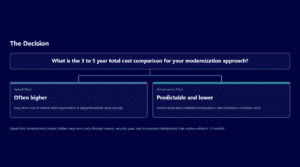
Enterprise excel modernization outcomes consulting for regulated enterprises operates from the outcomes-accountability frame. The Stage 1 Outcome Definition artifact names the five outcome categories, populates qualified-range targets against the organization’s specific Excel estate and compliance posture, and pairs each named outcome with the operational owner who signs the engagement deliverable at the milestone. The framework discipline is the differentiator between consulting partners who deliver modernization features and partners who deliver outcomes the audit committee accepts. The adjacent excel vs cloud data management investment framework carries the investment-decision discipline that precedes the outcomes commitment named in this engagement.
Five Named Enterprise Excel Modernization Outcomes Categories Regulated Enterprises Measure
The five outcome categories below cover the operational, compliance, and decision-velocity dimensions a regulated enterprise tracks across a multi-stage Excel modernization engagement. Each category names what is measured, names how it is quantified at a qualified-range level, and names the operational owner accountable for the outcome at engagement completion.
Outcome Category 1: Time Recovered Across Excel-Heavy Roles
Time recovered measures the hours per week the modernized workflow returns to the affected operational roles after the legacy spreadsheet retires. Source data for the quantification comes from time-tracking systems where available, or from documented headcount-to-task ratios across the role types most affected (financial analysts reconciling models, compliance officers assembling audit evidence, operations leads tracking workflow status across multiple spreadsheet copies). Qualified-range targets vary by workflow profile: financial reconciliation workflows typically recover 8 to 16 hours per week per analyst; audit-evidence assembly workflows typically recover 4 to 10 hours per week per compliance officer; multi-editor operational tracking workflows typically recover 6 to 12 hours per week per operations lead. The operational owner signs the time-recovered outcome at the 90-day milestone after parallel-run validation completes.
Outcome Category 2: Error Reduction Across Reconciliation and Data Integrity
Error reduction measures the percentage drop in data errors that previously surfaced as audit findings, operational incidents, or reconciliation rework after migration to the cloud platform. Source data for the quantification comes from the organization’s incident tracking, audit-finding history, and reconciliation-rework logs across the 12 months preceding the engagement. Qualified-range targets for error reduction range from 60 to 90 percent depending on the workflow complexity and the architecture target (Power Apps with Dataverse typically delivers the strongest error reduction for forms-driven workflows because data validation runs at field-write time; Azure SQL delivers the strongest reduction for high-volume transactional workflows because constraint enforcement runs at database tier). Error reduction outcomes pair with audit-finding closure outcomes in the named-control-families category below.
Outcome Category 3: Audit Readiness Outcomes: Days-to-Evidence
Audit readiness measures the elapsed days between an audit information request and the production of compliant audit evidence. Excel-as-system-of-record workflows typically require seven to fifteen business days to assemble audit evidence (locating the right file version, reproducing the calculation history, gathering the access logs from file-system metadata, documenting the workforce who touched the file). Modernized workflows typically reduce this to one to three business days because audit evidence is generated by report against the audit-trail logs the cloud platform produces natively. The outcome category lifts immediately at the 60-day milestone after the parallel-run reporting capability is in place and is locked at the 90-day milestone when legacy spreadsheet retirement transfers full audit-evidence responsibility to the cloud platform.
Outcome Category 4: Compliance Gap Closure: Named Control Families From Finding to Pass
Compliance gap closure measures named control families moving from audit-finding disposition to pass disposition at the next compliance cycle. CMMC 2.0 Level 2 control families that commonly close after Excel modernization include AC-2 (Account Management), AC-6 (Least Privilege), AU-2 (Audit Events), AU-12 (Audit Generation), and MP-2 (Media Access) because the cloud platform delivers technical enforcement the spreadsheet could not. HIPAA Security Rule provisions that commonly close include 164.308(a)(4) workforce-security review and 164.312(b) audit controls. SOC 2 trust services criteria that commonly close include CC6.1 logical access, CC7.2 monitoring, and CC8.1 change management. The compliance gap closure outcome is the one the audit committee weights most heavily because dollar consequences attach directly to the finding-to-pass movement.
Outcome Category 5: Decision Velocity: Reporting Cadence and Data-to-Decision Latency
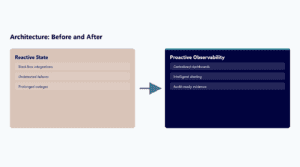
Decision velocity measures the reduction in elapsed time between data event and management decision. Excel-based workflows typically support monthly reporting cadences because the assembly labor required to produce the reporting artifact does not scale to weekly cycles. Modernized workflows typically support weekly cadences and frequently support daily refresh against operational dashboards because the data is governed at the platform tier and reporting is generated rather than assembled. Decision velocity outcomes pair with the time-recovered outcomes because the freed analyst time enables operational owners to act on data the previous reporting cadence delayed. The outcome category is the one the VP of Operations typically reports to executive leadership as the strongest signal of modernization impact on operational rhythm.
Three-Stage Enterprise Excel Modernization Outcomes Engagement Model: 30-Day, 60-Day, and 90-Day Milestones
Enterprise excel modernization outcomes engagements run as three stages with named milestone outcomes at 30 days, 60 days, and 90 days with operational owner sign-off per stage. The three stages produce a structured accountability framework because regulated enterprises require staged accountability against named deliverables rather than open-ended modernization commitments; the audit committee approves staged outcomes more readily than continuous-flow projects.
30-Day Milestone: Outcome Definition and Baseline Establishment
The 30-day milestone produces the signed Outcome Definition document: the five named outcome categories populated with qualified-range targets against the organization’s specific Excel estate, the source-data attribution for each baseline measurement, the operational owner per outcome category, and the milestone-by-milestone accountability structure. Baseline establishment runs in parallel with outcome definition; the engagement captures current-state metrics for time-recovered baseline (hours per week per role), error baseline (incident and audit-finding rates over the trailing 12 months), audit-evidence baseline (days-to-evidence over recent audit cycles), compliance baseline (current finding disposition across the four named frameworks), and decision-velocity baseline (current reporting cadence and latency). The 30-day artifact is the document the VP of Operations signs and the document the audit committee reviews at the modernization checkpoint.
60-Day Milestone: Architecture Decision and Parallel-Run Capability Live
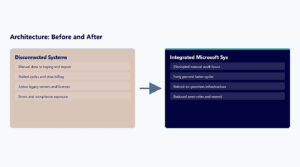
The 60-day milestone produces the signed Architecture Decision Document per migrating workflow and lights up parallel-run capability for the first workflow phase. The Architecture Decision Document names the target platform (Azure SQL, Power Platform with Dataverse, or Microsoft 365 with SharePoint), names the rationale anchored to workload complexity, names the integration surface, and names the security-and-audit-trail design mapped to the applicable compliance framework. Where the workflow needs a browser-delivered interface rather than a report layer, the Architecture Decision routes into excel to web application development, the build track that turns the retiring spreadsheet into an enterprise-ready web application. Parallel-run capability live means the cloud platform produces output side-by-side with the legacy spreadsheet against the operational reporting cadence the workflow requires. The 60-day milestone outcomes begin showing in the audit-readiness outcome category and the decision-velocity outcome category even before legacy retirement completes because the parallel-run reporting capability is in operational hands.
90-Day Milestone: Legacy Retirement and Outcome Lock
The 90-day milestone produces the signed parallel-run reconciliation report, the operational owner sign-off on the migrated workflow, and the legacy spreadsheet retirement disposition. Outcome lock means the engagement quantifies the actual outcome numbers against the qualified-range targets named in the 30-day Outcome Definition: hours per week recovered (actual vs target), error reduction percentage (actual vs target), days-to-audit-evidence (actual vs target), compliance gap closure (named control families moved to pass disposition), and decision velocity (cadence change actual vs target). The 90-day milestone is when the audit committee reviews the outcomes the modernization budget was approved against; outcomes within or exceeding qualified-range targets demonstrate engagement accountability discipline. Outcomes below qualified-range targets surface the gap explicitly so the next-phase scope can address the remediation.
Lock the Outcomes Before the Modernization Begins
Enterprise Excel modernization outcomes that survive audit committee scrutiny are named, quantified, and signed at the 30-day Outcome Definition milestone before any architecture commitment. i3solutions’ senior application development advisors work with VP-of-Operations and Director-of-IT partnerships building the Outcome Definition artifact for board approval.
Sector-Specific Enterprise Excel Modernization Outcomes Profiles by Regulated Sector
Outcome profiles vary by regulated sector because the compliance framework anchoring, audit cadence, and operational decision rhythm differ across aerospace and defense, financial services, and healthcare. The sector profiles below describe outcome patterns observed across i3solutions engagements without attribution to named clients (engagement detail appears in anonymous sector vignettes per the confidentiality discipline regulated enterprises require).
Aerospace and Defense Sector Outcome Profile
Aerospace and defense Excel modernization outcomes anchor most heavily to CMMC 2.0 Level 2 control family closure and audit readiness for DFARS 252.204-7012 contract compliance. Time-recovered outcomes typically range 8 to 14 hours per week per affected role; error reduction typically lands between 70 and 85 percent across reconciliation-heavy financial and proposal workflows; days-to-audit-evidence typically falls from 10 to 14 business days into 1 to 3 business days; compliance gap closure typically covers AC-2 + AC-6 + AU-2 + AU-12 + MP-2 movements from finding to pass at the next CMMC self-assessment cycle. An aerospace defense contractor engaged i3solutions after a CMMC 2.0 Level 2 self-assessment surfaced four Excel workflows with CUI exposure and no documented access control; the engagement migrated the workflows into a Power Apps with Dataverse environment with row-level security mapped to AC-2 and AC-6, audit-trail logging mapped to AU-2 and AU-12, and parallel-run validation that satisfied assessor scrutiny at the next assessment cycle.
Financial Services Sector Outcome Profile
Financial services Excel modernization outcomes anchor to SOC 2 trust services criteria closure and decision-velocity improvement to support faster client-facing reporting cycles. Time-recovered outcomes typically range 10 to 18 hours per week per affected analyst because financial workflows tend to be reconciliation-intensive; error reduction typically lands between 75 and 90 percent because financial workflow data tends to be highly structured and benefits most from database-tier validation; days-to-audit-evidence typically falls from 7 to 12 business days into 1 to 2 business days for SOC 2 evidence requests; compliance gap closure typically covers CC6.1 + CC7.2 + CC8.1 movements from finding to pass at the next SOC 2 attestation cycle. A regional financial services firm engaged i3solutions after an internal SOC 2 readiness assessment identified business-critical Excel models lacking CC8.1 change management documentation; the engagement migrated the models into an Azure SQL environment with schema change control routed through the existing production change-management process and audit logging that satisfied CC7.2 monitoring at the next attestation cycle.
Healthcare Sector Outcome Profile
Healthcare Excel modernization outcomes anchor to HIPAA Security Rule provision closure and decision-velocity improvement for operational and clinical-adjacent workflows. Time-recovered outcomes typically range 6 to 12 hours per week per affected role; error reduction typically lands between 65 and 85 percent depending on workflow data quality at baseline; days-to-audit-evidence typically falls from 5 to 10 business days into 1 to 2 business days for HIPAA audit-control evidence; compliance gap closure typically covers 164.308(a)(4) workforce-security review and 164.312(b) audit controls movements from gap to compliant disposition at the next internal HIPAA review. A regional healthcare network engaged i3solutions after an internal HIPAA Security Rule audit identified business-critical patient-data Excel workflows lacking 164.312(b) audit controls; the engagement migrated the workflows into an Azure SQL environment with role-based access enforced at the database tier and audit-trail logging that satisfied 164.308(a)(4) workforce-security review at the next internal audit. The canonical source for HIPAA Security Rule provision text is at the HHS HIPAA Security Rule laws and regulations reference page.
Compliance Gap Closure: Enterprise Excel Modernization Outcomes Across Named Control Family Movements
Compliance gap closure is the outcome category the audit committee weights most heavily because dollar consequences attach directly to the finding-to-pass disposition movement. The four compliance frameworks below cover the regulated-enterprise scope for excel modernization for regulated enterprises engagements; each maps named control family movements that consistently close after Excel-to-cloud migration.
CMMC 2.0 Level 2 Control Family Closure Outcomes
CMMC 2.0 Level 2 covers 110 controls drawn from NIST SP 800-171 across 14 control families. Excel modernization typically closes findings across AC-2 (Account Management; cloud platform enforces account lifecycle the spreadsheet could not), AC-6 (Least Privilege; row-level and field-level access control replaces file-system permissions), AU-2 (Audit Events; database-tier audit logging captures what file-system metadata could not), AU-12 (Audit Generation; structured logs replace file-modification timestamps), and MP-2 (Media Access; cloud platform replaces uncontrolled file-share storage). The canonical primary source for the NIST 800-171 Rev 2 control set used by CMMC is at the NIST SP 800-171 Rev 2 final publication.
HIPAA Security Rule Provision Closure Outcomes
HIPAA Security Rule provisions that consistently close after Excel modernization include 164.308(a)(4) (Workforce Access Authorization; cloud platform role-based access replaces file-share groups), 164.312(a) (Access Control; technical safeguards enforced at platform tier), 164.312(b) (Audit Controls; audit-trail logging at platform tier replaces gap), and 164.312(c) (Integrity Controls; constraint enforcement at platform tier replaces reconciliation processes). The audit-trail evidence the cloud platform produces natively satisfies the workforce-access-review discipline the rule’s 164.308(a)(4) provision requires.
SOC 2 Trust Services Criteria Closure Outcomes
SOC 2 trust services criteria that consistently close after Excel modernization include CC6.1 (Logical and Physical Access; access enforced at database or platform tier replaces file-share permissions), CC7.2 (System Operations Monitoring; platform-tier monitoring replaces file-modification observation gap), and CC8.1 (Change Management; schema and stored procedure changes routed through the production change-control process replace ad-hoc spreadsheet modifications). The qualified-report risk attaches directly to the closure movement: workflows with control failures at any of these CC criteria produce report qualifications that carry customer-contract notification obligations the cloud migration eliminates.
NIST 800-171 Rev 2 and DFARS 252.204-7012 Closure Outcomes for Federal Contractor Workflows
DFARS 252.204-7012 covered defense information handling requirements implement through NIST SP 800-171 Rev 2 controls. Excel-modernization closure outcomes include the CMMC control families above (AC-2 + AC-6 + AU-2 + AU-12 + MP-2 + MP-6) plus SC-8 (Transmission Confidentiality; encrypted transport between platform tiers replaces email attachment movement) and the specific CDI-handling discipline DFARS requires. The contract-compliance dollar exposure that attached to the CDI-in-Excel posture eliminates after migration; the next contract scope review or contracting officer inquiry produces the documented evidence chain DFARS requires without remediation labor.
Closing Compliance Gaps Is the Outcome Category the Audit Committee Weights Most
Audit committees approve modernization budgets when the compliance gap closure outcomes are named at control family granularity and the engagement carries operational owner sign-off through to finding-to-pass disposition. i3solutions’ Excel modernization services anchor compliance gap closure at named control family depth before any architecture commitment.
How to Build a Board-Defensible Enterprise Excel Modernization Outcomes Business Case
Outcomes-defensible business cases name outcome categories, qualified-range targets, operational owners, and accountability milestones before board approval. Five construction criteria separate business cases the audit committee scrutinizes successfully from cases that stall at financial review.
Named Outcome Categories Stated Before the Engagement Begins
Board approval requires named outcome categories rather than aspirational benefit language. The business case names the five outcome categories (time recovered, error reduction, audit readiness, compliance gap closure, decision velocity) and specifies qualified-range targets for each. Naming the categories before the engagement begins is the discipline that makes the modernization accountable.
Qualified-Range Numbers With Source Attribution
Board defense requires qualified-range numbers sourced from internal systems (time-tracking, incident logs, audit-finding history) or pattern-recognized from comparable regulated-enterprise engagements. The business case names the source per number; audit committees scrutinize the source attribution before the number itself. Consulting partner-supplied qualified-range numbers carry weight when the partner names the engagement pattern providing the range.
Operational Owner Accountability per Outcome Category
Board approval rests on internal owners committed to the outcome categories. The business case names the operational owner per outcome category, the owner’s milestone sign-off responsibility at 30, 60, and 90 days, and the post-migration ownership for the cloud platform. External consulting partners support; internal owners drive.
Compliance Gap Closure at Control Family Granularity
Audit committees include members with audit-cycle experience who scrutinize compliance closure claims. Generic compliance language signals the partner has not done the work; named control families with named consequences (CMMC AC-2 + AC-6; HIPAA 164.308(a)(4) + 164.312(b); SOC 2 CC6.1 + CC8.1) carry the credibility audit committees require.
Milestone Accountability Structure for Stage-Based Sign-Off
Board approval is for a specific outcome accountability structure, not a vague modernization commitment. The business case names the 30/60/90-day milestone structure, the operational owner sign-off discipline at each milestone, and the engagement disposition if outcomes fall outside qualified-range targets at the 90-day measurement.
How to Evaluate an Enterprise Excel Modernization Outcomes Consulting Partner
Choosing a consulting partner for enterprise excel modernization outcomes engagements separates partners who deliver named outcomes accountability from partners who pitch generic modernization services. Five evaluation criteria let the Director of IT and VP of Operations partnership filter candidates against the outcomes-accountability depth their engagement actually requires.
Outcome Category Discipline at the Stage 1 Engagement Artifact
Evaluate the candidate consulting partner on whether the proposed engagement produces a signed Outcome Definition document at the 30-day milestone naming the five outcome categories with qualified-range targets and operational owner sign-off per outcome. Partners who name the outcomes in writing carry the accountability discipline; partners who pitch outcomes verbally without artifact-bound commitment do not.
Sector-Specific Outcome Pattern Recognition
Evaluate the candidate on whether they can name outcome ranges from comparable engagements in the organization’s regulated sector. Aerospace and defense buyers get aerospace-and-defense outcome ranges, financial services buyers get financial services ranges, healthcare buyers get healthcare ranges. Generic cross-sector range language signals the partner has not run engagements at the sector depth a regulated enterprise requires.
Compliance Framework Depth at Control Family Granularity
Evaluate the candidate on whether they name control families with audit-team specificity: CMMC 2.0 Level 2 control families AC-2 + AC-6 + AU-2 + AU-12 + MP-2 + MP-6; HIPAA 164.308(a)(4) + 164.312(b); SOC 2 CC6.1 + CC7.2 + CC8.1. Generic compliance language at the executive-summary level signals the partner has not done the work; control-family-anchored language signals the partner has.
Milestone Accountability Through Legacy Spreadsheet Retirement
Evaluate the candidate on whether the proposed engagement carries operational owner sign-off through legacy spreadsheet retirement at the 90-day milestone, or stops at feature install. Partners who hand off after deployment let the operational owner work out audit-trail discipline alone; partners who carry parallel-run validation through retirement deliver the audit-survived outcome regulated enterprises need.
Regulated-Sector Audit-Survived Reference Engagements
Evaluate the candidate on whether they can name reference engagements in aerospace and defense, financial services, healthcare, or federal contracting where the modernization survived a post-migration audit cycle. Reference engagements without audit-cycle pass-through indicate the partner ran the migration but not the audit-defense discipline regulated enterprises require. The adjacent excel to web application consulting discipline describes the engagement model for Power Apps with Dataverse builds where many of these outcomes originate.
About i3solutions Enterprise Excel Modernization Outcomes Advisory
i3solutions has been a Microsoft partner since 1997, with 600+ Microsoft platform implementations across regulated enterprises in aerospace and defense, financial services, healthcare, and federal contracting. The firm has served clients across aerospace and defense, financial services, and healthcare, and enterprise excel modernization outcomes advisory engagements draw on the same Enterprise Delivery Assurance model that lands solutions on-time, in-scope, and in-production.
The borrowed expertise that enterprise excel modernization outcomes advisory brings to a regulated-enterprise engagement is pattern recognition across hundreds of modernization milestones at 30, 60, and 90 days. The pattern is consistent: the outcome categories are named at the 30-day Outcome Definition milestone, the parallel-run capability lights up at the 60-day Architecture milestone, the legacy spreadsheet retires at the 90-day Outcome Lock milestone, and the audit-trail discipline carries through the migration so the next compliance cycle finds the named control families in pass disposition.
Advisory engagements are senior-staffed, US-based, and scoped against the Stage 1 Outcome Definition artifact rather than an open-ended discovery phase. The methodology discipline is the differentiator: named outcome categories, qualified-range targets, operational owner sign-off, and milestone accountability through legacy spreadsheet retirement.
Pressure-Test the Outcome Definition Before the Modernization Begins
Enterprise Excel modernization outcomes engagements stall most often when the 30-day Outcome Definition artifact is treated as discovery rather than a board-defensible accountability commitment. i3solutions’ senior application development advisors work with VP-of-Operations and Director-of-IT partnerships with a draft Outcome Definition that needs an external review before board presentation.
Related Reading
Excel to Web Application Consulting for Regulated Enterprises
AI Enhanced Excel Modernization Consulting
Excel to Database Migration Consulting for Regulated Enterprises
Excel vs Cloud Data Management: How Regulated Enterprises Evaluate the Investment Decision
Frequently Asked Questions About Enterprise Excel Modernization Outcomes
What does an enterprise excel modernization outcomes advisory engagement cost for regulated enterprises?
Advisory engagement cost ranges by milestone stage and Excel estate scope. The 30-day Outcome Definition milestone typically runs $40,000 to $95,000 depending on whether the scope is departmental (lower end, single-sector compliance framework anchoring) or enterprise-wide (upper end, multi-sector compliance cross-mapping). The 60-day Architecture Decision milestone typically runs $35,000 to $80,000 per Architecture Decision Document depending on target platform count and integration surface. The 90-day Outcome Lock with parallel-run validation typically runs $85,000 to $275,000 per migration phase depending on workflow complexity and the regulatory reporting cadence the parallel-run period must satisfy. A complete multi-phase enterprise excel modernization engagement ranges from $55,000 to $325,000.
How long does a 30-day, 60-day, 90-day enterprise excel modernization outcomes engagement actually take from kickoff to legacy spreadsheet retirement?
The named milestones describe outcome-accountability checkpoints rather than calendar-week absolutes. The 30-day Outcome Definition typically completes between four and six weeks from kickoff depending on the Excel estate inventory work required. The 60-day Architecture Decision typically completes between eight and twelve weeks from kickoff depending on the number of target platforms and the integration surface complexity. The 90-day Outcome Lock with legacy spreadsheet retirement typically completes between twelve and twenty-four weeks from kickoff depending on the parallel-run validation period the regulated workflow requires; high-cadence operational workflows complete sooner, regulatory-reporting workflows that span a full reporting cycle complete on the longer end.
Which enterprise excel modernization outcome categories does the engagement measure and how are the qualified ranges established?
Five outcome categories carry into every regulated-enterprise modernization engagement: time recovered (hours per week per affected role), error reduction (percentage drop in incidents and audit findings), audit readiness (days-to-evidence improvement), compliance gap closure (named control families moving from finding to pass), and decision velocity (reporting cadence and data-to-decision latency). Qualified ranges per category come from two sources: baseline measurement against the organization’s specific data captured during the 30-day milestone, and pattern recognition from prior engagements in the same regulated sector. The engagement names both the source-attributed organization-specific number and the pattern-recognized sector range so the board approval has both anchors.
What outcome accountability does the 90-day milestone produce that the 30-day milestone does not?
The 30-day Outcome Definition milestone produces the signed accountability framework: the five outcome categories with qualified-range targets, the baseline measurements, the operational owner per outcome, and the milestone-by-milestone sign-off discipline. The 90-day Outcome Lock milestone produces the actuals: the realized outcome numbers against the targets named at the 30-day milestone, the signed parallel-run reconciliation report, the operational-owner sign-off on the migrated workflow, and the legacy spreadsheet retirement disposition. The 90-day milestone is when the audit committee reviews actual outcomes against the budget-approval commitment; the 30-day milestone is when the board approves the commitment.
How do enterprise excel modernization outcomes differ by sector across aerospace and defense, financial services, and healthcare?
Aerospace and defense outcomes anchor most heavily to CMMC 2.0 Level 2 control family closure and DFARS 252.204-7012 audit-readiness; time-recovered ranges 8 to 14 hours per week per affected role; error reduction 70 to 85 percent. Financial services outcomes anchor to SOC 2 trust services criteria closure and decision-velocity improvement for client reporting; time-recovered ranges 10 to 18 hours per week per analyst; error reduction 75 to 90 percent. Healthcare outcomes anchor to HIPAA Security Rule provision closure and operational decision velocity; time-recovered ranges 6 to 12 hours per week per affected role; error reduction 65 to 85 percent. Sector-specific outcome profiles inform the qualified-range targets the engagement names at the 30-day milestone.